



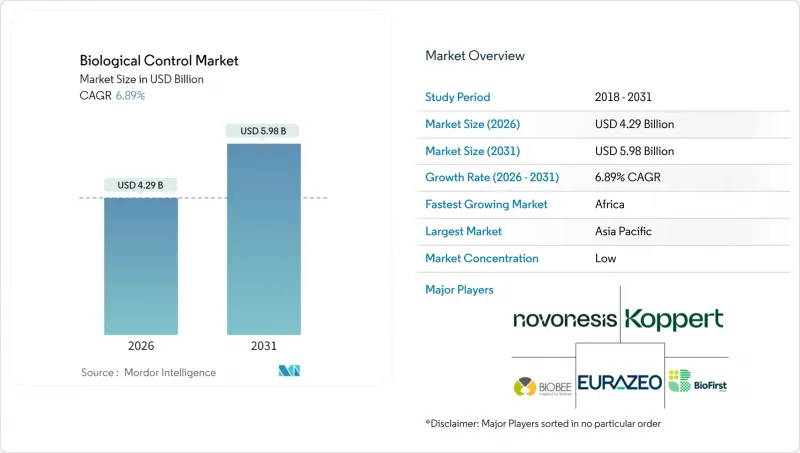
생물적 방제 시장은 2025년에 40억 1,000만 달러로 평가되었으며, 2026년 42억 9,000만 달러에서 2031년까지 59억 8,000만 달러에 달할 것으로 예측됩니다.
예측 기간(2026-2031년) 동안 CAGR은 6.89%로 예상됩니다.
비용 효율적인 미생물 플랫폼, 곤충 사육 자동화, 기존 농약에 대한 규제 압력이 증가하면서 주요 작물 시스템 전반에 걸쳐 채택이 가속화되고 있습니다. 아시아태평양은 정부의 광범위한 보조금 프로그램을 통해 세계 수요를 주도하고 있으며, 아프리카의 적극적인 식량 안보 이니셔티브가 가장 빠른 성장 전망을 뒷받침하고 있습니다. 합성화학제품에 대한 해충의 빠른 내성 획득과 인증 유기농산물에 대한 소비자의 선호도가 높아지면서 대상 작물 재배 면적이 지속적으로 확대되고 있습니다. 한편, 발효기술의 혁신과 저장기간이 긴 제제 개발로 기존 화학농약과의 성능차이가 줄어들고 있어 생물학적 자재의 경쟁력이 높아지고 있습니다.
규제 당국은 고위험 화학제품의 단계적 폐지를 계속하고 있으며, 생물학적 솔루션에 대한 즉각적인 대체 기회를 촉진하고 있습니다. 유럽연합(EU)의 '농장에서 식탁까지' 전략은 2030년까지 화학농약 사용량 50% 감축을 의무화하고 있으며, 미국 환경보호청(EPA)은 2024년 이후 40여 종의 유효성분을 등록 취소했습니다. 브라질과 인도도 2024년 유사한 규제를 발표하며, 생물적 방제 도입이 가능한 단기적인 재배 면적을 확대하고 있습니다. 이러한 정책적 움직임은 제조업체의 제품 출시를 가속화하고, 농부들이 종합적 해충 관리(IPM) 프레임워크를 향해 작물 보호 프로그램을 재검토하는 계기가 되고 있습니다.
세계 유기농 식품 매출은 2024년 1,340억 달러에 달할 것으로 예상되며, 미국, 독일, 중국에서는 연간 8% 이상의 성장률을 보이고 있습니다. 슈퍼마켓은 잔류물 제로 공급업체 정책을 철저하게 시행하고 있으며, 생산자는 인증을 유지하기 위해 생물학적 자재를 도입해야 합니다. 일반적으로 기존 농산물보다 20-40% 높은 프리미엄 농장 출하 가격은 생물학적 약품의 높은 비용을 상쇄하여 고부가가치 원예 분야에서 더 많은 보급을 촉진하고 있습니다.
대부분의 미생물 생물방제제는 냉장 조건에서도 2-4주 정도만 생존력을 유지할 수 있으며, 고비용의 콜드체인 물류 시스템을 필요로 합니다. 이로 인해 전력 공급이 불안정한 지역에서의 시장 침투가 크게 제한되고 있습니다. 최근 캡슐화 기술 및 동결 보호제 배합의 발전으로 파일럿 연구에서 제품 보존 기간을 두 배로 늘릴 수 있는 가능성을 보여주었지만, 이러한 개선은 합성 화학 대체품이 달성하는 다년간의 안정성에 크게 미치지 못합니다.
2025년에도 매크로바이오알은 생물적 방제 시장에서 97.25%의 압도적인 점유율을 유지했습니다. 이는 수십 년에 걸친 유익한 곤충 생산의 상업적 발전과 전 세계 농업 시장에 서비스를 제공하는 확립된 유통 네트워크를 반영합니다. 이 부문의 우위는 현장 적용에서 입증된 효과와 포식성 곤충 및 기생 천적 방제 절차에 대한 농가의 숙련도에 기인합니다. 특히 연작 시스템에서 토양 해충에 효과적인 곤충 병원성 선충이 대형 생물제 카테고리 중 가장 큰 비중을 차지하고 있습니다. 한편, 포식성 천적과 기생성 천적은 환경조건을 조절할 수 있는 온실 환경에서 탁월한 효과를 발휘합니다.
미생물제는 성장 동력으로 부상하고 있으며, 2031년까지 8.59%의 예측 CAGR을 기록할 것으로 예상됩니다. 미생물제로의 전환은 발효 과정과 제제 안정성의 기술적 진보를 반영하고 있으며, 이는 박테리아 및 곰팡이계 생물 방제제의 기존 한계를 극복하고 있습니다. 최근 다균주 미생물 제품의 규제 승인으로 특히 고부가가치 원예 작물에 대한 적용 가능성이 확대되고 있습니다. 정밀한 살포가 가능하기 때문에 프리미엄 가격 책정이 정당화되는 분야입니다. 바이러스성 및 원생동물성 약제를 포함한 다른 미생물 약제는 여전히 틈새 시장에 머물러 있지만, 기존 방법이 효과가 없었던 특정 해충 복합체에 대해 유망한 결과를 보여주고 있습니다. 형태별 세분화의 진화는 표적 해충의 생물학 및 작물 생산 시스템에 따라 서로 다른 생물학적 메커니즘이 최적의 상업적 응용을 찾았다는 것을 보여줍니다.
생물적 방제 시장 보고서는 형태별(매크로 바이오탈, 마이크로 바이오탈), 작물 유형별(현금 작물, 원예 작물, 열대 작물), 지역별(아프리카, 아시아태평양, 유럽, 중동, 아메리카)로 세분화되어 있습니다. 시장 예측은 금액(달러) 및 미터톤으로 제공됩니다.
2025년 아시아태평양은 생물적 방제 시장의 66.80%를 차지했습니다. 이는 중국의 1,650만 헥타르에 달하는 농약 감축 의무화 정책과 인도의 풍부한 보조금 제도를 반영한 것입니다. 중국의 '농약 감축 국가행동계획'은 2030년까지 화학농약 사용량을 40% 감축하는 것을 목표로 하고 있으며, 실제 현장 규모에서 기생성 천적 방사를 실증하는 성(省)급 교육 센터에 자금을 지원하고 있습니다. 인도의 '지속가능한 농업을 위한 국가 미션'은 소규모 농민 협동조합에 미생물 자재를 공급하는 30개 지역 생산기지를 재정적으로 지원하고 있습니다.
아프리카는 2031년까지 10.44%의 가장 빠른 CAGR을 기록할 것으로 예상됩니다. 각국 정부가 식량 안보 목표와 기부자 자금으로 지원되는 지속가능성 프로그램을 통합하고 있기 때문입니다. 나이지리아의 민관협력 이니셔티브는 2027년까지 200만 소규모 농가에 서비스를 제공할 계획이며, 이집트는 수입 의존도를 낮추기 위해 15개의 현지 생산기지를 건설 중입니다. 현지 생산능력을 통해 보다 신선한 제품을 공급할 수 있으며, 콜드체인 결함을 피할 수 있습니다.
유럽과 북미에서는 유럽연합의 '농장에서 식탁까지' 전략과 프리미엄 유기농 부문에 힘입어 꾸준한 성장이 예상됩니다. 유럽의 생물적 방제 시장 규모는 제품 비용의 최대 70%를 커버하는 공동농업정책(CAP)의 환급 제도의 혜택을 받고 있습니다. 북미에서는 기존 농산물보다 20-40% 높은 프리미엄 가격을 보장하는 1,340억 달러 규모의 유기농 소매 채널이 기반이 되어 생물학적 작물 보호에 대한 수요를 강화하고 있습니다.
The biological control market was valued at USD 4.01 billion in 2025 and estimated to grow from USD 4.29 billion in 2026 to reach USD 5.98 billion by 2031, at a CAGR of 6.89% during the forecast period (2026-2031).
Cost-effective microbial platforms, automation in insect rearing, and mounting regulatory pressure against conventional pesticides are accelerating adoption across major crop systems. Asia-Pacific drives global demand through expansive government subsidy programs, while Africa's aggressive food-security initiatives anchor the fastest growth outlook. Rapid pest resistance to synthetic chemistries and rising consumer preference for certified-organic produce continue to expand addressable acreage. Meanwhile, fermentation innovation and longer shelf-life formulations are narrowing historical performance gaps with chemical alternatives, strengthening the competitive position of biological inputs.
Regulators continue to phase out high-risk chemistries, catalyzing immediate substitution opportunities for biological solutions. The European Union Farm-to-Fork Strategy mandates a 50% cut in chemical pesticide use by 2030, and the United States Environmental Protection Agency (EPA) has canceled more than 40 active ingredients since 2024. Brazil and India issued parallel restrictions in 2024, increasing near-term acreage available for biocontrol adoption. These policy moves encourage manufacturers to accelerate product launches and spur farmers to recalibrate crop-protection programs toward IPM frameworks.
Global organic food sales climbed to USD 134 billion in 2024, with annual growth above 8% in the United States, Germany, and China. Supermarkets enforce residue-free supplier policies, pushing growers to adopt biological inputs that preserve certification. Premium farm-gate prices, typically 20-40% above conventional produce, offset higher biological agent costs and facilitate deeper penetration in high-value horticulture.
Most macrobial biocontrol agents maintain viability for only 2-4 weeks even under refrigerated conditions, necessitating expensive cold-chain logistics systems and significantly restricting market penetration in regions experiencing unreliable electricity supply. While recent technological advances in encapsulation methods and cryoprotectant formulations have demonstrated the potential to double product shelf-life in pilot studies, these improvements still fall considerably short of matching the multi-year stability achieved by synthetic chemical alternatives.
Other drivers and restraints analyzed in the detailed report include:
For complete list of drivers and restraints, kindly check the Table Of Contents.
Macrobials maintained their commanding 97.25% market share of the biological control market in 2025, reflecting decades of commercial development in beneficial insect production and established distribution networks that serve agricultural markets worldwide. The segment's dominance stems from proven efficacy in field applications and farmer familiarity with release protocols for predatory insects and parasitoids. Entomopathogenic nematodes represent the largest macrobial category, particularly effective against soil-dwelling pests in row crop systems. At the same time, predators and parasitoids excel in greenhouse environments where environmental conditions can be controlled.
Microbials are emerging as the growth engine with an 8.59% forecast CAGR through 2031. The shift toward microbials reflects technological advances in fermentation processes and formulation stability that are addressing historical limitations of bacterial and fungal biocontrol agents. Recent regulatory approvals for multi-strain microbial products are expanding application possibilities, particularly in high-value horticultural crops, where precision application justifies premium pricing. Other microbials, including viral and protozoan agents, remain niche applications but show promise for specific pest complexes where conventional approaches have failed. The form segmentation evolution indicates how different biological mechanisms are finding optimal commercial applications based on target pest biology and crop production systems.
The Biological Control Market Report is Segmented by Form (Macrobials, Microbials), Crop Type (Cash Crops, Horticultural Crops, and Row Crops), and Geography (Africa, Asia-Pacific, Europe, Middle East, North America, and South America). The Market Forecasts are Provided in Terms of Value (USD) and Volume (Metric Tons).
Asia-Pacific commanded 66.80% of the biological control market in 2025, reflecting 165 million hectares under mandatory pesticide-reduction mandates in China and generous subsidies in India. China's National Action Plan for Pesticide Reduction targets a 40% cut in chemical use by 2030 and funds provincial training centers that demonstrate field-scale parasitoid releases. India's National Mission for Sustainable Agriculture finances 30 regional production hubs supplying microbials to smallholder cooperatives.
Africa posts the fastest 10.44% CAGR to 2031 as governments combine food-security goals with donor-funded sustainability programs. Nigeria's public-private initiative plans to serve 2 million smallholders by 2027, while Egypt builds 15 local production sites to lessen import dependence. Local capacity enables fresher products and circumvents cold-chain gaps.
Europe and North America register steady gains supported by the European Union Farm-to-Fork Strategy and premium organic sectors. The biological control market size for Europe benefits from CAP reimbursements that cover up to 70% of product costs. North America leans on a USD 134 billion organic retail channel that secures premiums of 20-40% above conventional produce, reinforcing demand for biological crop protection.