



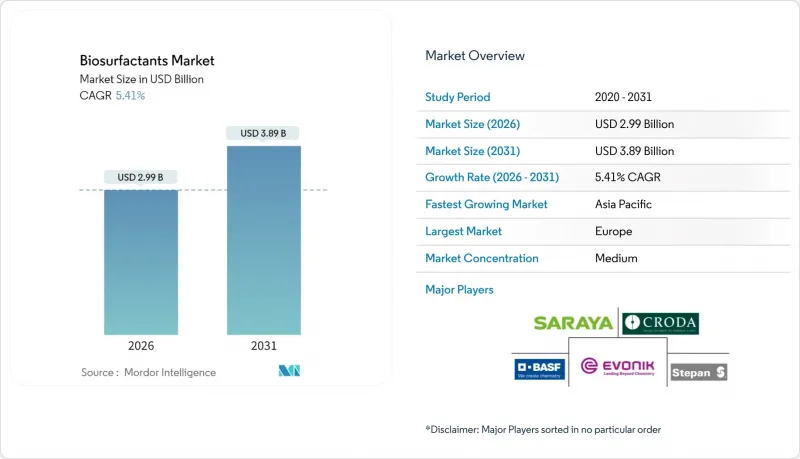
바이오 계면활성제 시장은 2025년 28억 4,000만 달러에서 2026년에는 29억 9,000만 달러로 성장하며, 2026-2031년에 CAGR 5.41%로 추이하며, 2031년까지 38억 9,000만 달러에 달할 것으로 예측됩니다.
생분해성 원료에 대한 강력한 정책적 의무, 대규모 발효 기술의 꾸준한 기술 혁신, 퍼스널케어 및 유전 화학 응용 분야 수요 증가가 이러한 성장 궤도를 지원하고 있습니다. 생산자들이 저비용 폐기물 기질을 통합함에 따라 생산 경제성이 미생물 합성으로 전환되고 있으며, 급성장하는 아시아태평양공급 기지가 세계 무역의 흐름을 변화시키고 있습니다. 경쟁 전략은 현재 업스트림 원료 공급과 하류 정제 공정을 모두 통제하는 데 초점을 맞추고 있으며, 이러한 변화는 수직 통합형 사업을 운영하는 기업에게 유리하게 작용하고 있습니다.
지역 소득 증가와 소비자의 '클린 라벨' 원료에 대한 선호도가 높아짐에 따라 천연 유래 저자극성 계면활성제에 대한 수요가 증가하고 있습니다. 글리코리피드 분자는 우수한 피부 적합성으로 이러한 요구를 충족시키며, 배합 설계자에게 합성 에톡실레이트를 대체할 수 있는 확실한 대안이 되었습니다. 이에 따라 BASF는 레인포레스트 얼라이언스 인증을 획득한 코코넛 오일 유래 계면활성제 'Dehyton PK45GA/RA'를 발표했습니다. 이는 피부 친화적인 스킨케어 제품을 목표로 하고 있습니다. 현지 제조업체들은 팜핵유와 코코넛 공급망과의 지역적 근접성을 활용하여 추가적인 비용 절감과 납기 단축을 꾀하고 있습니다. 이러한 소비자 기대치 상승과 구조적 공급 우위가 맞물려 바이오 계면활성제 시장은 퍼스널케어 분야에서 주류 채택이 가속화되고 있습니다. 이러한 전환은 아시아태평양이 유럽산 특수 계면활성제에 대한 수입 의존도를 완화시켜 장기적으로 세계 무역 패턴이 재조정될 것으로 예측됩니다.
유럽연합(EU)의 개정된 세제 규정은 디지털 제품 여권, 엄격한 생분해성 기준, 인 함량 상한선, 화석 유래 계면활성제 배합 변경 비용을 증가시킵니다. 이와 동시에 미국 환경보호청(EPA)은 유해물질관리법(TSCA) 등록 대상을 Locus Ingredients의 Amphi 바이오 계면활성제 전 라인으로 확대하여 산업 응용 분야에서 미생물 유래 계면활성제의 명확한 수용을 보여주었습니다. 이러한 정책적 움직임이 동시에 진행되면서 바이오 계면활성제가 본질적인 우위를 발휘할 수 있는 대서양 횡단 컴플라이언스 회랑이 형성되고 있습니다. 새로운 기준을 충족하는 기업은 신속하게 제품 승인을 받을 수 있으며, 가격 및 성능뿐만 아니라 지속가능성 점수를 중요시하는 주요 소매점에서 진열대를 확보할 수 있습니다. 따라서 규제의 확실성은 바이오 계면활성제 시장 침투율 향상과 직결됩니다.
식품 및 의약품 응용 분야에서는 낮은 최종 독소 수준과 배치 간 균일성이 요구되며, 다단계 다운스트림 정제 공정이 필수적입니다. 각 공정은 설비투자와 수율 저하를 수반하여 제품 원가를 상승시킵니다. 규제 당국은 신규 바이오 계면활성제 첨가제 승인 전에 안전성 데이터와 알레르겐 테스트를 요구하므로 상용화 일정이 지연됩니다. 소규모 기업은 이러한 연구에 투자할 자금이 부족한 경우가 많으며, 자본력이 있는 기존 기업만이 이러한 프리미엄 분야를 추구할 수 있는 상황입니다. 그 결과, 시장은 양극화되어 벌크 제품 수요는 꾸준히 증가하는 반면, 초순수 틈새 시장은 진입장벽에 의해 보호되고 있습니다.
2025년 기준 글리코리피드는 바이오 계면활성제 시장 점유율의 68.87%를 차지하며, 수량과 매출 모두에서 구조적 우위를 확인했습니다. 또한 2031년까지 연평균 성장률(CAGR)이 5.78%로 가장 높은 것으로 나타나 단일 분자 클래스를 중심으로 규모의 경제가 지속적으로 구축되고 있음을 알 수 있습니다. 에보닉의 슬로바키아 공장에서의 람노리피드 상업화는 최적화된 슈도모나스 발효가 상품 수준의 생산량을 유지하고 전환 비용을 절감할 수 있다는 것을 보여줍니다. 소포로리피드는 가장 진보된 글리코리피드 변종으로, 2025년 파일럿 라인을 가동한 홀리파마(Holifarma)와 같은 신규 시장 진출기업을 끌어들이고 있습니다. 경쟁적 차별화는 이제 주식 설계 및 통합 정제 기술을 포함한 지적 재산의 폭으로 옮겨가고 있습니다.
서펙틴과 같은 리포펩티드는 항균작용이 계면활성제와 유효성분의 이중 편의성을 제공하는 농업용 생물방제 분야에서 점유율을 확대하고 있습니다. 인지질은 규모는 작지만 상처치유 크림이나 정맥주사용 제제에서 인체 세포와의 친화력이 높은 가격 설정을 가능하게 하여 높은 이익률을 실현하고 있습니다. 고분자계 바이오 계면활성제 및 리케니신은 산업용 탈지 및 고온 오일 추출과 같은 기술적 틈새 시장을 점유하고 있으며, 내열성이 요구됩니다. 진화하는 제품 포트폴리오는 바이오 계면활성제 시장 규모가 확대됨에 따라 제품의 다양성이 다양한 가격대를 지원하여 공급업체가 범용 제품의 대량 생산과 특수 제품의 이익을 동시에 달성할 수 있음을 보여줍니다.
바이오 계면활성제 보고서는 제품 유형별(글리코리피드, 인지질, 서펙틴, 리케니신 등), 원료별(식물성 오일, 산업용 폐글리세린, 농업 잔류물, 기타), 용도별(세제 및 산업용 세정제, 화장품, 식품 가공, 유전 화학 등), 지역별(아시아태평양, 북미, 유럽, 남미, 중동 및 아프리카, 아시아태평양, 북미, 유럽, 남미, 유럽, 중동. 중동 및 아프리카)로 분석했습니다.
유럽은 탄탄한 생명공학 기반과 식물 유래 원료를 우대하는 엄격한 환경 정책으로 인해 2025년 매출의 51.62%를 차지했습니다. 세제 지침 개정으로 생분해성 기준치 상향 조정이 의무화되어 유럽 제조업체의 대응 가능량이 확대되고 수요가 강화되고 있습니다. 에보닉의 산업용 람노리피드 공장, BASF의 RSPO 인증 계면활성제 라인과 같은 시설은 지역내 주도권 유지를 위한 자본 투자를 반영하고 있습니다.
아시아태평양은 2031년까지 연평균 복합 성장률(CAGR) 5.98%로 확대되어 주요 수요 거점이 될 것으로 예측됩니다. 중국은 정밀 발효 기술과 산업 바이오파크 기반에 막대한 국가 투자를 집중하여 대량 생산이 가능한 바이오 계면활성제의 국내 생산 능력을 구축하고 있습니다. 인도에서는 중산층이 확대되면서 퍼스널케어 지출을 주도하고 있으며, 식물성 오일 농장에 대한 근접성이 원료 물류의 효율성에 기여하고 있습니다. 일본 화장품 제조업체들은 고순도 글리코리피드를 화장품에 사용하기 위해 고순도 글리코리피드를 요구하고 있으며, 일본의 첨단화된 규제 시스템을 활용하여 가격 프리미엄을 획득하고 있습니다.
북미는 EPA 승인, 연방정부의 바이오 경제 보조금 등 유리한 정책적 지원을 통해 여전히 큰 기반을 유지하고 있습니다. 이 지역의 거대한 제조 및 에너지 산업을 배경으로 산업용 세정제와 유전 화학제품이 가장 강력한 견인차 역할을 하고 있습니다. 남미는 원료 자원이 풍부하고 경쟁력 있는 제조원가를 실현하고 있지만, 발효 인프라가 제한적이기 때문에 생산량은 소규모로 유지되고 있습니다. 중동 및 아프리카에서는 틈새 시장이 확대되고 있습니다. 걸프 산유국에서는 저류층 자극을 위해 람노리피드를 이용한 파일럿 테스트를 진행하고 있으며, 아프리카 소비재 기업은 도시 시장용 식물 유래 세정제 테스트를 진행하고 있습니다.
The Biosurfactants market is expected to grow from USD 2.84 billion in 2025 to USD 2.99 billion in 2026 and is forecast to reach USD 3.89 billion by 2031 at 5.41% CAGR over 2026-2031.
Robust policy mandates for biodegradable ingredients, steady breakthroughs in large-scale fermentation, and rising demand from personal care and oilfield chemicals applications collectively anchor this trajectory. Production economics have begun tilting toward microbial synthesis as producers integrate low-cost waste substrates, while fast-growing Asia-Pacific supply hubs reshape global trade flows. Competitive strategies now revolve around controlling both upstream feedstock and downstream purification, a shift that favors companies with vertically integrated operations.
Regional income growth and a consumer pivot toward "clean label" ingredients have intensified demand for mild surfactants that are naturally derived. Glycolipid molecules meet this need through excellent dermatological compatibility, giving formulators a clear alternative to synthetic ethoxylates. BASF responded by unveiling Dehyton PK45 GA/RA, a Rainforest Alliance-certified coconut-oil surfactant that targets gentle skin-care products. Local manufacturers leverage proximity to palm kernel and coconut supply chains to further compress costs and shorten delivery cycles. This combination of rising consumer expectations and structural supply advantages accelerates the biosurfactants market toward mainstream personal-care adoption. Over time the shift is expected to rebalance global trade patterns by lowering Asia-Pacific's import dependence on European specialty surfactants.
The European Union's updated detergent regulation introduces digital product passports, stringent biodegradability metrics, and phosphorus ceilings, measures that make fossil-based surfactants costlier to reformulate. In parallel, the U.S. Environmental Protection Agency expanded Toxic Substances Control Act registration to cover Locus Ingredients' full Amphi biosurfactant line, sending a clear acceptance signal for microbial surfactants across industrial uses. These synchronized policy moves create a trans-Atlantic compliance corridor in which biosurfactants hold an intrinsic advantage. Companies meeting the new criteria secure faster product approvals, protecting shelf space at major retailers that now rank sustainability scores alongside price and performance. Regulatory certainty, therefore, translates directly into rising biosurfactants market penetration.
Food and pharmaceutical end uses require low endotoxin levels and batch-to-batch consistency, which demand multistep downstream polishing. Each step adds capital expense and yield losses, inflating cost of goods. Regulatory bodies insist on safety dossiers and allergen studies before approving new biosurfactant excipients, slowing commercial timelines. Small firms often lack resources to fund these studies, allowing only well-capitalized incumbents to pursue these premium segments. The result is a bifurcated market in which bulk commodity demand grows steadily but ultra-high-purity niches remain protected by entry barriers.
Other drivers and restraints analyzed in the detailed report include:
For complete list of drivers and restraints, kindly check the Table Of Contents.
Glycolipids captured 68.87% of the biosurfactants market share in 2025, confirming their structural dominance in both volume and revenue terms. They also deliver the fastest 5.78% CAGR to 2031, underscoring how economies of scale continue to build around a single molecular class. Rhamnolipid commercialization at Evonik's Slovak plant shows that optimized Pseudomonas fermentation can sustain commodity output and drive down conversion costs. Sophorolipids represent the most advanced glycolipid variant and attract new entrants like Holiferm that commission pilot lines in 2025. Competitive differentiation now shifts toward intellectual-property breadth, covering strain engineering and integrated purification.
Lipopeptides such as surfactin gain share in agricultural biocontrol, where antimicrobial action offers dual utility as a surfactant and active ingredient. Phospholipids remain small but deliver outsized margins in wound-healing creams and intravenous formulations where their human-cell compatibility commands premium pricing. Polymeric biosurfactants and lichenysin occupy technical niches, industrial degreasing and high-temperature oil extraction, requiring thermal resilience. The evolving portfolio demonstrates that as the biosurfactants market size broadens, product diversity supports multiple price ladders, enabling suppliers to balance commodity volumes with specialty profits.
The Biosurfactants Report is Segmented by Product Type (Glycolipids, Phospholipids, Surfactin, Lichenysin, and More), Feedstock (Vegetable Oils, Industrial Waste Glycerol, Agricultural Residues, Others), Application (Detergents and Industrial Cleaners, Cosmetics, Food Processing, Oilfield Chemicals, and More), and Geography (Asia-Pacific, North America, Europe, South America, and Middle-East and Africa).
Europe anchored 51.62% of 2025 revenue through entrenched biotechnology infrastructure and stringent environmental policy that favors plant-based inputs. Updated detergent directives strengthen demand by mandating higher biodegradability thresholds, thereby expanding addressable volumes for European producers. Facilities such as Evonik's industrial rhamnolipid plant and BASF's RSPO-certified surfactant lines reflect capital commitment to maintaining home-region leadership.
Asia-Pacific is forecast to grow at 5.98% CAGR to 2031, turning into the primary demand center. China directs considerable state investment toward precision fermentation and industrial bio-park infrastructure, creating domestic capacity for large-volume biosurfactant output. India's expanding middle class drives personal-care spending, while proximity to vegetable-oil plantations keeps raw-material logistics efficient. Japanese formulators seek high-purity glycolipids for cosmeceuticals, leveraging the country's advanced regulatory system to command price premiums.
North America maintains a sizable base that benefits from favorable policy signals, including EPA approvals and federal bio-economy grants. Given the region's large manufacturing and energy sectors, industrial cleaning and oilfield chemicals remain the strongest pull factors. South America's feedstock abundance offers competitive manufacturing costs, but limited fermentation infrastructure keeps output small. Middle East and Africa develop niche opportunities; Gulf oil producers run pilot trials using rhamnolipids for reservoir stimulation, while African consumer goods companies test plant-based cleaners for urban markets.