



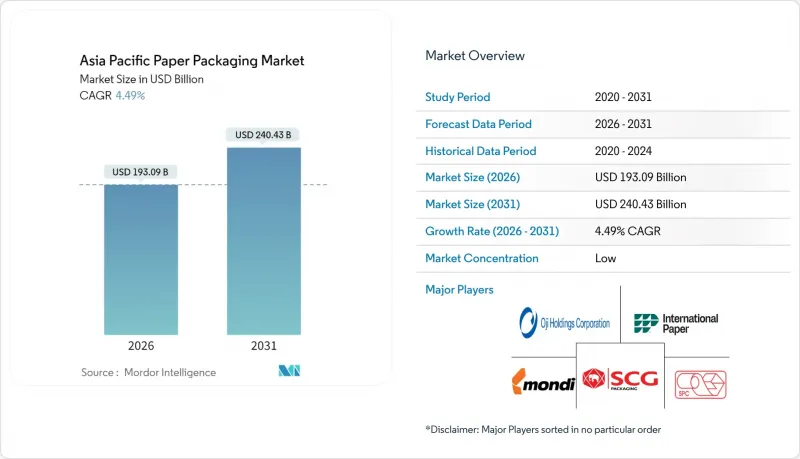
아시아태평양의 종이 포장 시장 규모는 2026년에 1,930억 9,000만 달러로 추정됩니다.
이는 2025년 1,847억 9,000만 달러에서 성장한 수치이며, 2031년에는 2,404억 3,000만 달러에 달할 것으로 예상됩니다. 2026년부터 2031년까지 CAGR 4.49%로 확대될 것으로 예상됩니다.
주요 경제권의 60%가 넘는 도시화와 이미 포장 수요의 80%를 차지하는 E-Commerce가 결합하여 단기적인 물량 확대를 뒷받침하고 있습니다. 베트남, 호주, 태국에서 확대된 생산자책임재활용제도(EPR)의 지역적 도입은 재생지 등급과 고배리어 코팅에 대한 자본 유입을 촉진하여 평균 판매 가격을 높이는 동시에 버진 펄프에 대한 의존도를 낮추고 있습니다. 골판지 형태가 라스트 마일 물류를 지배하고 있기 때문에 컨테이너 보드는 여전히 주요 기판이지만, 브랜드 소유자가 인쇄 품질, 장벽 기능 및 지속가능성을 우선시하는 가운데 고급 소비재 및 규제 대상 의료 분야에서 카톤 보드가 빠르게 인기를 얻고 있습니다. 생산자들은 경재 펄프 가격 변동과 중국의 과잉 생산능력으로 인해 수익률이 압박을 받고 있는 상황에서도 폭발적인 SKU 증가에 대응하기 위해 AI 탑재 설계 소프트웨어와 빠른 납기의 디지털 인쇄에 대한 투자를 진행하고 있습니다.
아시아태평양에서는 현재 EC 소포의 80%가 골판지 형태로 배송되고 있으며, 연간 박스 사용량은 사상 최고치를 기록했습니다. 이에 따라 제지 공장에서는 신문용지에서 재생 컨테이너 보드로의 전환이 진행되고 있습니다. 2024년 중국 택배에서만 약 2,200만 톤의 포장 폐기물이 발생할 것으로 예상되며, 지자체에서는 재사용 가능한 골판지 토트백에 보조금을 지급하는 시범사업을 시작했습니다. 지역 판매업체들은 동시에 보호 성능은 그대로 유지하면서 판지 사용량을 최대 30%까지 줄일 수 있는 제품 적합성 시스템을 도입하여 알고리즘 기반 설계 서비스에 대한 수요를 높이고 있습니다. 이를 통해 제조업체는 다이 커팅 및 디지털 인쇄 능력을 물류 센터에 근접한 마이크로 허브를 구축하여 맞춤형 그래픽의 24시간 배송을 실현하고 있습니다. 당일 배송 경쟁 심화로 라스트 마일 운송 비용을 절감하는 경량-고강도 플루트 등급의 수요 확대가 예상됩니다.
베트남의 EPR 법령은 2024년부터 골판지 포장재에 20%의 재활용 재료 사용을 의무화하고 있으며, 제지 공장들은 탈묵 능력을 향상시키는 폐쇄 루프 섬유 회수 라인에 대한 투자를 가속화하고 있습니다. 호주의 2024년 초안 규정은 모든 포장재에 최소 재활용 함량을 설정하고, 목표 미달 시 브랜드 소유자에게 책임을 전가하기 때문에 인증된 포스트 소비재 섬유에 대한 수요가 증가하고 있습니다. 인도는 이미 제지 생산량의 70%를 비목재 원료로 충당하고 있으며, 국내 가공업체들에게 버진펄프 가격 변동에 대한 비용 헤지 역할을 하고 있습니다. 그러나 2차 섬유에 대한 의존도 증가는 오염물질 제거에 따른 에너지 소비를 15-20% 증가시키기 때문에 제지 공장에서는 효소 보조 세정 기술의 시험 도입이 진행되고 있습니다. 초기 도입 기업들은 EPR 비용을 두 자릿수 절감할 수 있었다고 보고하고 있으며, 재생지 등급 전문 제조업체는 다국적 소비재 기업의 우선 공급업체로 자리매김하고 있습니다.
2024년, 기후변화의 영향으로 임업 생산이 제한되면서 경재 펄프 가격은 평균 30% 상승했고, 아시아 제지 공장들은 2025년 초에 톤당 31.50달러의 가격 인상을 발표할 수밖에 없었습니다. 인도네시아와 태국의 통화 약세로 인해 착륙 비용이 5-10% 추가 상승하여 고정 계약에 묶여 있는 컨버터들의 수익률이 압박을 받았습니다. 수입 의존도가 높은 가공업체들은 공급을 확보하기 위해 선물 구매로 대응했지만, 저장 공간의 제약과 재고의 위험가치가 이 전략을 제한하고 있습니다. 재생섬유로의 대체는 리스크를 감소시키지만, 회수 원료의 품질 변동으로 가동률의 불안정성을 높이고 있습니다. 자체 조림지를 보유한 제지회사나 섬유 조달처를 분산시킨 기업들은 다운스트림에 있는 박스 제조 공장에 대한 협상력을 강화하고 있습니다.
골판지 케이스가 옴니채널 소매의 표준 운송 컨테이너가 되는 가운데, 컨테이너 보드는 2025년 매출의 57.76%를 차지했습니다. 아시아태평양의 종이 포장 시장에서 골판지의 규모는 꾸준히 확대될 것으로 예상됩니다. 이는 무게 감소 추세에도 불구하고 제품 적합성 알고리즘이 수요를 유지하기 때문입니다. 카톤 용지의 CAGR 5.39%는 프리미엄 포지셔닝을 반영하고 있으며, 접이식 박스용 판지와 무표백 황산 펄프 판지는 그래픽이 강한 식품, 화장품, 의약품 분야의 수요를 충족시키고 경질 플라스틱에서 점유율을 확보하고 있습니다.
투자 동향은 재생 컨테이너 보드에 유리하며, 노르스케스코그사가 3억 2,000만 유로를 투자한 골베이 공장의 전환 계획(2025년까지 연간 55만 톤의 재생지(RCF) 베이스 라이너 증산)이 그 실례입니다. 통합 대기업은 자체 회수한 폐지(OCC) 흐름을 활용하는 반면, 틈새 시장인 카톤 전문 업체는 짧은 전환 시간과 우수한 인쇄면 품질을 강점으로 내세우고 있습니다. EPR(확대 생산자 책임) 비용이 비용 곡선의 재활용성을 중시하는 방향으로 기울어짐에 따라 중규모 독립 기업은 통합 압력에 직면하거나 서비스 중심의 판지 틈새 시장으로 전환해야 합니다.
기타 테스트 라이너는 풍부한 재생 섬유와 저렴한 비용의 혜택을 받아 2025년 골판지 원지 생산량의 39.10%를 차지했습니다. 브랜드 소유자가 디스플레이 효과를 높이기 위해 더 강하고 밝은 화이트 탑 사양을 요구함에 따라 아시아태평양의 종이 포장 시장에서 이러한 등급의 점유율이 감소할 수 있습니다. 화이트 탑 크래프트 라이너는 CAGR 6.46%로 가장 빠르게 성장하고 있으며, 이는 고화질 플렉소 인쇄와 디지털 그래픽이 운송용 카톤으로 이동하는 추세가 소셜 미디어의 개봉 동영상에 의해 가속화되고 있기 때문입니다.
접이식 박스용 판지는 41.12%로 판지 등급을 지배하고 있으며, 6.05%의 CAGR로 등급 성장을 주도하고 있습니다. 차세대 클레이 및 PVOH 코팅은 분유에 적합한 수증기 투과율을 실현하여 FBB의 확장을 지원하고 있습니다. 커튼코터를 개조하는 제조업체는 내유성 식품용 라이너와 의약품 블리스터 포장용 백킹재 제조를 전환할 수 있어 설비의 유연성을 높일 수 있습니다. 코팅 능력이 없는 공장은 기판, 디자인, 컴플라이언스 문서를 통합적으로 제공하는 통합형 경쟁사에게 시장을 내줄 가능성이 높습니다.
Asia Pacific paper packaging market size in 2026 is estimated at USD 193.09 billion, growing from 2025 value of USD 184.79 billion with 2031 projections showing USD 240.43 billion, growing at 4.49% CAGR over 2026-2031.
Robust urbanization exceeding 60% across leading economies, coupled with e-commerce that already commands 80% of packaging demand, underpins near-term volume expansion. Region-wide adoption of Extended Producer Responsibility (EPR) regimes in Vietnam, Australia and Thailand is steering capital toward recycled grades and high-barrier coatings, thereby nudging average selling prices upward while trimming virgin-fiber exposure. Containerboard remains the workhorse substrate because corrugated formats dominate last-mile logistics, yet carton board is rapidly gaining favor in premium consumer goods and regulated healthcare channels as brand owners prioritize print quality, barrier functionality and sustainability. Producers are investing in AI-enabled design software and short-run digital printing to satisfy explosive SKU proliferation, even as hardwood pulp price swings and Chinese over-capacity keep margins under pressure.
Corrugated formats now ship 80% of all e-commerce parcels in Asia Pacific, pushing annual box volumes to record highs and spurring mill conversions from newsprint to recycled containerboard.Chinese express shipments alone generated roughly 22 million tons of packaging waste in 2024, prompting municipal pilots that subsidize reusable corrugated totes. Regional sellers simultaneously deploy fit-to-product systems that trim board usage by up to 30% without sacrificing protection, heightening demand for algorithm-based design services. Manufacturers are therefore establishing micro-hubs that bring die-cutting and digital print capacity closer to fulfillment centers, allowing 24-hour turnaround on custom graphics. Intensifying competition in same-day delivery widens the opportunity for lightweight, high-strength fluting grades that lower last-mile freight costs.
Vietnam's EPR decree mandates 20% recycling for carton packaging beginning 2024, accelerating mill investment in closed-loop fiber recovery lines that boost de-inking capacity. Australia's 2024 draft regulation sets minimum recycled-content thresholds for all packaging, transferring liability to brand owners should targets be missed and elevating demand for certified post-consumer fiber. India already derives 70% of paper output from non-wood sources, offering domestic converters a cost hedge against virgin pulp volatility. Higher dependence on secondary fibers, however, raises energy intensity 15-20% owing to contaminant removal, prompting mills to pilot enzyme-assisted cleaning technologies. Early adopters tout double-digit EPR-fee savings, positioning recycled-grade specialists as preferred suppliers to multinational consumer-goods clients.
Hardwood pulp averaged 30% price inflation during 2024 as climate events constrained forestry output, forcing Asian mills to announce USD 31.50 per-ton price hikes for early 2025. Currency depreciation in Indonesia and Thailand inflated landed costs a further 5-10%, eroding converter margins tied to fixed contracts. Import-heavy processors responded by forward-buying to lock in supplies, but storage constraints and inventory value-at-risk limit this tactic. Substitution toward recycled fibers lowers exposure, yet quality variation in recovered material heightens run-rate instability. Mills with captive plantations or balanced fiber baskets thus gain negotiating leverage over downstream box-plants.
Other drivers and restraints analyzed in the detailed report include:
For complete list of drivers and restraints, kindly check the Table Of Contents.
Containerboard controlled 57.76% of 2025 revenue as corrugated cases became the default shipper for omnichannel retail. The Asia Pacific paper packaging market size for containerboard is forecast to expand steadily, supported by fit-to-product algorithms that maintain board demand even as weights decline. Carton board's 5.39% CAGR reflects premium positioning: folding boxboard and solid bleached sulfate satisfy high-graphic food, beauty and pharma needs, capturing share from rigid plastics.
Investment momentum favors recycled containerboard, illustrated by Norske Skog's EUR 320 million Golbey conversion that will add 550,000 tpa of RCF-based liner by 2025. Integrated giants exploit captive OCC streams, whereas niche carton specialists capitalize on shorter change-over times and print-surface excellence. As EPR fees tilt cost curves toward recyclability, mid-sized independents face consolidation pressure or must pivot to service-driven carton niches.
Other Testliners held 39.10% of containerboard volume in 2025, benefiting from abundant recovered fiber and lower cost. Asia Pacific paper packaging market share for these grades could erode as brand owners demand stronger, brighter, white-top variants that lift shelf appearance. White-top kraftliner is growing fastest at 6.46% CAGR because high-definition flexo and digital graphics migrate onto shipper cartons, a trend amplified by social-media unboxing.
Folding boxboard dominated carton board grades at 41.12% while also leading grade growth at 6.05% CAGR. Next-generation clay and PVOH coatings grant water-vapor transmission rates suitable for dairy powders, anchoring FBB's expansion. Producers that retrofit curtain-coaters can pivot between grease-proof food liners and pharma blister-wallet backers, enhancing asset flexibility. Mills lacking coating capability will likely cede ground to integrated rivals that bundle substrate, design and compliance documentation.
The Asia Pacific Paper Packaging Market Report is Segmented by Packaging Type (Carton Board, Containerboard), Product (Folding Cartons, Corrugated Boxes, Liquid Packaging Board, Paper Bags), End-User Industry (Food, Beverage, Healthcare, Personal Care, Electronics, and More), and Country (China, India, Japan, Indonesia, Thailand, Vietnam, Australia, Rest of APAC). The Market Forecasts are Provided in Terms of Value (USD).