



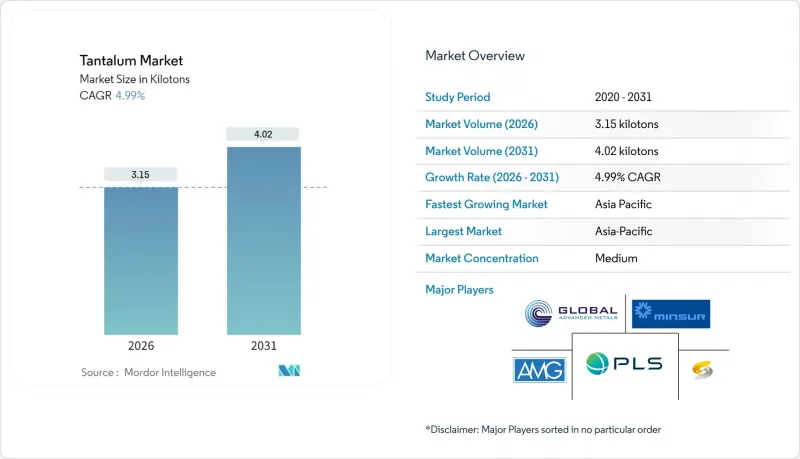
탄탈룸 시장은 2025년 3 킬로톤에서 2026년에는 3.15 킬로톤으로 성장하며, 2026-2031년에 CAGR 4.99%로 추이하며, 2031년까지 4.02 킬로톤에 달할 것으로 예측되고 있습니다.
이러한 성장 궤적은 내식성, 생체 적합성, 높은 절연 저항이라는 독보적인 특성의 조합을 반영하여 커패시터, 스퍼터링 타겟, 초합금, 임베디드 의료기기 등의 견고한 수요를 지원하고 있습니다. 견고한 전자기기 소형화, 가속화되는 5G 보급, 안정된 항공우주 엔진 생산 속도가 주요 수요의 촉매제로 작용하고 있습니다. 한편, 호주와 짐바브웨의 리튬 페그마타이트 광산의 공동 생산으로 분쟁광물 컴플라이언스 및 현물 가격 변동성에 대한 우려는 여전히 존재하지만, 구조적 공급 리스크는 완화되고 있습니다. 항공우주 및 의료 기술 분야의 OEM 업체들은 가격보다 공급 안정성을 우선시하고 있으며, 시장의 불투명한 거래 환경에도 불구하고 장기 계약을 통해 안정적인 조달을 유지하고 있습니다.
5G 인프라의 고도화와 휴대폰의 업그레이드에 따라 고주파 스위칭에서도 정전 용량 안정성을 유지할 수 있는 고체 탄탈럼 칩 커패시터의 조달이 가속화되고 있습니다. 부품 제조업체에 따르면 탄탈럼 커패시터는 적층 세라믹 유형에 비해 우수한 체적 효율과 낮은 등가 직렬 저항(ESR)을 제공하여 플래그십 스마트폰과 스몰셀 기지국의 공간 제약이 있는 전원 관리 회로에서 중요한 특성으로 작용하고 있습니다. -55℃에서 +175℃의 온도 변동 범위에서의 신뢰성으로 인해 통신 장비 제조업체는 현장 고장 방지를 위해 탄탈럼 장치를 우선적으로 선택하고 있습니다. 패키징 로드맵은 현재 최소 케이스 크기인 0201 사이즈를 목표로 하고 있으며, 이 크기에서 분말로 가공된 양극은 기계적 강도를 손상시키지 않고 높은 용량 전압비(CV)를 달성할 수 있습니다. 디바이스 소형화로 인해 단위 그램당 사용량이 증가하는 한편, 소재 경량화 추세가 확산되면서 탄탈럼 시장은 직접적인 수혜를 받고 있습니다.
7nm 이하의 로직 회로 및 DRAM 제조 플로우 시트에서는 구리의 확산을 방지하고 낮은 라인 저항을 유지하기 위해 탄탈럼 및 탄탈럼 질화물 확산 장벽 층이 지정되어 있습니다. 극자외선 리소그래피는 순도 기준이 99.999% 이상으로 높아져 초고진공 진공야금 기술을 보유한 정제업체로 공급업체 기반이 한정되어 있습니다. 2025년 아시아 주요 파운드리 업체들이 체결한 장기 공급 계약은 이 전구체가 웨이퍼 수율 유지에 있으며, 얼마나 전략적으로 중요한 역할을 하는지를 보여줍니다. 따라서 한국, 대만, 중국 본토의 설비 갱신은 고순도 분말 제조업체의 안정적인 수요량으로 이어지고 있습니다. 중앙아프리카의 농축물 공급이 지정학적 혼란의 영향을 받을 때마다 공급 부족 가능성이 남아 있으며, 탄탈럼 시장은 가격 안정성을 프리미엄으로 평가하는 경향이 강화되고 있습니다.
미국 및 EU 규정에 따른 엄격한 실사 의무로 인해 다운스트림 제조업체는 분쟁이 없는 제련소까지 원료를 역추적해야 하며, 감사 및 인증 비용이 추가되어 완제품 비용이 최대 4분의 1까지 상승할 수 있습니다. 중앙아프리카의 소규모 생산은 여전히 세계 공급의 상당 부분을 차지하고 있으며, 정기적인 국경 폐쇄와 치안 사건으로 인해 거의 예고 없이 유통이 중단될 수 있습니다. 그 결과, 커패시터 및 초합금 공급업체는 더 큰 안전 재고를 보유하고 현물 가격이 하락하더라도 수량을 확보할 수 있는 다년 계약(Take or Pay)을 선호합니다.
2025년, 분말은 탄탈럼 시장 점유율의 36.10%를 차지했습니다. 이는 커패시터용 양극재 및 스퍼터링 타겟의 소비가 급증한 데 따른 것입니다. 이 하위 부문은 2031년까지 연평균 5.43%의 연평균 복합 성장률(CAGR)을 보일 것으로 예측되며, 미세화로 인해 보다 엄격한 입자 크기 분포와 높은 비용량에 대한 수요가 증가함에 따라 2031년까지 5.43%의 연평균 복합 성장률(CAGR)을 보일 것으로 예측됩니다. 금속 빌렛, 선재, 시트는 분말에 이어 두 번째 규모이지만, 화학처리장치, 항공우주용 고온부 부품 등 단조 형상이 필수적인 분야에서는 여전히 필수적입니다. 초경합금 등급은 2,000HV 이상의 경도를 중시하는 절삭 공구 및 내마모성 강판 제조업체에, 합금 첨가제는 제트엔진용 초합금을 지원하고 있습니다.
적층제조 기술로의 전환은 새로운 성장 경로를 개발하고 있습니다. 레이저 분말층 용융법에 최적화된 구형 분말은 의료용 임플란트에서 복잡한 격자 구조를 구현할 수 있습니다. 주요 분말 공급업체는 골격 고정용 케이지 및 두개 안면 메쉬의 최적 사양인 산소 함량 200ppm 이하, D50 값 3µm 내외의 분말을 공급하기 위해 분무 라인을 확장하고 있습니다. 형상 정확도 관리의 강화로 인해 예측 기간 중 분말은 탄탈럼 시장의 중심이 될 것입니다.
탄탈럼 시장 보고서는 제품별(금속, 탄화물, 분말, 분말, 합금, 기타 형태), 순도별(순도 99.95% 미만 및 99.95% 이상), 용도별(커패시터, 반도체, 엔진터빈 블레이드, 화학처리장치 등), 지역별(아시아태평양, 북미, 유럽, 남미, 중동/아프리카) 분석했습니다. 시장 예측은 톤 단위로 제공됩니다.
2025년 기준 아시아태평양은 전 세계 소비량의 46.50%를 차지할 것으로 예상되며, 2031년까지 연평균 5.93%의 연평균 복합 성장률(CAGR)을 나타낼 전망입니다. 중국, 일본, 한국에는 커패시터 조립 라인, 메모리 칩 공장, 디스플레이 패널 공장이 집중되어 있으며, 이들이 분말 및 스퍼터링 타겟을 흡수하고 있습니다. 대만의 로직 파운드리 확대로 초순도 수요가 증가하고 있으며, 국내 메모리 업체들은 국내 연구 프로그램을 활용하여 DDR6 모듈용 탄탈럼계 MIM(금속-절연체-금속) 커패시터를 시험 도입하고 있습니다. 호주가 제품별 공급처로 부상하면서 지역적 공급 안보가 강화되고, 아프리카산 농축광석에 대한 과도한 의존도를 낮추는 동시에 밸류체인의 탄력성이 향상되고 있습니다.
북미는 항공우주, 방산, 의료기기 분야를 중심으로 한 전략적 최종 소비 지역입니다. 1차 광산 생산은 캐나다 탄코 광산에 국한되어 있지만, 탄탄한 2차 회수 네트워크가 초합금 스크랩과 전자 폐기물을 처리하여 분말 및 합금 회로에 공급하고 있습니다. 미국내 분쟁광물 무분쟁광물 우선 조달 정책은 가격 프리미엄을 유지하면서 제트엔진 OEM 업체 및 심장리듬관리기기 제조업체에 공급 물량을 확보하고 있습니다.
유럽은 높은 기술 표준과 엄격한 환경 규제를 특징으로 하는 성숙하면서도 안정적인 수요 곡선을 보이고 있습니다. 독일의 1차 자동차 부품 공급업체는 첨단 운전 보조 모듈용 커패시터 수요를 주도하고 있으며, 프랑스의 원자력 장비 제조업체는 방사성 폐기물 시스템용 탄탈럼 라이닝을 지정하고 있습니다. 유럽연합의 분쟁광물 지침으로 인해 컴플라이언스 예산이 엄격해졌지만, 순환경제 프레임워크에 포함된 재활용 의무가 새로운 원료 수요를 점차 상쇄하고 있습니다. 동유럽의 커패시터 공장은 비용 경쟁력 있는 조립을 제공하면서 지역 전체의 추적성 요건을 준수하고 있습니다.
The Tantalum market is expected to grow from 3 kilotons in 2025 to 3.15 kilotons in 2026 and is forecast to reach 4.02 kilotons by 2031 at 4.99% CAGR over 2026-2031.
This growth trajectory reflects the metal's unmatched combination of corrosion resistance, biocompatibility, and high dielectric strength that keeps demand resilient across capacitors, sputtering targets, super-alloys, and implantable medical devices. Robust electronics miniaturization, accelerating 5G deployment, and steady aerospace engine build rates remain primary demand catalysts. Parallelly, co-production from lithium pegmatite mines in Australia and Zimbabwe is easing structural supply risk even as concerns over conflict-mineral compliance and spot-price volatility persist. OEMs in aerospace and medical technology continue to prioritize security of supply over price, supporting long-term contracts that stabilize procurement despite the market's opaque trading environment.
5G infrastructure densification and handset upgrades are accelerating procurement of solid tantalum chip capacitors that can maintain capacitance stability under high-frequency switching. Component makers report that tantalum capacitors provide superior volumetric efficiency and lower equivalent series resistance than multi-layer ceramic types, features critical for space-constrained power-management circuits in flagship smartphones and small-cell base stations. Reliability across -55 °C to +175 °C temperature excursions makes tantalum devices the preferred choice for telecommunications OEMs keen to avoid field failures. Packaging road-maps now target case sizes as low as 0201, a node where powder-engineered anodes deliver high CV (capacitance-voltage) ratios without sacrificing mechanical integrity. The tantalum market benefits directly as device miniaturization lifts grams-per-unit usage despite broader material-lightweighting trends.
Sub-7 nm logic and DRAM production flow-sheets specify tantalum and tantalum nitride diffusion-barrier layers that prevent copper migration while preserving low line resistance. Extreme ultraviolet lithography raises purity thresholds to 99.999%+, narrowing the supplier base to refiners with ultra-high-vacuum metallurgy capabilities. Long-term offtake agreements signed by leading Asian foundries in 2025 underscore how strategic this precursor has become in maintaining wafer yield. Equipment upgrades in South Korea, Taiwan, and mainland China are therefore translating into steady volumes for high-purity powder producers. Supply tightness remains a possibility whenever geopolitical disruptions affect concentrate flows from Central Africa, reinforcing the tantalum market's tendency to price security at a premium.
Stringent due-diligence mandates under U.S. and EU regulations oblige downstream manufacturers to trace concentrate back to conflict-free smelters, adding audit and certification fees that lift finished-component costs by as much as one-quarter. Artisanal production from Central Africa still provides a significant share of global supply, and periodic border closures or security incidents can interrupt flows with little notice. As a result, capacitor and super-alloy suppliers hold larger safety stocks and favor multi-year take-or-pay contracts that lock in volumes even if spot prices ease.
Other drivers and restraints analyzed in the detailed report include:
For complete list of drivers and restraints, kindly check the Table Of Contents.
Powder accounted for 36.10% of the tantalum market share in 2025, propelled by surging capacitor anode and sputtering-target consumption. This sub-segment is forecast to post a 5.43% CAGR through 2031 as miniaturization pushes demand for tighter particle-size distributions and higher specific capacitance. Metal billet, wire, and sheet collectively trail powder but remain essential for chemical-processing equipment and aerospace hot-zone components where wrought form factors are mandatory. Carbide grades serve cutting-tool and wear-plate manufacturers who value hardness exceeding 2,000 HV, while alloy additions underpin jet-engine super-alloys.
The shift toward additive manufacturing is opening a parallel growth lane: spherical powder optimized for laser powder-bed fusion enables complex lattice geometries in medical implants. Key powder suppliers scale atomization lines to deliver D50 values near 3 µm with oxygen content below 200 ppm, a specification sweet spot for orthopedic cages and craniofacial meshes. Tight form-factor control will keep powder at the epicenter of the tantalum market during the forecast horizon.
The Tantalum Market Report is Segmented by Product (Metal, Carbide, Powder, Alloys, Other Forms), Purity (Less Than 99. 95% Purity and More Than 99. 95% Purity), Application (Capacitors, Semiconductors, Engine Turbine Blades, Chemical Processing Equipment, and More), and Geography (Asia-Pacific, North America, Europe, South America, and Middle-East and Africa). The Market Forecasts are Provided in Terms of Volume (tons).
Asia-Pacific dominated with 46.50% of global consumption in 2025, and the region is forecast to post a 5.93% CAGR through 2031. China, Japan, and South Korea concentrate capacitor assembly lines, memory-chip fabs, and display-panel plants that absorb powder and sputtering targets. Taiwan's logic-foundry expansion amplifies ultra-high-purity demand, while Korean memory producers leverage domestic research programs to trial tantalum-based MIM (metal-insulator-metal) capacitors in DDR6 modules. Australia's rise as a co-product supplier strengthens regional supply security, reducing over-reliance on African concentrates and bolstering value-chain resilience.
North America remains a strategic end-use region anchored by aerospace, defense, and medical device verticals. Although primary mine output is limited to Canada's Tanco operation, a robust secondary recovery network processes super-alloy scrap and electronic waste, feeding powder and alloy circuits. U.S. procurement policies that prioritize conflict-free sourcing sustain price premiums yet secure volume for jet-engine OEMs and cardiac-rhythm-management manufacturers.
Europe exhibits a mature yet stable demand curve, characterized by high engineering standards and stringent environmental regulations. Germany's Tier-1 automotive suppliers drive capacitor off-take for advanced driver-assistance modules, while French nuclear-equipment firms specify tantalum linings for rad-waste systems. The European Union's conflict-minerals directive tightens compliance budgets, but recycling mandates embedded in the circular economy framework gradually offset virgin-material needs. Eastern European capacitor plants offer cost-competitive assembly yet still adhere to region-wide traceability requirements.