



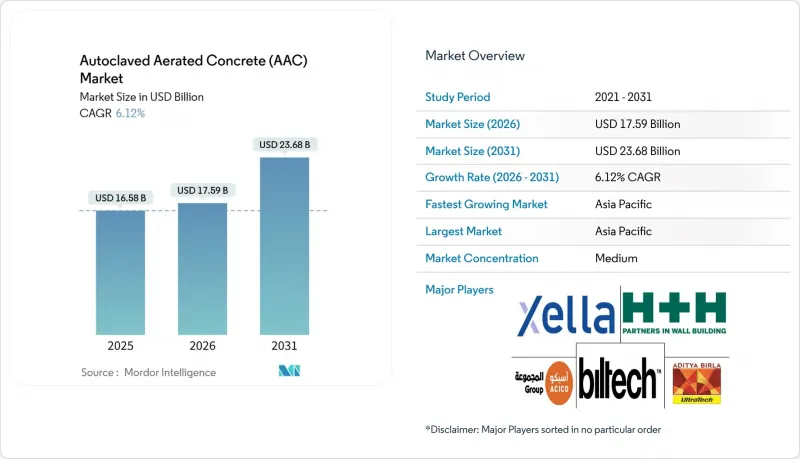
오토클레이브 기포 콘크리트(AAC) 시장은 2025년 155억 6,000만 달러에서 2026년에는 165억 달러로 성장하여 2026년부터 2031년까지 CAGR 6.04%를 기록하며 2031년까지 221억 1,000만 달러에 달할 것으로 예측됩니다.
성장의 배경에는 녹색건축 규제 강화, 내진 구조물에 대한 수요 증가, 모듈식 건축의 급속한 보급이 있으며, 이 모든 것이 AAC의 경량성과 에너지 효율을 부각시키고 있습니다. 블록은 여전히 전통적인 조립식 건축을 지배하고 있지만, 프리패브화에 따른 공기 단축이 진행됨에 따라 패널의 채택이 가속화되고 있습니다. 아시아태평양은 도시화와 인프라 투자에 힘입어 세계 수요의 거의 절반을 차지하고 있으며, 북미와 유럽은 엄격한 에너지 및 내진 기준을 활용하고 있습니다. 각 제조사들은 수요 급증에 대응하고, 비용구조를 개선하고, 지역 공급망을 강화하기 위해 생산능력 확대와 공장 자동화를 추진하고 있습니다.
신흥국의 주택 및 상업시설 착공이 급증함에 따라 경량 건축자재는 기초 하중을 줄이고 프로젝트 주기를 단축하기 위해 필수적인 존재가 되고 있습니다. AAC는 무게가 30-40% 감소하기 때문에 기초 경량화와 층간 시공의 신속성이 가능하기 때문에 밀집된 도심에서는 매우 중요합니다. 인도의 주택건설 촉진책이 이러한 추세를 여실히 보여주고 있으며, 국내 업체인 BigBloc Construction은 도시지역 주택건설 허가 건수 증가에 대응하기 위해 생산능력 확충을 추진하고 있습니다. 개보수 공사에서도 AAC는 정밀한 블록으로 구조 라인의 재구축이 필요 없고, 개보수 작업을 효율적으로 할 수 있어 선호됩니다. 4시간의 내화성능은 상업시설 개보수 시 규제 적합성을 높이고, 곰팡이 방지 매트릭스는 습한 기후에서 특히 높은 평가를 받고 있습니다. 이러한 요인들이 결합하여 오토클레이브 양생 기포 콘크리트 시장의 지속적인 성장을 뒷받침하고 있습니다.
매장탄소 감축을 위한 정책이 전 세계적으로 건축자재 선택의 방식을 바꾸고 있습니다. 미국 정부가 지속가능한 건축자재 벤치마크에 1억 6,000만 달러의 자금을 지원한 것은 AAC의 채택을 확실히 촉진하고 있습니다. 미국 환경보호청(EPA)의 2024년 저탄소 라벨은 제조업체가 기후 우위를 정량화할 수 있는 명확한 경로를 제시하여 공공 프로젝트 입찰 점수를 높일 수 있도록 합니다. 유럽에서도 비슷한 변화가 진행되고 있으며, H+H UK는 EU의 탈탄소화 목표에 따라 2050년까지 순 제로 운영을 목표로 하고 있습니다. 두께 200mm에 단열값 R=1.43을 실현하는 AAC는 운영 에너지를 10-20% 절감하고, 재생 플라이애시를 배합하여 순환경제의 기준을 충족합니다.
AAC의 보급을 저해하는 요인으로 건설사가 라이프사이클 비용 절감보다 구매 가격을 우선시하는 경우, 프리미엄 가격이라는 인식을 들 수 있습니다. 그러나 인도의 주요 도시 지역에서는 기존 붉은 벽돌이 AAC보다 약 20% 더 비싸짐에 따라 경량 대체재로 전환이 진행되고 있습니다. 자재 가격의 변동이 비교 기준을 재구성하고 있습니다. 2025년 관세로 인해 철강재는 10-25%, 콘크리트는 3-7% 가격 상승으로 AAC의 원가 우위가 축소되었습니다. 일부 지역에서는 현지 공장이 한정되어 있어 납품가격이 15-20% 높게 형성되어 있습니다. 에너지 비용 30% 절감과 노동력 절감을 강조하는 인식 개선 활동으로 총소유비용(TCO)을 중심으로 한 조달 판단이 점차 자리를 잡아가고 있습니다.
블록은 2025년 매출의 54.10%를 차지할 것으로 예상되며, 이는 수십 년간의 시공업체들의 친숙함과 광범위한 유통망을 반영합니다. 이와 동시에, 패널은 2031년까지 CAGR 7.55%로 성장하고 있는데, 이는 건설업체들이 조립식 외벽재로 전환하고 있기 때문입니다. 패널 붐은 건설 산업의 산업화 추진을 구현합니다: 공장에서 절단된 모듈은 현장에서 바로 사용할 수 있고, 폐기물을 줄이고 공사 기간을 단축합니다. 개발자들은 고층 주거용 타워에서 패널을 선호합니다. 접합부가 적어 단열 성능이 향상되고 열 손실이 감소하기 때문입니다.
블록 부문은 여전히 저층 주택에서 중심적인 존재이며, 특히 노동력이 풍부하고 현장 시공 기술이 주류인 시장에서는 그 경향이 강합니다. 그러나 패널 기술의 혁신은 멈추지 않습니다. 보강벽 패널은 내력벽 역할을 하고, 열전도율 0.11 W/mK의 지붕 모듈은 제로 에너지 빌딩의 목표 달성에 기여하고 있습니다. 자동화된 톱 라인과 로봇 이송으로 패널 제조 비용이 절감되면서 오토클레이브 기포 콘크리트(AAC) 시장은 장인이 블록을 쌓는 방식에서 산업용 패널 조립으로 전환하고 있습니다.
아시아태평양은 2025년 세계 매출의 46.40%를 차지하며 2031년까지 연평균 7.11%의 성장률을 기록할 것으로 예상됩니다. 중국과 인도가 수요의 중추를 담당하고 있으며, 주택 메가 프로젝트와 국가 인프라 계획이 견인차 역할을 하고 있습니다. 저탄소 건축 방식에 대한 정부의 우대 정책은 AAC의 사양 채택을 더욱 촉진하고 있습니다. 일본과 한국은 내진 안전성을 이유로 AAC를 채택하고 있으며, 호주에서는 주택 에너지 기준이 꾸준한 보급을 뒷받침하고 있습니다. 높은 원자재 자급률과 자동화의 진전으로 단가 경쟁력이 유지되어 아시아태평양의 우위를 확고히 하고 있습니다.
북미에서는 미국 서부의 산불 저항성 요건과 기후대별 건축 외피 규제가 강화되면서 AAC 사용이 다시 부상하고 있습니다. 미국 환경보호청(EPA)의 저탄소 함량 라벨이 공공 조달을 촉진하고, 캐나다의 국가 에너지 기준 개정이 추진력을 증폭시킴. 멕시코의 주택 부양책은 지역 전체를 보완하여 오토클레이브 양생 기포 콘크리트 시장의 견고한 성장 궤도를 이끌고 있습니다.
유럽의 성숙된 시장에서는 엄격한 탄소 목표가 추진력이 되고 있습니다. 독일과 영국에서는 건물의 적극적인 리노베이션이 진행되고 있으며, 북유럽 시장에서는 넷 제로 에너지 표준으로의 전환이 가속화되고 있습니다. EU 그린딜을 통한 자금 지원으로 공장 업그레이드와 신규 라인 설치가 가능해졌습니다. 중동부 유럽 지역에서는 물류시설 및 데이터센터 건설 붐에 따라 내화 및 단열성이 우수한 외장재에 대한 수요가 증가하면서 새로운 성장 영역이 생겨나고 있습니다.
The Autoclaved Aerated Concrete Market is expected to grow from USD 15.56 billion in 2025 to USD 16.5 billion in 2026 and is forecast to reach USD 22.11 billion by 2031 at 6.04% CAGR over 2026-2031.
Growth is fueled by tightening green-building mandates, rising demand for seismic-resilient structures, and the rapid adoption of modular construction, all of which highlight AAC's lightweight, energy-efficient profile. Blocks continue to dominate traditional masonry, yet panels are gaining momentum as prefabrication revamps project timelines. Asia-Pacific commands nearly half of global demand on the back of urbanization and infrastructure outlays, while North America and Europe capitalize on strict energy and seismic codes. Manufacturers are scaling capacity and automating plants to match demand spikes, improve cost structures, and strengthen regional supply chains.
Surging residential and commercial starts in emerging economies have made lightweight materials indispensable because they lower foundation loads and shorten project cycles. AAC cuts dead weight by 30-40%, enabling slimmer foundations and quicker floor-to-floor progress, which is vital in dense city cores. India's housing drive illustrates the trend; domestic producer BigBloc Construction is expanding capacity to keep pace with elevated urban housing approvals. Renovation schemes also prefer AAC because its precision blocks streamline retrofits without reforging structure lines. Four-hour fire ratings boost compliance in commercial refurbishments, and its mold-proof matrix appeals in humid climates. Together, these factors underpin sustained Autoclaved Aerated Concrete market growth.
Policies aimed at curbing embodied carbon are reshaping material selection worldwide. The US government's USD 160 million funding for sustainable-materials benchmarking explicitly encourages AAC uptake. EPA's 2024 low-carbon label gives manufacturers a clear route to quantify climate advantages, enhancing bid scores on public projects. Europe mirrors the shift; H+H UK is targeting net-zero operations by 2050, in line with EU decarbonization goals. With an R-value of 1.43 for 200 mm thickness, AAC delivers 10-20% operational energy savings and incorporates recycled fly ash, satisfying circular-economy criteria.
Perceptions of premium pricing hinder AAC's penetration where contractors prioritize purchase price over life-cycle savings. However, traditional red bricks recently became roughly 20% more expensive than AAC in key Indian metros, nudging buyers toward the lighter alternative. Material-price volatility is reshaping comparisons; 2025 tariffs elevated steel by 10-25% and concrete by 3-7%, eroding AAC's cost differential. Limited local plants in some regions still inflate delivered prices by 15-20%. Education campaigns stressing 30% energy-bill reductions and lower labor needs are gradually reframing procurement decisions around total cost of ownership.
Other drivers and restraints analyzed in the detailed report include:
For complete list of drivers and restraints, kindly check the Table Of Contents.
Blocks held 54.10% of 2025 revenue, reflecting decades of contractor familiarity and broad distribution networks. In parallel, panels are charting a 7.55% CAGR through 2031 as builders pivot toward prefabricated envelopes. The panel boom embodies the construction industry's industrialization push: factory-cut modules arrive field-ready, reducing waste and compressing schedules. Developers favor panels in tall residential towers because fewer joints mean tighter thermal envelopes and lower infiltration losses.
The blocks segment remains central to low-rise housing, especially in markets where labor is abundant and on-site techniques dominate. Yet panel innovation is relentless. Reinforced wall panels now handle load-bearing duties, and roof modules with thermal conductivity of 0.11 W/mK meet zero-energy-building targets. Automated saw lines and robotic handling have cut panel-fabrication costs, underpinning an Autoclaved Aerated Concrete market shift from craft-based block laying to industrial panel assembly.
The Autoclaved Aerated Concrete Market Report is Segmented by Product Type (Block, Panel, Lintel, Tile, Others), Construction Method (On-Site Masonry, Prefabricated/Modular), Application (Residential, Commercial, Industrial, Other Applications), and Geography (Asia-Pacific, North America, Europe, South America, Middle East and Africa). The Market Forecasts are Provided in Terms of Value (USD).
Asia-Pacific held 46.40% of global revenue in 2025 and is accelerating at 7.11% CAGR to 2031. China and India anchor demand, driven by housing mega-projects and state infrastructure pipelines. Government incentives for low-carbon building methods further tip specifications toward AAC. Japan and South Korea adopt AAC for seismic safety, while Australia's home-energy codes sustain steady uptake. High regional self-sufficiency in raw materials and rising automation keep unit costs competitive, cementing Asia-Pacific's dominance.
North America is experiencing a renaissance in AAC usage, propelled by wildfire resilience requirements in the western United States and stricter building envelopes across climate zones. The EPA's low-embodied-carbon label is catalyzing public procurement, and Canada's national energy code revision amplifies momentum. Mexico's housing stimulus complements the regional picture, leading to a robust Autoclaved Aerated Concrete market trajectory.
Europe's mature landscape benefits from stringent carbon targets: Germany and the UK aggressively retrofit buildings, while Nordic markets edge toward near-zero-energy codes. EU Green Deal financing supports plant upgrades and new lines. Central and Eastern Europe provide white-space growth as booming logistics and data-center construction seek fire-safe, thermally efficient shells.