



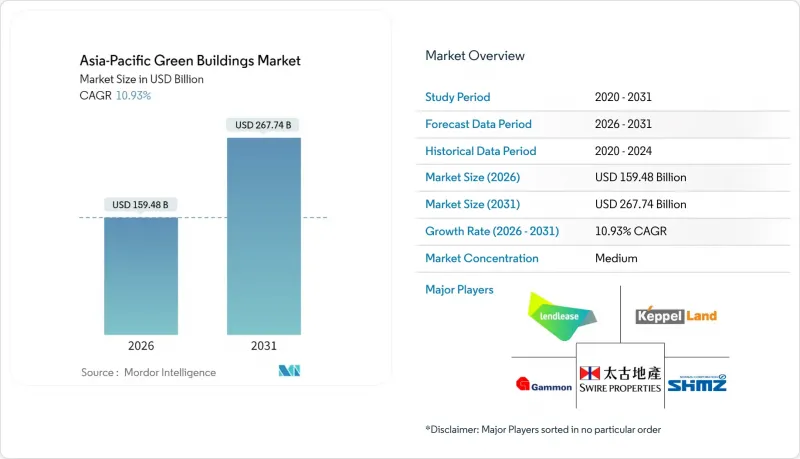
아시아태평양의 그린 빌딩 시장은 2025년에 1,437억 7,000만 달러로 평가되었으며, 2026년 1,594억 8,000만 달러에서 2031년까지 2,677억 4,000만 달러에 달할 것으로 예측됩니다.
예측 기간(2026-2031년) 동안 CAGR은 10.93%로 예상됩니다.
정책의 엄격화, 기업의 순 제로 목표의 지속적인 추진, 에너지 가격 변동에 따른 실질적 비용으로 인해 녹색 사양은 프리미엄 추가 기능이 아닌 프로젝트의 기본 요구 사항으로 자리 매김했습니다. 중국이 규모면에서 주도권을 유지하고 있는 가운데, 인도의 13.02%의 가속화된 CAGR은 급성장하는 남아시아의 수요 거점으로의 지리적 이동을 보여줍니다. 빌딩 시스템 통합, 스마트 HVAC 도입, 성숙한 녹색 금융이 탄탄한 공급업체 파이프라인을 뒷받침하고 단기적인 공급망 마찰의 영향을 완화하고 있습니다. 인증 장벽이 기존 기업에 유리하게 작용하여 경쟁 강도는 중간 정도이지만, 디지털 디스럽터들이 서비스형 서비스 모델을 통해 가치 획득의 방식을 재구성하고 있습니다.
중국 'GB 55015-2021', 일본 개정 건축물 에너지절약법, 인도 '2024년 에너지절약 건축기준' 등 의무화 기준에 따라 법령으로 녹색기술 도입이 의무화되는 프로젝트 대상 범위가 확대되고 있습니다. 개발사들은 현재 개념 설계 단계에서 성능 모델링을 통합하고 있습니다. 이는 기준 미준수가 프로젝트 승인 지연 및 재판매 제한 리스크로 이어질 수 있기 때문입니다. 그 결과, 조립식 외벽 제조업체와 스마트 공조 시스템 공급업체는 수주가 안정화되고 생산능력 확대가 진행되어 단가 압박이 완화되고 있습니다. 또한, 중국에서는 지방 당국이 입주 후 에너지 감사를 지원하여 건설 단계의 기준에서 사용 시 성능 지표로의 전환을 촉진하고 있습니다. 이러한 시너지 효과로 인해 규제, 검증, 조달 기준이 상호 강화되는 생태계가 형성되어 아시아태평양의 그린 빌딩 시장은 자발적 도입을 넘어 가속화되고 있습니다.
캐피털랜드의 순 탄소 제로 약속과 스와이어 프로퍼티스의 12억 달러 규모의 지속가능성 연동 대출은 자금 조달 조건이 측정 가능한 건축 성능에 의존하게 된 좋은 예입니다. 아시아 주요 개발사의 임원 보수는 '과학에 기반한 목표 이니셔티브'의 마일스톤과 연동되어 탈탄소 목표를 기업 지배구조에 반영하고 있습니다. 대형 다국적 기업들은 표준화된 건물 평가 템플릿을 활용하고 이를 현지 공급망에 적용함으로써 하청업체들의 역량 향상을 압박하고 있습니다. 그렇지 않으면 거래가 중단될 위험이 있습니다. 고효율 냉각기 및 스마트 센서의 포트폴리오 전반에 걸친 조달을 통해 수량 할인을 실현하고, 소규모 프로젝트의 도입 장벽을 낮추고 있습니다. 이러한 네트워크 효과로 인해 아시아태평양의 그린 빌딩 산업이 서비스할 수 있는 시장 규모는 눈에 띄는 플래그십 개발 프로젝트를 훨씬 뛰어넘어 확대되고 있습니다.
인도네시아에서는 수입 파사드 부품과 현지 테스트 시설의 부족으로 인해 최대 30%의 비용 프리미엄이 지속되고 있습니다. 중소형 은행은 주요 도시 외에는 인증된 건물의 재판매 실적이 부족하기 때문에 건설 대출에 높은 리스크 프리미엄을 반영하고 있습니다. 개발사들은 수익성을 확보하기 위해 사양 수준을 타협하고, 환경 효과와 시장 평가를 낮추고 있습니다. 강력한 2차 시장 데이터가 부족하기 때문에 평가 전문가들은 보수적인 평가 전제를 채택할 수 밖에 없어 자금 조달에 어려움을 겪고 있습니다. 이러한 상황은 가격에 민감한 아시아태평양의 그린 빌딩 시장 침투를 단기적으로 억제하는 요인으로 작용할 것입니다.
건축 시스템 분야는 2025년 아시아태평양 그린 빌딩 시장 점유율의 40.85%를 차지할 것이며, 2031년까지 CAGR 11.73%로 확대될 것으로 예상됩니다. 이러한 성장은 예측 유지보수 및 실시간 부하 분산에 인공지능 알고리즘을 적용하여 에너지 소비 강도를 측정 가능한 수준으로 낮추는 지능형 HVAC 플랫폼에 기인합니다. 공급업체들은 현장 태양광발전, 축전지, 수요 반응 기능을 통합하여 건물이 정적인 소비자가 아닌 유연한 그리드 참여자로서의 역할을 할 수 있도록 하고 있습니다. 외피 제품은 건축 외피의 혁신을 통해 다양한 기후대에 적합한 단열성과 미적 다양성을 겸비하여 규모면에서 이를 이어갑니다. 인테리어 제품은 저 VOC 소재, 서큘러 조명 등 거주자의 건강 증진 특성을 촉진하고, 팬데믹 이후 건강에 대한 기대에 부응하는 제품입니다. 신흥 '기타' 카테고리에는 건물 일체형 태양광발전(BIPV) 등이 포함되며, 아시아태평양의 그린 빌딩 시장을 재편하고 있는 혁신적인 소재의 파이프라인을 뒷받침하고 있습니다.
통합 플랫폼은 제어 기능을 통합 대시보드에 통합하여 시운전의 복잡성을 줄여줍니다. 이 기능은 증가하는 보고 의무를 달성해야 하는 시설 관리 팀으로부터 점점 더 높은 평가를 받고 있습니다. 표준화된 디지털 트윈은 원격 성능 감사를 가능하게 하고, 시스템 벤더의 인도 후 서비스 수익을 강화합니다. 탄소 가격제도가 확산되는 가운데, 요금 최적화 제어 알고리즘은 조달 입찰에서 중요한 차별화 요소가 되어 통합 빌딩 시스템 공급자의 경쟁 우위를 더욱 높이고 있습니다. 외장재 및 인테리어 제품은 지속적인 성장세를 유지하고 있으며, 연간 성장률은 주요 시스템 카테고리에 비해 뒤쳐져 있으며, 현재 아시아태평양 그린 빌딩 시장의 핵심 수익원이 되고 있습니다.
The Asia-Pacific Green Buildings Market was valued at USD 143.77 billion in 2025 and estimated to grow from USD 159.48 billion in 2026 to reach USD 267.74 billion by 2031, at a CAGR of 10.93% during the forecast period (2026-2031).
Heightened policy stringency, sustained corporate net-zero pledges, and the tangible cost of energy volatility now position green specifications as baseline project requirements rather than premium add-ons. China retains scale leadership, while India's accelerating 13.02% CAGR underscores a geographic pivot toward fast-growing South Asian demand centers. Building systems integration, smart-HVAC adoption, and maturing green finance underpin robust supplier pipelines that dilute the impact of short-term supply chain friction. Competitive intensity remains moderate as certification hurdles favor incumbents, yet digital disruptors are reshaping value capture through performance-as-a-service models.
Mandatory codes such as China's GB 55015-2021, Japan's revised Building Energy Efficiency Act, and India's 2024 Energy Conservation Building Code enlarge the addressable pool of projects that must integrate green technologies by statute. Developers now incorporate performance modeling during concept design because non-compliance risks project approval delays, and resale limitations. Prefabricated facade makers and smart-HVAC suppliers consequently enjoy more stable order books, prompting capacity expansions that ease unit-cost pressures. Provincial authorities in China further subsidize post-occupancy energy audits, reinforcing the shift from construction-stage criteria to in-use performance metrics. The cumulative effect is a self-reinforcing ecosystem in which regulation, verification, and procurement standards accelerate the APAC Green Buildings market beyond voluntary adoption.
CapitaLand's net-zero carbon pledge and Swire Properties' USD 1.2 billion sustainability-linked loan exemplify how financing terms now hinge on measurable building performance. Executive compensation at leading Asian developers is tied to the Science Based Targets initiative milestones, embedding decarbonization goals in corporate governance. Large multinationals leverage standardized building assessment templates that cascade to local supply chains, forcing subcontractors to upgrade capabilities or face disqualification. Cross-portfolio procurement of high-efficiency chillers and smart sensors yields volume discounts, lowering adoption thresholds for smaller projects. The resulting network effects expand the APAC Green Buildings industry's serviceable obtainable market well beyond marquee flagship developments.
In Indonesia, cost premiums of up to 30% persist due to imported facade components and limited local testing facilities. Smaller banks price higher risk premiums into construction loans because resale benchmarks for certified buildings remain thin outside capital cities. Developers compromise on specification depth to preserve pro-forma returns, diluting environmental outcomes and market perception. Absent robust secondary-market data, valuation professionals default to conservative appraisal assumptions, perpetuating financing challenges. This dynamic tempers near-term APAC Green Buildings market penetration in price-sensitive locales.
Other drivers and restraints analyzed in the detailed report include:
For complete list of drivers and restraints, kindly check the Table Of Contents.
Building Systems commanded 40.85% of the APAC Green Buildings market share in 2025, and the segment is expected to escalate at an 11.73% CAGR through 2031. This growth stems from intelligent HVAC platforms that apply artificial-intelligence algorithms for predictive maintenance and real-time load balancing, delivering measurable reductions in energy intensity. Suppliers integrate on-site solar, battery storage, and demand-response capabilities, enabling buildings to act as flexible grid participants rather than static consumers. Exterior Products follow in scale as building-envelope innovations combine thermal resistance with aesthetic versatility suited to diverse climatic zones. Interior Products advance occupant-wellness attributes, such as low-VOC materials and circadian lighting, aligning with post-pandemic health expectations. An emergent "Others" cluster, including building-integrated photovoltaics, underscores a pipeline of disruptive materials that will continue to reshape the APAC Green Buildings market.
Integrated platforms also lower commissioning complexity by consolidating controls under unified dashboards, a feature increasingly valued by facilities-management teams tasked with meeting escalating reporting obligations. Standardized digital twins facilitate remote performance auditing, strengthening post-handover service revenues for system vendors. As carbon-pricing schemes spread, tariff-optimized control algorithms become critical differentiators in procurement tenders, amplifying the competitive moat around integrated Building Systems providers. Although Exterior and Interior Products maintain momentum, their annual gains trail the flagship Systems category, which now represents the core revenue engine of the APAC Green Buildings market.
The Asia-Pacific Green Buildings Market Report is Segmented by Product Type (Exterior Products, Interior Products, Building Systems, Others), by End User (Residential - Apartments & Condominiums, Villas & Landed Houses; Commercial - Office, and More), by Construction Stage (New Construction, Renovation), and by Country (China, India, Japan, South Korea, and More). The Market Forecasts are Provided in Terms of Value (USD).