



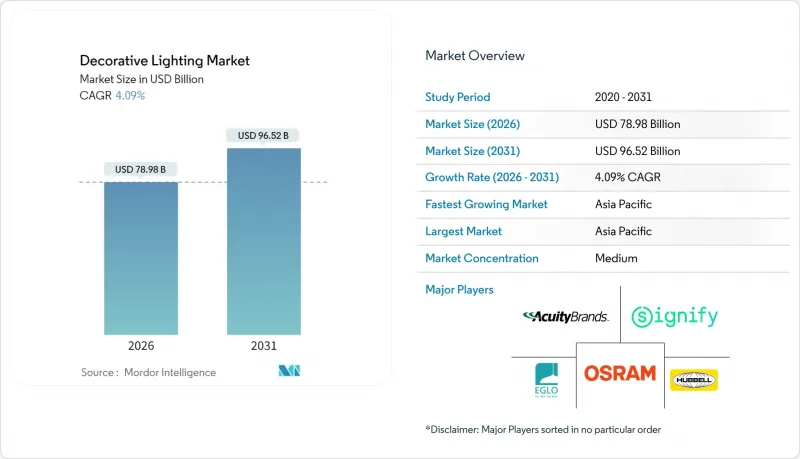
장식 조명 시장은 2025년에 758억 8,000만 달러로 평가되었으며, 2026년 789억 8,000만 달러에서 2031년까지 965억 2,000만 달러에 달할 것으로 예측됩니다.
예측 기간(2026-2031년) 동안 CAGR은 4.09%로 예상됩니다.
LED 가격 하락, 스마트홈 보급 확대, 지속적인 리노베이션 붐이 맞물려 이러한 꾸준한 확대를 뒷받침하고 있습니다. 음성 지원 생태계가 확산됨에 따라, 제조업체는 단일 장식용 제품에서 Matter와 Thread를 기본적으로 지원하는 조명기구로 방향을 전환하여 조명을 보다 광범위한 주거 및 상업용 IoT 스택의 기능적 노드로 전환하고 있습니다. 중국 제품에 대한 미국의 104% 관세 도입 후, 생산 네트워크는 재조정 중입니다. 다국가 조달과 구리 헤지를 구축한 기업들은 비용 충격을 완화하면서 납품 신뢰성을 유지하고 있습니다. 무선 충전식 램프, 균일 발광 OLED 패널, 태양광 하이브리드 가든 랜턴이 소비자 선택의 폭을 넓히는 한편, 디자이너들은 인간 중심의 조명 프로파일을 채택하고 색조를 변화시켜 직장 및 호스피탈리티 시설의 웰빙을 향상시키기 위해 노력하고 있습니다. 지속가능성에 대한 요구, 특히 유럽의 순환 경제에 대한 의무는 재활용 가능성을 문서화하고, 환경 제품 선언(EPD)을 공개하고, 분해를 전제로 설계된 조명기구를 제공하는 브랜드를 우대합니다.
LED 부품 가격은 2025년 와트당 0.12달러 이하로 떨어질 것이며, 장식용 조명기구는 75% 에너지 절약과 50,000시간의 수명을 달성할 것입니다. 이를 통해 총 소유 비용 계산이 재구성되었습니다. 연색성 지수(CRI)가 90을 넘어서면서 호스피탈리티 브랜드는 효율성을 위해 색의 따뜻함을 희생할 필요가 없어졌고, 로비, 레스토랑, 객실의 교체 주기가 빨라지고 있습니다. 주택 사용자들은 백열등 분위기 조명에서 빈티지한 미관을 유지하면서 소비전력을 절반으로 줄인 필라멘트형 LED로 전환하고 있습니다. 동시에 소형화된 방열판으로 인해 기존 대형 램프 본체에서는 구현할 수 없었던 조각적인 디자인이 가능해졌습니다. 이러한 경제성으로 인해 빔 확산을 제어하는 광학 기술에 대한 연구 개발이 촉진되어 디자이너는 눈에 띄는 핫스팟 없이 악센트 조명과 작업 조명을 겹쳐서 배치할 수 있게 되었습니다.
Matter 인증을 통해 장식용 펜던트 1대로 Amazon, Google, Apple의 각 허브와 동기화가 가능하여 소매업체의 SKU 증가를 방지할 수 있습니다. Thread의 저전력 메시 기술은 석조 건물의 통신 범위 문제를 해결하여 무선 침대 옆 벽 조명이 음성 명령에 안정적으로 반응할 수 있도록 합니다. 시설 관리자는 유지보수 담당자가 고가 설치물을 직접 확인하지 않고도 원격으로 문제를 해결할 수 있도록 Matter 대응 샹들리에의 도입을 강력히 요구하고 있습니다. 호텔에서는 중앙 관리 대시보드를 도입하여 로비의 분위기를 원터치로 낮에서 밤의 따뜻함으로 바꾸어 체인 전체에서 일관된 브랜드 경험을 강화하고 있습니다. 통합업체들이 개방형 프로토콜을 표준화하는 가운데, 조달팀은 스타일뿐만 아니라 내구성과 사이버 보안 인증을 중시하고 있습니다.
중국산 조명기구에 대한 관세 부과로 인해 착륙 비용이 크게 상승하고, 제한된 공급업체 네트워크를 가진 틈새 브랜드는 대체 조달처를 찾아야 하는 상황입니다. 베트남과 멕시코가 일부 수요를 흡수하고 있지만, 두꺼운 장인정신 유리 전용 용광로의 공급은 여전히 제한적이어서 빠르게 진화하는 장식 시장과 상충되는 납기 연장을 초래하고 있습니다. 또한, 파운드당 5달러 이상으로 변동하는 구리 가격은 선반 가공된 황동 하우징에 의존하는 펜던트 제조업체의 비용 압박을 더욱 가중시키고 있습니다. 규모가 크고 다각화된 기업들은 헤지 전략을 채택하거나, 큰 설비 변경 없이 황동을 강재로 대체하는 등 재료 대체를 용이하게 하는 모듈식 설계를 도입하여 이러한 문제를 완화하고 있습니다. 반면 소규모 공방은 현금 흐름을 유지하기 위해 제품 출시를 연기하거나 컬렉션 규모를 축소하고 있습니다. 이러한 추세는 변화하는 시장 환경 속에서 업계 관계자들이 직면하고 있는 운영 및 재무적 압박을 잘 보여주고 있습니다.
천장 조명과 샹들리에는 2025년 매출 265억 8,000만 달러로 장식용 조명 시장 규모의 35.02%를 차지했습니다. 그 우위는 신축 및 리노베이션 공사 시 거실이나 로비 공간의 중심이 되는 '주장력 있는' 조명기구에 예산이 할당되는 경향에 기인합니다. 프로젝트 디자이너는 LED 필라멘트 전구와 반투명 아크릴 디퓨저를 활용하여 기존 크리스탈 모델보다 가볍고 볼륨감 있는 형상을 만들어냈습니다. 이를 통해 석고보드 천장에 쉽게 설치할 수 있습니다. 동시에 제조업체는 Matter 지원 드라이버를 통합하여 소유자가 음성 어시스턴트를 통해 색온도를 조정할 수 있습니다. 온백색(저녁용)에서 냉백색(작업용)까지 설정할 수 있습니다. 엔트리 레벨 건설업체는 사전 배선된 캐노피를 채택하여 인테리어 공정을 가속화하고 현장 작업을 줄이고 있습니다. 고급 주택 소유주들은 체코나 무라노의 공방에 주문 제작 샹들리에를 의뢰하고, 현장 조립을 위해 모듈식 부품을 운송해오고 있습니다. 이는 장인의 유리 공예가 스마트 드라이버와 정밀 절단 알루미늄 프레임과의 융합을 통해 살아남을 수 있는 길을 보여주고 있습니다.
테이블 램프와 플로어 램프는 2025년에 119억 3,000만 달러의 시장 규모를 형성했으며, 2031년까지 CAGR 5.21%로 가장 빠른 성장세를 보일 것으로 예상됩니다. 이는 리튬 배터리의 밀도 향상으로 15시간의 무선 작동이 가능해졌기 때문입니다. 유연한 작업이 방의 기능을 모호하게 만드는 가운데, 소비자는 코드를 끌지 않고 책상, 소파, 테라스 사이에서 램프를 자유롭게 이동할 수 있습니다. 각 브랜드는 USB-C 충전과 Qi 무선 충전 패드를 기본으로 탑재하고, 스마트폰과 이어폰을 충전할 수 있는 다기능 허브로서 램프를 홍보하고 있습니다. 소매점에서는 무광택 황동 마감의 미드센추리 디자인에 편중되어 있으며, AR 앱 분석을 통해 사이드보드와 침대 옆 탁자에 설치되는 경향을 확인할 수 있었습니다. 한편, 벽걸이형 조명에는 PIR 센서가 내장되어 복도나 화장실의 자동화를 실현했습니다. 주변 조명이 내장된 거울과의 교차 판매를 촉진합니다. 트랙 조명은 천장 레일에 자석식 헤드를 스냅으로 연결하는 모듈식으로 제품 라인을 확장했습니다. 소매점에서는 액센트 스팟 모듈과 워시 렌즈가 포함된 스타터 키트를 판매하여 갤러리 스타일의 주택 디스플레이를 제안하고 있습니다.
2025년, LED 기술은 장식 조명 시장 점유율의 70.12%를 차지했습니다. 필라멘트 풍의 전구가 백열등의 빛을 재현하면서 110lm/W의 효율을 구현했기 때문입니다. 각 제조사들은 하나의 샹들리에 안에 협각 빔 액센트 모듈과 확산형 백라이트를 결합한 부문 광학을 추구하며 LED의 다재다능함을 보여주고 있습니다. 2026년 이후 전력회사의 보조금 종료에 따라 투자 회수에서 웰빙으로 논의가 전환되고, 조광 가능한 백색 LED가 프리미엄 가격대에 위치하게 될 것입니다. 동시에 OLED 패널과 태양광 하이브리드 엔진은 2025년 25억 3,000만 달러의 매출을 기록할 것이며, CAGR 4.88%로 확대될 것입니다. 종이처럼 얇은 OLED 시트는 무드조명을 겸한 벽면 아트를 구현하여 도쿄와 베를린의 디자인 지향적인 부티크에서 판매되고 있습니다. 고효율 단결정 패널과 3,000회 이상의 충방전 사이클을 실현하는 LiFePO4 배터리를 채택하여 태양열 정원 랜턴의 광량을 1,800루멘으로 비약적으로 향상시켰습니다.
규제 강화에 따라 백열등 및 할로겐 조명 카테고리는 장식용 조명 시장 규모의 5% 미만으로 축소될 것입니다. 그러나 부티크 호텔 디자이너들은 일부 LED 복제품으로는 재현할 수 없는 따뜻한 향수를 이유로 여전히 2,400K 필라멘트 전구를 스피크이지바에 지정하고 있습니다. 형광등과 CFL 유닛은 엄격한 색상 평가로 인해 쇠퇴하고 있으며, 개조 수요는 LED 튜브 또는 통합형 드라이버로 완전히 전환되고 있습니다. 향후 전망으로는 OLED와 같은 표면 발광을 구현하면서 수명을 연장하는 마이크로 LED 어레이에 대한 연구개발 투자가 진행되어 디자인 자유도에 있어 더 큰 도약을 예고하고 있습니다.
아시아태평양은 2025년 270억 9,000만 달러의 시장 규모를 기록했으며, 2031년까지 연평균 5.98%의 CAGR로 2031년까지 가장 빠르게 성장할 것으로 예상됩니다. 중국에서는 광동성 수출 거점이 유리 그늘막과 다이캐스팅 하우징 생산을 계속 지배하고 있으며, 도시 지역 분양 아파트 완공에 따른 국내 소비 증가와 맞물려 그 우위는 흔들림이 없습니다. 인도의 모듈식 스위치 분야는 7.99%의 CAGR로 성장하고 있으며, 장식기구의 업그레이드와 연계된 광범위한 전기화 추세를 보이고 있습니다. 싱가포르, 말레이시아, 태국은 에너지 강도 목표 달성을 위해 숙박시설 복도에 스마트 LED 개보수를 장려하고 있으며, 네트워크 지원 벽 조명에 대한 수요를 지속하고 있습니다. 일본에서는 마이크로 아파트의 공간 제약에 대응하는 고급 OLED 벽면 예술이 주목받고 있습니다. 한편, 호주에서는 주택 개조 붐으로 인해 염수 분무에 견딜 수 있는 분말 코팅 내염성 실외 펜던트 조명의 판매가 증가하고 있습니다.
북미에서는 견조한 주택 자산 가치와 스마트 스피커의 광범위한 보급을 배경으로 교체 수요가 주도하는 추세를 보이고 있습니다. 주택 소유자가 앱을 정리하고 하나의 음성 명령으로 샹들리에, 매입형 다운라이트, 액센트 랜턴을 조작하는 것을 선호하기 때문에 Matter의 상호 운용성이 특히 주목을 받고 있습니다. 상업시설에는 하이브리드 근무형태의 직원들을 유인하는 인간 중심의 로비 조명이 도입되고, 공급망의 국내 회귀로 인해 소매업체들은 관세를 피하기 위해 멕시코산 금속 인클로저 공급업체를 선택하고 있습니다.
유럽에서는 지속가능성이 최우선이며, 공공 입찰에서 환경 제품 선언(EPD) 서류를 요구하고, 분해 설계한 기구를 선호합니다. 독일에서는 바우하우스 양식에서 영감을 받은 재활용 알루미늄 소재의 암램프가 환경의식이 높은 소비자들에게 호응을 얻고 있으며, 이탈리아에서는 전통적인 무라노 유리와 조광 시 따뜻한 색으로 변하는 LED 필라멘트가 융합된 제품이 인기를 끌고 있습니다. 네덜란드에서는 순환형 임대 계약을 시범 도입하여 호텔이 5년 후 펜던트 조명을 반납하여 재생 및 재사용 사이클을 실현했습니다. 순환성을 브랜드 스토리에 녹여내고 있습니다. 영국의 브렉시트 복잡성은 수입 유통에 계속 도전하고 있으며, 현지 창고가 리드타임의 완충 역할을 하고 있습니다.
라틴아메리카와 중동은 매출 비중은 작지만, 대규모 호스피탈리티 프로젝트로 인해 평균 이상의 성장을 기록하고 있습니다. 사우디아라비아의 엔터테인먼트 지구에서는 프로그래밍 가능한 RGBW 노드를 갖춘 대형 키네틱 샹들리에가 지정되어 현지 통합 업체는 DMX 프로그래밍 기술을 향상시켜야 합니다. 브라질의 리조트 운영자들은 외딴 해변 시설의 굴착 비용을 절감할 수 있는 태양열 하이브리드식 가든 랜턴을 선호하고 있습니다.
The decorative lighting market was valued at USD 75.88 billion in 2025 and estimated to grow from USD 78.98 billion in 2026 to reach USD 96.52 billion by 2031, at a CAGR of 4.09% during the forecast period (2026-2031).
LED cost erosion, rising smart-home adoption, and a sustained renovation boom jointly underpin this steady expansion. As voice-enabled ecosystems normalize, manufacturers pivot from isolated aesthetic pieces toward fixtures that natively support Matter and Thread, thereby converting lighting into a functional node within a larger residential or commercial IoT stack. Production networks are re-balancing after 104% U.S. tariffs on Chinese imports; firms that lock in multi-country sourcing and copper hedges buffer cost shocks while maintaining delivery reliability. Cordless rechargeable lamps, uniform-emission OLED panels, and solar-hybrid garden lanterns broaden consumer choice, while designers rely on human-centric light profiles that shift hue to boost wellness in workplaces and hospitality venues. Sustainability imperatives-especially Europe's circular-economy mandates-favor brands that document recyclability, publish Environmental Product Declarations, and engineer fixtures for disassembly.
LED component prices slid below USD 0.12 per watt in 2025, letting decorative fixtures deliver 75% energy savings and 50,000-hour lifespans that recast total ownership calculations. As CRI values exceed 90, hospitality brands no longer trade color warmth for efficiency, accelerating replacement cycles across lobbies, restaurants, and guest rooms. Residential adopters migrate from incandescent ambience toward filament-style LEDs that keep vintage aesthetics yet halve power draw. Simultaneously, miniaturized heat sinks unlock sculptural designs once infeasible with bulkier lamp bodies. These economics redirect R&D toward optics that modulate beam spread, empowering designers to layer accent and task lighting without perceptible hotspots.
Matter certification now ensures a single decorative pendant can sync with Amazon, Google, and Apple hubs, sparing retailers from SKU proliferation. The thread's low-power mesh solves coverage gaps in masonry-heavy dwellings, enabling cordless bedside sconces to respond reliably to voice commands. Facility managers insist on Matter-ready chandeliers so maintenance staff can troubleshoot remotely rather than accessing high-ceiling installations. Hotels deploy centralized dashboards that change lobby ambience from daylight to evening warmth at a touch, fortifying brand experience consistently chain-wide. As integrators standardize open protocols, procurement teams weigh longevity and cybersecurity certifications alongside style.
The imposition of tariffs on Chinese fixtures has substantially increased landed costs, compelling niche brands with limited supplier networks to explore alternative sourcing options. While Vietnam and Mexico have absorbed some of the demand, the availability of furnaces designed for thick artisan glass remains limited, leading to extended lead times that conflict with the fast-evolving decor market. Additionally, copper prices, which have been fluctuating above USD 5.00 per pound, are exacerbating cost pressures for pendant manufacturers reliant on spun brass housings. Larger, diversified players are mitigating these challenges by employing hedging strategies and adopting modular designs that facilitate material substitution, such as replacing brass with steel, without requiring significant retooling. Conversely, smaller ateliers are deferring product launches or reducing collection sizes to preserve cash flow. These dynamics highlight the operational and financial pressures faced by industry participants amid shifting market conditions.
Other drivers and restraints analyzed in the detailed report include:
For complete list of drivers and restraints, kindly check the Table Of Contents.
Ceiling lights and chandeliers accounted for USD 26.58 billion of 2025 revenue, representing 35.02% of the decorative lighting market size. Their dominance stems from new-build construction and renovation priorities that allocate budget to a central "statement" piece anchoring living or lobby spaces. Project designers exploit LED filament bulbs and translucent acrylic diffusers to craft voluminous forms that weigh less than legacy crystal models, easing installation on gypsum ceilings. At the same time, manufacturers integrate Matter-ready drivers so owners can adjust color temperature from warm-white dinners to cool-white task settings via voice assistants. Entry-level builders adopt pre-wired canopies that accelerate fit-out schedules, reducing job-site labor. Luxury homeowners commission bespoke chandeliers from Czech and Murano studios that ship modular sections for on-site assembly, demonstrating how artisan glass survives by aligning with smart drivers and precision-cut aluminum frames.
Table and floor lamps, valued at USD 11.93 billion in 2025, deliver the fastest 5.21% CAGR through 2031, catalyzed by lithium-battery density improvements that enable 15-hour cordless operation. As flexible working blurs room functions, consumers reposition lamps between desks, sofas, and terraces without trailing cords. Brands emphasize USB-C charging and Qi wireless pads in bases, converting lamps into multi-utility hubs that power phones and earbuds. Retail assortments skew toward mid-century silhouettes in matte-brass finishes, verified by AR app analytics that flag user placement preferences for sideboards and bedside tables. Meanwhile, wall sconces integrate PIR sensors to automate hallways and powder rooms, seeding cross-sales of matching mirrors with embedded perimeter lighting. Track lighting rounds out the product hierarchy with modular magnetic heads that snap onto ceiling rails, letting retailers market starter kits bundled with accent spot modules and wash lenses for gallery-style residential displays.
LED technology secured 70.12% of the decorative lighting market share in 2025 as filament-style bulbs replicate the incandescent glow while delivering 110 lm/W efficiencies. Manufacturers pursue segmented optics that combine narrow beam accent modules with diffuse backlights inside a single chandelier, showcasing LED versatility. Utility rebate sunsets after 2026 shift conversation from payback to wellness, positioning tunable-white LEDs at premium price points. Simultaneously, OLED panels and solar-hybrid engines together logged USD 2.53 billion in 2025 revenue, advancing at a 4.88% CAGR. Paper-thin OLED sheets enable wall art that doubles as mood lighting, selling through design-forward boutiques in Tokyo and Berlin. Solar garden lanterns leap to 1,800 lumen outputs courtesy of higher-efficiency mono-crystalline panels and LiFePO4 batteries that cycle 3,000+ times.
Incandescent and halogen categories shrink below 5% of the decorative lighting market size as regulatory bans tighten. Yet boutique hospitality designers still specify 2,400 K filament bulbs in speakeasy bars, citing warm nostalgia unsatisfied by some LED replicas. Fluorescent and CFL units fade under harsh color critique, redirecting retrofit demand squarely into LED tubes or integrated drivers. Looking forward, R&D invests in micro-LED arrays that promise OLED-like surface emission but longer lifespans, foreshadowing another leap in design freedom.
The Global Decorative Lighting Market Report is Segmented by Product Type (Ceiling Lights & Chandeliers, Pendants, Wall Sconces, and More), Light Source (LED, Incandescent, Fluorescent & CFL, Halogen, Others), End-User (Residential, Commercial), Distribution Channel (B2C/Retail Channels, B2B/Direct Sales & Projects), and Geography (North America, South America, and More). The Market Forecasts are Provided in Terms of Value (USD).
Asia-Pacific generated USD 27.09 billion in 2025, translating to 35.70% of global value and the fastest 5.98% CAGR through 2031. China's export clusters in Guangdong continue to dominate glass shade and die-cast housing output even as domestic consumption climbs with urban condominium completions. India's modular switch segment, growing at 7.99% CAGR, signals broader electrification that dovetails with decorative fixture upgrades. Singapore, Malaysia, and Thailand incentivize smart LED retrofits in hospitality corridors to hit energy-intensity targets, sustaining demand for networkable sconces. Japan tilts toward premium OLED wall art addressing space constraints in micro-apartments, while Australia's home-renovation wave fuels sales of coastal-proof outdoor pendants powder-coated against salt spray.
North America displays replacement-driven dynamics underpinned by robust housing equity and wide smart-speaker penetration. Matter interoperability gains particular traction as homeowners declutter apps, preferring one voice command to operate chandeliers, recessed cans, and accent lanterns. Commercial retrofits install human-centric lobby lighting aimed at enticing employees back in hybrid work patterns, while supply-chain reshoring steers retailers toward Mexican metallic housing suppliers that skirt tariffs.
Europe foregrounds sustainability, requiring EPD documentation for public tenders and favoring fixtures engineered for disassembly. Germany's Bauhaus-inspired armature lamps in recycled aluminum resonate with eco-savvy consumers, whereas Italy merges heritage Murano glass with dim-to-warm LED filaments. The Netherlands pilots circular-leasing contracts where hotels return pendants after five years for refurbish-and-reuse cycles, embedding circularity into brand narratives. Brexit complexities continue to challenge U.K. import flows, prompting local warehouses to buffer lead times.
Latin America and the Middle East, though smaller in revenue share, record above-average growth courtesy of hospitality megaprojects. Saudi Arabia's entertainment districts specify large-scale kinetic chandeliers with programmable RGBW nodes, pushing local integrators to upskill in DMX programming. Brazilian resort operators favor solar-hybrid garden lanterns that cut trenching costs in remote beach properties.