


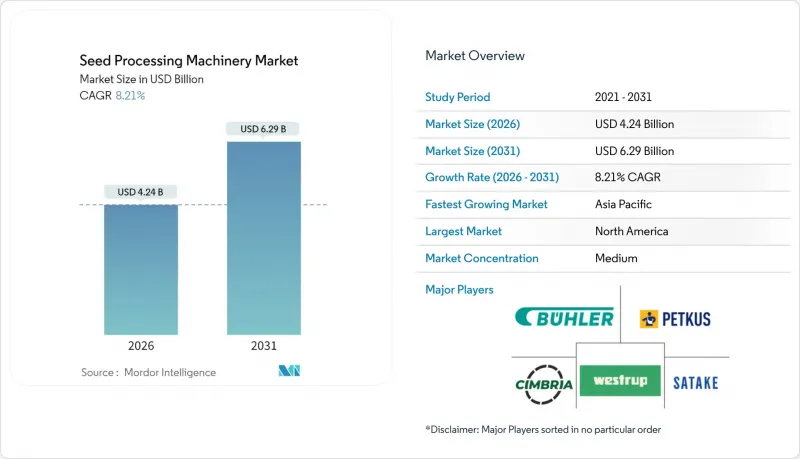
종자 가공 기계 시장은 2025년 39억 2,000만 달러에서 2026년에는 42억 4,000만 달러로 성장하고, 2026년부터 2031년까지 CAGR 8.21%를 기록하며 2031년까지 62억 9,000만 달러에 달할 것으로 예측됩니다.
이러한 성장은 농업의 기계화, AI 기반 광학 선별기 도입, 가공된 고부가가치 종자에 대한 수요 증가에 힘입어 성장세를 보이고 있습니다. 2050년까지 세계 인구가 97억 명에 달할 것으로 예측되는 상황에서 식량 안보를 위해서는 농업 생산성 향상이 필수적입니다. 작물 수확량 향상에 있어 고품질 종자의 중요성이 높아짐에 따라 첨단 종자 가공 기계에 대한 수요가 증가하고 있습니다. 인도, 인도네시아, 폴란드의 정부 보조금이 장비 구매를 촉진하는 한편, 중규모 상업용 플랜트 및 연구 기관에서는 정밀 육종 프로그램을 위한 역량 확대가 진행되고 있습니다. 시장 진입 기업들은 유지보수 서비스 계약, 사이버 보안 기능을 갖춘 IoT 연결성, 상업용 시설과 소규모 이동 단위 모두에 적합한 모듈식 설계를 통해 경쟁을 벌이고 있습니다.
인공지능을 탑재한 광학 선별기는 99.5% 이상의 결함 제거 정확도를 달성하고, 기계식 장비에 비해 손이 많이 가는 부분을 줄여 최대 40%의 처리량 증가를 실현합니다. 머신러닝 알고리즘이 색상, 밀도, X선 파라미터를 지속적으로 최적화하기 때문에 품종 변경 시 수동으로 재조정할 필요가 없습니다. 이러한 시스템을 조기에 도입한 기업들은 가동 시간 보장 및 원격 최적화를 특징으로 하는 프리미엄 서비스 계약을 제공하고 있습니다. 반도체 공급의 안정화와 이에 따른 부품 비용의 하락이 예상됨에 따라 중규모 가공 플랜트에서의 도입이 증가할 것으로 예상됩니다. 종자 가공 기계 시장에서는 비전 시스템이나 엣지 컴퓨팅이 옵션이 아닌 표준 기능으로 내장되어 시설 측의 설비 업데이트 압력이 높아지고 있습니다. 초기 비용은 높지만 높은 투자수익률(ROI)을 기대할 수 있기 때문에 광학 선별은 설비투자의 주요 초점이 되고 있습니다.
상업용 종자 처리 기술은 기본적인 살균제 처리에서 미량영양소와 유익한 미생물을 포함한 첨단 코팅 기술로 발전하고 있습니다. 처리된 종자 로트는 15-25%의 수익률 향상을 가져다주기 때문에 가공업체들은 그램 단위의 정확도로 폴리머 도포량을 측정하는 정밀 코팅 장비에 대한 투자를 추진하고 있습니다. 2028년까지 코팅제 내 미세플라스틱을 금지하는 유럽 규정에 따라 생분해성 배합제에 대응하는 신규 설비로의 업데이트가 가속화되고 있습니다. 탈크와 산화칼슘을 혼합한 펠릿화 재료의 사용으로 종자 발아율이 23% 향상되어 코팅 품질의 농학적 가치가 입증되었습니다. 고품질 종자 생산의 확대는 코팅 설비의 전략적 중요성을 높이고, 종자 가공 기계 시장 전체의 수익 증가에 기여하고 있습니다.
첨단 종자 가공 장비에 AI 및 자동 제어 시스템을 통합하는 것은 프리미엄 가격 책정으로 인해 소규모 사업자와 신흥 시장 진출 기업의 도입 장벽으로 작용하고 있습니다. AI 탑재 광학 선별기는 기계식 모델보다 40-60% 더 비싸고, 중형 플랜트에서는 투자 회수 기간이 3-5년으로 연장됩니다. 연성 상품 가격 변동과 금리 상승과 같은 시장 이슈로 인해 가격 민감도가 높아지고 있습니다. 리스나 종량제 계약과 같은 대체 자금 조달 수단이 존재하지만, 벤더 측에서는 새로운 신용 리스크 평가 도구의 개발이 요구됩니다. 특히 남아시아나 사하라 이남 아프리카의 경우 자금조달 환경이 미비하여 중소규모 사업자의 시장 침투가 여전히 제한적일 수 밖에 없습니다.
2025년 기준, 클리너는 종자 가공 기계 시장의 31.85%를 차지하며 가공 라인의 필수 구성요소로 작용할 것으로 예상됩니다. 곡물, 유지종자, 채소 등 다양한 품목을 처리할 수 있는 범용성으로 인해 시설 증설과 설비 교체에 대한 수요가 꾸준히 발생하고 있습니다. 잡초 종자의 엄격한 관리와 발아 기준을 요구하는 수출 규제로 인해 다단식 스크리너와 중력분리기의 필요성이 대두되고 있습니다. 광학 인식 시스템의 통합으로 이물질을 단일 공정으로 효율적으로 제거할 수 있어 생산성이 향상되고 수작업의 필요성이 감소합니다. 대규모 상업용 가공 시설의 추세는 고용량 자동 세척 시스템에 대한 수요를 증가시켜 중요한 시장 점유율을 강화하고 있습니다.
코팅 장비 부문은 미세플라스틱 프리 코팅 재료 및 생물학적 활성 배양액의 채택 확대에 힘입어 2031년까지 CAGR 7.98%로 성장할 것으로 예상됩니다. 첨단 계량 시스템을 통해 종자 발아를 촉진하고 규정을 준수하는 균일한 코팅 도포가 가능합니다. 수용성 결합제의 개발로 저온 경화 공정이 가능해져 에너지 절약형 건조 시스템과의 통합이 촉진되고 있습니다. 특수 하이브리드 종자를 개발하는 연구기관은 소량 코팅 장비에 대한 수요를 창출하여 고객 기반을 확대하고 있습니다. 가공업체들이 고품질 종자 생산에 집중함에 따라 코팅 장비 부문의 성장이 가속화될 것으로 예상됩니다.
북미는 2025년 기준 종자 가공 기계 시장의 34.02%를 차지했으며, 옥수수 벨트 지역과 태평양 북서부 지역의 대규모 시설이 이를 뒷받침하고 있습니다. 신젠타의 파스코 공장 개보수(1,500만 달러), 벡의 미주리주 대두 신공장 등 대규모 투자가 지속적인 갱신 수요를 뒷받침하고 있습니다. 관세의 불확실성이 전체 매출에 영향을 미치는 반면, 가공업체들은 수출 시장의 식물 검역 요건을 충족하기 위해 시설 현대화를 지속적으로 추진하고 있습니다. 이 지역의 종자 가공 기계 시장은 잘 구축된 자금 조달 옵션과 높은 운영 효율성을 유지하는 광범위한 서비스 계약자 네트워크의 혜택을 누리고 있습니다.
아시아태평양은 6.86%의 CAGR로 가장 높은 성장률을 보이고 있으며, 인도의 50% 보조금 프로그램, 인도네시아의 설비 보급 정책, KPAGRO와 어드밴타시드의 시설 투자가 주도하고 있습니다. 현지 제조업체는 비용 효율적인 세척기 및 반자동 선별기를 제공하고, 국제 기업은 첨단 광학 선별기를 공급하고 있습니다. 쌀과 잡종 채소의 상업용 종자 채택이 확대되면서 시장도 활기를 띠고 있습니다. 미국산 장비에 대한 중국의 10% 관세는 공급망 현지화를 촉진하고 지역 제조 역량을 강화하고 있습니다.
유럽에서는 환경 규제와 현대화 조치로 인해 안정적인 시장 성과를 유지하고 있습니다. 인코텍의 미세플라스틱 프리 코팅 기술로의 전환에 따라 가공 설비 업그레이드 및 장비 교체가 필요합니다. 폴란드의 '농업 4.0' 프로그램(자금 규모 25억 유로=27억 달러)은 첨단 가공 라인에 대한 투자를 지원하고 있습니다. 독일과 프랑스의 에너지 효율화 인센티브는 저열 건조기 및 태양광 보조 세척기 도입을 촉진하고 있습니다. 경제적인 어려움에도 불구하고, 환경 규제에 대한 대응 요건으로 인해 유럽 전역의 사업장에서 일관된 설비 업데이트가 이루어지고 있습니다.
The seed processing machinery market is expected to grow from USD 3.92 billion in 2025 to USD 4.24 billion in 2026 and is forecast to reach USD 6.29 billion by 2031 at 8.21% CAGR over 2026-2031.
This growth is driven by increased agricultural mechanization, adoption of AI-enabled optical sorters, and higher demand for treated, value-added seeds. The projected increase in world population to 9.7 billion by 2050 necessitates enhanced agricultural productivity for food security. The importance of high-quality seeds in improving crop yields has increased the demand for advanced seed processing machinery. Government subsidies in India, Indonesia, and Poland are encouraging equipment purchases, while mid-scale commercial plants and research institutes are expanding their capacity for precision breeding programs. Companies in the market compete through maintenance service contracts, IoT connectivity with cybersecurity features, and modular designs suitable for both commercial facilities and small-scale mobile units.
Optical sorters equipped with artificial intelligence achieve defect-removal accuracy exceeding 99.5%, reducing rework and increasing throughput by up to 40% compared to mechanical units. Machine learning algorithms continuously optimize color, density, and X-ray parameters, eliminating the need for manual recalibration during variety changes. Companies that implemented these systems early now offer premium service contracts featuring guaranteed uptime and remote optimization. The projected stabilization of semiconductor supply and subsequent reduction in component costs are likely to increase adoption among mid-sized processing plants. The seed processing machinery market now includes vision systems and edge computing as standard features rather than optional additions, creating pressure for facilities to upgrade their equipment. The strong return on investment, despite higher initial costs, makes optical sorting a primary focus for capital expenditure.
Commercial seed treatment has progressed from basic fungicide applications to advanced coatings containing micronutrients and beneficial microorganisms. Treated seed batches yield 15-25% higher margins, driving processors to invest in precision coating equipment that measures polymer application with gram-level accuracy. European regulations prohibiting microplastics in coatings by 2028 are accelerating equipment upgrades, as new machinery must be compatible with biodegradable formulations. The use of pelleting materials, including talcum-calcium-oxide mixtures, has improved seed emergence rates by 23%, demonstrating the agronomic value of coating quality. The expansion of premium seed production has increased the strategic importance of coating equipment, contributing to higher overall revenue in the seed processing machinery market.
The integration of AI and automated controls in advanced seed processing equipment results in premium pricing, creating adoption barriers for smaller operations and emerging market participants. AI-enabled optical sorters are 40-60% more expensive than mechanical models, extending payback periods to three to five years for mid-volume plants. Market challenges, including soft commodity price fluctuations and rising interest rates, increase price sensitivity. While leasing and pay-per-use contracts provide alternative financing options, they require vendors to develop new credit risk assessment tools. Market penetration among smaller players remains limited, particularly in South Asia and sub-Saharan Africa, due to insufficient financing ecosystems.
Other drivers and restraints analyzed in the detailed report include:
For complete list of drivers and restraints, kindly check the Table Of Contents.
Cleaners held a 31.85% of the seed processing machinery market share in 2025, serving as essential components in processing lines. Their versatility in handling cereals, oilseeds, and vegetables generates consistent demand from both facility expansions and equipment replacement initiatives. Export regulations requiring strict weed-seed control and germination standards drive the need for multi-deck screeners and gravity separators. The integration of optical recognition systems enables efficient removal of foreign materials in a single pass, increasing productivity and reducing manual labor requirements. The trend toward larger commercial processing facilities has increased demand for high-capacity, automated cleaning systems, reinforcing their significant market share.
The coaters segment is projected to grow at an 7.98% CAGR through 2031, driven by increased adoption of microplastic-free coating materials and bioactive inoculants. Advanced dosing systems ensure consistent coating application that supports seed germination and complies with regulations. The development of water-soluble binding agents enables lower temperature curing processes, facilitating integration with energy-efficient drying systems. Research institutions developing specialized hybrid seeds create demand for small-batch coating equipment, expanding the customer base. The coating equipment segment's growth is anticipated to accelerate as processors focus on premium seed production.
Seed Processing Machinery Market Report is Segmented by Machinery Type (Pre-Cleaners, Cleaners, Dryers, Graders, Coaters, Separators, Polishers, and More), by Operation Mode (Automatic and Semi-Automatic), by End-User (Commercial Seed Processing Plants, Seed Producers, Research Institutions, and More), and by Geography (North America, Europe, Asia-Pacific, and More). The Market Forecasts are Provided in Terms of Value (USD).
North America held a 34.02% of the seed processing machinery market share in 2025, supported by extensive facilities in the Corn Belt and Pacific Northwest. Significant investments, including Syngenta's USD 15 million Pasco facility upgrade and Beck's new soybean plant in Missouri, demonstrate sustained replacement demand. While tariff uncertainties affect combined sales, processors continue facility modernization to meet export market phytosanitary requirements. The region's seed processing machinery market benefits from established financing options and an extensive network of service contractors maintaining high operational efficiency.
Asia-Pacific shows the highest growth at 6.86% CAGR, driven by India's 50% subsidy program, Indonesia's equipment distribution initiatives, and facility investments from KPAGRO and Advanta Seeds. Local manufacturers provide cost-effective cleaners and semi-automatic graders, while international companies supply advanced optical sorters. The market gains momentum from increased commercial seed adoption in rice and hybrid vegetables. The 10% Chinese tariffs on U.S. equipment have encouraged supply-chain localization, strengthening regional manufacturing capabilities.
Europe maintains a stable market performance through environmental regulations and modernization initiatives. Incotec's transition to microplastic-free coating technologies necessitates processor upgrades and equipment replacement. Poland's Agriculture 4.0 program, with EUR 2.5 billion (USD 2.7 billion) in funding, supports investment in advanced processing lines. Energy efficiency incentives in Germany and France encourage the adoption of low-heat dryers and solar-assisted cleaners. Despite economic challenges, environmental compliance requirements ensure consistent equipment upgrades across European operations.