



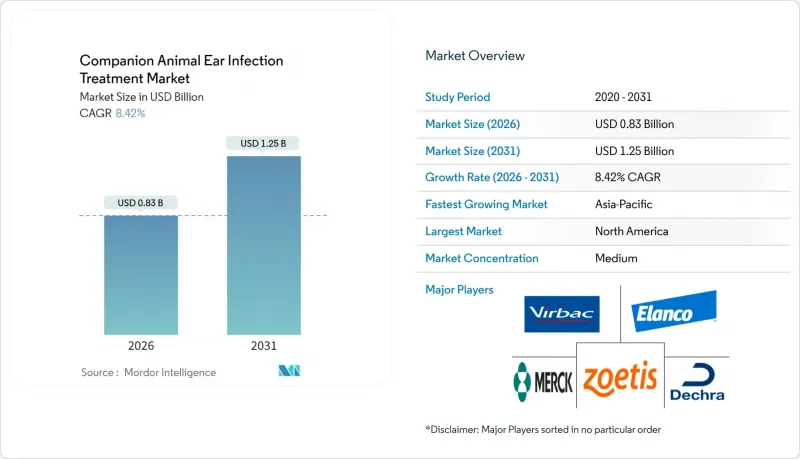
2026년 반려 동물용 귀감염증 치료제 시장 규모는 8억 3,000만 달러로 추정되며, 2025년 7억 7,000만 달러에서 성장이 전망됩니다.
2031년에는 12억 5,000만 달러에 달하며, 2026-2031년에 CAGR 8.42%로 확대할 전망입니다.
반려동물 사육 수 증가와 동물의료비 확대가 맞물려 수요가 가속화되고 있으며, 수의학계에서는 정밀의료에 의한 항균제 내성 대책이 시급한 상황입니다. 서방형 제제, 마이크로바이옴 기반 제품 등 첨단 귀 치료제의 선택의 폭이 넓어짐에 따라 수의사들은 치료 효과와 순응도를 향상시킬 수 있는 새로운 수단을 얻게 되었습니다. 또한 사후관리 부담을 줄이고 항균제의 적정 사용을 지원하는 원격의료의 도입이 보급을 촉진합니다. 한편, 소비자 직접 판매 채널은 처방약에 대한 접근성을 확대하고 있습니다. 이러한 시너지 효과로 인해 반려동물 귀 감염 치료제 시장은 성숙한 지역과 신흥 지역 모두 더 나은 임상 결과를 추구하면서 건전한 성장 궤도를 유지하고 있습니다.
세계 반려동물 보유율이 사상 최고치를 기록하고 있습니다. 2024년 미국 가구의 70%가 반려동물을 키우고 있으며, 중국, 인도, 라틴아메리카 일부 지역에서도 반려동물 사육률이 가속화되고 있습니다. 밀레니얼 세대와 Z세대는 반려동물을 가족의 일원으로 여기는 경향이 강해지고 있으며, 가격에 민감한 계층이 많은 가운데 프리미엄급 헬스케어에 대한 요구가 확산되고 있습니다. 반려동물 귀 감염 치료 시장에서는 반려동물 수 증가로 인해 예방적 귀 관리와 치료적 개입 모두에서 잠재적 고객 기반이 확대되고 있습니다. 그러나 2024년에는 반려동물 보호자의 52%가 비용 때문에 수의사가 권장하는 진료를 받지 않겠다고 응답해, 저렴한 가격과 유연한 서비스 제공이 여전히 중요하다는 것을 보여줍니다. 이에 따라 보다 저렴한 비용으로 시술을 받기 위해 해외로 떠나는 '수의 의료관광'이 증가하고 있으며, 엄격한 품질 기준을 충족하면서도 경쟁력 있는 가격의 이비인후과 치료에 대한 수요가 존재함을 시사하고 있습니다.
반려동물의 인간화가 진행됨에 따라 반려동물 의료비도 증가하는 추세입니다. 진료 현장에서는 이염을 조기에 발견할 수 있는 Point of Care 진단과 디지털 영상 진단이 도입되어 치료 시기를 앞당기고 임상적 성공률 향상에 기여하고 있습니다. 2025년 마스 애완동물 케어가 주당 120달러에 헤스카를 인수한 것은 자체 진단 포트폴리오를 강화하고, 기업 투자가 혁신을 촉진하며, 일상적인 귀 관리로 파급되는 좋은 예입니다. AI 탑재 영상 진단 기술은 미세한 외이도 변화를 감지하여 정밀한 처방 판단과 항균제의 신중한 사용을 돕습니다. 첨단 진단 기술이 전문병원에서 일반 병원으로 확산되는 가운데, 반려동물 귀 감염 치료 시장은 빠른 진단을 통한 적절한 약물 개입을 촉진하는 혜택을 누리고 있습니다.
만성 외이염의 염증 억제에 코르티코스테로이드는 여전히 필수적이지만, 장기 투여는 2차 감염의 위험을 높이고 치유를 방해하며 재발의 악순환을 초래할 수 있습니다. 고실 덱사메타손은 전신에 미치는 영향을 최소화하면서 국소적인 완화를 기대할 수 있지만, 이 기술은 전문적인 기술이 필요하며, 모든 곳에서 사용할 수 있는 것은 아닙니다. 유해한 후유증에 대한 인식이 높아지면서 수의사들은 스테로이드의 단기 투여나 미생물총 조절제 등의 보조요법으로 전환하고 있습니다. 이에 따라 반려동물의 귀 감염 치료 시장에서는 비스테로이드성 항염증약 및 치료를 국소화하면서 장기적인 귀 건강을 유지하는 전달 시스템에 대한 수요가 증가하고 있습니다.
항균제 제제는 세균성 외이염에 대한 1차 치료제로서 2025년 42.10%의 매출을 차지할 것으로 예측됩니다. 이 부문의 주도권은 광범위 아미노글리코사이드 및 플루오로퀴놀론 계열이 쥐고 있지만, 그 지속적 효과는 적절한 사용 프로토콜에 따라 달라질 수 있습니다. 임상의의 높은 혼합감염률 확인에 따라 항균제의 반려동물 귀 감염 치료제 시장 규모는 꾸준히 성장할 것으로 예상되며, 상대적 점유율은 항진균제에 밀릴 것으로 전망됩니다. 항진균제는 2026-2031년 10.08%의 연평균 복합 성장률(CAGR)을 보일 것으로 예측되며, 이는 말라세티아 및 아스페르길루스균에 대한 관리가 더욱 중요시되고 있음을 반영합니다. 항균제와 항진균제, 그리고 코르티코스테로이드가 결합된 복합 점안제는 만성 증상에 대해 수의사들이 점점 더 선호하는 종합적인 접근법을 보여주고 있습니다.
획기적인 아졸계 유도체와 습한 외이도 내에서 효과적인 접촉을 유지하는 전달 시스템이 항진균제의 성장을 가속하고 있습니다. 또한 수의사는 보호자의 라이프스타일에 맞추어 투약 스케줄을 조정하여 복약 순응도를 높이기 위해 노력하고 있습니다. 현재 경쟁 차별화는 약물의 침투 깊이, 작용 지속시간, 내성 억제 프로파일을 중심으로 이루어지고 있습니다. 코르티코스테로이드 제품은 여전히 급성 염증 조절에 중요한 역할을 하고 있지만, 그 사용은 첨단 소독제와 함께 단기간 투여하는 방식으로 전환되고 있습니다. 이러한 변화의 흐름 속에서 항균 및 항염증 통합 솔루션을 제공하는 업체들은 반려동물의 귀 감염 치료 시장에서 점진적인 수요를 확보할 수 있는 위치에 있습니다.
외이염은 2025년 매출의 66.70%를 차지하며 압도적인 비중을 차지하고 있으며, 이는 임상 사례의 보편성을 반영하고 있습니다. 그러나 정밀진단을 통해 기존에 생각했던 것보다 더 깊은 구조가 관여하고 있음이 밝혀지고 있습니다. 그 결과, 내이염은 2031년까지 연평균 복합 성장률(CAGR) 8.83%로 확대될 것으로 예측됩니다. 고해상도 CT와 디지털 비디오 이비인후과 검사의 보급으로 내이 병변의 조기 발견이 가능해져 전신요법 및 시술요법의 대상이 확대되고 있습니다. 중이염으로 인한 반려동물의 귀 감염 치료 시장 점유율은 여전히 두드러지고 있으며, 외이에서 내이로 진행되는 감염의 전이 경로로 작용하고 있습니다.
심부투과성 제제 및 전신주사제는 내이염의 표준 치료법이 되었습니다. 이에 대해 제조업체들은 혈액내 귀 미로 장벽 투과성을 개선하고 안전성 프로파일이 우수한 분자 설계를 위해 노력하고 있습니다. 수의과대학 부속병원에서는 조기에 적극적인 치료를 통해 외이도 전체를 대상으로 한 경우 재발 사례가 감소하는 것으로 보고되고 있습니다. 이러한 연구 결과는 지속적인 세포내 활성을 가진 제품에 대한 수요를 불러일으키고, 더 넓은 반려동물 귀 감염 치료 시장에서 내이염 부문의 성장 예측을 지원하고 있습니다.
북미는 2025년 매출의 43.10%를 차지하며 1위를 유지했습니다. 이는 촘촘한 수의학 네트워크, 높은 보험 가입률, 그리고 프리미엄 치료제에 대한 소비자의 지불 의지가 지원하고 있습니다. 항균제 내성에 대한 높은 인식은 배양 검사에 기반한 처방과 새로운 약물전달 기술의 채택을 촉진하고 있습니다. 미국에서 시작된 원격의료 플랫폼은 현재 캐나다와 멕시코의 반려동물 소유주들에게도 서비스를 제공하고 있으며, 대륙 전체 시장 통합을 더욱 심화시키고 있습니다. 하지만 비용 압박도 만만치 않아 진료소에서는 치료 기회 손실을 최소화하기 위해 헬스케어 플랜과 제네릭 의약품의 제공을 확대하고 있습니다.
유럽은 성숙하면서도 혁신 지향적인 지역으로 남아 있습니다. 엄격한 약물 관리 지침은 제품 개발을 형성하고, 제조업체는 내성 억제에 효과적인 좁은 범위의 약물과 복합제제를 우선시하고 있습니다. 반려동물의 귀 감염 치료 시장은 '원헬스' 프레임워크의 혜택을 받고 있으며, 종을 초월한 항균 솔루션에 대한 연구 자금이 투입되고 있습니다. 중동부 유럽 국가들은 수의과대학의 확대와 가처분 소득 증가를 배경으로 지역 평균을 상회하는 성장세를 보이고 있습니다.
아시아태평양은 2026-2031년 연평균 복합 성장률(CAGR) 9.62%로 가장 빠르게 성장하는 지역입니다. 중국, 인도, 동남아시아의 도시화와 급성장하는 중산층으로 인해 반려동물 헬스케어에 대한 기대가 높아지고 있습니다. 지역 기업은 비용에 최적화된 제네릭 의약품을 도입하는 반면, 다국적 기업은 문화적 취향에 맞추어 프리미엄 라인을 현지화하고 있습니다. 수의학 교육 수준 향상과 정부의 의약품 승인 효율화에 따라 아시아태평양의 반려동물 귀 감염 치료제 시장 규모가 빠르게 확대되고 있습니다. 여전히 규제 편차가 장벽으로 남아있지만, 아세안 역내 조화 노력으로 국경을 넘어선 제품 유통이 원활하게 이루어질 것으로 기대됩니다.
The companion animal ear infection treatment market size in 2026 is estimated at USD 0.83 billion, growing from 2025 value of USD 0.77 billion with 2031 projections showing USD 1.25 billion, growing at 8.42% CAGR over 2026-2031.
Demand is gaining momentum as escalating pet ownership intersects with higher veterinary spending and the veterinary community's urgent push to counter antimicrobial resistance through precision medicine. An expanding range of advanced otic therapeutics, including controlled-release formulations and microbiome-based products, is giving veterinarians new tools to improve efficacy and compliance. Uptake is further propelled by telehealth, which reduces follow-up burdens and supports antimicrobial stewardship, while direct-to-consumer channels broaden access to prescription medications. These dynamics collectively sustain a healthy growth runway for the companion animal ear infection treatment market as both mature and emerging regions pursue better clinical outcomes.
Global pet ownership has reached record highs: 70% of U.S. households reported having a pet in 2024, and ownership is accelerating in China, India, and parts of Latin America. Millennials and Gen Z increasingly view pets as family members, seeking premium healthcare even as many remain price-sensitive. Within the companion animal ear infection treatment market, higher pet numbers enlarge the addressable base for both preventive ear care and therapeutic interventions. Yet 52% of pet owners skipped suggested veterinary visits in 2024 because of cost, signaling that affordability and flexible service delivery will remain critical. Veterinary tourism has grown in response, with owners traveling for lower-cost procedures, pointing to demand for competitively priced otic treatments that still meet stringent quality standards.
Veterinary spending is climbing alongside pet humanization. Practices are adopting point-of-care diagnostics and digital imaging to enable earlier otitis detection, shortening therapeutic windows and improving clinical success. Mars Petcare's USD 120-per-share acquisition of Heska Corporation in 2025 strengthened its in-house diagnostics portfolio, illustrating how corporate investment fuels innovation that cascades into routine otic care. AI-enabled imaging now flags subtle ear canal changes, supporting precision prescription decisions and more prudent antimicrobial use. As advanced diagnostics proliferate beyond referral hospitals into general practice, the companion animal ear infection treatment market benefits from quicker diagnoses that favor timely pharmaceutical intervention.
Corticosteroids remain indispensable for reducing inflammation in chronic otitis, yet prolonged exposure can heighten secondary infection risk, impede healing, and foster a cycle of relapse. Intratympanic dexamethasone shows promise for targeted relief with lower systemic impact, but the technique requires specialized skills not universally available. Growing awareness of adverse sequelae drives veterinarians toward shorter steroid courses and adjunct therapies such as microbiome-modulating agents. Consequently, the companion animal ear infection treatment market is witnessing higher demand for non-steroidal anti-inflammatory pharmaceuticals and delivery systems that localize therapy while preserving long-term ear health.
Other drivers and restraints analyzed in the detailed report include:
For complete list of drivers and restraints, kindly check the Table Of Contents.
Antibacterial formulations commanded 42.10% revenue in 2025 as frontline therapy against bacterial otitis externa. Segment leadership rests on broad-spectrum aminoglycosides and fluoroquinolones, though their continued efficacy hinges on stewardship protocols. The companion animal ear infection treatment market size for antibacterials is projected to grow steadily yet cede relative share to antifungals as clinicians confirm higher rates of mixed infections. Antifungal products are set for a 10.08% CAGR from 2026-2031, reflecting greater emphasis on Malassezia and Aspergillus management. Combination drops that merge antibacterial and antifungal agents alongside corticosteroids illustrate a holistic approach that veterinarians increasingly favor for chronic presentations.
Breakthrough azole derivatives and delivery vehicles that maintain effective contact in moist ear canals underpin antifungal momentum. In addition, veterinarians are aligning dosing schedules with owner lifestyle to improve adherence. Competitive differentiation now revolves around drug penetration depth, dwell time, and resistance-mitigating profiles. Corticosteroid-based products still play a pivotal role in acute inflammation control, yet their use is transitioning toward shorter courses supplemented by advanced antiseptics. As these shifts converge, manufacturers that supply integrated antimicrobial-anti-inflammatory solutions are positioned to capture incremental volumes in the companion animal ear infection treatment market.
Otitis externa retained a commanding 66.70% contribution to 2025 revenue, mirroring its ubiquity in clinical caseloads. Precise diagnostics, however, reveal that deeper structures are implicated more often than previously assumed. Consequently, otitis interna is forecast to deliver an 8.83% CAGR through 2031. Heightened use of high-resolution CT and digital video otoscopy enables earlier identification of inner-ear pathology, broadening the addressable base for systemic and procedure-based therapies. The companion animal ear infection treatment market share attributed to otitis media remains notable, acting as a transitional pathway for infections that progress from external to internal compartments.
Deep-penetrating formulations and systemic injectables have become standard for inner-ear infections. Manufacturers respond by engineering molecules with improved blood-labyrinth permeability and favorable safety profiles. Veterinary teaching hospitals document fewer recurrence episodes when early aggressive therapy targets the entire ear canal continuum. These findings spur demand for products capable of sustained intracellular activity, reinforcing growth expectations for the otitis interna segment within the broader companion animal ear infection treatment market.
The Companion Animal Ear Infection Treatment Market Report is Segmented by Product Type (Antibacterial, and More), Disease Type (Otitis Externa, and More), Animal Type (Dogs, and More), Mode of Administration (Topical, and More), Sales Channel (Veterinary Hospitals & Clinics, and More), Geography (North America, Europe, Asia-Pacific, and More). The Market Forecasts are Provided in Terms of Value (USD).
North America led with 43.10% of 2025 revenue, supported by dense veterinary networks, strong insurance penetration, and consumer willingness to pay for premium therapeutics. High awareness of antimicrobial resistance has spurred adoption of culture-based prescribing and novel drug delivery technologies. Telehealth platforms originating in the United States now serve Canadian and Mexican pet owners, further deepening market integration across the continent. Cost pressures, however, remain evident; clinics increasingly offer wellness plans and generics to minimize missed care episodes.
Europe follows as a mature yet innovation-oriented region. Stringent stewardship directives shape product development, prompting manufacturers to prioritize narrow-spectrum agents and combination formulations that curb resistance. The companion animal ear infection treatment market benefits from the One Health framework, which channels research funding toward cross-species antimicrobial solutions. Growth in Central and Eastern European countries outpaces the region's average, aided by veterinary school expansions and rising disposable income.
Asia-Pacific is the fastest growing area at 9.62% CAGR for 2026-2031. Urbanization and a burgeoning middle class in China, India, and Southeast Asia elevate pet healthcare expectations. Regional players introduce cost-optimized generics, while multinational corporations localize premium lines to suit cultural preferences. The companion animal ear infection treatment market size for Asia-Pacific is advancing quickly as veterinary education standards climb and governments streamline pharmaceutical approvals. Regulatory variability remains a hurdle, yet harmonization efforts within ASEAN promise smoother cross-border product flow.