


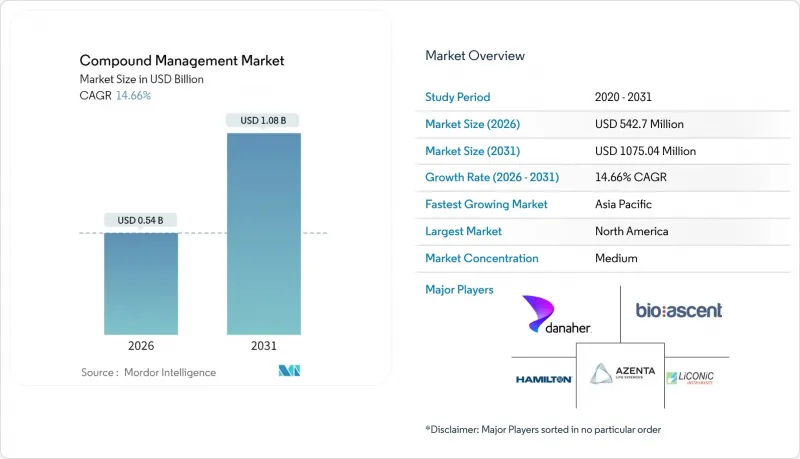
화합물 관리 시장은 2025년 4억 7,332만 달러에서 2026년에는 5억 4,270만 달러로 성장하고, 2026-2031년 CAGR 14.66%로 성장을 지속하여, 2031년까지 10억 7,504만 달러에 이를 것으로 예측되고 있습니다.
수요는 신약개발 프로세스 가속화, AI 기반 스크리닝 시스템, 샘플 처리 능력 향상, 자동화된 콜드체인 관리에 대한 규제 강화에 대한 기대에 의해 주도되고 있습니다. 대형 제약사들은 자사 소유의 화합물 라이브러리를 보호하기 위해 사내 자동화 보관소를 도입하는 것을 우선순위로 삼고 있습니다. 한편, 중소 바이오기업은 세포 및 유전자 치료 샘플을 관리하는 전문 바이오 리포지토리를 채택하고 있습니다. 생물학적 제제 파이프라인의 확대, 실험실 로봇 기술에 대한 벤처 자금 증가, 운영 비용 절감을 위한 에너지 절약형 자동화 기술이 화합물 관리 시장의 성장을 더욱 촉진하고 있습니다. 이러한 요소들이 결합되어 샘플 보관은 단순한 실험실 작업에서 데이터 분석 및 품질 설계(QbD) 워크플로우와 긴밀하게 연계된 전략적 역량으로 변모하고 있습니다.
고함량 스크리닝 시스템은 현재 머신러닝 알고리즘을 자동화 스토리지에 직접 연결하여 연간 수백만 개의 플레이트가 실시간으로 수집되어 과거 발견을 지연시켰던 수동 개입 지점을 제거할 수 있게 되었습니다. 통합을 위해서는 강력한 시료 추적, 저온 로봇 공학, 분석 엔진에 지연 없이 데이터를 공급하는 데이터 파이프라인이 필요합니다. 제약사 R&D 부서는 이러한 폐쇄형 워크플로우를 위양성을 최소화하면서 리드 최적화 주기를 단축할 수 있는 수단으로 인식하고 있습니다. 단품 냉동고가 아닌 통합된 하드웨어-소프트웨어 생태계를 제공할 수 있는 벤더가 경쟁 우위를 점할 수 있습니다. AI가 성숙함에 따라 확장 가능한 화합물 라이브러리에 대한 수요가 증가하여 상온에서 영하 190℃까지 다층 및 고밀도 스토리지의 지속적인 구매를 지원하고 있습니다.
세포-유전자치료제 후보물질은 -190℃에 이르는 극저온 보관과 연방규정집 21편 1271.260조에 따른 관리기록(엄격한 온도대 및 오염방지 조치 의무화)이 요구됩니다. 액체 질소를 통한 이중화 기능을 갖춘 자동화 스토리지는 시료의 생존성을 보호하고, 통합 모니터링 시스템은 감사 가능한 온도 기록을 제공합니다. 규제 당국의 감시가 강화됨에 따라 중단 없는 초저온 보존이 가능한 시스템에 대한 수요가 증가하고 있습니다. Phase III 파이프라인에서 대용량 생물학적 제제가 저분자 화합물을 추월하고 있으며, 스폰서 기업들은 자체 및 위탁 개발 제조 파트너의 저온 저장 용량을 확대해야 하는 상황에 직면해 있습니다. 복잡한 치료법의 등장으로 첨단 치료법 공급망의 기본 요소로서 화합물 관리 시장의 역할이 더욱 중요해지고 있습니다.
-80℃ 또는 액체 질소 환경에서 수백만 개의 바이알을 보관할 수 있는 종합적인 설비를 갖추기 위해서는 1곳당 1,000만 달러 이상의 초기 투자가 필요합니다. 비용은 스테인리스 스틸 랙, 로봇 시스템, 이중화 냉각장치, 클린룸 설비까지 포함됩니다. 운영 비용에는 모니터링, 교정, 비상용 발전기, 정기적인 검증이 포함되며, 이 모든 것이 초기 단계의 바이오테크 기업의 예산을 압박합니다. 따라서 많은 혁신 기업들은 외부 위탁을 선택하지만, 이러한 선택은 자사 라이브러리에 대한 직접적인 관리를 제한할 수 있습니다. 자본의 장벽으로 인해 보급이 늦어지고, 화합물 관리 시장에는 이중 구조가 생겨나고 있습니다. 즉, 자원이 풍부한 제약 그룹은 사내 자동화를 완전히 도입하는 반면, 소규모 기업은 제3자 보관소에 의존하는 구조입니다.
2025년 기준, 자체 소유 인프라(자체 라이브러리를 직접 관리할 수 있는 제품)가 전체 제품의 72.64%를 차지했습니다. 자동화 저장 시스템, 액체 처리 로봇, 통합 시료 추적 모듈이 가장 큰 자본 지출을 차지합니다. 한편, 서비스 분야는 더욱 빠르게 확대될 것으로 예측됩니다. 소규모 생명공학 기업은 대규모 설비 도입 자금이 부족하고, GMP에 부합하는 보관 환경이 필요하기 때문입니다. 이러한 변화는 견조한 하드웨어 수요와 함께 2026년부터 2031년까지 서비스 분야의 화합물 관리 시장 규모가 16.07%로 꾸준히 확대될 것임을 보여줍니다.
턴키 솔루션에 대한 수요가 증가함에 따라 기존의 두 카테고리의 경계가 모호해지고 있습니다. 제조업체들은 지속적인 유지보수, 소프트웨어 업데이트, 원격 모니터링을 하나의 계약으로 통합한 구독 패키지를 제공하는 것을 확대하고 있습니다. 이를 통해 하드웨어 공급자는 지속적인 수익원을 확보할 수 있고, 고객은 예측 가능한 운영 예산을 확보할 수 있는 하이브리드 모델을 구현할 수 있습니다. 이러한 융합을 통해 완전 관리형 서비스는 파이프라인이 성숙된 후 자체 자산으로 전환하는 기업에게 진입장벽으로 자리매김하고 있습니다.
화학 라이브러리는 발견 프로그램의 핵심으로, 2025년 51.04%의 점유율을 차지할 것으로 예측됩니다. 수십년동안 축적된 저분자 자산과 명확하게 정의된 보관 프로토콜은 -20℃에서 -80℃까지 운영되는 자동화된 저장고에 유리하게 작용합니다. 그러나 가장 빠른 성장은 단클론 항체, 세포치료제, mRNA 기반 백신에 사용되는 바이오 샘플에서 발생하고 있습니다. 이러한 고부가가치 재료에 대한 저온 저장에 대한 수요는 로봇 회수 기능을 갖춘 액체 질소 캐비닛에 새로운 수익원을 가져다 줄 것입니다. 바이오 시료용 화합물 관리 시장 점유율은 2031년까지 연평균 복합 성장률(CAGR) 15.72%로 가장 높은 성장률을 보일 것으로 예측됩니다.
연구 개발 기관에서는 생물학적 무결성을 유지하고 동결융해 사이클을 최소화하기 위해 고밀도 저산소 환경을 도입하고 있습니다. 최근 설치 사례에서는 384 튜브 랙과 로봇 암을 결합하여 전 분석 단계의 오류를 줄이고, 연속적인 바이오프로세스 스케줄에 대응하기 위해 24시간 365일 가동이 가능한 시스템을 구축하였습니다. 이는 처리 능력의 향상으로 인해 정밀한 온도 모니터링과 강력한 정보 관리에 대한 수요가 증가하여 하드웨어 및 소프트웨어 공급업체 모두에게 잠재적인 시장이 확대되고 있습니다.
북미는 집중된 제약 R&D 비용, 전자 기록에 대한 명확한 규제 지침, 차세대 실험실 자동화에 자금을 지원하는 벤처 캐피탈 생태계를 배경으로 2025년 40.80%의 가장 높은 수익을 창출할 것으로 예측됩니다. FDA의 감독으로 인해 스폰서들은 통합된 감사 대응 플랫폼을 요구하고 있으며, 종합적인 하드웨어 및 소프트웨어 제품군에 대한 수요가 증가하고 있습니다. 성숙한 콜드체인 물류는 자체 보관과 외부 위탁보관을 모두 지원하고 있으며, 이 지역의 화합물 관리 시장 규모는 세계 최대 규모를 유지하고 있습니다.
아시아태평양은 2031년까지 연평균 복합 성장률(CAGR) 17.16%로 가장 빠르게 성장하는 지역으로, 첨단 치료제의 제조를 국산화하고 의약품 승인 절차를 단축하려는 국가 정책에 힘입어 성장하고 있습니다. 중국에서 진행 중인 규제 개혁은 국내 생명공학 기업들이 국제 우수의약품 제조 및 품질관리기준(GMP) 요건을 준수하는 자동화 창고에 대한 투자를 촉진하고 있습니다. 일본, 한국, 인도에서는 백신, 세포치료제 등 극저온 저장 솔루션을 필요로 하는 바이오 의약품 개발 파이프라인이 강화되고 있습니다. 지역 공급업체들은 역량 강화에 힘쓰고 있지만, 많은 프로젝트가 여전히 수입 시스템에 의존하고 있어 기존 세계 공급업체에 대한 기회가 확대되고 있습니다.
유럽은 엄격한 데이터 보호법과 야심찬 탄소 감축 목표를 배경으로 수요의 상당 부분을 차지하고 있습니다. 제조업체는 에너지 절약형 냉동 기술, 자연 냉매 대체품, GDPR(EU 개인정보보호규정)을 준수하는 폐쇄형 루프 자산 추적 소프트웨어로 대응하고 있습니다. 중동, 아프리카 및 남미는 다국적 기업들이 2차 생산기지를 설립하는 신흥 성장 지역이지만, 한정된 자본 예산과 기술력의 편차로 인해 도입이 억제되고 있습니다. 그러나 단계적인 인프라 구축과 정부 지원의 혁신 허브가 보급을 촉진하여 복합관리 시장에 점진적인 성장을 가져올 것입니다.
The Compound Management market is expected to grow from USD 473.32 million in 2025 to USD 542.7 million in 2026 and is forecast to reach USD 1075.04 million by 2031 at 14.66% CAGR over 2026-2031.
Demand is powered by accelerated drug-discovery timelines, AI-enabled screening systems that generate higher sample throughput, and stricter regulatory expectations for automated cold-chain compliance. Large pharmaceutical companies are prioritizing in-house automated stores to safeguard proprietary compound libraries while smaller biotechnology firms adopt specialized biorepositories to manage cell- and gene-therapy samples. Expansion of biologics pipelines, growing venture funding for laboratory robotics, and energy-efficient automation that lowers operating costs are further supporting momentum in the compound management market. Together, these forces are transforming sample storage from a discrete laboratory task into a strategic capability tightly integrated with data analytics and quality-by-design workflows.
High-content screening systems now link machine-learning algorithms directly to automated storage, enabling real-time retrieval of millions of plates annually and removing manual intervention points that once slowed discovery. Integration requires robust sample tracking, low-temperature robotics, and data pipelines that feed analysis engines without latency. Pharmaceutical R&D groups view these closed-loop workflows as a way to shorten lead-optimization cycles while minimizing false positives. Vendors able to supply integrated hardware-software ecosystems rather than standalone freezers gain competitive advantage. As AI matures, demand for scalable compound libraries rises, underpinning sustained purchases of multi-tier, high-density stores from ambient to -190 °C.
Cell- and gene-therapy candidates require cryogenic storage reaching -190 °C and chain-of-custody documentation governed by Title 21 CFR 1271.260, which mandates strict temperature bands and contamination safeguards. Automated stores equipped with liquid-nitrogen redundancy protect sample viability while integrated monitoring delivers audit-ready temperature logs. As regulators increase oversight, demand for systems capable of uninterrupted ultra-low storage escalates. Large-volume biologics now outpace small molecules in phase-III pipelines, pushing sponsors to expand cryostorage capacity both in house and at contract development and manufacturing partners. The rise of complex modalities therefore magnifies the role of the compound management market as a foundational element of advanced-therapy supply chains.
Comprehensive installations capable of holding millions of vials under -80 °C or liquid-nitrogen conditions demand initial investments that can surpass USD 10 million per site. The expense spans stainless-steel racking, robotics, redundant refrigeration, and clean-room infrastructure. Operational costs add monitoring, calibration, backup generators, and routine validation, all of which strain the budgets of early-stage biotech firms. Many innovators therefore opt for outsourcing, but that choice can limit direct control over proprietary libraries. The capital hurdle slows universal adoption and yields a two-tier structure in the compound management market wherein resource-rich pharma groups deploy full in-house automation while smaller entities depend on third-party repositories.
Other drivers and restraints analyzed in the detailed report include:
For complete list of drivers and restraints, kindly check the Table Of Contents.
Products accounted for 72.64% in 2025 owned infrastructure that grants direct oversight of proprietary libraries. Automated storage systems, liquid-handling robots, and integrated sample-tracking modules account for the largest capital expenditures. In contrast, the services category is projected to expand more rapidly because smaller biotechnology companies lack the funds for large-scale installations yet still require GMP-compliant storage. The shift illustrates how the compound management market size for services will climb with 16.07% between 2026 -2031 steadily alongside robust hardware demand.
Demand for turnkey solutions is blurring traditional lines between the two categories. Manufacturers increasingly provide subscription packages that fold continuous maintenance, software updates, and remote monitoring into a single contract. Hybrid models therefore enable hardware providers to capture recurring revenue streams while clients enjoy predictable operating budgets. This convergence positions fully managed offerings as a gateway for firms that will later migrate to owned assets once pipelines mature.
Chemical libraries continue to anchor discovery programs, explaining their leading share of 51.04% in 2025. Decades of accumulated small-molecule assets and well-defined storage protocols favor automated stores that operate between -20 °C and -80 °C. Yet the fastest growth arises from biosamples used in monoclonal antibodies, cell therapies, and mRNA-based vaccines. Cryostorage requirements for these high-value materials create fresh revenue pools for liquid-nitrogen cabinets equipped with robotic retrieval. The compound management market share for biosamples is therefore set to climb exhibit the fastest rise at an 15.72% CAGR through 2031.
R&D organizations are deploying high-density, low-O2 environments to maintain biological integrity and minimize freeze-thaw cycles. Recent installations couple 384-tube racks with robotic arms that reduce preanalytical errors and run 24/7 to match continuous bioprocessing schedules. The resulting increase in throughput heightens demand for precision temperature monitoring and robust information management, expanding the addressable base for hardware and software suppliers alike.
The Compound Management Market Report is Segmented by Type (Products [Automated Compound/Sample Storage Systems, and More], Services), Sample Type (Chemical Compounds, Biosamples), Application (Drug Discovery, Gene Synthesis, and More), End User (Pharmaceutical Companies, and More), and Geography (North America, Europe, Asia Pacific, Middle East & Africa, South America). The Market Forecasts are Provided in Terms of Value (USD).
North America generated the highest revenue with 40.80% in 2025 on the back of concentrated pharmaceutical R&D spend, clear regulatory guidance on electronic records, and a venture-capital ecosystem that funds next-generation laboratory automation. FDA oversight pushes sponsors toward integrated, audit-ready platforms, reinforcing demand for comprehensive hardware-software suites. Mature cold-chain logistics support both in-house and outsourced storage, ensuring the compound management market size in the region remains the largest worldwide.
Asia Pacific is the fastest-growing territory with CAGR 17.16% through 2031, propelled by national policies that seek to localize advanced-therapy manufacturing and shorten drug-approval timelines. China's ongoing regulatory reforms encourage domestic biotechs to invest in automated stores that align with global good-manufacturing-practice requirements. Japan, South Korea, and India are strengthening biopharmaceutical pipelines that increasingly include vaccines and cell therapies, both of which require cryogenic storage solutions. Regional suppliers are stepping up capabilities, yet many projects still rely on imported systems, expanding opportunities for established global vendors.
Europe holds a sizable portion of demand underpinned by rigorous data-protection laws and ambitious carbon-reduction targets. Manufacturers respond with energy-efficient refrigeration, natural-refrigerant alternatives, and closed-loop asset-tracking software that complies with GDPR. Middle East & Africa as well as South America represent emerging pockets of growth where multinational firms place secondary manufacturing sites, although adoption is tempered by limited capital budgets and patchy technical skills. Nevertheless, gradual infrastructure upgrades and government-backed innovation hubs will broaden uptake and contribute incremental gains to the compound management market.