



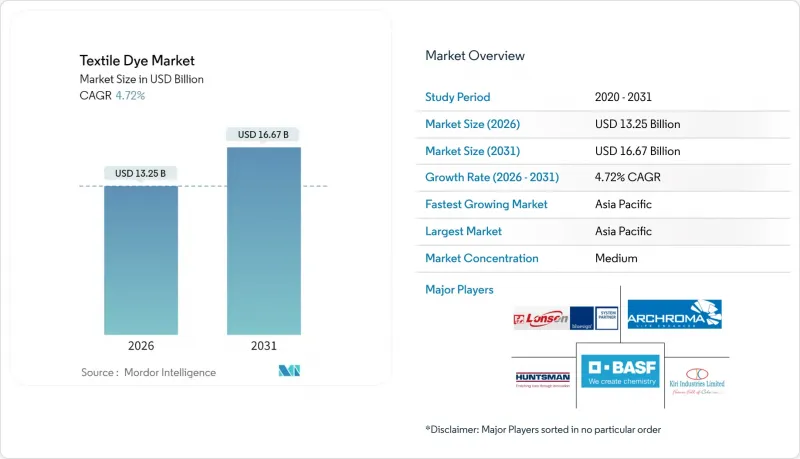
섬유용 염료 시장은 2025년에 126억 5,000만 달러로 평가되었고, 2026년 132억 5,000만 달러에서 2031년까지 166억 7,000만 달러에 이를 것으로 예측됩니다.
예측 기간(2026-2031년)의 CAGR은 4.72%로 예상됩니다.

패스트 패션의 생산량 증가, 온디맨드 디지털 인쇄의 보급 확대, 브랜드의 지속가능성 목표 강화, 천연 및 합성 염료 시스템 모두에 대한 수요가 강화되고 있습니다. 한편, 지속적인 산업 구조조정으로 인해 주요 공급업체들은 환경 친화적인 화학 기술에 투자할 수 있는 규모를 확보했습니다. 폴리에스터 가공에서 높은 평가를 받고 있는 분산형 염료는 2024년 염료 유형별 점유율 32.08%로 1위를 유지하며, 고온 가공에서 높은 효율성의 이점을 계속 누리고 있습니다. 아시아태평양은 생산 거점으로서의 지위를 유지하고 있습니다. 중국, 인도, 베트남의 정부 지원 프로그램과 전자상거래 중심의 소량 주문이 맞물려 생산 능력 확대가 활발하게 진행되고 있습니다. 한편, EU와 미국의 폐수 규제는 폐쇄 루프 시스템 및 바이오 염료로의 전환을 가속화하고 있으며, 향후 디지털 제품 여권 요건에 따라 보다 친환경적인 화학 물질에 대한 인증을 획득할 수 있는 공급업체에게 단기적인 기회를 창출하고 있습니다.
패스트 패션 브랜드는 수집 주기를 단축하고 중국, 인도, 베트남의 방적 공장에 대해 대량 생산에서도 품질 요구 사항을 충족하는 고속 염색 및 마무리 라인의 통합을 추진하고 있습니다. 중국만 해도 2025년까지 섬유 산업의 70%를 디지털화하는 것을 목표로 하고 있습니다. 인도에서는 생산연계형 인센티브와 신규 통합단지를 통해 섬유-인쇄-염색 설비에 726억 루피를 투입하여 원자재 수입을 줄이고 소비자 트렌드에 대한 대응 시간을 단축하고 있습니다. 베트남은 2025년까지 섬유 수출 480억 달러 달성을 목표로 비용 효율적인 폴리에스테르 프로그램을 확대합니다. 빠른 색상 전환이 가능한 분산계 화학물질을 우선적으로 사용하며, 전 세계 바이어의 요구에 대응하고 있습니다.
스크린, 판, 잉여액이 필요 없는 디지털 장비는 선명한 소량 생산을 실현하고, 로터리 공정에 비해 최대 95%의 물 절약 효과를 가져옵니다. 이에 따라 섬유용 염료 시장에서는 산업용 속도로 안정적으로 분사할 수 있는 고순도 마이크로 캡슐화 분산 염료 및 반응성 잉크에 대한 수요가 증가하고 있습니다. 자동차 및 항공우주 제조업체는 의류 브랜드와 마찬가지로 정확한 색상 매칭과 최소한의 무게 증가를 필요로 하는 디지털 인쇄 테크니컬 텍스타일를 시험적으로 도입하기 시작했습니다. 이는 기존 일괄 염색으로는 충분히 충족되지 않았던 틈새 시장입니다.
EU의 에코 디자인 규정은 2025년부터 2030년까지의 작업 계획에서 섬유 제품을 우선순위로 삼고 있으며, 공장에 화학물질 사용량 기록, 제품 수명 연장, 섬유 회수 등을 의무화하고 있습니다. 프랑스의 PFAS 금지 조치는 이러한 정책 추진을 더욱 강화하는 것입니다. 마찬가지로, 캘리포니아 주 SB 707 법안은 미국 생산자에게 제품 수명 종료 시 회수 비용을 부담하도록 의무화하고 있으며, 폐쇄형 루프 인프라가 성숙할 때까지 비용 압박이 가중되고 있습니다.
분산형 화학물질은 2025년 섬유용 염료 시장의 31.34%를 차지할 것으로 예상되며, 폴리에스테르 소재의 지속적인 인기에 힘입어 2031년까지 연평균 5.44%의 성장률을 나타낼 것으로 예측됩니다. 합성섬유용 염료 시장에서 분산형 화학물질은 물에 녹지 않는 특성으로 120-130℃에서 빠르게 확산되어 선명한 색상과 높은 습윤 견뢰도를 구현합니다. 현재 공급업체는 제품을 E, SE, S, S, P, RD 시리즈로 분류하여 균일성, 승화, 빠른 배치 처리 등의 목적에 대응하고 있습니다. 한편, 히드라지드 히드라존아조 구조의 조사는 더 낮은 pH 범위에서 더 높은 발색 강도를 실현할 수 있는 가능성을 가지고 있습니다. 반응성 염료계는 면 소재에서 중요한 역할을 유지하고 있으며, 단일 및 다중 앵커 화학을 이용한 공유결합 고정으로 가정용 세탁 내구성 기준을 충족합니다. 개트 염료와 유황 염료는 틈새 시장이지만, 극한 기후에서 판매되는 작업복 등 최고 수준의 내광성이 요구되는 상황에서는 필수적입니다.
2세대 분산 염료 등급은 초임계 CO2 염색 및 디지털 제트식 고형분 잉크와 같은 무수 공정에 대한 노력도 지원하고 있습니다. 모두 낮은 공정액비를 우선시하는 기술입니다. 이러한 혁신 기술의 조합은 패션, 레저, 테크니컬 섬유 분야에서의 보급을 촉진하고 섬유용 염료 시장에서 분산화학의 선도적 지위를 더욱 공고히 하고 있습니다.
아시아태평양은 2025년 세계 섬유용 염료 시장의 49.10%를 차지할 것으로 예상되며, 중국의 디지털 공장 추진과 인도의 450억 달러 규모의 수출 목표에 힘입어 2031년까지 연평균 복합 성장률(CAGR) 5.58%의 가장 빠른 성장세를 유지할 것으로 전망됩니다. 정부 지원 산업단지에서는 염색, 인쇄, 마무리 공정을 통합하여 공급망을 단축하고 있습니다. 한편, 베트남의 수출 목표는 대형 스포츠웨어 수주를 둘러싼 지역 내 경쟁이 심화되고 있습니다. 정제된 테레프탈산과 모노에틸렌글리콜의 현지 조달은 분산 염료 제조업체를 지원하며, 전 세계 운송 혼란 속에서도 원료 공급의 연속성을 보장하고 있습니다.
유럽의 규제 태도는 수요 구조를 재구성하고, 투명성, 추적성, 저위험성을 갖춘 염색 시스템으로 구매자의 전환을 촉진하고 있습니다. 2030년까지 도입 예정인 디지털 제품 패스포트와 PFAS 프리 의무화로 인해 방적공장은 보조제 감사, 이온 교환 폐수 처리 투자, 다운스트림 공정에서 배출을 최소화하는 도프 염색 솔루션을 채택해야할 것입니다. 이탈리아와 프랑스의 고급품 거점에서는 이러한 변화를 활용해 지속가능한 염색을 통한 프리미엄 컬렉션을 시장에 출시하고 있습니다. 한편, 스칸디나비아의 소매업체들은 기계적, 화학적 재활용 섬유를 순환형 염색 공정에 통합하는 회수 프로그램을 시범 운영하고 있습니다.
북미에서도 비슷한 움직임을 볼 수 있습니다. 캘리포니아주 SB707 법은 미국 최초의 확대 생산자 책임 제도를 확립하고, 노스캐롤라이나 주에서 2025년 중반 가동 예정인 셀레니스와 사이아의 폴리에스테르 재활용 사업 등 협력을 촉진하고 있습니다. 동시에, 아치 로마가 사우스캐롤라이나 주에 75만 달러를 투자하는 확장 계획은 특정 아조 중간체에 대한 수입 의존도가 감소하는 가운데 특수 제제의 지역 접근성을 확보하기 위한 리쇼어링 추세를 강조하고 있습니다. 이 지역은 생산량에서 아시아에 비해 뒤쳐져 있지만, 고부가가치 부문과 엄격한 규정 준수 요구사항이 결합되어 혁신적인 공급업체에게 매력적인 수익률을 제공합니다.
The Textile Dye Market was valued at USD 12.65 billion in 2025 and estimated to grow from USD 13.25 billion in 2026 to reach USD 16.67 billion by 2031, at a CAGR of 4.72% during the forecast period (2026-2031).
Rising fast-fashion output, wider adoption of on-demand digital printing, and stricter brand sustainability targets are strengthening demand across both natural and synthetic colorant systems, while ongoing consolidation gives large suppliers the scale needed to invest in lower-impact chemistries. Dispersive formulations, prized for polyester processing, held the largest dye-type share at 32.08% in 2024 and continue to benefit from high-temperature application efficiency. Asia-Pacific remains the production hub: supportive government programs in China, India and Vietnam converge with e-commerce-led small-lot orders to keep capacity additions brisk. At the same time, EU and US effluent rules are accelerating the shift toward closed-loop systems and bio-based shades, creating near-term opportunities for suppliers able to certify greener chemistries under future Digital Product Passport requirements.
Fast-fashion brands have shortened collection cycles and pushed mills in China, India and Vietnam to integrate high-speed dyeing and finishing lines that meet quality expectations at volume; China alone seeks 70% digitalization of its textile businesses by 2025. Indian production-linked incentives and new integrated parks allocate INR 726 crore for combined weaving, printing and dyeing assets that trim raw-material imports and tighten response times to consumer trends. Vietnam, targeting USD 48 billion in textile exports by 2025, is scaling cost-effective polyester programs that favor dispersive chemistries capable of rapid color changeovers to serve global buyers.
Eliminating screens, plates and excess liquor, digital equipment supports vivid short-run designs and drops water use by as much as 95% compared with rotary workflows. The textile dyes market is therefore seeing incremental demand for high-purity, micro-encapsulated dispersive and reactive inks that jet reliably at industrial speeds. Automotive and aerospace makers have joined apparel brands in piloting digitally printed technical textiles that require exact color matches and minimal weight gain, a niche previously underserved by traditional batch dyeing.
The EU Ecodesign regulation prioritizes textiles in its 2025-2030 workplan, compelling mills to document chemical inputs, extend product life and recover fibers, with PFAS bans in France reinforcing the policy push. California's SB 707 similarly obliges US producers to finance end-of-life collection, adding cost pressure until closed-loop infrastructure matures.
Other drivers and restraints analyzed in the detailed report include:
For complete list of drivers and restraints, kindly check the Table Of Contents.
Dispersive chemistries accounted for 31.34% of the textile dyes market in 2025 and are forecast to rise at 5.44% CAGR through 2031 on the back of polyester's continued popularity. Within the textile dyes market size for colorants applied to synthetics, their water-insoluble nature enables rapid diffusion at 120-130 °C, delivering bright shades and high wet-fastness. Suppliers now segment offerings into E-, SE-, S-, P- and RD-series to target leveling, sublimation or rapid batch objectives, while research into hydrazide-hydrazone azo structures promises even higher color strength at lower pH windows. Reactive systems retain critical roles in cotton, leveraging mono- and multi-anchor chemistry to achieve covalent fixation that passes home-laundry durability standards. Vat and sulfur options remain niche but indispensable where maximum light fastness is mandated, for example on workwear sold into extreme climates.
Second-generation dispersive grades also anchor the drive toward water-free routes such as super-critical CO2 dyeing and digitally jetted high-solids inks, both prioritizing low process-liquor ratios. Combined, these innovations support broader adoption across fashion, athleisure and technical textiles, reinforcing the leadership position of dispersive chemistry in the textile dyes market.
The Textile Dyes Market Report is Segmented by Dye Type (Reactive, Dispersive, Direct, Vat, Acidic, Basic, Other Dye Types), Fiber Type (Cotton, Polyester, Nylon, Wool, Acrylic, Viscose, Other Fiber Types), Application (Apparel, Household Textiles, Industrial Fabrics, Other Applications), and Geography (Asia-Pacific, North America, Europe, and More). The Market Forecasts are Provided in Terms of Value (USD).
Asia-Pacific contributed 49.10% of the global textile dyes market in 2025 and is on track to sustain the fastest 5.58% CAGR through 2031, powered by China's digital-factory push and India's USD 45 billion export ambition. Government-backed parks integrate dyeing, printing and finishing to shorten supply chains, while Vietnam's export targets intensify regional rivalry for large sportswear orders. Local access to purified terephthalic acid and mono-ethylene glycol supports dispersed-dye producers, ensuring raw-material continuity despite global shipping disruptions.
Europe's regulatory stance reshapes demand, steering buyers toward transparent, traceable and low-hazard colorant systems. The upcoming Digital Product Passport and a PFAS-free mandate by 2030 will force mills to audit auxiliaries, invest in ion-exchange effluent treatment and adopt dope-dyed solutions that minimize downstream releases. Luxury hubs in Italy and France leverage these changes to market premium sustainably dyed collections, while Scandinavian retailers pilot take-back programs that feed mechanically and chemically recycled fibers into circular dyeing loops.
North America is moving in parallel: California's SB 707 establishes the first US extended-producer system, catalyzing alliances such as the Selenis-Syre polyester recycling venture in North Carolina set for mid-2025 start-up. Concurrently, Archroma's USD 750,000 South Carolina expansion underlines the reshoring trend, ensuring regional access to specialty formulations as import reliance on certain azo intermediates diminishes. While the region sits behind Asia on volume, higher added-value segments and stricter compliance requirements translate to attractive margins for innovative suppliers.