



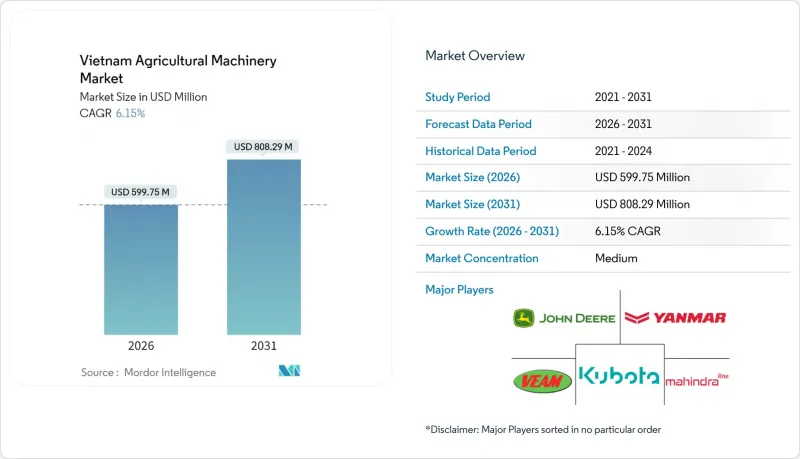
2026년 베트남의 농기계 시장 규모는 5억 9,975만 달러로 추정되며, 2025년 5억 6,500만 달러에서 성장이 전망됩니다.
2031년까지 8억 829만 달러에 달할 것으로 예상되며, 2026년부터 2031년까지 연평균 6.15%의 성장률을 나타낼 것으로 전망됩니다.

정부의 기계화 추진 정책, 농촌 노동력 감소 추세, 대출 옵션의 개선이 시장 성장을 견인하고 있습니다. 시장 확대는 트랙터의 잦은 교체, 고품질 쌀 백만 헥타르 계획을 통한 정밀 재배 장비의 도입 확대, 종합적인 애프터서비스에 의해 뒷받침되고 있습니다. 지속적인 성장은 미국 수출 수익 증가, 협동조합형 기계 공유 시스템 보급 확대, 농촌 전기화 사업 등에 힘입어 더욱 탄력을 받고 있습니다. 전기자동차, 자율주행 농업용 로봇, 데이터 기반 농업 솔루션에서 시장은 큰 잠재력을 보여주고 있습니다. 업계는 이러한 기존 기업들에 의해 중간 정도의 집중도를 유지하고 있습니다.
베트남의 농업 노동력은 젊은 층이 도시로 이주하는 경향이 지속되는 가운데 고령화된 생산자층만 남아있는 상황입니다. 이러한 인구통계학적 변화로 인해 벼농사, 과수재배, 산업용 작물 시스템 전반에 걸쳐 기계화에 대한 수요가 증가하고 있습니다. 농지의 집약화가 진행되면서 트랙터, 수확기, 기계식 이앙기의 경제적 도입 가능성이 높아지고 있습니다. 계절근로자 인건비 상승은 특히 성수기인 파종 및 수확기에 농가의 수익률에 영향을 미치고 있습니다.
베트남 정부는 재정적 인센티브와 정책 개혁을 통해 농업 기계화를 지원하고 있습니다. 농가는 저금리 융자, 세제 혜택, 시범농장 이용, 현대식 설비 도입이 촉진되고 있습니다. 2025년 2월에 설립된 농업환경부는 농업 및 농촌 부문의 조정과 효율성 향상을 목표로 하고 있습니다. 지방의 스마트팜에서는 자동관개시스템과 토양분석시스템의 효과가 입증되고 있습니다. 농가들은 보조금 지원과 저금리 대출을 통해 노후화된 농기계를 교체할 수 있게 되었고, 첨단 농기계에 대한 접근성 확대가 촉진되고 있습니다.
베트남의 농업은 소규모 농가가 주류를 이루고 있어 기계화의 경제성이 제한되어 있습니다. 농가의 70%가 0.5헥타르 미만의 농지에서 농사를 짓고 있어 기계 투자 회수율이 낮습니다. 세분화된 농지는 트랙터의 효율을 떨어뜨리고, 여러 농지에서 농기계의 사용을 복잡하게 만들고 있습니다. 토지 통합 개혁은 초기 단계에서는 유망하지만, 조상 대대로 내려오는 토지에 대한 문화적 유대가 그 진전을 늦추고 있습니다. 협동조합 모델과 맞춤형 렌탈 서비스는 자원 공유를 통해 부분적인 해결책을 제공하지만, 그 효과는 강력한 거버넌스와 조정력에 달려있습니다. 통합이 더 광범위하게 확산되고 서비스 생태계가 성숙하기 전까지는 세분화가 농업 기계 도입에 계속 방해가 되어 생산성 향상과 부문 변화를 제한할 것입니다.
트랙터 부문은 베트남 농업 기계 시장 규모의 54.40%를 차지하며 토지 준비, 운송 및 잔재물 관리에서 중요한 기능을 수행합니다. 이 부문의 중요성은 국가의 기계화 목표 및 높은 토지 정비 기계화율과 일치합니다. 소형 트랙터는 여전히 세분화된 북부 농지에서는 여전히 널리 보급되어 있지만, 중형 모델은 통합된 남부 농업 지역에서는 점점 더 많이 사용되고 있습니다. 사륜구동 시스템과 정밀 조향 기능의 통합은 종종 기존 장비에 대한 개조로 강력한 교체 수요를 유지하고 있습니다. 트랙터는 다양한 지리적 조건과 농장 구조에 대응하여 베트남의 기계화 농업 운영에 있어 여전히 기본이 되고 있습니다.
모내기 기계 부문은 농부들이 수작업으로 벼를 파종하던 방식에서 드릴 파종기나 이앙기로 전환하는 움직임에 따라 7.55%의 연평균 복합 성장률(CAGR)로 가장 높은 성장률을 보이고 있습니다. 이러한 기술은 발아율을 향상시키고 종자 소비를 줄이며, 특히 농업 협동조합에 도움이 될 수 있습니다. 효율적인 투입재 사용을 촉진하는 국가 정책에 힘입어 식재 장비 시장 점유율이 확대될 것으로 예측됩니다. 수확기계 부문은 농업 노동력 부족과 곡물 품질 기준 강화로 인해 꾸준한 성장세를 유지하고 있습니다. 목초 및 사료용 장비 부문은 북부 고원지대의 축산 경영을 지원하고 있습니다. 시장에서는 드론과 자율 로봇을 투입하고 자본 요구 사항을 줄이는 서비스 기반 모델을 도입하는 기업들이 '기타 제품 유형' 카테고리에 진입하고 있으며, 이는 농업 자동화의 미래 트렌드를 보여주고 있습니다. 쿠보타의 다목적 플랫폼 로봇은 한 번의 작업으로 여러 기능을 수행할 수 있는 멀티 롤 자동화의 선구자 역할을 하고 있습니다.
The Vietnam agricultural machinery market size in 2026 is estimated at USD 599.75 million, growing from 2025 value of USD 565 million with 2031 projections showing USD 808.29 million, growing at 6.15% CAGR over 2026-2031.
Government mechanization initiatives, decreasing rural workforce availability, and improved financing options drive market growth. The market expansion is supported by frequent tractor upgrades, increased adoption of precision planting equipment through the "One Million Hectares of High-Quality Rice" program, and comprehensive after-sales services. The market's sustained growth is further supported by increased rice export revenues, growing adoption of cooperative machinery-sharing systems, and rural electrification programs. The market shows significant potential in electric vehicles, autonomous farming robots, and data-driven agricultural solutions. The industry remains moderately concentrated under these established companies.
Vietnam's agricultural labor force continues to decline as younger generations migrate to urban areas, leaving an aging population of growers. This demographic shift increases the demand for mechanization across rice, fruit, and industrial crop systems. The consolidation of agricultural land makes tractors, harvesters, and mechanical planters more economically viable. Increasing seasonal labor costs impact farm margins, particularly during peak planting and harvesting periods.
The Vietnamese government supports agricultural mechanization through financial incentives and policy reforms. Farmers receive soft loans, tax relief, and access to demonstration farms to encourage the adoption of modern equipment. The establishment of the Ministry of Agriculture and Environment in February 2025 aims to enhance coordination and efficiency in the agriculture and rural sector.Provincial smart farms demonstrate the effectiveness of automated irrigation and soil analytics systems. Farmers can access subsidized credit lines and reduced interest rates to replace outdated machinery, facilitating broader access to advanced agricultural equipment.
Vietnam's agricultural landscape is dominated by small farms, which limits the economic viability of mechanization. Seventy percent of farms operate on less than 0.5 hectares, weakening machinery payback ratios. The fragmented plots reduce tractor efficiency and complicate implement usage across multiple fields. While land consolidation reforms show early promise, cultural ties to ancestral land slow progress. Cooperative models and custom hire services offer partial solutions through resource pooling, but their effectiveness depends on strong governance and coordination. Until consolidation becomes more widespread and service ecosystems mature, fragmentation will continue to hinder agricultural machinery adoption, limiting productivity gains and sector transformation.
Other drivers and restraints analyzed in the detailed report include:
For complete list of drivers and restraints, kindly check the Table Of Contents.
The tractor segment accounts for 54.40% of the Vietnam agricultural machinery market size, serving essential functions in land preparation, transportation, and residue management. The segment's prominence aligns with national mechanization objectives and high mechanized land preparation rates. While compact tractors remain prevalent in the fragmented northern farmlands, mid-range models see increasing adoption in the consolidated southern agricultural regions. The integration of four-wheel drive systems and precision steering capabilities, often as retrofits to existing equipment, maintains strong replacement demand. Tractors remain fundamental to Vietnam's mechanized farming operations, serving diverse geographical conditions and farm structures.
The planting machinery segment demonstrates the highest growth rate at 7.55% CAGR, as farmers transition from manual rice seed broadcasting to drill seeders and transplanters. These technologies improve germination rates and reduce seed consumption, particularly benefiting agricultural cooperatives. The market share for planting equipment is projected to increase, supported by national initiatives promoting efficient input usage. The harvesting machinery segment maintains steady growth due to agricultural labor shortages and stricter grain quality requirements. The haying and forage equipment segment supports livestock operations in the northern highlands. The market sees companies entering the other product types category with drones and autonomous robots, introducing service-based models that reduce capital requirements and indicate future trends in agricultural automation. Kubota's versatile platform robots preview multirole automation that can perform multiple functions in a single pass.
The Vietnam Agricultural Machinery Market Report is Segmented by Product Type (Tractors, Planting Machinery, Harvesting Machinery, Haying and Forage Machinery, and Other Product Types). The Market Forecasts are Provided in Terms of Value (USD).