



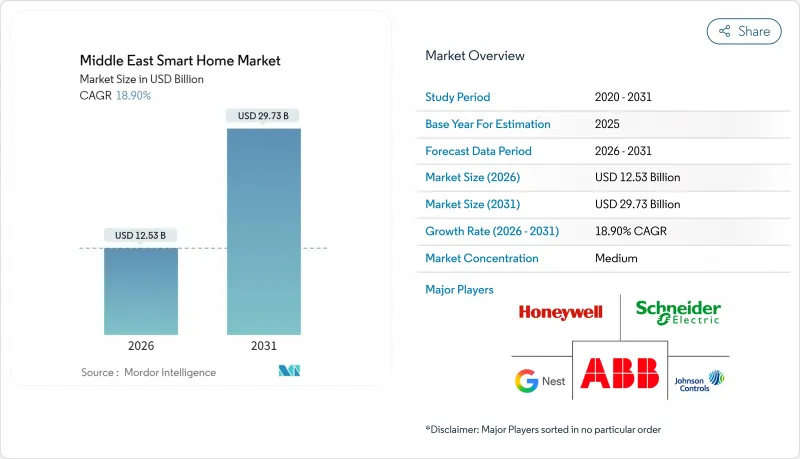
중동의 스마트 홈 시장은 2025년에 105억 4,000만 달러로 평가되었고, 2026년 125억 3,000만 달러, 2031년에는 297억 3,000만 달러에 이를 것으로 예측되고 있으며, 예측 기간(2026년-2031년) CAGR은 18.90%를 나타낼 전망입니다.
디지털 정부 프로그램의 가속화, 프리미엄 지향 소비자 부문 및 대규모 스마트 시티 프로젝트가 이 두 자리의 성장을 지원합니다. 사우디아라비아의 '비전 2030'과 걸프 협력 회의(GCC) 국가의 동등한 국가 의제는 지속 가능한 도시 개발에 중점을 두고 있으며, 공급업체는 주택 자동화 수요에 대한 장기적인 전망을 세울 수 있습니다. 고급 통신 서비스의 전개, 특히 전국적인 광섬유 및 5G의 보급은 대역폭 제약을 없애고 보다 풍부한 연결 장치 생태계를 가능하게 합니다. 국민과 주재원 모두의 가처분 소득의 높이는 프리미엄 가격대를 지원하고 있는 반면, 고급 부동산 개발자는 새로운 프로젝트를 차별화하기 위해 턴키 자동화 패키지를 번들하는 경향이 강해지고 있습니다. 한편, 보안을 최우선으로 하는 제품의 포지셔닝은 자산 보호를 우려하는 가구의 공감을 불러 일으키고, 감시 및 액세스 제어 솔루션을 초기 구매 리스트의 톱에 밀어 올려, 시간이 지나면서 생태계의 확대를 촉진하고 있습니다.
장기적인 국가 프로그램은 주택 계획의 의무 요건에 스마트 홈 고려 사항을 통합합니다. 사우디아라비아의 NEOM과 UAE의 스마트 지구 계획과 같은 기함 프로젝트는 고 대역폭의 마지막 마일 연결, On-Premise(On-premise) IoT 게이트웨이 및 수요 측 관리 플랫폼에 인프라 예산을 할당합니다. 이러한 공공 투자는 디바이스 사양과 설치 지침을 표준화함으로써 공급업체 진입을 용이하게 하고 조달량 확대를 통해 부품 비용의 급속한 저하를 촉진하고 있습니다. 비전 2030 프레임워크 내 지속가능성 목표는 에너지 효율적인 주택 설계를 명확하게 평가할 수 있도록 하고 있으며, 디바이스 제조업체는 자동화를 사치품이 아닌 규제 준수 지원으로 판매할 수 있습니다. 정부지원의 모델지구에 의한 실증효과는 주택 소유자의 인지를 가속화시키고 중동의 스마트 홈 시장을 지역 디지털 경제계획의 핵심 기둥으로 강화하고 있습니다.
걸프 지역의 통신 사업자는 거의 모든 가구를 커버하는 광섬유 네트워크를 정비하고 현재는 실내 이용 사례를 위해 저지연 5G를 단계적으로 도입하고 있습니다. 고정 무선 액세스 옵션에 의해 지금까지 전파 상황이 나빴던 교외의 별장에의 서비스 제공 범위가 확대. 이를 통해 시스템 통합자는 품질 보증의 제약 없이 멀티룸 모니터링 시스템과 몰입형 멀티미디어 솔루션을 제안할 수 있습니다. 네트워크 슬라이싱의 시험 운용에 의해 보안 기기나 생명 안전 장치용으로 격리된 가상 채널을 제공. 리스크 회피 지향의 구매층이 우려하는 신뢰성 문제에 대응하고 있습니다. 인터넷 서비스 제공업체가 제공하는 Wi-Fi 6E 라우터와 조합하는 것으로, 소비자는 밀집한 디바이스군을 눈에 띄는 지연없이 운용 가능. 연결성이 제약 요인이 없어진 것으로, 경쟁상의 차별화는 소프트웨어 기능의 깊이, 데이터 분석 대시보드, 사용자 체험 설계로 이행. 중동의 스마트 홈 시장 전체에서 프리미엄 서비스에 대한 수요를 강화하고 있습니다.
IoT 관련 보안 침해에 대한 보도가 꾸준히 증가하고 있기 때문에 소비자의 경계감이 높아지고 있습니다. 사우디아라비아와 아랍에미리트(UAE)(UAE) 양국의 연방 데이터 보호법은 보다 엄격한 동의 규칙을 부과하고 공급업체의 컴플라이언스 비용을 증가시키고 있습니다. 가정에서는 On-Premise에서의 데이터 보존과 다요소 인증의 요구가 증가하고 있어 신속한 플러그 앤 플레이 제안을 복잡화시키고 있습니다. 한때 상업 빌딩용이었던 엔터프라이즈급 암호화 기술이 현재는 부유층용 주택용으로 판매되고 있으며, 판매 사이클은 장기화하는 것, 평균 판매 가격도 상승하고 있습니다. 보안 중시의 자세는 단기적인 판매 수량을 억제하는 한편, 신뢰성이 높은 브랜드가 중동의 스마트 홈 시장에서 보다 높은 수익률을 확보하는 기반을 구축하고 있습니다.
보안시스템은 2025년 중동의 스마트 홈 시장 규모의 30.12%를 차지하며, 이 지역에서 자산보호와 프라이버시보호 우선순위가 높습니다. 수요의 중심은 게이트가 달린 주택에 대한 문화적 선호와 일치하는 장치 내 분석 기능이있는 스마트 카메라, 비디오 도어 벨 및 생체 인증 잠금 장치입니다. 가정이 에너지 관리 센서를 동일한 네트워크에 추가 도입함에 따라 이미 투자한 인프라 비용을 활용하는 형태로 업셀의 기세가 증가하고 있습니다. 에너지 관리 장치는 요금 체계에 따른 투자 회수율의 계산과 정부의 기후 변화 대책에 대한 헌신에 힘입어 20.75%라는 가장 높은 CAGR 전망을 나타냅니다. 한편, 제어·접속 허브는 단기능 게이트웨이에서 AI 지원형 통합 엔진으로 진화해 타사 가전의 크로스셀링 경로를 개척하고 있습니다. 엔터테인먼트 번들은 고화질 스트리밍 보급의 파도를 타고 있지만 소비자가 안전 기능 강화를 우선하기 때문에 수익 점유율은 저조합니다. 가격대의 하락에 따라 중소득층 아파트 거주자에 의한 올인원 스타터 키트의 도입이 시작되어 중동의 스마트 홈 시장의 잠재 고객층이 확대되고 있습니다.
두 번째 성장 층은 실내 공기 품질을 모니터링하고 HVAC 제어 장치와 연계하는 웰빙 센서를 포장한 프리미엄 브랜드에서 태어납니다. 건강과 쾌적성의 융합은 고급 별장용 제품을 차별화하여 단체당 수익을 향상시킵니다. Matter 프레임워크를 통한 상호 운용성의 발전은 전통적인 생태계 장벽을 제거하고 주택 소유자가 미래의 진부화를 염려하지 않고 여러 브랜드 제품군을 도입 할 수있게합니다. 이러한 시너지 효과는 단일 카테고리 수요 변동으로부터 공급업체를 보호하는 내성 제품 구성을 형성하며 중동의 스마트 홈 시장은 높은 성장 궤도를 유지하고 있습니다.
Wi-Fi는 거의 보편적인 라우터 보급률과 간편한 설정 체험에 힘입어 2025년 중동의 스마트 홈 시장 점유율의 40.35%를 차지했습니다. 메쉬 확장 기술은 걸프 지역에 많은 다층 주택의 통신 데드 존을 해소하고 추가 허브없이 카메라와 센서를 설치할 수 있습니다. 그러나, Thread 프로토콜은 20.56%의 연평균 복합 성장률(CAGR)을 보일 것으로 예측되고 있으며, 배터리 구동 노드용 에너지 절약 메쉬 네트워크에의 세계적 조류를 반영하고 있습니다. Matter 인증의 Thread Border Router는 신형 스마트 스피커에 표준으로 탑재되어 향후 디바이스 접속률을 재구성하는 대규모 도입 기반을 형성합니다. Bluetooth Low Energy는 개인 건강 트래커와 휴대용 음성 어시스턴트에서 틈새 역할을 유지하며 Zigbee는 기존 빌딩 관리 통합을 위한 상업 통합업체 포트폴리오에 지속됩니다. Z-Wave는 스펙트럼 할당 규칙에 의한 제약이 계속되어 대중 시장용 소매를 복잡화시키고 있습니다.
업계 연합은 현재 듀얼 프로토콜 운영을 가능하게 하는 펌웨어 업데이트를 추진하고 있으며 초기 기술 선택에 대한 소비자의 불안을 완화하고 있습니다. 이 융합은 소매업체가 다른 SKU의 재고 수를 줄이고 재고 위험을 줄일 수 있다는 점에서 유용합니다. Wi-Fi 7이 확정적인 지연 보증과 함께 등장함으로써, 8K 보안 피드나 몰입형 가상현실 등의 고대역폭 용도는 성능 향상을 도모할 수 있습니다. 따라서 강화된 Wi-Fi 백본과 Thread 에지 디바이스의 공존은 중동의 스마트 홈 시장을 원활한 하이브리드 네트워크 아키텍처로 이끌어 냅니다.
The Middle East smart home market was valued at USD 10.54 billion in 2025 and estimated to grow from USD 12.53 billion in 2026 to reach USD 29.73 billion by 2031, at a CAGR of 18.90% during the forecast period (2026-2031).
Accelerating digital-government programs, premium-focused consumer segments, and large-scale smart-city projects collectively underpin this double-digit expansion. Saudi Vision 2030 and comparable national agendas across the Gulf Cooperation Council emphasize sustainable urban development, giving vendors long-range visibility into residential automation demand. Advanced telecommunications rollouts, especially nationwide fiber and 5G coverage, remove bandwidth constraints and enable richer connected-device ecosystems. High disposable incomes among both nationals and expatriates support premium price points, while luxury real-estate developers increasingly bundle turnkey automation packages to differentiate new projects. Meanwhile, security-first product positioning resonates with households concerned about property protection, pushing surveillance and access-control solutions to the top of initial purchase lists and encouraging ecosystem expansion over time.
Long-range national programs have hard-wired smart-home considerations into residential planning mandates. Flagship projects such as Saudi Arabia's NEOM and the UAE's smart-district blueprints allocate infrastructure budgets for high-bandwidth last-mile connectivity, on-premises IoT gateways, and demand-side management platforms. These public investments ease vendor entry by standardizing device specifications and installation guidelines while unlocking procurement volumes that quickly shift component costs downward. Sustainability targets inside Vision 2030 frameworks explicitly reward energy-efficient dwelling designs, allowing device makers to market automation not as a luxury but as a compliance aid. The demonstration effect of government-backed model neighborhoods accelerates homeowner awareness, reinforcing the Middle East smart home market as a core pillar of regional digital-economy plans.
Operators in the Gulf have achieved near-ubiquitous household fiber coverage and are now layering low-latency 5G for indoor use-cases. Fixed-wireless access options widen reach to suburban villas that previously suffered from signal drop-offs, letting integrators pitch multi-room surveillance and immersive multimedia without quality-of-service caveats. Network slicing pilots provide isolated virtual channels for security and life-safety devices, addressing reliability fears among risk-averse buyers. Combined with Wi-Fi-6E routers bundled by internet-service providers, consumers can run dense device clusters without perceivable lag. As connectivity ceases to be a limiting factor, competitive differentiation shifts toward software feature depth, data analytics dashboards, and user-experience design, reinforcing premium service willingness across the Middle East smart home market.
A steady rise in IoT-related breach headlines has elevated consumer caution. Federal data-protection statutes in both Saudi Arabia and the UAE impose stricter consent rules, heightening vendor compliance costs. Households increasingly request on-premises data storage and multi-factor authentication, complicating quick plug-and-play proposals. Enterprise-grade encryption, once aimed at commercial buildings, is now marketed for high-net-worth residences, lengthening sales cycles but also raising average selling prices. While the security narrative restrains short-term volumes, it simultaneously positions trusted brands to command higher margins within the Middle East smart home market.
Other drivers and restraints analyzed in the detailed report include:
For complete list of drivers and restraints, kindly check the Table Of Contents.
Security systems captured 30.12% of the Middle East smart home market size in 2025, underscoring the region's priority on property protection and privacy safeguards. Demand centers on smart cameras with on-device analytics, video doorbells, and biometric locks that align with cultural preferences for gated living. Upsell momentum builds as households layer energy-management sensors onto the same network, leveraging sunk infrastructure costs. Energy-management devices exhibit the strongest 20.75% CAGR outlook, propelled by tariff-driven return-on-investment calculations and government climate commitments. Meanwhile, control and connectivity hubs evolve from single-purpose gateways into AI-assisted orchestration engines, opening cross-selling pathways for third-party appliances. Entertainment bundles ride high-definition streaming adoption, yet their revenue share lags because consumers often prioritize core safety features before discretionary upgrades. As price points descend, some middle-income apartment dwellers begin installing all-in-one starter kits, broadening addressable volume within the Middle East smart home market.
A second growth layer emerges from premium brands packaging wellness sensors that monitor indoor air quality and integrate with HVAC controllers. This convergence of health and comfort differentiates offerings in upscale villas, raising per-unit revenue. Interoperability progress under the Matter framework removes earlier ecosystem barriers, letting homeowners adopt multi-brand product stacks without fear of future obsolescence. The combined effect is a more resilient product mix that buffers vendors from single-category demand shocks and keeps the Middle East smart home market on its high-growth trajectory.
Wi-Fi supported 40.35% of the Middle East smart home market share in 2025, buoyed by near-universal router penetration and straightforward setup experiences. Mesh extensions eliminate dead zones in multi-story properties common across the Gulf, letting homeowners deploy cameras and sensors without additional hubs. Nevertheless, Thread protocol is projected to log a 20.56% CAGR, mirroring global momentum toward energy-efficient mesh networks for battery-powered nodes. Matter-certified Thread border routers ship as standard in new smart speakers, creating a large installed base that will redirect future device attach rates. Bluetooth Low Energy retains niche roles in personal health trackers and portable voice assistants, while Zigbee persists in commercial integrator portfolios for legacy building-management integrations. Z-Wave remains constrained by spectrum allocation rules that complicate mass-market retail.
Industry alliances now push firmware updates enabling dual-protocol operation, reducing consumer anxiety over early technology bets. This convergence benefits retailers who can stock fewer distinct SKUs, lowering inventory risk. As Wi-Fi 7 arrives with deterministic latency guarantees, high-bandwidth applications such as 8K security feeds and immersive virtual reality receive a performance boost. The coexistence of upgraded Wi-Fi backbones and Thread edge devices thus positions the Middle East smart home market for seamless hybrid networking architectures.
The Middle East Smart Home Market Report is Segmented by Product (Comfort and Lighting, Control and Connectivity, and More), Connectivity Technology (Wi-Fi, Bluetooth, and More), Residential Type (Luxury Villas, High-Income Apartments, and More), Sales Channel (Direct-To-Consumer, Retail, and More), and Country. The Market Forecasts are Provided in Terms of Value (USD).