



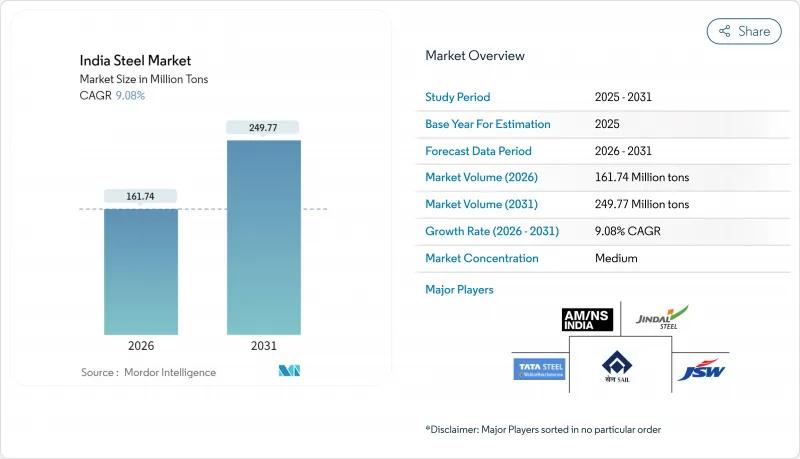
인도의 철강 시장 규모는 2026년 1억 6,174만 톤으로 추정되고, 2025년 1억 4,828만 톤에서 성장할 전망입니다.
2031년 2억 4,977만 톤으로 성장할 것으로 예측되며, 2026-2031년 연평균 복합 성장률(CAGR) 9.08%로 확대될 전망입니다.
2030년까지 3억 톤의 생산 능력 확대 목표, 인프라 투자 가속, 정책 인센티브가 함께 이 성장 궤도를 지지해 인도의 철강 업계를 세계 2위 생산국 그룹으로 자리매김하고 있습니다. 정부 주도의 대형 프로젝트(예 : 34,800km에 달하는 고속도로망 정비 'Bharatmala', 대규모 주택 공급 계획 'PM-AWAS', 스마트 시티 2.0)가 지속적인 국내 수요를 창출하는 한편, 신흥 그린 철강 정책 에코시스템이 저탄소 기술에 대한 투자를 촉진하고 있습니다. 주요 생산자가 기존 설비 및 신규 설비 확보, 수입 급증에 대한 헤지, EU의 탄소 경계 조정 메커니즘(CBAM) 등 수출 관련 환경 규제에 대한 대응을 겨루는 가운데 경쟁의 치열성은 여전히 높은 수준에 있습니다. 동시에 원재료의 가용성 및 물류 네트워크의 주 수준 우위성이 생산 거점에 있어서 동부로의 이동을 촉진하고, 지역 경제의 발전을 지원하며, 공급망 비용의 최적화를 도모하고 있습니다. 탈탄소화에 대한 지출 증가, 자본 효율성 향상, 부가가치 제품 전략에도 불구하고, 이들은 원재료 가격 변동 속에서도 영업 이익률을 보호하는 데 도움을 주며 인도의 철강 산업 전체의 탄력성을 강화하고 있습니다.
국가 철강 정책의 3억 톤 생산 능력 목표, 특수 철강용 생산 연동형 보조금(PLI) 제도, 국산 철강 제품 의무화를 조합한 종합적인 틀이 인도의 철강 업계 전체 수요 확실성을 지원하고 있습니다. 생산 연동형 인센티브(총액 27,106캐롤 루피)는 이미 특수 철강 분야에서 790만 톤의 생산 능력과 약 1만 5천명의 고용 창출을 실현했습니다. 정부 조달의 부가가치 15-50% 우선 조달 기준은 국내 공급업체를 지원하고, 철강 수입 모니터링 시스템에 의한 실시간 수입 모니터링은 무역 구제 조치의 결정을 정밀화합니다. PM-Gati Shakti를 통한 인프라 통합은 물류 비용을 최대 15% 절감하고 광물 자원이 풍부한 지역의 생산자 경쟁력을 높여줍니다. 마지막으로 인도 규격국(BIS)에 의한 품질 기준의 철저함으로 신규 설비가 수출 시장의 요구에 부응하는 국제 수준의 제품 등급을 공급할 것이 보장되고 있습니다.
민간 및 공적 분야의 투자 총액이 250억 달러를 넘는 규모에 달하며, 인도의 철강 업계 투자 사이클이 가속되고 있습니다. 유력 기업의 진입과 기존 기업의 확장이 진행되고 있습니다. 15조 루피 규모의 안드라 프라데시 복합시설은 알세롤 미탈 일본 제철에 의해 선진 고강도 철강에서 기술 이전 주도의 설비 갱신을 구현하고 있습니다. SAIL(인도 철강 공사)은 2025년도 단계적 설비 투자 예산 배분으로 2031년까지 생산 능력을 2,000만 톤에서 3,565만 톤으로 확대할 계획이며, 이는 공공 부문이 국가 목표를 따라 진행되고 있음을 보여줍니다. 전략적 외국 직접투자(FDI) 유입은 저탄소 기술 지식을 통합하고 광물 자원이 풍부한 동부 클러스터는 원재료 공급 라인을 단축하고 규모의 경제를 실현합니다. 고용 승수 효과는 주정부의 지원을 강화하고 인도의 철강 산업 전반에 걸쳐 기술 개발 및 산업 성장의 선순환을 창출하고 있습니다.
2023년 인도의 1인당 철강 사용량은 93.44kg이며 세계 평균 230kg보다 크게 낮습니다. 이것은 미개척의 잠재력을 나타내는 한편, 구조적인 병목의 존재도 부조로 하고 있습니다. 인구의 65%를 차지하는 농촌 시장에서는 인프라 보급 지연 및 소득 제약으로 인해 수요가 현저히 저수준에 머물고 있습니다. 소비량의 격차는 생산자가 공급 확대 및 현실적인 지역별 수요 곡선의 균형을 맞추어야 하기 때문에 생산 능력 계획의 결정을 복잡하게 하고 있습니다. 이러한 추세는 인도 철강 산업의 잠재력을 극대화하기 위해 농촌 인프라에 병행 투자가 필요하다는 것을 강조합니다.
2025년 시점에서 고로-산소 취입 전로(BF-BOF) 루트는 인도의 철강 산업의 46.12%를 차지했으며, 이 수준은 대량 생산에 있어서 비용 우위성을 여전히 제공하는 통합 플랜트의 확고한 기반을 뒷받침하고 있습니다. 생산자가 탈탄소화 로드맵을 책정하는 한편 기존 설비의 효율화를 도모하는 가운데 인도의 BF-BOF 시장 규모는 CAGR 8.77%로 확대될 것으로 예측되고 있습니다. 점진적인 효율성 향상 및 부분 수소 주입으로 인한 단위 배출량 감소는 현실적인 전환 속도를 보여줍니다. 전기로는 스크랩 풍부한 도시에서 보급이 진행되고 있어 장래의 저탄소 거점에 대한 생산 능력 재배분을 시사하고 있습니다. 신흥 수소 DRI 파일럿 플랜트는 세 번째 옵션이지만, 상업화는 그린 수소의 비용 경쟁력에 달려 있으며, 그 실현은 2030년 이후로 예상됩니다.
중기적으로는 고로-산소 취입 전로(BOF) 복합 플랜트가 열풍로, 상부 압력 회수 터빈, 슬래그 조립 설비의 개량을 통해 진화하여 에너지 회수율 및 제품 품질 향상을 도모합니다. 기술 제휴는 공정 제어의 디지털화를 가속화하고 최상의 실천 플랜트 및 평균 플랜트의 수율 차이를 확대합니다. 한편, 2차 철강 제조업체는 전기로의 유연성을 활용해, 특수 철강 공급이나 진화하는 건설 기준에 대한 대응을 기민하게 실시합니다. 다중 루트의 공존은 인도의 철강 시장 규모와 지역별 스크랩 공급 상황의 차이를 반영하여 기술 재구성이 급격하지 않고 점진적임을 시사합니다.
조강은 기본 형태 부문 전체를 구성하고 통합제철소와 2차제철소에서의 업스트림 설비 증강을 반영하며 CAGR 7.73%로 증가할 것으로 예측됩니다. 약 80%의 높은 가동률은 대규모 신규 건설이 필요하기 전에 잠재적인 여지가 있음을 나타냅니다. 오디샤, 채티스가르, 카르나타카의 철광석 자급 자족은 동남아시아의 수입 종속 기업과 비교하여 조강 생산자에게 지속적인 원료 우위를 부여하여 인도의 철강 산업 지역에서의 지위를 강화하고 있습니다.
자사 광산 할당 및 확장 프로젝트의 신속한 환경 허가와 같은 지원 정책은 인도의 철강 시장에서 생산량 증가를 촉진하고 있습니다. 동시에, 철스크랩 재활용 정책에 의해 스크랩 사용률을 25%에서 70%로 끌어올려 공정 효율의 향상을 도모하고 있습니다. 조강 제조업체는 예측 보전 분석과 공정 최적화 소프트웨어의 도입을 가속시켜 최고 수준의 성능에 차이를 줄이고 에너지 소비 강도를 삭감하고 있습니다. 이러한 이니셔티브가 결합되어 이 부문은 인도 철강 산업의 핵심 지위를 확고히 하고 있습니다.
인도의 철강 보고서는 기술별(고로 및 기본 산소로, 전기로, 기타 기술), 기본 형태별(조강), 최종 형태별(완성 철강), 최종 사용자 산업별(자동차 및 운송기기, 건축 및 건설, 공구 및 기계, 소비재, 에너지, 기타 최종 사용자 산업)로 분류되어 있습니다. 시장 예측은 수량(백만 톤) 단위로 제공됩니다.
India Steel Market size in 2026 is estimated at 161.74 million tons, growing from 2025 value of 148.28 million tons with 2031 projections showing 249.77 million tons, growing at 9.08% CAGR over 2026-2031.
Expanding capacity targets of 300 million tons by 2030, accelerating infrastructure spending, and policy incentives together anchor this trajectory, positioning the India steel industry as the world's second-largest producer cohort. Government-backed megaprojects such as Bharatmala's 34,800 km highway build-out, PM-AWAS's large-scale housing programs, and Smart Cities 2.0 create durable domestic offtake, while an emerging green-steel policy ecosystem channels investment toward low-carbon technologies. Competitive intensity remains high, as leading producers race to secure brown- and green-field capacity, hedge against import surges, and comply with export-linked environmental mandates, such as the EU's CBAM. Simultaneously, state-level advantages in raw material availability and logistics connectivity spur an eastward production shift, supporting regional economic development and optimizing supply chain costs. Despite rising decarbonization outlays, capital efficiency gains, and value-added product strategies, these help shield operating margins amid volatile raw-material prices, thereby strengthening the overall resilience of the India steel industry.
A comprehensive framework, combining the National Steel Policy's 300 million ton capacity target, the PLI scheme for specialty steel, and the mandate for domestically manufactured iron and steel products, underpins demand certainty across the India steel industry. Production-linked incentives worth INR 27,106 crore have already unlocked 7.9 million tons of specialty capacity and nearly 15,000 jobs. Preferential procurement thresholds of 15-50% value-added bolster domestic suppliers in government tenders, while real-time import monitoring via the Steel Import Monitoring System refines trade remedy decisions. Infrastructure integration through PM-Gati Shakti lowers logistics costs by up to 15%, sharpening competitiveness for producers in mineral-rich regions. Finally, the Bureau of Indian Standards enforces quality compliance, ensuring that new capacity delivers globally acceptable product grades that align with export market requirements.
Private and public commitments exceeding USD 25 billion have amplified the India Steel investment cycle, drawing marquee entrants and expanding incumbents. ArcelorMittal Nippon Steel's INR 1.5 lakh crore Andhra Pradesh complex exemplifies technology-transfer driven upgrades in advanced high-strength grades. SAIL's trajectory from 20 million tons to 35.65 million tons capacity by 2031, supported by incremental FY25 capex allocations, highlights public-sector alignment with national targets. Strategic FDI flows embed knowledge of low-carbon technologies, while mineral-rich eastern clusters shorten raw material supply lines and enable economies of scale. Employment multipliers reinforce state support, creating virtuous cycles of skill development and industrial growth across the India Steel industry.
At 93.44 kg in 2023, India's per-capita steel usage remains far below the 230 kg global mean, signaling untapped potential but also revealing structural bottlenecks. Rural markets, which account for 65% of the population, have disproportionately low demand due to limited infrastructure penetration and income constraints. Consumption disparities complicate capacity-planning decisions, as producers must balance supply expansion with realistic regional demand curves. These patterns underline the need for parallel investments in rural infrastructure to unlock the full potential of the India Steel industry.
Other drivers and restraints analyzed in the detailed report include:
For complete list of drivers and restraints, kindly check the Table Of Contents.
The BF-BOF route held 46.12% India Steel industry share in 2025, a level underscoring the entrenched integrated-plant footprint that still delivers cost advantages on large volumes. The India steel market size for BF-BOF output is forecast to compound at an 8.77% CAGR as producers sweat existing assets even while charting decarbonization roadmaps. Declining unit emissions through incremental efficiency gains and partial hydrogen injection illustrate pragmatic transition pacing. Electric-arc furnaces are gaining traction in scrap-rich urban clusters, signaling a future redistribution of capacity toward low-carbon hubs. Emerging hydrogen DRI pilot plants introduce a third vector, although commercial uptake hinges on green-hydrogen cost parity, which is expected only beyond 2030.
In the medium term, BF-BOF complexes evolve through the use of hot-blast stoves, top-pressure recovery turbines, and slag granulation upgrades, thereby enhancing energy recovery and product quality. Technology partnerships accelerate process-control digitalization, widening yield spreads between best- and average-practice plants. Meanwhile, secondary producers leverage EAF flexibility to nimbly supply specialty grades and meet evolving construction standards. The coexistence of multiple routes reflects the India Steel market size and varied regional scrap-availability profiles, suggesting a gradual rather than abrupt technology realignment.
Crude steel constitutes the entire basic-form segment and is forecast to climb at a 7.73% CAGR, mirroring upstream capacity additions across integrated and secondary mills. High utilization rates of roughly 80% underscore latent headroom before extensive green-field builds are required. Iron-ore self-sufficiency across Odisha, Chhattisgarh, and Karnataka grants crude-steel producers a sustained raw-material edge compared with import-dependent peers in Southeast Asia, strengthening the india steel industry position in the region.
Enabling policies, such as captive mine allocations and express environmental clearances for expansion projects, expedite throughput gains in the India steel market. Simultaneously, the Steel Scrap Recycling Policy aims to lift scrap use from 25% to 70%, driving process efficiency. Crude steel players are increasingly integrating predictive maintenance analytics and process optimization software, narrowing the gap to best performance and trimming energy intensity. These moves collectively solidify the segment's centrality within the India steel industry.
The India Steel Report is Segmented by Technology (Blast Furnace-Basic Oxygen Furnace, Electric Arc Furnace, and Other Technologies), Basic Form (Crude Steel), Final Form (Finished Steel), and End-User Industry (Automotive and Transportation, Building and Construction, Tools and Machinery, Consumer Goods, Energy, and Other End-User Industries). The Market Forecasts are Provided in Terms of Volume (Million Tons).