



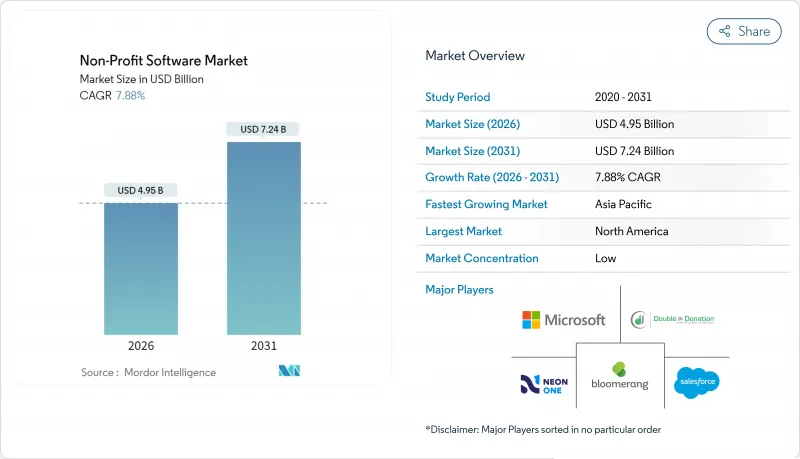
비영리 소프트웨어 시장 규모는 2026년에는 49억 5,000만 달러로 추정되고 있으며, 2025년 45억 9,000만 달러에서 성장한 수치입니다. 2031년 72억 4,000만 달러에 이르고, 2026년부터 2031년까지 연평균 복합 성장률(CAGR) 7.88%로 성장할 것으로 전망됩니다.

시장 규모 확대는 클라우드 도입으로의 현저한 전환, 인공지능 기능의 급속한 보급, 소프트웨어 규정 준수 요구 사항을 높이는 엄격한 데이터 프라이버시 규정을 반영합니다. 수요가 가장 높은 것은 데이터의 사일로화를 해소하는 통합형 자금 조달 스위트와 만성적인 직원 부족을 보완하는 자동화 도구입니다. 예측 기부자 분석, 모바일 우선 기부 옵션, 임베디드 결제 기능을 통합한 공급업체는 명확한 경쟁 우위를 확립하고 있습니다. 한편, GDPR(EU 개인정보보호규정) 및 CCPA와 같은 규제 프레임워크는 비영리 단체 이사회가 인증된 보안 관리 기능을 갖춘 플랫폼을 선호하도록 촉구하고 있으며, 이는 기존 On-Premise 시스템 교체를 가속화하고 있습니다.
클라우드 배포는 자본 지출을 줄이고 유통 시 잠그는 데 필요한 원격 액세스를 제공합니다. 배포 데이터에 따르면 On-Premise에서 SaaS로의 전환으로 총 소유 비용(TCO)이 약 30-40% 절감됩니다. Microsoft가 2026년 12월까지 'Fundraising and Engagement'제품 제공 종료를 계획하고 있다는 것은 클라우드 네이티브 아키텍처로의 광범위한 마이그레이션을 뒷받침하고 있습니다. 구독 요금 체계는 비영리 단체의 현금 흐름 사이클에 적합하며, 내장 컴플라이언스 기능은 GDPR(EU 개인정보보호규정) 및 CCPA 의무에 직면하는 이사회에 매력적입니다. 이러한 특성으로 인해 스프레드시트와 노후화된 로컬 서버에서 캠페인 규모에 따라 확장 가능한 지속적으로 업데이트되는 현대 플랫폼으로의 전환이 가속화됩니다.
이사회는 통합된 영향도 보고서를 기대하고 있으며, 사일로화된 단일 기능 솔루션은 그 목표를 훼손합니다. OneCause가 2025년 1월에 출시 예정인 Salesforce Nonprofit Success Pack용 커넥터는 긴밀한 협력이 수동 데이터 입력 감소 및 기부자 통찰력 향상에 어떻게 기여하는지 보여줍니다. 기존 CRM과 원활하게 동기화할 수 있는 공급업체는 이점을 얻습니다. 비영리 단체는 위험이 높은 전면 쇄신 프로젝트보다 단계적인 업그레이드를 선호하기 때문입니다. 통합 제품군으로의 전환은 이 분야의 성숙도를 반영합니다. 조직은 지금까지 상업 브랜드만 사용할 수 있었던 엔터프라이즈급 분석 기능, 자동화된 워크플로우 및 옴니채널 참여를 추구하고 있습니다.
뉴질랜드와 호주의 상근 직원 1인당 평균 기술 예산이 2,537-3,942달러이기 때문에 자금 부족이 소프트웨어 업데이트를 늦추고 있는 실태가 분명합니다. 라이선스 할인이 존재하는 경우에도 도입 및 연수 비용이 자원을 압박하고, 전임 IT 스탭의 부재가 전 기능의 활용을 방해하고 있습니다. 프리미엄층이나 TechSoup의 보조금에 의해 도입 비용은 경감되지만, 계속적인 관리 비용을 충당하는 것은 드물고, 이것에 의해 대규모 조직과 소규모 조직의 사이에서 양극화한 도입 패턴이 강화되고 있습니다.
2025년 시점에서 비영리 소프트웨어 시장의 61.72%를 차지한 클라우드 도입은 2031년까지 연평균 복합 성장률(CAGR) 11.32%로 확대될 것으로 전망됩니다. 비영리 단체가 노후화된 서버를 폐지하고 회계 사이클이나 원격 근무 형태에 적합한 SaaS로 이행하는 중 클라우드 솔루션 시장 규모는 업계 전체의 성장률을 상회할 전망입니다. 공급업체는 마이그레이션 서비스를 패키징하여 기부자 기록 데이터, 자원 봉사 기록 및 자금 계좌를 다운타임 없이 마이그레이션할 수 있습니다. Microsoft의 'Fundraising and Engagement' 제품 지원 중단이 다가오기 때문에 많은 조직들이 인프라 재평가를 받고 있으며, GDPR(EU 개인정보보호규정)(일반 데이터 보호 규칙)도 지역별 데이터 호스팅에 대한 의사결정에 영향을 미치고 있습니다.
대규모 기관에서는 이미 자사 데이터센터에 많은 투자를 하고 있거나 병원재단 등 엄격한 거주규칙을 충족해야 하는 경우 On-Premise 설치가 계속됩니다. 그러나 이러한 조직조차도 기밀성이 높은 의료 기부자 파일을 보호하면서 최신 분석 기술을 활용하기 위해 하이브리드 모델을 채택하고 있습니다. On-Premise 솔루션의 비영리 소프트웨어 시장 점유율은 꾸준히 감소할 것으로 예상되며 클라우드 내결함성, 자동 패치 적용 및 종량 과금제의 수용이 확대되고 있음을 보여줍니다.
대규모 비영리 단체는 2025년 지출의 52.05%를 차지했으며, 보다 풍부한 예산, 전임 IT 팀, 복잡한 다중 기지 운영을 통해 2025년 지출을 차지했습니다. Boys & Girls Club of America는 9개월 만에 350개 지부에 유니버설 CRM을 도입하여 이 규모의 실현 가능성을 보여주었습니다. 그러나 SaaS가 진입 장벽을 낮추는 가운데 중소규모 단체가 13.05%의 연평균 복합 성장률(CAGR)로 가장 빠르게 성장하고 있습니다. 클라우드 구독은 전통적인 자본 지출을 예측 가능한 운영비로 변환하고 프리미엄 플랜은 완전한 도입 전에 기능을 제공합니다.
성장에도 불구하고 중소기업은 첨단 기능 이용을 제한하는 인력 및 자금 부족에 직면하고 있습니다. 직원 1인당 평균 기술 예산은 여전히 4,000달러 미만이므로 풍부한 도입 지원, 템플릿화된 워크플로우 및 피어 트레이닝 커뮤니티를 제공하는 공급업체가 이점을 누릴 수 있습니다. TechSoup과 같은 플랫폼을 통한 지속적인 할인 프로그램은 보급 확대에 매우 중요합니다. 비영리 소프트웨어 시장 규모는 중소기업용이 현재 격차 일부를 채울 것으로 예상되지만, 여전히 대기업이 대부분을 차지할 전망입니다.
북미는 2025년 수익의 44.05%를 차지했고 자선 기부에 대한 우대 세제와 고급 벤더 에코시스템이 기반을 두고 있습니다. 미국 조직이 수백 개의 거점에 걸쳐 있는 데이터를 통합할 때의 규모의 잠재적 가능성은 보이즈 & 걸스 클럽 오브 아메리카와 같은 대규모 전국적 도입 사례가 보여줍니다. 캐나다와 멕시코는 성장 여지가 있으며 특히 미국 표준에 필적하는 보안 인증을 바탕으로 클라우드 마이그레이션이 촉진되고 있습니다. CCPA와 같은 데이터 보호법은 입증 가능한 컴플라이언스 감사를 갖춘 플랫폼의 매력을 높이고 주요 공급업체의 지위를 더욱 확고하게합니다.
유럽은 성숙하면서도 고도로 규제된 시장을 형성하고 있습니다. GDPR(EU 개인정보보호규정)은 엄격한 동의 추적 및 정보 유출 통지를 의무화하기 때문에 비영리 단체는 현지 데이터센터와 견고한 감사 추적을 갖춘 공급자를 선택합니다. 지속가능성 지표와 사회적 영향 보고에 중점을 두어 기부와 성과를 연결하는 상세한 분석 수요를 추진하고 있습니다. 현지화(언어, 통화 및 법정 보고)는 세계의 플랫폼과 경쟁하는 지역 벤더의 차별화 요인으로 계속되고 있습니다. GDP 성장률은 완만하지만 유럽 위원회의 디지털 변혁 자금은 현대 비영리 단체를 위한 스택에 대한 투자를 지속적으로 지원하고 있습니다.
아시아태평양은 2031년까지 연평균 복합 성장률(CAGR) 11.36%에서 가장 빠르게 성장하는 지역입니다. 비영리 단체의 클라우드 전환율은 27%에 불과하며 큰 성장 여지가 나타났습니다. 스마트폰 보급률은 은행 지점망을 크게 상회하고 있기 때문에 모바일 퍼스트 기부 앱이 강하게 지지되고 있습니다. Google.org의 Infoxchange에 대한 150만 달러의 보조금은 지역 자선 단체의 업무 디지털화를 위한 협력적인 노력을 강조합니다. 호주 및 뉴질랜드는 조기 도입 사례를 제공하고 동남아시아는 비영리 단체가 레거시 시스템의 제약 없이 SaaS로 직접 이행할 수 있는 미개척 시장으로서의 가능성을 갖고 있습니다. 가볍고 모바일 최적화된 인터페이스를 맞춤설정하고 지역별 결제 옵션을 제공하는 공급업체가 가장 빠르게 공유할 수 있습니다.
Non-Profit Software market size in 2026 is estimated at USD 4.95 billion, growing from 2025 value of USD 4.59 billion with 2031 projections showing USD 7.24 billion, growing at 7.88% CAGR over 2026-2031.
The market size expansion mirrors a pronounced shift toward cloud deployment, rapid uptake of artificial intelligence features, and stricter data-privacy regulation that elevates software compliance requirements. Demand is strongest for unified fundraising suites that collapse data silos and for automation tools that offset chronic staff shortages. Vendors that embed predictive donor analytics, mobile-first giving options, and embedded payment capabilities are carving out clear competitive advantage. Meanwhile, regulatory frameworks such as GDPR and CCPA encourage nonprofit boards to favor platforms with certified security controls, which in turn accelerates the replacement of legacy on-premises systems.
Cloud adoption trims capital expenditure and delivers remote access that became essential during pandemic lockdowns. Moving from on-premises to SaaS cuts total cost of ownership by around 30-40% according to implementation data. Microsoft's plan to retire its Fundraising and Engagement product by December 2026 underscores a wider pivot to cloud-native architectures. Subscription pricing meshes with nonprofit cash-flow cycles, and built-in compliance features appeal to boards grappling with GDPR and CCPA obligations. These attributes accelerate migration from spreadsheets and aging local servers into modern, continuously updated platforms that scale with campaign volume.
Boards expect consolidated impact reporting, and siloed point solutions undermine that goal. OneCause's January 2025 connector for Salesforce Nonprofit Success Pack shows how tight integration reduces manual data entry and improves donor insights. Vendors able to sync seamlessly with existing CRMs gain an edge because nonprofits prefer evolutionary upgrades over risky rip-and-replace projects. The move toward unified suites reflects the sector's maturation: organizations now demand enterprise-grade analytics, automated workflows, and omnichannel engagement once reserved for commercial brands.
Average technology budgets of USD 2,537-3,942 per full-time employee in New Zealand and Australia reveal how limited funds delay software upgrades. Even when license discounts exist, implementation and training costs strain resources, and the absence of dedicated IT staff hampers full feature utilization. Freemium tiers and TechSoup subsidies alleviate entry costs yet rarely cover ongoing administration, reinforcing a two-speed adoption pattern between large and small organizations.
Other drivers and restraints analyzed in the detailed report include:
For complete list of drivers and restraints, kindly check the Table Of Contents.
Cloud deployments generated 61.72% of the Non-Profit Software market in 2025 and are projected to expand at an 11.32% CAGR through 2031. The Non-Profit Software market size for cloud solutions is therefore set to outpace overall sector growth as nonprofits retire aging servers in favor of SaaS that matches fiscal cycles and remote-work patterns. Vendors bundle migration services so that historical donor data, volunteer records, and fund accounts transfer without downtime. The looming sunset of Microsoft's Fundraising and Engagement product compels many organizations to reevaluate infrastructure, and GDPR is shaping decisions about regional data hosting.
On-premises installations persist within large institutions that already invested heavily in in-house data centers or that must meet strict residency rules, such as hospital foundations. Yet even these organizations are adopting hybrid models to tap modern analytics while safeguarding sensitive medical donor files. The Non-Profit Software market share of on-premises solutions is forecast to decline steadily, signaling widening acceptance of cloud resilience, automatic patching, and consumption-based pricing.
Large nonprofits held 52.05% of 2025 spending thanks to deeper budgets, dedicated IT teams, and complex multi-site operations. The Boys and Girls Clubs of America deployed a universal CRM across 350 chapters within nine months, highlighting the scale possible in this tier. However, the small and medium band grows fastest at 13.05% CAGR as SaaS lowers entry barriers. Cloud subscriptions convert what used to be capital expenditure into predictable operating outlays, while freemium plans introduce functionality before a full commitment.
Despite growth, SMEs confront staff and capital shortages that limit advanced feature usage. Average technology allocations remain under USD 4,000 per employee, so vendors that provide robust onboarding, templated workflows, and peer training communities stand to gain. Continued discount programs from platforms such as TechSoup will be critical in widening adoption. The Non-Profit Software market size for SMEs is expected to close part of today's gap, yet large organizations will still account for a majority of absolute dollars.
The Non-Profit Software Market Report is Segmented by Deployment (On Premises, Cloud), by Enterprise Size (SMEs, Large Enterprise), by Type (Admission-Based Nonprofit Software, Fundraising Software, Marketing Software, Volunteer Management, CRM, Other Types), and by Geography. The Market Forecasts are Provided in Terms of Value (USD).
North America delivered 44.05% of 2025 revenue, underpinned by favorable tax incentives for charitable giving and sophisticated vendor ecosystems. Large national implementations such as Boys and Girls Clubs of America highlight the scale potential when U.S. organizations unify data across hundreds of locations. Canada and Mexico add headroom, particularly for cloud migrations spurred by security certifications that now rival U.S. standards. Data-privacy laws such as CCPA reinforce the appeal of platforms with demonstrable compliance audits, further entrenching leading vendors.
Europe forms a mature but highly regulated landscape. GDPR mandates rigorous consent tracking and breach notification, so nonprofits select providers with local data centers and robust audit trails. Emphasis on sustainability metrics and social-impact reporting fuels demand for granular analytics that tie donations to outcomes. Localization-language, currency, and statutory reporting-remains a differentiator for regional vendors competing against global platforms. Despite modest GDP growth, digital-transformation funding from the European Commission keeps investment flowing into modern nonprofit stacks.
Asia-Pacific is the fastest-growing region at an 11.36% CAGR through 2031. Only 27% of nonprofits have migrated to cloud, revealing significant runway for uptake. Smartphone penetration vastly exceeds branch banking coverage, so mobile-first giving apps resonate strongly. Google.org's USD 1.5 million grant to Infoxchange underscores a coordinated push to digitize operations among regional charities. Australia and New Zealand provide early-adopter case studies, while Southeast Asia offers a greenfield prospect where nonprofits can leapfrog directly to SaaS without legacy baggage. Vendors that tailor lightweight, mobile-optimized interfaces and deliver regional payment options stand to gain share fastest.