



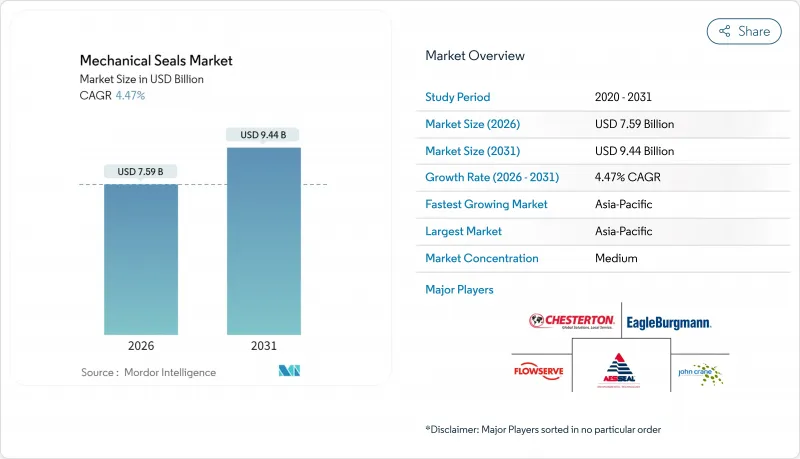
기계식 씰 시장 규모는 2026년에는 75억 9,000만 달러로 추정되고, 2025년 72억 7,000만 달러에서 계속 성장하고 있습니다. 2031년 94억 4,000만 달러에 이를 것으로 예측되며, 2026-2031년 연평균 복합 성장률(CAGR) 4.47%로 성장할 것으로 전망됩니다.

수요는 회전 장비에서 누설 방지의 중요성에 따라 증가하고 있으며 펌프 고장의 70%는 씰 관련 문제로 인한 것입니다. 성장은 휘발성 유기 화합물을 1.5 psia 이상 취급하는 회전 펌프에 적합한 기계식 씰을 채택할 것을 의무화하는 미국 환경 보호청(EPA)의 규제 등 누설 배출 규제의 강화에 의해 뒷받침되고 있습니다. 수소 및 탄소 포집 인프라 확대와 대규모 석유화학 및 전력 프로젝트가 결합되어 향후 10년 동안 기계식 씰 시장에 구조적인 추풍을 가져올 것입니다.
대규모 파이프라인 및 처리 시설의 확장으로 150바를 넘는 압력과 H2S, CO2, 고응축분율을 풍부하게 포함한 가스 조성에 대응한 설계의 유닛이 필요해져 씰 수요가 높아지고 있습니다. 사우디아라비아의 마스터 가스 시스템 세 번째 단계만으로도 네트워크 용량이 하루에 125억 입방 피트로 확장되고 사워 가스 조건 하에서도 무결성을 유지하는 설계 카트리지 씰의 대량 재고가 필수적입니다. 아부다비 국영 석유회사(ADNOC)의 씰 고장으로 인한 과거 실적 보증 청구액이 280만 달러에 달한 사실은 이러한 기기의 사양 부족이 초래하는 비용을 여실히 이야기하고 있습니다. ADNOC의 연간 150만 톤 규모의 이산화탄소 포집 시설에 연동된 드라이가스용 씰 계약은 이 분야의 전략적 중요성을 뒷받침하고 있습니다. 펌프 OEM 제조업체와 씰 전문 제조업체의 제휴가 심화해, 공동으로 솔루션을 개발하는 동향이 현저하고, 러시아 간선 파이프라인용 이글버그만사제 고압 씰 패키지가 그 일례입니다. 이 프로젝트들은 결합되어 기계식 씰 시장의 견조한 여러 해에 걸친 성장을 지원하고 있습니다.
원자력 발전의 부흥, 화력 발전소의 개수, 재생에너지와의 하이브리드화에 의해 고속 펌프, 컴프레서, 터빈 보조 시스템 등의 설치 베이스가 확대되고 있습니다. 이들 모두에 특수한 씰 구조가 요구됩니다. 플로사브사는 2025년 원자력 관련 수주액이 3분기 연속 1억 달러를 돌파해 탄소 중립 발전을 향한 자본 투입의 가속을 부각시켰습니다. 집광형 태양열 발전 프로젝트에서는 약 565℃에서 가동하는 용융염 루프가 도입되어 공급자는 극한 온도를 견디는 흑연 그라포일 라이닝 씰면의 개발을 강요받고 있습니다. 신재생 에너지 및 기존 발전 설비를 불문하고, 전력회사는 18-24개월의 정지 사이클로 유지보수가 없는 운전이 가능한 씰을 우선하고 있어 플랜 32 완충액 시스템을 갖춘 견고한 카트리지 설계에 대한 선호가 높아지고 있습니다. 이 기세는 향후 10년간의 기계식 씰 시장의 지속적인 성장을 지원할 것입니다.
마그네틱 커플링은 마찰을 제거하고 수명을 연장하며 물 소비를 줄이는 특성으로 제약, 식품 및 특정 화학 공정 분야에서 주목을 받고 있습니다. 단, 토크 용량 및 방열 능력의 제약에 의해 적용 범위는 한정되어 저출력 용도로의 보급이 제한되어 있습니다. 그러나 특정 부문에서 틈새 대체 수요로 인해 기계식 씰 시장에서 증분 성장이 억제될 수 있습니다.
펌프용 씰은 2025년에 기계식 씰 시장 수익의 64.35%를 차지했으며, 원유 이송, 화학 반응기, 상수도 시설 등 폭넓은 분야에서의 보급을 반영하고 있습니다. 공급업체는 내장 센서 및 클라우드 대시보드를 연동시켜 진동과 온도를 기록하여 예지보전을 실현하며 다운타임 삭감을 도모하고 있습니다. 컴프레서용 씰은 가스 파이프라인이나 LNG 시설용으로 중요한 역할을 담당하는 반면, 규모는 작고, 드라이 가스 설계에 의해 유분 혼입을 방지하며 메탄 슬립을 억제합니다. 믹서용 씰은 제약 및 식품 가공 분야의 배치 반응기용으로 제품 라인을 보완하고 있어 위생 설계와 CIP 대응 엘라스토머가 중시되는 틈새 시장입니다. 펌프 설치 대수 증가를 배경으로 이 분야는 4.56%라는 가장 높은 CAGR을 기록하여 기계식 씰 시장에서 지속적인 우위성을 확고히 하고 있습니다.
수요의 추풍으로는 중류 부문의 건설 증가 및 배출 규제 강화에 의해 패킹 방식이 불리해지는 점을 들 수 있습니다. 존 크레인의 USP 시리즈 펌프는 기존 푸셔 유형에 비해 5년간 라이프사이클 비용을 40% 절감합니다. 컴프레서 씰 공급업체는 탄소 캡처 서비스 계약을 결합하여 탈탄소화 파도를 타고 있습니다. 믹서 씰 제조업체는 속도 변동 내성과 레이디얼 방향의 미스 얼라인먼트 보상에 주력하고 있습니다. 모든 카테고리에서 급속한 교환 프로그램은 기계식 씰 산업의 탄력성을 지원하며 설비 투자의 주기적 변동에도 불구하고 견고함을 유지하고 있습니다.
기계식 씰 보고서는 씰 유형별(펌프용 씰, 컴프레서용 씰, 믹서용 씰), 설계 유형별(컴포넌트 및 푸셔, 카트리지, 스플릿), 최종 사용자 산업별(석유 및 가스, 발전, 화학, 상하수도, 기타 최종 사용자 산업), 지역별(아시아태평양, 북미, 유럽, 남미, 중동 및 아프리카)로 분류되어 있습니다. 시장 예측은 금액(달러)으로 제공됩니다.
아시아태평양이 기계식 씰 시장에서 36.35%를 차지하는 배경에는 사이트당 수천개의 회전 씰이 필요한 석유화학 및 가스 파이프라인의 메가 프로젝트가 존재합니다. 4.68%의 지속적인 CAGR은 인도의 정유업 업그레이드 및 중국의 석탄화학 복합시설과 같은 장기 프로젝트에 기인하고 있으며, 모두 연마성 및 고온의 원료에 대응 가능한 카트리지 기술과 벨로우즈 기술을 요구하고 있습니다. 현지에서의 라이선싱 생산은 확대되고 있으며, 복잡한 씰링 표면과 코팅은 여전히 수입에 의존하고 있으며 세계 공급업체의 가격 결정력을 유지하고 있습니다. 존 크레인사의 배턴루지형 모델을 싱가포르에서 재현한 서비스 센터의 확대는 애프터마켓 수익과 고객의 생애에 걸친 충성심을 강화하고 있습니다.
북미에서는 셰일 액화 가스 물류, LNG 수출 터미널, 미국 정부의 탄소 포집를 위한 45Q 세액 공제가 추풍이 되고 있으며, 이들 모두가 API 준거의 듀얼 씰 및 드라이 가스 씰을 지정하고 있습니다. 북미의 기계식 씰 시장 규모는 엄격한 메탄 감축 규제에 따른 리노베이션 프로그램에 의해 지원되며, 2031년까지 21억 2,000만 달러 이상에 달할 것으로 예측됩니다.
유럽에서는 엄격한 TA-Luft 규제의 실시와 신재생 에너지 보급의 가속이 결합되어 초저 누설 솔루션의 기술 시험장으로서의 지위를 확립하고 있습니다. 사업자는 컴플라이언스 확보를 위해 감시 제어 시스템에 연동한 씰 감시 프로브를 추가 도입하고 있어 디지털 대응 카트리지 유닛 수요를 견인하고 있습니다.
북해의 수소 충전소 및 암모니아 벙커링 사업은 틈새 시장에서 높은 부가가치 수주를 견인하고 있습니다. 기계식 씰 시장 점유율은 아시아태평양에 비해 작고 복잡한 사양 계층과 장기 보증 기간으로 인해 유럽 단가는 최고 수준입니다. EN 10204에 대한 재료 인증 획득과 PED 및 ATEX 규제를 준수할 수 있는 공급업체는 이 엄격한 규제 환경에서 전략적 이점을 유지하고 있습니다.
Mechanical Seals Market size in 2026 is estimated at USD 7.59 billion, growing from 2025 value of USD 7.27 billion with 2031 projections showing USD 9.44 billion, growing at 4.47% CAGR over 2026-2031.
Demand tracks the critical need to prevent leakage in rotating equipment, as 70% of pump failures originate with seal issues. Growth is reinforced by tightening fugitive-emission rules, including the U.S. EPA mandate that rotary pumps handling volatile organic compounds above 1.5 psia must employ compliant mechanical seals. Expansion of hydrogen and carbon-capture infrastructure, coupled with large-scale petrochemical and power projects, adds structural tailwinds for the mechanical seals market across the next decade.
Massive pipeline and processing expansions elevate seal demand by requiring units designed for pressures surpassing 150 bar and gas compositions rich in H2S, CO2, and high condensate fractions. Saudi Arabia's Master Gas System Phase 3 alone raises network capacity to 12.5 billion cubic feet per day, mandating large inventories of engineered cartridge seals that maintain integrity under sour-gas conditions. ADNOC's historical warranty claims of USD 2.8 million for seal failures illustrate the cost of under-specifying such equipment. Dry-gas seal contracts tied to ADNOC's 1.5 million-tons-per-year carbon-capture facility confirm the segment's strategic importance. Partnerships between pump OEMs and seal specialists are deepening to co-engineer solutions, a trend evidenced by EagleBurgmann's high-pressure seal packages for Russian trunk pipelines. Collectively, these projects underpin robust, multi-year growth for the mechanical seals market.
Nuclear renaissance, thermal retrofits, and renewable hybrids expand the installed base of high-speed pumps, compressors, and turbine auxiliary systems that all require specialized sealing arrangements. Flowserve recorded nuclear orders topping USD 100 million for the third straight quarter in 2025, highlighting capital acceleration toward carbon-neutral generation. Concentrated solar power projects are introducing molten-salt loops operating near 565 °C, prompting suppliers to develop graphite- and grafoil-lined seal faces that withstand extreme temperatures. Across renewable and conventional builds, utilities prioritize seals that can run maintenance-free across 18- to 24-month outage cycles, lifting preference for robust cartridge designs equipped with Plan 32 buffer fluid systems. This momentum supports a durable uplift in the mechanical seals market across the coming decade.
Magnetic couplings eliminate friction, extend service life, and cut water consumption, attributes that are resonating in pharmaceutical, food, and certain chemical processes. Their applicability remains limited by torque capacity and heat dissipation constraints, restricting penetration to low-power services. Nonetheless, niche substitution pressures may trim incremental growth from the mechanical seals market in selected segments.
Other drivers and restraints analyzed in the detailed report include:
For complete list of drivers and restraints, kindly check the Table Of Contents.
Pump seals generated 64.35% of the mechanical seals market revenue in 2025, reflecting ubiquitous deployment across crude-oil transfer, chemical reactors, and municipal water stations. Suppliers are pairing embedded sensors with cloud dashboards to log vibration and temperature, enabling predictive maintenance that lowers downtime. Compressor seals occupy a crucial but smaller share focused on gas pipelines and LNG facilities, where dry-gas designs eliminate oil entrainment and curtail methane slip. Mixer seals round out the portfolio by servicing batch reactors in pharma and food processing, a niche that values hygienic designs and CIP-friendly elastomers. Rising pump installations underpin the fastest CAGR at 4.56% for this group, locking in continued dominance within the mechanical seals market.
Demand tailwinds include heightened midstream construction and stricter emission caps that disfavor packing solutions. John Crane's USP-series pumps display a 40% reduction in lifecycle cost versus traditional pusher types over five-year spans. Compressor seal suppliers are capitalizing on decarbonization by bundling carbon-capture service agreements. Mixer-seal makers focus on speed variation tolerance and radial misalignment compensation. Across categories, rapid replacement programs support resilience in the mechanical seals industry despite cyclical capex swings.
The Mechanical Seals Report is Segmented by Seal Type (Pump Seals, Compressor Seals, and Mixer Seals), Design Type (Component/Pusher, Cartridge, and Split), End-User Industry (Oil and Gas, Power Generation, Chemical, Water and Waste-Water, and Other End-User Industries), and Geography (Asia-Pacific, North America, Europe, South America, and Middle-East and Africa). The Market Forecasts are Provided in Terms of Value (USD).
Asia-Pacific's 36.35% holding in the mechanical seals market reflects petrochemical and gas-pipeline megaprojects that require thousands of rotary seals per site. Sustained 4.68% CAGR stems from long-lead projects like India's refinery upgrades and China's coal-to-chemicals complexes, each demanding cartridge and bellows technology able to tackle abrasive and high-temperature feeds. Local manufacture under license is expanding, yet complex faces and coatings still rely on imports, preserving pricing power for global suppliers. Service-center expansion, such as John Crane's Baton Rouge-style model replicated in Singapore, shores up aftermarket revenues and lifetime customer loyalty.
North America benefits from shale liquids logistics, LNG export terminals, and the U.S. government's 45Q tax credit for carbon capture, all of which specify API-compliant dual seals and dry-gas seals. The mechanical seals market size in North America is forecast to pass USD 2.12 billion by 2031, supported by retrofit programs that align with stringent methane-reduction rules.
Europe's strict TA-Luft implementation, coupled with accelerating renewables penetration, positions the region as a technology test bed for ultra-low-leakage solutions. Operators add seal-monitoring probes tied to supervisory control systems to ensure compliance, feeding demand for digital-ready cartridge units.
Hydrogen refueling stations and ammonia bunkering ventures in the North Sea drive niche, high-value orders. While overall mechanical seals market share is smaller than Asia-Pacific's, European unit values are highest because of complex specification layers and long warranty terms. Suppliers that can certify materials to EN 10204 and adhere to PED and ATEX regulations maintain strategic advantage in this tightly regulated arena.