



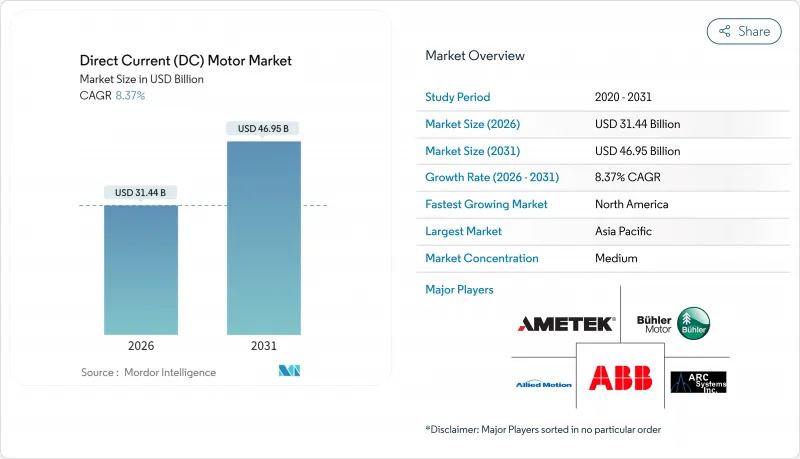
직류 모터 시장 규모는 2026년 314억 4,000만 달러로 추정되고, 2025년 290억 1,000만 달러에서 성장이 예상됩니다. 2031년에는 469억 5,000만 달러에 이를 것으로 예측되며, 2026-2031년 CAGR 8.37%로 확대될 전망입니다.
이 견조한 DC 모터 시장의 성장은 전기자동차 보급, 인더스트리 4.0 자동화, 재생에너지 도입의 확대에 뒷받침됩니다. 브러쉬리스 DC(BLDC) 모터는 유지 보수 감소, 효율성 향상, 스마트 제어 기능 지원으로 브러시 설계를 대체합니다. 제조업체 각사는 비용 억제를 위해 페라이트 대체재의 실험을 진행하면서, 희토류 자석 공급망 강화에 임하고 있습니다. 48V 자동차 시스템, IoT 대응 예지 보전, 풍력 및 태양광 추적 시스템용 고출력 구동 장치에 대한 전략적 투자가 채용 기회를 확대하고 있습니다. 아시아태평양은 제조업의 집중 및 정책 지원으로 DC 모터 시장을 독점하는 반면 남미는 유틸리티 규모의 태양광, 풍력발전 설비에 의해 가장 빠른 수익 성장률을 기록하고 있습니다.
급증하는 배터리 전기자동차 및 하이브리드 자동차의 생산은 트랙션 시스템, 열 관리 시스템 및 보조 시스템이 보다 엄격한 토크 제어 및 고출력 밀도를 실현하는 BLDC 설계로 전환함에 따라 DC 모터 수요 구조를 변화시키고 있습니다. 테슬라의 영구 자석 전략은 비용 및 효율성의 이점을 입증하고 주요 OEM 제조업체의 추종을 촉진했습니다. 유럽의 탄소 감축 규제가 이러한 전환을 가속화하면서 중국은 모터 드라이브 통합 라인에 대한 보조금으로 국내 생산 능력을 강화하고 있습니다. 희토류 조달 문제는 여전히 우려 물질이지만, BYD에 의한 수직 통합 및 미국 인플레이션 억제법에 근거한 공급 장려 프로그램이 당면한 위험을 완화하고 있습니다. 이러한 요인들이 함께 DC 모터 시장은 급격한 전기화의 궤도를 유지하고 있습니다.
Industry 4.0을 도입하는 제조업체는 운영중인 건강 상태 데이터를 플랜트 클라우드로 전송하는 지능형 DC 드라이브에 투자합니다. Siemens의 MindSphere 도입 사례에서는 BLDC 모터가 진동 및 온도 데이터를 예지보전 알고리즘에 송신함으로써 예기치 않은 다운타임을 최대 30% 삭감하고 있습니다. ABB의 레트로 핏 가능한 스마트 센서는 대응 가능한 설치 기반을 확대하여 신규 설비 판매를 넘어 라이프사이클 최적화를 실현합니다. 아시아의 인건비 상승 및 EU 배출 규제 강화가 결합되어 이러한 가치 제안은 더욱 견고합니다. 반면 IEC 62443과 같은 사이버 보안 표준은 설계 단계부터 안전성을 고려한 펌웨어를 요구합니다. 공장이 무인 운전을 목표로 하는 가운데, 직류 모터 시장은 많은 교류 모터에서는 실현할 수 없는 제어의 세분화라는 이점으로부터 혜택을 받고 있습니다.
직류 솔루션은 동등한 교류 유도 유닛에 비해 구매 가격이 15-30% 높아지는 경향이 있으며, 자본 예산이 까다로운 환경에서는 도입이 저해됩니다. 신흥 경제국의 중소기업은 단기적인 자금 확보를 우선하기 때문에 2년간의 투자 회수 기간이라는 장애물이 많은 BLDC 개조 프로젝트를 막고 있습니다. 공급업체는 검증된 에너지 절약 효과와 연계된 월별 요금의 임대 모델을 도입하고 있지만, 이 메커니즘은 신뢰할 수 있는 스마트 미터 데이터 및 장기 계약에 의존하며 일부 고객이 저항을 나타내는 요인이 되고 있습니다. 경기 감속은 도입에 대한 주저를 증폭시켜, 최근의 역풍이 되어 직류 모터 시장의 확대를 억제하고 있습니다.
BLDC 부문은 2025년에 직류 모터 시장의 62.75%를 차지했고, 2031년까지 연평균 복합 성장률(CAGR) 10.02%로 추이할 전망이며, 확고한 주도적 지위를 뒷받침하고 있습니다. 내륜형은 냉각 팬, 연료 펌프, 로봇 분야에서 주류를 차지하고 컴팩트한 형상 및 고회전수 성능을 실현하고 있습니다. 아우터 로터 구조는 기어 박스 손실을 줄이고 신뢰성을 향상시켜 직접 드라이브 HVAC 및 휠 모터 용도에서 우위를 확립합니다. 희토류 공급이 안정화되는 가운데 영구 자석의 장점은 비용 리스크를 상회하고 프리미엄 용도로의 채용이 지속되고 있습니다.
브러시가 있는 모터는 비용이 많이 드는 가전제품, 스타터 모터, 작업 공구 분야에서 여전히 채택되고 있습니다. 이러한 분야에서는 단순한 구동 전자기기와 풍부한 서비스 노하우가 여전히 매력적이기 때문입니다. 그러나 브러시 마모가 미션 크리티컬 환경에서의 가동 시간을 제한하기 때문에 OEM 제조업체의 로드맵은 센서리스 BLDC로 업그레이드하기로 향하고 있습니다. 48V 차량 탑재 보조 시스템의 보급 추진에 의해 회생 에너지를 활용 가능한 전자 정류 설계가 주목을 끌고 있습니다. 전기자동차 펌프 및 스티어 바이 와이어 시스템의 지속적인 설계 채택으로 DC 모터 시장은 브러쉬리스 기술 혁신으로 확실히 기울고 있습니다.
75-750W 정격 모터는 컨베이어, HVAC 블로어, 소형 산업용 펌프 등 폭넓은 용도로 보급되어 2025년 DC 모터 시장 규모의 46.05%를 차지했습니다. 표준화된 실적 및 세계의 IEC 플랜지는 호환성을 높여 OEM 전환 비용을 절감합니다. 대량 주문을 통해 제조업체는 자동화를 최적화하고 비용을 절감할 수 있으므로 이 부문의 이점이 향상되었습니다.
75kW 이상의 모터는 EV 구동 장치, 대규모 태양광 추적 시스템, 중공업용 서보가 정밀한 고토크 제어를 요구하는 분야로 9.51%라는 높은 CAGR을 나타내고 있습니다. 내장 엔코더, 온도 센서, SiC 기반 인버터를 통한 추가 효율화가 프리미엄 가격을 정당화하고 있습니다. 한편, 75W 미만의 설계는 소형화, 저소음 및 배터리 최적화가 절대적인 에너지 변환 효율 향상을 웃도는 소비자용 전자기기 분야에서 활용되고 있습니다. 종합적으로 보면, 다양한 전력대역의 동향이 직류 모터 시장의 견조함을 지원하고 있습니다.
아시아태평양은 2025년 수익의 44.00%를 차지하며 선두를 유지했습니다. 중국에서는 수직 통합형 대기업이 자석, 권선, 인버터의 생산을 자사내제화하고 있습니다. 인도에서는 생산 연동형 우대 조치가 자동차 및 산업용 모터의 신규 생산 능력을 유치하고, 일본과 한국은 정밀 공학의 평판을 살려, 전자기기 및 로봇용 마이크로 모터를 공급하고 있습니다. 이러한 구조적 이점으로 인해 이 지역은 예측 기간을 크게 넘어 DC 모터 시장의 핵심 지역으로 지속될 것입니다.
북미는 청정에너지 제조를 위한 연방세액공제와 국내 모터라인 확대를 목적으로 한 리쇼어링의 움직임으로 꾸준한 성장을 이루고 있습니다. 멕시코의 자동차 산업 회랑은 니어 쇼어링된 부품 프로그램을 흡수하여 국경을 넘은 공급망을 강화하고 있습니다. 캐나다의 광업 및 에너지 부문에서는 원격 운영을 위해 견고한 BLDC 구동 장치가 지정되어 특수 수요를 지원합니다.
남미는 2031년까지 연평균 CAGR 9.18%로 성장을 견인할 전망입니다. 브라질 및 아르헨티나에서는 고토크 직류 모터를 이용한 선회 구동 장치나 피치 제어 시스템을 필요로 하는 대규모 태양광, 풍력 발전 설비가 가동을 개시했습니다. 브라질의 산업 현대화 프로그램은 자동화 프로젝트를 증가시키고 현지 조달 규제는 새로운 모터 공장의 건설을 촉진합니다. 유럽은 효율성을 최우선으로 하는 시장으로 계속하고 있습니다. 독일은 기계 수출에 IE4 규격의 채용을 추진하고, 북유럽 국가는 해상 풍력 발전소에 고전압 BLDC 유닛을 도입하고 있습니다. 지역별 특성이 결합되어 직류 모터 시장의 이해 관계자에게 있어서 리스크는 다양화하고 있습니다.
DC motor market size in 2026 is estimated at USD 31.44 billion, growing from 2025 value of USD 29.01 billion with 2031 projections showing USD 46.95 billion, growing at 8.37% CAGR over 2026-2031.
This robust DC motor market growth rides on electric-vehicle penetration, Industry 4.0 automation, and widening renewable-energy deployments. Brushless DC (BLDC) motors are displacing brushed designs because they cut maintenance, elevate efficiency, and support smart-control functions. Manufacturers strengthen supply chains for rare-earth magnets while experimenting with ferrite alternatives to contain costs. Strategic investments in 48 V automotive systems, IoT-enabled predictive maintenance, and high-power drives for wind and solar tracking broaden adoption opportunities. Asia-Pacific dominates the DC motor market thanks to its manufacturing concentration and policy support, whereas South America registers the fastest revenue acceleration due to utility-scale solar and wind installations.
Soaring battery-electric and hybrid production reshapes DC motor demand as traction, thermal-management, and auxiliary systems switch to BLDC designs for tighter torque control and higher power density. Tesla's permanent-magnet strategy validated cost and efficiency advantages and prompted mainstream OEMs to follow suit. European carbon-reduction rules intensify the shift, while China bolsters domestic capacity through subsidies for integrated motor-drive lines. Although rare-earth sourcing remains a vulnerability, vertical integration by BYD and supply-reward programs under the U.S. Inflation Reduction Act mitigate immediate risks. Combined, these forces keep the DC motor market on a steep electrification trajectory.
Manufacturers embracing Industry 4.0 invest in intelligent DC drives that feed live health metrics into plant clouds. Siemens MindSphere deployments show unplanned downtime cuts of up to 30% when BLDC motors stream vibration and temperature data into predictive-maintenance algorithms. ABB retrofittable smart sensors widen addressable installed bases, enabling lifecycle optimization beyond new-equipment sales. The combination of rising labor costs in Asia and stricter emission rules in the EU strengthens value propositions, while cybersecurity standards such as IEC 62443 dictate secure-by-design firmware. As factories target lights-out operations, the DC motor market benefits from control granularity unavailable in many AC alternatives.
DC solutions often command 15-30% higher purchase prices than comparable AC induction units, impeding uptake where capital budgets are tight. Small and midsize enterprises in emerging economies prioritize near-term cash preservation, so two-year payback hurdles rule out many BLDC retrofits. Vendors introduce leasing models tying monthly fees to verified energy savings, yet these structures depend on reliable smart-meter data and long contracts that some customers resist. Economic slowdowns amplify hesitancy, creating short-term headwinds that temper the DC motor market expansion.
Other drivers and restraints analyzed in the detailed report include:
For complete list of drivers and restraints, kindly check the Table Of Contents.
The BLDC segment claimed 62.75% of the DC motor market in 2025 and is tracking toward a 10.02% CAGR up to 2031, underscoring its entrenched leadership. Inner-rotor variants dominate cooling fans, fuel pumps, and robotics, delivering compact form factors and high rpm ceilings. Outer-rotor architectures conquer direct-drive HVAC and wheel-motor roles by slashing gearbox losses and boosting reliability. As rare-earth supply stabilizes, permanent-magnet strengths outnumber cost risks, which sustains premium adoption.
Brushed motors linger in cost-sensitive appliances, starter motors, and workshop tools where simple drive electronics and ample service expertise still appeal. Even so, brush wear limits uptime in mission-critical environments, steering OEM roadmaps toward sensorless BLDC upgrades. The push toward 48 V automotive auxiliaries shines a spotlight on electronically commutated designs able to exploit regenerative energy. Continuous design wins in EV pumps and steer-by-wire systems keep the DC motor market tilted firmly toward brushless innovations.
Motors rated 75-750 W captured 46.05% of the DC motor market size in 2025, thanks to ubiquity across conveyors, HVAC blowers, and small industrial pumps. Standardized footprints and global IEC flanges ease interchangeability, shrinking switching costs for OEMs. High-volume orders help manufacturers optimize automation and squeeze cost curves, reinforcing segment dominance.
Motors above 75 kW show a leading 9.51% CAGR as EV traction, utility-scale trackers, and heavy industrial servos request precise high-torque control. Integrated encoders, thermal sensors, and SiC-based inverters extract additional efficiency, justifying premium prices. At the other end, sub-75 W designs serve consumer electronics where miniaturization, low noise, and battery optimization trump absolute energy-conversion gains. Altogether, diverse power-band dynamics safeguard a resilient DC motor market.
The Direct Current (DC) Motor Market Report is Segmented by Motor Technology (Brushed DC Motors, and Brushless DC Motors), Power Rating (Less Than 75W, 75-750W, 0. 75-75kW, and More), Voltage Class (Less Than 60V, 60-300V, and Greater Than 300V), End-Use Industry (Automotive, Industrial, HVAC, Consumer Electronics, Healthcare, Water Treatment, and More), and Geography. The Market Forecasts are Provided in Terms of Value (USD).
Asia-Pacific retains the crown with 44.00% of 2025 revenue as China's vertically integrated giants internalize magnet, winding, and inverter production. Production-linked incentives in India invite fresh capacity for automotive and industrial motors, while Japan and South Korea leverage precision-engineering reputations to supply micro-motors for electronics and robotics. These structural advantages ensure the region remains the anchor of the DC motor market well beyond the forecast horizon.
North America posts steady gains amid federal credits for clean-energy manufacturing and reshoring moves that expand domestic motor lines. Mexico's automotive corridor absorbs nearshored parts programs, strengthening the cross-border supply chain. Canada's mining and energy sectors specify rugged BLDC drives for remote operations, underpinning specialized demand.
South America leads growth at a 9.18% CAGR into 2031 as Brazil and Argentina commission utility-scale solar and wind arrays that require slew drives and pitch systems using high-torque DC motors. Industrial modernization programs in Brazil add automation projects, and local content rules encourage greenfield motor plants. Europe remains an efficiency-first market; Germany pushes IE4+ adoption in machinery exports, while Nordic countries deploy high-voltage BLDC units in offshore wind farms. Collectively, regional nuances diversify risk for DC motor market stakeholders.