



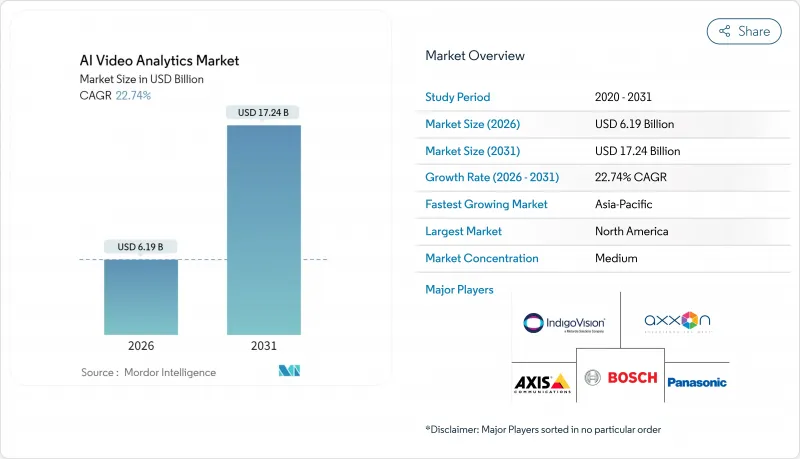
AI 비디오 분석 시장 규모는 2026년 61억 9,000만 달러로 추정되고, 2025년 50억 4,000만 달러에서 성장이 예상됩니다. 2031년까지 172억 4,000만 달러에 달할 것으로 예측되며, 2026-2031년 CAGR 22.74%로 확대될 전망입니다.

도시 부문의 보안 리스크 증가, 스마트 시티의 급속한 개발, 엣지 AI 칩셋 가격의 급격한 하락으로 이 기술의 적용 범위가 계속 확대되고 있습니다. 지자체 프로그램에서는 현재 AI 탑재 카메라를 다기능 센서로 위치시키고 교통 제어에서 예지 보전에 이르기까지 다양한 용도를 실현하고 있습니다. 소매업체는 매장 내 행동 분석을 도입하여 물리적 및 디지털 고객 경험을 통합합니다. 한편, 기업은 거대한 자본 지출 없이 모델을 업데이트할 수 있는 클라우드 워크플로우를 점점 더 중시하고 있습니다. 이러한 변화는 보다 신속한 투자 회수를 약속하는 성과 기반 서비스 모델과 업계 특화형 솔루션의 배치 기회를 창출하고 있습니다.
지자체 프로그램은 기본적인 모니터링망을 실시간 도시 운영 시스템으로 진화시키고 있습니다. 심천시 후쿠다구에서는 AI 구동 이벤트 라우팅 플랫폼을 도입 후, 교통 팀, 유틸리티 및 긴급 서비스를 제휴시킴으로써, 사고 대응 시간을 4분에서 50초로 단축했습니다. 항저우시의 '시티브레인'은 100개 이상 교차로의 카메라 영상을 분석하여 몇 초 안에 사고를 감지하고 신호 타이밍을 재조정하여 평균 통근 시간을 4.6분 단축하고 있습니다. 이러한 성과는 지자체의 지속적인 예산 배분을 정당화하고, 인근 도시에 비슷한 대처를 촉구함으로써 AI 비디오 분석 시장의 확대로 이어지고 있습니다.
소매 체인은 비전 데이터를 로열티 프로그램 및 EC 플랫폼과 통합하여 고객의 실제 행동 경로를 시각화합니다. 열 추적, 선반 재고 히트 맵, 고객 Tier 분석 대시보드는 전환율 향상 및 대기 시간 단축을 제공하며, 도입 사례에 따라 3자리 ROI를 달성했습니다. 영상에서 캡처된 체류 패턴은 온라인 프로모션을 맞춤 설정하는 추천 엔진에 활용됩니다. 패스트 푸드 가게에서는 유사한 데이터를 활용하여 식품 안전 체크리스트의 철저한 인력 배치 최적화를 실현하고 있습니다. 오프라인 매장이 데이터 풍부한 접점이 되는 가운데, 클라우드 네이티브 분석 기술에 대한 투자가 가속하고 있습니다.
GDPR(EU 개인정보보호규정)과 유사한 법령은 명시적인 동의 및 데이터 최소화를 의무화했으며 공급업체는 생체 정보를 마스크 및 해시화해야 합니다. 공급자는 점유율 및 동선 맵을 유지하면서 개인 식별자를 제거하는 메타데이터 전용 솔루션을 적극적으로 전개합니다. 컴플라이언스 대응은 비용 증가 및 도입 지연을 가져오는 반면, 페더레이티드 학습과 차등 프라이버시 기술의 진전을 촉진하여 미래를 향한 솔루션 구축을 가능하게 합니다.
2025년 소프트웨어 수익 점유율은 63.88%를 유지했으며 구매 결정을 좌우하는 것은 하드웨어가 아니라 알고리즘 정확도임을 나타냅니다. 서비스 수익은 23.96%의 연평균 복합 성장률(CAGR)로 성장하고 있으며, 고객은 영구 라이선스보다 관리된 성과를 중시하고, 모델 트레이닝 및 성능 튜닝을 다년간 계약에 통합하는 경우가 늘고 있습니다. 2024년에 도입된 비전 언어 변환기 모델을 포함한 신경망의 지속적인 업그레이드로 업데이트 사이클은 활발한 상태를 유지하고 있습니다.
생성형 AI를 통한 지능형 검색 기능을 통해 운영자는 프레임별 리뷰가 아닌 일반 언어 프롬프트에서 이벤트를 추출할 수 있습니다. 동시에 하드웨어 구성은 소성 및 양자화에 최적화된 칩렛으로 이행하여 수동적 설치 환경에서의 전력 소비를 삭감하고 있습니다. 소프트웨어 중심의 구독 가격 체계는 공급업체에게 안정적인 연간 반복 수익(ARR)을 제공하는 동시에 사용자가 필요할 때만 전문 모듈을 활성화할 수 있도록 합니다.
2025년에는 로컬에 영상을 유지해야 하는 정부 기관 및 중요 인프라 고객으로 인해, 온프레미스 호스팅이 수익의 53.54%를 차지했습니다. 그러나 빈번한 모델 재학습에 탄력적인 GPU 풀을 평가하는 기업이 증가했기 때문에 클라우드 부문은 23.74%의 연평균 복합 성장률(CAGR)로 확대되고 있습니다. 3년간의 TCO 설문 조사는 영상 보유 기간이 90일을 넘으면 클라우드 전개가 엣지 어플라이언스에 비해 지출을 55% 줄일 수 있음을 보여줍니다.
하이브리드 형태가 대두되고 있습니다. 추론 처리는 카메라측에서 실행, 메타데이터는 지역 허브에 스트리밍, 법규제 대응을 위해 대규모 재학습 태스크는 주권 클라우드에서 실시됩니다. 각 공급업체는 MLOps 파이프라인을 차별화 요소로 배치하여 데이터 라벨링 및 드리프트 감지 및 롤백을 자동화합니다. 컴플라이언스 요구 사항이 명확해짐에 따라 많은 온프레미스 사용자가 클라우드 샌드박스를 병렬로 테스트하고 향후 마이그레이션을 위한 성능 벤치마킹을 실시했습니다.
북미는 2025년에도 38.22%의 수익 점유율을 유지하고 있으며, 그 기반은 깊은 연구개발, 통합자 생태계, 기업 IT 예산에 있습니다. 중요 인프라 보호를 위한 연방 보조금에 의해 카메라 군의 갱신이 계속되는 한편, 대형 소매 체인은 수천 점포에 분석 기능을 확대하고 있습니다. 하지만 아시아태평양은 2031년까지 연평균 복합 성장률(CAGR)의 23.18%로 가속화되고 있으며, 대규모 스마트시티 구축 및 확대되는 전자상거래 플랫폼을 배경으로 하고 있습니다.
중국의 성 수준 프로젝트(항저우의 100개 교차점 '시티 브레인' 등)는 도시 전체의 AI 활용으로 긴급 대응 시간을 거의 반감할 수 있음을 실증하고 있습니다. 인도의 AI 시장은 2025년까지 80억 달러 규모에 달할 것으로 예측되며, 소매, 제조 및 의료 분야에서는 이미 카메라 해석의 파일럿 사업에 예산이 계상되고 있습니다. 일본은 자동화 투자를 간병 로봇이나 공장용 비전 시스템에 집중시켜 노동력 부족을 보전하고 있습니다. 유럽에서는 프라이버시 바이 디자인 의무가 시행되고 있으며, 주요 벤더는 세계에 준거 템플릿을 수출하고 있습니다. 한편, 걸프 국가는 AI 아카데미에 자금을 제공하고 10,000명의 숙련 실습자를 육성하고 있습니다.
AI video analytics market size in 2026 is estimated at USD 6.19 billion, growing from 2025 value of USD 5.04 billion with 2031 projections showing USD 17.24 billion, growing at 22.74% CAGR over 2026-2031.
Elevated urban-security risks, rapid smart-city rollouts, and sharply lower edge-AI chipset prices continue to expand the technology's addressable base. Municipal programs now treat AI-enabled cameras as multi-utility sensors, unlocking uses from traffic orchestration to predictive maintenance. Retailers deploy in-store behavior analytics to merge physical and digital customer journeys, while enterprises increasingly favor cloud workflows that keep models updated without large capital outlays. These shifts open room for outcome-based service models and vertical-specific offerings that promise faster ROI.
Municipal programs have evolved basic surveillance grids into real-time urban operating systems. Shenzhen's Futian District reduced incident response from 4 minutes to 50 seconds after rolling out an AI-driven event-routing platform that now guides traffic teams, utilities, and emergency services. Hangzhou's City Brain analyzes camera feeds from more than 100 intersections, detects accidents in seconds, and reshapes signal timing to trim average commutes by 4.6 minutes. These outcomes justify repeat municipal budgets and encourage neighboring cities to replicate blueprints, widening the AI video analytics market.
Retail chains integrate vision data with loyalty and e-commerce platforms to reveal true customer journeys. Queue tracking, shelf-stock heatmaps, and demographic dashboards lift conversion and cut wait times, with some deployments reporting triple-digit ROI. Video-captured dwell patterns now feed recommendation engines to tailor online promotions. Quick-service restaurants apply the same feeds to enforce food-safety checklists and optimize staffing. As physical stores become data-rich touchpoints, investment in cloud-native analytics accelerates.
GDPR and similar statutes now require explicit consent and data-minimization, forcing vendors to mask or hash biometric information. Providers increasingly market metadata-only solutions that strip personal identifiers while preserving occupancy counts and flow maps. Compliance revamps add cost and delay rollouts, yet they also catalyze advances in federated learning and differential privacy that may future-proof offerings.
Other drivers and restraints analyzed in the detailed report include:
For complete list of drivers and restraints, kindly check the Table Of Contents.
Software retained 63.88% revenue share in 2025, underscoring how algorithm accuracy rather than hardware dictates purchase decisions. Services revenue is growing at a 23.96% CAGR as customers favor managed outcomes over perpetual licenses, often bundling model training and performance tuning in multiyear contracts. Continuous neural-network upgrades, including vision-language transformer models introduced in 2024, have kept replacement cycles brisk.
Intelligent search functions driven by generative AI let operators retrieve events using plain-language prompts instead of frame-by-frame review. Simultaneously, the hardware stack is shifting to chiplets optimized for sparsity and quantization, cutting power draw for passive installations. Software-centric subscription pricing gives vendors stable ARR while permitting users to activate specialized modules only when needed.
On-premises hosting accounted for 53.54% of revenue in 2025 thanks to government and critical-infrastructure clients that must retain footage locally. Yet the cloud segment is expanding at 23.74% CAGR as enterprises appreciate elastic GPU pools for frequent model retraining. Three-year TCO studies show cloud deployments lowering spend by 55% compared with edge appliances when video retention exceeds 90 days.
Hybrid patterns have emerged: inference runs at the camera, metadata streams to a regional hub, and intensive re-training tasks occur in a sovereign cloud to meet residency laws. Vendors position MLOps pipelines as differentiators, automating data labeling, drift detection, and rollback. As compliance clarity improves, many on-premises users pilot parallel cloud sandboxes to benchmark performance, nudging future migration.
The AI Video Analytics Market Report is Segmented by Component (Software, Hardware, and Services), Deployment Mode (On-Premises, and More), Analytics Type (Video Content Analytics, Facial Recognition, and More), Application (Security and Surveillance, Traffic and Transportation Management, and More), End-User (Government and Public Safety, and More), and Geography. The Market Forecasts are Provided in Terms of Value (USD).
North America retained a 38.22% revenue share in 2025, grounded in deep R&D, integrator ecosystems, and enterprise IT budgets. Federal grants for critical-infrastructure protection continue to refresh camera fleets, while big-box retail chains scale analytics to thousands of stores. Yet Asia Pacific is accelerating at a 23.18% CAGR to 2031 on the back of large-scale smart-city rollouts and expanding e-commerce platforms.
China's provincial projects, such as Hangzhou's 100-intersection City Brain, demonstrate how city-wide AI can cut emergency response times nearly in half. India's AI sector is forecast to hit USD 8 billion by 2025, with retail, manufacturing, and healthcare pilots already budgeting camera analytics. Japan channels automation spending toward elder-care robots and factory vision systems, offsetting workforce shortages. Europe enforces privacy-by-design mandates, leading vendors to export compliant templates worldwide, while Gulf states fund AI academies to cultivate 10,000 skilled practitioners