



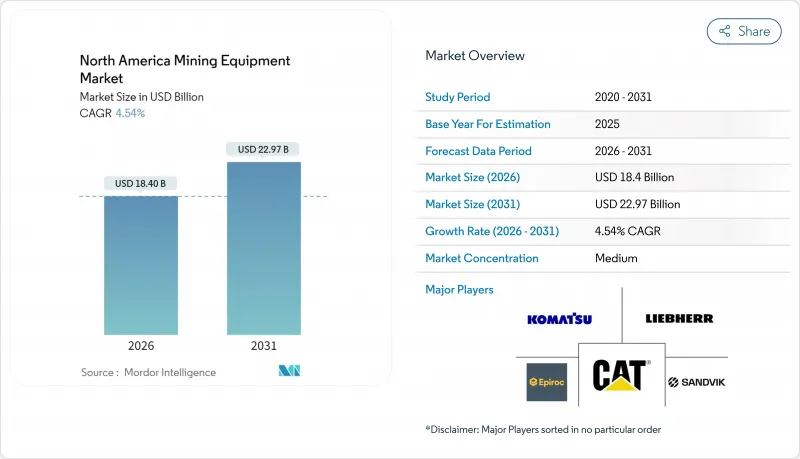
북미의 광산기계 시장은 2025년 176억 달러로 평가되었으며, 2026년 184억 달러에서 2031년까지 229억 7,000만 달러에 이를 것으로 예상됩니다. 예측 기간(2026-2031년)의 CAGR은 4.54%를 나타낼 것으로 전망됩니다.
차량의 전동화가 진행 중임, 자동화의 도입이 가속되고 있는 것, 에너지 전환에 따른 중요한 광물에 대한 수요가 이 꾸준한 확대를 지지하고 있습니다. 이는 사업자가 설비투자를 억제하고 설비 전체의 효율성에 주력하고 있는 상황에서도 마찬가지입니다. 디젤 배출 가스에 대한 규제 모니터링을 강화하고 지하 광산에서 환기 비용 절감을 추진함으로써 배터리 전기 운반 솔루션의 도입을 가속화하고 있습니다. 동시에 디지털 광산 플랫폼은 예지 보전 및 실시간 광석 추적을 통해 생산성 향상을 실현합니다. 광산업체는 금속가격 변동에 대응하기 때문에 차량의 수명주기 연장과 유연한 소유 모델의 도입을 추진하고 있으며, OEM 제조업체에게는 신중하면서도 견조한 판매 파이프라인이 형성되고 있습니다. 세계 기계 제조업체들이 자율 기술과 배출 제로 파워트레인을 단일 서비스 패키지에 통합함으로써 구매자에게 보다 명확한 총소유비용(TCO) 우위를 제공하고 경쟁의 격화가 예상됩니다.
환기 비용 절감, 톤당 비용의 65% 절감, 10-15%의 유지 보수 비용 절감으로 규제 압력이 없는 경우에도 배터리식 전기 운반 트럭은 디젤 차량을 대체할 수 있는 유력한 선택이 되고 있습니다. 인산철 리튬 배터리는 현재 24시간 가동 사이클을 지원하고 있으며 전기식 유닛이 디젤 차량과 동등한 가동 시간을 실현할 수 있습니다. 캐나다에서는 제로에미션 대형 차량에 대해 30%의 환불 가능한 세액공제가 적용되어 도입을 더욱 가속시키고 있습니다. 이를 통해 조기 도입 기업은 운영 측면과 ESG 측면에서 우위를 확보할 수 있습니다. 이러한 이점이 있음에도 불구하고 현재 가동중인 전동 차량은 제한되어 있으며, 온타리오, 퀘벡, 네바다의 광산 현장에서 급속 충전 인프라가 정비됨에 따라 성장의 여지가 매우 크다는 것을 보여줍니다. 이를 위해 OEM 각사는 모듈식 배터리 팩과 차재 에너지 관리 소프트웨어를 우선적으로 개발하여 교환 시간 단축과 파워트레인의 내구성 향상에 임하고 있습니다.
자율주행 운반 차량은 파일럿 프로젝트에서 미션 크리티컬한 생산 자산으로 규모를 확대하고 있습니다. 오퍼레이터는 무인 트럭 도입 후 생산성 향상과 인적 오퍼레이터에 의한 부상 사고의 완전한 근절을 보고하고 있습니다. 디지털 트윈은 드릴링, 운반 및 처리 데이터를 실시간으로 통합하여 예측 보전 분석을 통해 예기치 않은 다운타임 절감을 실현합니다. 원격지에서의 노동력 부족은 자율형 솔루션의 유효성을 더욱 뒷받침하고 있으며, 미국 중서부와 캐나다 북부에서는 숙련직 확보가 곤란한 상황입니다. 클라우드 연동형 IoT 센서는 베어링 진동, 유압, 적재 중량 분포를 지속적으로 모니터링하고 루트 최적화 및 자산 수명 연장을 실현하는 AI 알고리즘에 데이터를 제공합니다.
미국 환경보호청(EPA)이 제안한 Tier 5 디젤 기준은 고급 배기 후처리 시스템을 의무화하여 중견광산 기업에 있어서 단위 비용 상승과 자본 예산 편성의 복잡화를 가져옵니다. 지하광산사업자도 디젤미립자 배출량의 하한치 달성을 위해 통풍량을 늘려야 하고 전력 수요 증가와 이익률 저하를 초래하고 있습니다. 미국과 캐나다 주마다 서로 다른 시행시기가 설정되어 있어 규제 준수 불확실성이 높아지고 있으며, 여러 관할 구역에서 사업을 전개하는 기업은 가능한 한 제로 방출 차량에 대한 표준화를 강요받고 있습니다. 대기업은 보다 광범위한 자산 기반으로 이러한 비용을 분산할 수 있는 입장에 있기 때문에 북미 광산기계 시장의 통합이 가속화될 수 있습니다. 반면 중소기업은 대규모 초기 투자 없이 규제 준수를 유지하기 때문에 대여 계약 및 부품 개조를 선택하는 경향이 있습니다.
2025년 시점에서 노천굴 채굴 기기는 북미 광산기계 시장 점유율의 44.86%를 차지했지만, 광물 처리 유닛은 2031년까지 최고가 되는 8.14%의 연평균 복합 성장률(CAGR)로 확대가 전망되고 있습니다. 이 기세는 광산 기업이 변동하는 상품 가격과 저품위 광석에 직면하는 가운데, 다운스트림 공정에서의 가치 획득을 향한 전략적 전환을 반영하고 있습니다. 최종 사용자는 금속 회수율을 극대화하기 위해 고용량 크러셔, 에너지 절약형 SAG 밀, 모듈식 부동 셀을 주문하고 있습니다. 자율형 드릴링 장비와 실시간 광석 감지 기술도 보급되고 있으며, 운영자는 파쇄 입자 크기를 개선하고 톤당 에너지 소비를 줄일 수 있습니다.
광업기업이 원료광석의 수출에만 의존하지 않고 밸류체인 전체에 미치는 영향력을 확대하는 가운데 처리설비 수요 증가가 북미의 광산기계 시장을 견인하고 있습니다. OEM 제조업체는 분쇄·분급·탈수 공정을 단일의 제어 환경에 통합하는 플러그 앤 플레이형 디지털 모듈로 이것에 대응하고 있습니다. 지표설비 수요는 네바다주, 애리조나주, 퀘벡주 북부에 있어서 구리·리튬 프로젝트를 배경으로 견조를 유지하고 있습니다. 지하 작업의 심도화에 따라 자율 기능을 갖춘 보다 강력하고 컴팩트한 기계가 요구되는 가운데 지하용 로더와 드릴 수요도 꾸준히 증가하고 있습니다.
2025년 시점에서 디젤 플랫폼이 북미 광산기계 시장의 71.88%를 차지했지만, 전기식 유닛은 2031년까지 연평균 복합 성장률(CAGR) 8.66%를 나타낼 것으로 예측되고 있습니다. 배터리식 전기 운반 트럭은 순시 토크가 높고 연료비의 변동을 배제하기 위해 비용 안정성을 요구하는 사업자로부터 지지를 모으고 있습니다. 지하광산에서는 환기요건의 삭감과 노동자의 건강지표 개선에 의해 최대의 혜택을 받고, 지상작업에서는 과도적 조치로서 하이브리드 구동 시스템의 개조가 도입되고 있습니다.
충전 인프라는 여전히 주요 병목입니다. 송전망 허가의 지연을 보완하기 위해 이해관계자는 현장 설치형 태양광 발전 시스템과 축전지를 갖춘 마이크로그리드의 시험 운용을 진행하고 있습니다. OEM 제조업체는 브랜드를 넘어선 플릿의 유연성을 확보하기 위해 상호 운용 가능한 충전 표준에 주력하고 있습니다. 광산 내에서의 전기식 경차량의 도입 기반 확대는 고출력 기기의 광범위한 전개를 위한 토대를 구축하고, 북미의 광산기계 시장 전체에서 이용 데이터와 투자 신뢰성의 선순환을 창출하고 있습니다.
The North American mining equipment market was valued at USD 17.6 billion in 2025 and estimated to grow from USD 18.4 billion in 2026 to reach USD 22.97 billion by 2031, at a CAGR of 4.54% during the forecast period (2026-2031).
Ongoing electrification of fleets, accelerated automation roll-outs, and energy-transition-driven demand for critical minerals underpin this steady expansion, even as operators temper capital spending and focus on overall equipment efficiency. Heightened regulatory scrutiny on diesel emissions and a push for lower ventilation costs in underground mines are hastening the adoption of battery-electric haulage solutions. At the same time, digital mine platforms unlock productivity gains through predictive maintenance and real-time ore tracking. Mining companies are extending fleet lifecycles and embracing flexible ownership models to navigate metals-price volatility, creating resilient, albeit measured, sales pipelines for OEMs. Competitive intensity is expected to sharpen as global machinery leaders integrate autonomous technologies and emission-free powertrains into a single service envelope, giving buyers more apparent total-cost-of-ownership advantages.
Lower ventilation costs, a 65% reduction in cost per tonne moved, and 10-15% maintenance savings make battery-electric haul trucks a compelling alternative to diesel, even without regulatory pressure . Lithium-iron-phosphate batteries now support 24-hour duty cycles, allowing electric units to match diesel uptime. Canada's 30% refundable tax credit for zero-emission heavy-duty vehicles further accelerates uptake, positioning early adopters for operational and ESG advantages. Despite the upside, a limited number of active machines are electric today, underscoring a vast runway for growth as fast-charge infrastructure is rolled out at mine sites across Ontario, Quebec, and Nevada. OEMs are therefore prioritizing modular battery packs and on-board energy-management software to reduce swap times and improve powertrain longevity.
Autonomous haulage fleets have scaled from pilot projects to mission-critical production assets. Operators report productivity gains and a complete elimination of human-operator injury events after deploying driverless trucks. Digital twins synthesize data from drilling, haulage, and processing in real-time, enabling a reduction in unplanned downtime through predictive maintenance analytics . Labor shortages in remote regions further validate autonomous solutions, with the United States Midwest and Canada's North struggling to fill skilled roles. Cloud-linked IoT sensors now continuously monitor bearing vibration, hydraulic pressure, and payload distribution, feeding AI algorithms that optimize routes and prolong asset life.
Proposed Tier 5 diesel standards from the United States Environmental Protection Agency mandate advanced after-treatment systems, raising unit costs and complicating capital budgeting for mid-tier miners. Underground operators must also increase airflow to meet lower diesel particulate limits, elevating power demand and eroding margins. Varied timelines across the United States and Canadian provinces add compliance uncertainty, pushing multi-jurisdictional companies to standardize on zero-emission fleets where feasible. Larger corporations are better positioned to spread these costs across broader asset bases, potentially accelerating consolidation in the North American mining equipment market. Conversely, smaller firms lean toward rental agreements or component retrofits to remain compliant without large upfront outlays.
Other drivers and restraints analyzed in the detailed report include:
For complete list of drivers and restraints, kindly check the Table Of Contents.
In 2025, surface mining gear accounted for 44.86% of the North America mining equipment market share, while mineral processing units are projected to capture the highest 8.14% CAGR to 2031. This momentum reflects a strategic shift toward downstream value capture as miners confront volatile commodity pricing and lower ore grades. End users are ordering high-capacity crushers, energy-efficient SAG mills, and modular flotation cells to maximize metal recovery. Autonomous drilling rigs and real-time ore-sensing technologies are also gaining traction, allowing operators to improve fragment size and reduce energy per tonne milled.
Processing equipment's rise boosts the North American mining equipment market as miners expand leverage over the value chain rather than relying solely on raw-ore exports. OEMs respond with plug-and-play digital modules that integrate grinding, classification, and dewatering into a single control environment. Surface equipment demand remains robust, underpinned by copper and lithium projects in Nevada, Arizona, and northern Quebec. Underground loaders and drills are experiencing steady interest as operations move deeper, necessitating stronger, more compact machinery with autonomous capability.
Diesel platforms dominate the North American mining equipment market with a 71.88% share in 2025, yet electric units are forecast to grow at an 8.66% CAGR to 2031. Battery-electric haul trucks deliver higher instantaneous torque and eliminate fuel-cost variability, which resonates with operators seeking cost stability. Underground mines benefit most, reducing ventilation requirements and improving worker health metrics, while surface operations adopt hybrid drivetrain retrofits as a transitional step.
Charging infrastructure remains the principal bottleneck. To offset grid-permitting delays, stakeholders are trialing on-site solar arrays coupled with battery-storage microgrids. OEMs focus on interoperable charging standards to ensure fleet flexibility across brands. The expanding installed base of electric light vehicles inside mines lays the groundwork for broader high-power equipment deployment, creating a virtuous circle of utilization data and investment confidence throughout the North American mining equipment market.
The North American Mining Equipment Market is Segmented by Equipment Type (Surface Mining Equipment, Underground Mining Equipment, Mineral Processing Equipment, and More), Power Source (Diesel, Electric, and Hybrid), Application (Metal Mining, Industrial Mineral Mining, and More), Ownership Model (New Equipment Sales, Rental/Leasing, and More) and by Country. The Market Forecasts are Provided in Terms of Value (USD).