



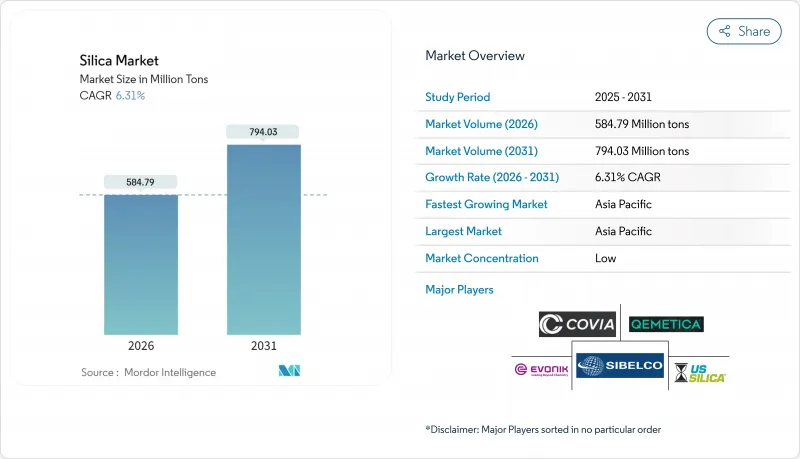
실리카 시장은 2025년 5억 5,008만 톤에서 2026년에는 5억 8,479만 톤으로 성장하며, 2026년부터 2031년까지 연평균 복합 성장률(CAGR) 6.31%를 나타낼 전망입니다. 2031년까지 7억 9,403만 톤에 이를 것으로 예측되고 있습니다.
이 견조한 확장은 건축자재, 에너지 절약 타이어, 태양전지용 유리 및 반도체 기판에서의 같은 광물의 중심 역할을 반영합니다. 아시아태평양의 인프라 투자 증가, 세계의 낮은 구름 저항 타이어의 보급 추진, 태양광 발전 설비의 가속적인 확대가 수요를 끌어올리는 한편 특수 등급 공급업체는 고순도 제품과 표면 개질 제품을 통해 가격 프리미엄을 확보하고 있습니다. 운송 비용 변동과 노동 위생 규제가 성장을 억제하는 반면, 바이오 가공 기술에 대한 투자와 지역 선광 강화는 실리카 시장의 장기적인 탄력적 전망을 지원합니다.
낮은 구름 저항 타이어는 연비를 3-7% 개선하고 유럽의 타이어 효율 표시 의무화 규제에 의해 트레드 컴파운드에 대한 실리카 배합량이 증가하고 있습니다. 고급 승용차용 타이어는 현재 최대 90 phr(피트/시간)의 침전 실리카를 포함하고 있으며, 이는 2020년 표준 수준의 두 배에 해당합니다. 상용차 플릿도 디젤 비용 절감을 위해 유사한 배합을 채용하고, 전기자동차 제조업체는 항속 거리 연장 때문에 이 동향을 더욱 강화하고 있습니다.
태양광 발전 설비 1기가와트당 철분 함량이 120ppm 미만인 초투명 실리카 베이스 유리가 1만 5,000-2만톤 필요합니다. 중국은 세계의 태양광 발전용 유리 생산 능력의 85% 이상을 차지하고 있으며 원료 품질을 보장하기 위해 새로운 플로트 유리 제조 라인과 자사용 실리카 선광 플랜트를 조합하고 있습니다. 양면 수광형 패널용 유리의 박형화에 의해 순도 사양이 더욱 엄격화되어 첨단 선광 기술에 대한 투자가 촉진되고 있습니다.
소성 점토 및 메타카올린 제품은 콘크리트 및 폴리머 복합재에서 동등한 보강 효과를 제공하면서 범용 제품 등급 실리카보다 최대 25% 미만의 가격으로 제공됩니다. 공급업체는 입자 표면 처리 기술에 대한 투자로 기존의 성능 차이를 줄이고 있으며, 미분화된 알루미나 실리케이트는 비용 중심 건설용 혼합재 시장에서 점유율을 확대하고 있습니다.
2025년 시점에서 결정질 등급은 실리카 시장의 99.15%를 차지했고 2031년까지 연평균 복합 성장률(CAGR) 6.22%를 나타낼 전망입니다. 석영은 열 안정성과 확립된 공급망으로 콘크리트, 유리, 주조용 주형에 필수적인 존재입니다. 트리디마이트와 크리스토발라이트는 고온 세라믹의 틈새 시장을 차지하지만 복잡한 상전이 처리는 규모 확장을 제한합니다. 비정질 등급은 생산량이 적은 것, 그린 타이어 컴파운드, 고고형분 배터리 슬러리, 반도체 CMP 슬러리에서 프리미엄 가격을 실현하고 있습니다. 전문 공급업체는 친수성 및 소수성 표면 처리 기술을 활용하여 대량 생산을 넘어 부가가치를 창출하고 있습니다.
환경규제 강화로 채굴된 결정성 원료로부터 흡입성 분진 위험이 낮은 설계된 비정질 형태로의 이행이 촉진되고 있습니다. 바이오의 껍질 실리카는이 요구 사항을 충족하고 수명주기에서 탄소 감소 효과와 아시아 타이어 제조 기지에 대한 근접성을 제공합니다. 진공 플래시 반응기와 낮은 알칼리 정제 라인에 대한 투자는 상품의 대량 생산을 추구하는 것이 아니라 소규모 고마진 제품군을 목표로 하는 전략을 뒷받침합니다. 그 결과, 실리카 시장은 고순도·용도 특화 그레이드와 건설용 벌크 모래로 양극화를 계속해, 가격차는 2030년까지 확대할 것으로 예측됩니다.
본 실리카 보고서는 유형별(비정질(흄드/파이로제닉, 수화물), 결정질(석영, 트리디마이트, 크리스토발라이트)), 최종 사용자 산업별(건축 및 건설, 셰일 오일·가스, 유리 제조, 수처리, 기타), 지역별(아시아태평양, 북미, 유럽, 남미, 중동 및 아프리카)으로 분류 시장 예측은 수량(톤) 단위로 제공됩니다.
아시아태평양은 2025년에 41.00%의 점유율을 차지했고, 2031년까지 연평균 복합 성장률(CAGR) 8.10%로 성장해 실리카 시장을 독점하고 있습니다. 중국은 전략적 비축과 통합된 선광 거점에 지지되어 건설, 태양광 발전용 유리, 화학 파생 제품에서 연간 2억톤 이상을 소비하고 있습니다. 인도에서는 고속도로망의 확충과 스마트 시티 계획이 국내 수요를 밀어 올리고 있어 정부 보조금이 왕겨 실리카 사업의 확대를 촉진. 이로 인해 현지 타이어 공장과 수출 시장 모두에 공급이 이루어지고 있습니다.
북미는 셰일 프로판트 공급의 핵심 위치를 차지하고 있으며 위스콘신, 텍사스 및 앨버타의 광상은 엄격한 파쇄 강도 사양을 충족합니다. 이 지역의 가공 플랜트는 멕시코 걸프의 유리 용해로를 위한 공급망을 단축하고 캐나다 생산자는 LNG 건설과 그린 수소 인프라로부터 수요를 받고 있습니다. 규제 요인, 특히 OSHA의 흡입성 실리카 제한은 광산업자에게 습식 처리 및 밀폐형 처리 시스템으로의 전환을 촉구하고 있으며, 설비 투자가 증가하는 것 보험 책임은 저감됩니다.
유럽에서는 독일, 프랑스, 영국을 중심으로 안정적인 부가가치 수요가 존재합니다. 자동차·화학 유저는 고순도 등급을 요구하고 EU 순환 경제 지령은 재생재·바이오 베이스 원료의 이용을 촉진하고 있습니다. 동유럽 공급업체(특히 Qemetica사의 확장된 폴란드 거점)는 서유럽의 OEM 기업과 성장하는 튀르키예·북아프리카 건설 시장 양쪽에의 근접성을 살리고 있습니다. 에너지 절약형 킬른 기술과 현지 태양광 발전 설비에 대한 투자는 EU의 탈탄소화 규제에 따른 것으로, 지역의 장기적인 경쟁력의 기반이 됩니다.
The Silica market is expected to grow from 550.08 Million tons in 2025 to 584.79 Million tons in 2026 and is forecast to reach 794.03 Million tons by 2031 at 6.31% CAGR over 2026-2031.
This robust expansion mirrors the mineral's central role in construction materials, energy-efficient tires, solar glass, and semiconductor substrates. Rising infrastructure spending in Asia-Pacific, the global push for low-rolling-resistance tires, and accelerating photovoltaic build-outs are amplifying demand, while specialty-grade suppliers secure pricing premiums through high-purity and surface-modified offerings. Freight-cost volatility and occupational-health regulations temper growth, yet investment in bio-based processing and regional beneficiation reinforce a resilient long-term outlook for the silica market.
Low-rolling-resistance tires improve fuel economy by 3-7%, and European regulations that mandate tire-efficiency labeling spur higher silica loadings in tread compounds. Premium passenger-car tires now contain up to 90 phr of precipitated silica, double typical 2020 levels. Commercial fleets adopt similar formulations to lower diesel costs, while electric-vehicle makers intensify the trend to extend driving range.
Each gigawatt of solar deployment requires 15,000-20,000 tons of ultra-clear silica-based glass with iron content below 120 ppm. China commands over 85% of global PV-glass capacity and is pairing new float-glass lines with captive silica-beneficiation plants to guarantee feedstock quality. Thinner bifacial-panel glass further tightens purity specifications, driving investment in advanced beneficiation.
Calcined-clay and metakaolin products undercut commodity-grade silica by up to 25% while offering comparable reinforcement in concrete and polymer composites. Suppliers invest in particle-surface treatments that narrow historical performance gaps, with micronized aluminosilicates gaining share in cost-sensitive construction mixes.
Other drivers and restraints analyzed in the detailed report include:
For complete list of drivers and restraints, kindly check the Table Of Contents.
Crystalline grades account for 99.15% of the silica market in 2025 and are expanding at a 6.22% CAGR through 2031. Quartz remains indispensable in concrete, glass, and foundry molds thanks to thermal stability and a well-established supply chain. Tridymite and cristobalite fill smaller high-temperature ceramics niches, but their complex phase-conversion processing limits scale. Amorphous grades, while minor by tonnage, command premium pricing in green-tire compounds, high-solids battery slurries, and semiconductor CMP slurries. Specialty suppliers leverage hydrophilic and hydrophobic surface treatments that capture value beyond bulk tonnage.
Elevated environmental scrutiny encourages migration from mined crystalline inputs toward engineered amorphous forms with lower respirable-dust risk. Bio-based rice-husk silica meets this requirement while offering life-cycle carbon savings and proximity to Asian tire-manufacturing centers. Investment in vacuum flash reactors and low-alkali purification lines underscores the strategy of targeting smaller, higher-margin parcels rather than chasing commodity volume. As a result, the silica market continues bifurcating into high-purity, application-specific grades and bulk construction sand, with pricing divergence expected to widen through 2030.
The Silica Report is Segmented by Type (Amorphous (Fumed/Pyrogenic, and Hydrated), Crystalline (Quartz, Tridymite, and Cristobalite)), End-User Industry (Building and Construction, Shale Oil and Gas, Glass Manufacturing, Water Treatment, and Others), and Geography (Asia-Pacific, North America, Europe, South America, and Middle-East and Africa). The Market Forecasts are Provided in Terms of Volume (Tons).
Asia-Pacific dominates the silica market with 41.00% share in 2025 and an 8.10% CAGR to 2031. China consumes over 200 million tons annually across construction, photovoltaic glass, and chemical derivatives, underpinned by strategic reserves and integrated beneficiation hubs. India's highway expansion and smart-city programs lift domestic demand, while government subsidies accelerate rice-husk silica ventures that feed both local tire plants and export outlets.
North America holds a pivotal position in shale proppant supply, with Wisconsin, Texas, and Alberta deposits meeting stringent crush-strength specifications. Regional processing plants shorten supply chains for Gulf Coast glass furnaces, while Canadian producers capture demand from LNG construction and green-hydrogen infrastructure. Regulatory drivers, notably OSHA respirable-silica limits, push miners toward wet-processing and enclosed-handling systems that boost capex but lower insurance liabilities.
Europe presents stable, value-added demand centered on Germany, France, and the United Kingdom. Automotive and chemical users specify high-purity grades, and EU circular-economy directives promote recycled and bio-based inputs. Eastern European suppliers, led by Qemetica's expanded Polish site, benefit from proximity to both Western OEMs and growing Turkish and North African construction markets. Investments in energy-efficient kiln technology and on-site solar arrays align with EU decarbonization rules, anchoring long-term regional competitiveness.