



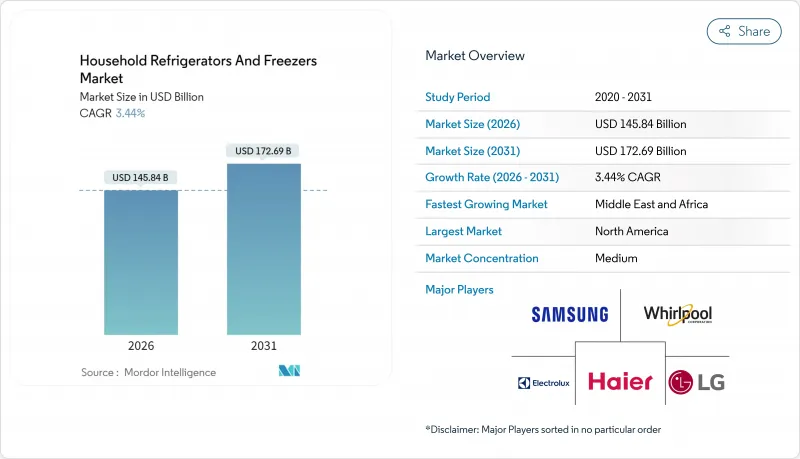
2026년 가정용 냉장고 및 냉동고 시장 규모는 1,458억 4,000만 달러로 추정되며, 2025년 1,409억 9,000만 달러에서 성장할 것으로 예상됩니다.
2031년에는 1,726억 9,000만 달러로 2026년부터 2031년까지 연평균 복합 성장률(CAGR) 3.44%로 확대될 전망입니다.
북미와 유럽연합의 에너지 절약 규제, 고GWP 냉매의 급속한 단계적 폐지, 신흥 아시아 국가의 꾸준한 도시화가 결합되어 완만하면서도 지속적인 확대를 뒷받침하고 있습니다. 스마트 연결 모델의 수요 증가, R600a 및 R290 등 천연 냉매의 보급 확대, 성숙 경제권의 지속적인 주방 개보수 사이클이 프리미엄 제품의 도입을 더욱 촉진하고 있습니다. 한편, 반도체 부족으로 인한 생산 리드 타임의 장기화와 여러 개발도상국의 전기 요금 상승이 교체 사이클을 억제하고 있습니다. 따라서 주요 제조업체는 자사 부품의 조달 강화, 공급망 단축을 위한 지역 공장 건설, AI를 활용한 식품 관리 기능을 위한 연구개발 투자 확대에 주력하고 있습니다. 이러한 움직임이 더하여 가정용 냉장고 및 냉동고 시장 전체에서 혁신이 지속됨과 동시에 단계적인 가치 성장을 뒷받침하고 있습니다.
성숙 경제권에서는 의무화된 효율화 기준의 강화로 제품 업그레이드 사이클이 가속화되고 있습니다. 미국 에너지부는 2029년 및 2030년에 시행되는 냉장고 기준을 확정하면서 연간 에너지 소비량에 대해 두 자릿수 퍼센트의 감축을 요구하고 있습니다. 더불어, EU의 개정 프론 규제에서는 2026년 1월부터 가정용 기기에서의 불소계 냉매 사용을 금지했으며, 이소부탄 또는 프로판 시스템으로의 완전 이행을 촉진하고 있습니다. 주요 OEM 제조업체는 이미 천연 가스 냉매로의 전환을 완료했습니다. GE 어플라이언스는 2024년까지 수년에 걸쳐 R600a 도입을 완료했으며 10%의 효율 향상과 오존층 파괴 계수 0을 달성했습니다. ENERGY STAR 등의 보완적인 표시제도에서는 냉매의 유형이 명시되어 소비자가 저GWP 대체품을 선택하도록 촉구하고 있습니다.
신흥 아시아시장에서는 중산층 확대와 도시화 동향으로 첫 구매 수요가 견조하게 유지되고 있습니다. 인도의 냉매 시장은 가전보급률과 밀접하게 관련되어 있으며, 저GWP 냉매의 도입 확대와 가전소유율의 증가에 따라 향후 5년간 CAGR 6-8%의 성장이 전망되고 있습니다. 중국 정부의 8가지 유형의 가전제품을 대상으로 한 교체 보조금 제도는 2025년 1월로 확대되어 국내 냉장고 시장에서 추정 40-50%의 점유율을 차지하는 하이얼 등 주요 제조업체에 직접적인 혜택을 가져왔습니다. 이러한 지역 수요 패턴에서는 대용량 유닛과 멀티 도어 구성이 선호되고, 중국 소비자는 기존 모델의 평균 가격의 1.4배에 달하는 빌트인 디자인을 점점 선택하는 경향이 있습니다. 규제 준수의 복잡화도 과제이며 인도가 2021년에 키갈리 개정을 비준함에 따라 2024년부터 HFC 단계적 삭감 요건이 개시되어 Refex Industries와 같은 공급업체에게 기회가 탄생하고 있습니다. 이 회사는 2024-25년도에 LG 및 Voltas와의 제휴를 포함하여 1,370m 톤의 냉매를 공급했습니다.
지속적인 반도체 부족으로 고급 브랜드용 냉장고의 리드 타임은 6개월 이상으로 연장되고 있습니다. 써마도사에 의하면, 사이드 바이 사이드형을 포함한 주요 카테고리 모두가 전원 관리 IC나 마이크로 콘트롤러의 공급 부족에 의해 제약을 받고 있습니다. 이 영향은 고급 브랜드에 머물지 않고, 현대의 냉장고 시스템의 에너지 절약 성능이나 스마트 기능에 필수적인 반도체 및 전자 부품 전반에 걸쳐 작용합니다. 냉장고와 부품 공급망을 공유하는 인도의 공조 시장에서는 부품 부족으로 단가가 18-24달러(1,500-2,000루피/4-5%) 상승할 가능성이 있습니다. 또한 컴프레서 부족과 BIS 인증 지연으로 인해 1대당 12-14.50달러(1,000-1,200루피)의 추가 비용이 발생하고 있습니다. 중국의 제조업체는 공급망의 다양화로 대응하고 있으며, 하이얼은 143곳의 세계 제조 거점으로 확대하고, 미데아는 40개 이상의 주요 생산 거점을 운영해 물류 및 무역 리스크를 경감하고 있습니다.
2025년 상냉동 냉장고는 가격 우위와 컴팩트한 설치 면적으로 가정용 냉장고 및 냉동고 시장에서 42.79%의 점유율을 차지하면서 매출의 기반이 되었습니다. 그러나 소비자가 넓은 내부 공간, 폭이 넓은 선반, 고도의 온도 관리 구역을 요구하는 경향이 있기 때문에 프렌치 도어형 하위 부문은 2031년까지 8.37%라는 최고의 CAGR을 나타낼 것으로 예측되고 있습니다. 삼성의 2025년 비스포크 인공지능 프렌치 도어 제품군은 하이브리드 컴프레서와 펠티어 냉각, 식품 인식 비전 소프트웨어를 통합하고 있으며, 이 조합을 통해 가치를 높이면서 향후 에너지 기준도 충족하고 있습니다. 사이드 바이 사이드 구성은 신선 식품과 냉동 식품의 비율 간에 균형이 잡혀 있기 때문에 북미에서는 여전히 인기가 있지만, 하냉동 모델은 눈높이에서 식재료에 접근할 수 있는 것을 우선시하는 건강 지향 구매자들 사이에서 인기가 높아지고 있습니다. 현재 벽 두께의 감소가 혁신의 목표가 되고 있습니다. Whirlpool의 SlimTech 진공 단열 기술은 캐비닛 벽을 66% 줄이고 내부 부피를 25% 확대하여 도시 지역의 공간 제약을 직접적으로 해결합니다. 통합 주방에 대한 수요 증가는 캐비닛과 원활하게 조화를 이루는 멀티 도어 유닛을 더욱 유리하게 만들고 가정용 냉장고 및 냉동고 시장에서 프리미엄 기회를 확대하고 있습니다.
2차적인 동향으로는 연결성의 도입과 항균 내장을 들 수 있습니다. LG의 '노크온' 패널은 내부를 밖에서 확인 가능하며 냉기 손실을 줄이고 연간 소비 전력을 저감합니다. 내장 UV-C 모듈은 냄새와 박테리아를 억제합니다. 중국 소매 분석에 의하면, 멀티 도어형은 2024년 상반기에 온라인 판매 점유율 58%를 돌파하였으며, 구획화된 레이아웃으로의 세계적인 전환을 뒷받침하고 있습니다. 제조업체 각사는 고이익률 확보를 위해, 라이프스타일 테마별(가족용, 건강 지향, 도시형 로프트)로 제품 라인을 세분화하고 있습니다. 이러한 다면적인 디자인 변혁이 더하여 프렌치 도어 부문은 2031년까지 가정용 냉장고 및 냉동고 시장의 규모 확대에 크게 공헌할 전망입니다.
북미는 2025년 가정용 냉장고 및 냉동고 시장에서 31.05%의 점유율을 획득하면서 매출을 견인했습니다. 이는 소유율의 포화 상태, 활발한 구매 사이클, 스마트 기능에 대한 수요에 의해 뒷받침됩니다. 삼성과 LG는 모두 미국제 내장 부문을 중점 영역으로 자리매김했으며, 각각 Dacor와 Signature Kitchen Suite를 활용하여 건설업자와의 제휴를 확보하여 두 자릿수의 프리미엄 성장을 달성했습니다. GE 어플라이언스는 2029년까지 30억 달러를 투자해 국내 11개 공장에서 냉장고 생산 확대를 추진하면서 지속적인 리쇼어링 기세를 보여주고 있습니다. 이 지역의 CAGR 3.74%는 세계 평균보다 낮지만, 안정적인 가격 구조 개선으로 가정용 냉장고 및 냉동고 시장에서 가장 큰 매출원으로 자리를 잡고 있습니다. 아시아태평양은 도시화, 최초 구매 수요, 현지 생산 투자에 힘입어 6.32%라는 가장 높은 CAGR을 달성하고 있습니다. 중국에서는 2024년에 44억 8,000만대의 가전이 출하되었고 이는 전년 대비 20.8% 증가했습니다. 이는 수출의 다양화와 국내 보조금 제도를 반영합니다. 인도의 가전 부문은 1인당 보급률이 여전히 낮지만, 중산층의 확대에 의해 혜택을 받고 있습니다. 반면 부품 부족은 가격 상승을 촉구하고 있습니다. 지역규제는 천연 냉매를 권장하고 있으며, 인도의 키갈리 협정에 따른 HFC의 단계적 저감은 중용량 모델에서 R290의 도입을 촉진하고 기후 변화 대책과의 무결성을 강화하고 있습니다.
유럽에서는 엄격한 경제 상황과 규제 전환으로 컴플라이언스 비용이 증가하면서 혁신이 가속화되어 CAGR 2.84%의 완만한 성장이 예상됩니다. EU 프론 규제에 의해 2026년 1월부터 가정용 냉장고에 대한 불소계 온실 가스의 사용이 금지되기 때문에 최근 이행 압력이 발생하고 있습니다. 다만 BSH 등의 제조업체는 멕시코 신규 냉동 공장 건설이나 연구 개발비 확충(총 8억 5,000만 유로, 9억 1,800만 달러에 육박하는 규모) 등, 컴플라이언스 대응에 거액의 투자를 실시했습니다. 유럽의 업계 단체는 규제의 분단화, 미국 대비 2-3배 높은 전력 비용, 중요 자재 공급망의 집중화에 의한 경쟁력 과제의 심각성을 강조하고 있습니다. 중동 및 아프리카는 6.87%의 연평균 복합 성장률(CAGR)로 가장 빠른 성장이 예상되며, 샤프사의 3,000만 달러 규모 이집트 합작사업과 하이얼의 동지역 내 26.8%의 매출 성장 등 전략적 투자가 뒷받침하고 있습니다. 이들은 현지 생산과 불안정한 전력 인프라에 맞춘 제품 전개에 기인합니다.
The household refrigerators and freezers market size in 2026 is estimated at USD 145.84 billion, growing from 2025 value of USD 140.99 billion with 2031 projections showing USD 172.69 billion, growing at 3.44% CAGR over 2026-2031.
Energy-efficiency mandates in North America and the European Union, the rapid phase-out of high-GWP refrigerants, and steady urbanization across emerging Asia together underpin this moderate yet durable expansion. Rising demand for smart-connected models, wider adoption of natural refrigerants such as R600a and R290, and ongoing kitchen renovation cycles in mature economies further stimulate premium product uptake. At the same time, semiconductor shortages continue to lengthen production lead times, while elevated electricity tariffs in several developing countries temper replacement cycles. Leading manufacturers are therefore doubling down on in-house component sourcing, building regional factories to shorten supply chains, and intensifying R&D outlays targeting AI-driven food-management functions. These dynamics collectively sustain innovation while supporting incremental value growth throughout the household refrigerators and freezers market.
Mandatory efficiency upgrades are accelerating replacement cycles across mature economies. The U.S. Department of Energy has finalized refrigerator standards taking effect in 2029 and 2030, demanding double-digit percentage cuts in annual energy use. In parallel, the EU's revised F-Gas Regulation bans fluorinated refrigerants in domestic units from January 2026, prompting full conversion to isobutane or propane systems. Leading OEMs have already transitioned to natural gases; GE Appliances finished a multiyear R600a roll-out during 2024, citing 10% efficiency gains and zero ozone-depletion potential. Complementary labelling schemes such as ENERGY STAR now spotlight refrigerant type, nudging consumers toward low-GWP alternatives.
Emerging Asian markets demonstrate robust first-time purchase demand driven by middle-class expansion and urbanization trends. India's refrigerant market, closely tied to appliance penetration, is forecast to grow 6-8% CAGR over the next five years as adoption of low-GWP refrigerants increases alongside appliance ownership. China's government trade-in subsidy program for eight home appliance categories, expanded in January 2025, directly benefits major manufacturers like Haier, which holds an estimated 40-50% share in the domestic refrigeration segment. The region's demand patterns favor larger-capacity units and multi-door configurations, with Chinese consumers increasingly selecting embedded (built-in) designs that command average prices 1.4x conventional models. Regulatory compliance adds complexity, as India's ratification of the Kigali Amendment in 2021 initiated HFC phase-down requirements in 2024, creating opportunities for suppliers like Refex Industries, which supplied 1,370 MT of refrigerants in FY24-25 with partnerships including LG and Voltas.
Persistent chip shortages extend refrigerator led times to upward of six months for high-end brands. Thermador notes that every major category, including side-by-side units, remains constrained owing to power-management IC and microcontroller gaps. The impact extends beyond premium brands, as semiconductors and electronic components are integral to modern refrigeration systems' energy efficiency and smart features. India's air conditioning market, which shares component supply chains with refrigeration, faces component shortages that may increase unit prices by USD 18-24 (Rs 1,500-2,000) (4-5%), with compressor shortages and BIS certification delays adding USD 12 -14.50 (Rs 1,000-1,200) per unit. Chinese manufacturers are responding through supply chain diversification, with Haier expanding to 143 global manufacturing centers and Midea operating over 40 major production bases to mitigate logistics and trade risks.
Other drivers and restraints analyzed in the detailed report include:
For complete list of drivers and restraints, kindly check the Table Of Contents.
Top-freezer units accounted for 42.79% of the household refrigerators and freezers market share in 2025, anchoring sales through their price advantage and compact footprint. Yet the French-door sub-segment is forecast to register the highest 8.37% CAGR through 2031 as consumers gravitate toward spacious interiors, wide shelves, and advanced climate zones. Samsung's 2025 Bespoke AI French-door portfolio integrates hybrid compressor-Peltier cooling and Food Recognition Vision software, a combination that elevates perceived value while meeting forthcoming energy benchmarks. Side-by-side configurations remain popular in North America for their balanced fresh-to-frozen ratio, whereas bottom-freezer models gain traction among wellness-focused buyers prioritizing eye-level produce access. Innovation now targets wall-thickness reduction; Whirlpool's SlimTech vacuum insulation trims cabinet walls by 66% and boosts interior volume by 25%, directly addressing urban space constraints. Growing demand for integrated kitchens further favors multi-door units that blend seamlessly with cabinetry, broadening premium opportunities within the household refrigerators and freezers market.
Second-tier trends include connectivity adoption and antimicrobial interiors. LG's door-in-door "knock" panels let users preview contents, cutting cold-air loss and lowering annual consumption, while built-in UV-C modules promise odor and germ suppression. Chinese retail analytics show that multi-door styles surpassed 58% online share in 2024H1, reinforcing a global pivot toward compartmentalized layouts. Manufacturers are therefore segmenting lines by lifestyle themes, family, wellness, and urban loft to command higher margins. These multifaceted design shifts collectively underpin the French-door segment's outsize contribution to household refrigerators and freezers market size expansion through 2031.
The Household Refrigerators and Freezers Market Report is Segmented by Type (Top-Freezer Refrigerators, Bottom-Freezer Refrigerators, Side-By-Side Refrigerators, French Door Refrigerators), Capacity (Less Than 300 Litres, 300 - 500 Litres, Greater Than 500 Litres), Distribution Channel (Multi-Branded Stores, and Other), and Geography (North America and Other). The Market Forecasts are Provided in Terms of Value (USD).
North America led revenue with a 31.05% household refrigerators and freezers market share in 2025, sustained by near-saturated ownership, brisk replacement cycles, and demand for smart features. Samsung and LG both prioritized the U.S.-built-in segment, leveraging Dacor and Signature Kitchen Suite, respectively, to secure builder partnerships and achieve double-digit premium growth. GE Appliances committed USD 3 billion through 2029 to expand fridge output across 11 domestic plants, underlining continued reshoring momentum. Although the region's 3.74% CAGR trails global averages, steady price-mix gains keep it the largest profit pool in the household refrigerators and freezers market. APAC delivers the fastest 6.32% CAGR, propelled by urbanization, first-time purchasing, and local manufacturing investments. China shipped 4.48 billion home appliances in 2024, up 20.8% year-on-year, reflecting export diversification and domestic subsidy schemes. India's appliances segment, still at low per-capita penetration, benefits from an expanding middle class even as component shortages nudge prices higher. Regional regulations favor natural refrigerants; India's Kigali-based HFC phase-down fosters uptake of R290 in mid-capacity models, reinforcing climate alignment.
Europe faces moderate growth at a 2.84% CAGR amid challenging economic conditions and regulatory transitions that increase compliance costs while driving innovation. The EU F-gas Regulation's January 2026 prohibition on fluorinated greenhouse gases in domestic refrigerators creates immediate transition pressure, though manufacturers like BSH have invested heavily in compliance, including a new refrigeration factory in Mexico and enhanced R&D spending approaching €850 million (USD 918 million). European industry associations emphasize competitiveness challenges from fragmented regulations, high electricity costs 2-3x US levels, and supply chain concentration for critical materials. The Middle East & Africa region exhibits the fastest forecast growth at 6.87% CAGR, supported by strategic investments like Sharp's USD 30 million joint venture in Egypt and Haier's 26.8% revenue growth in the region, driven by localized production and products adapted to unreliable power infrastructure.