


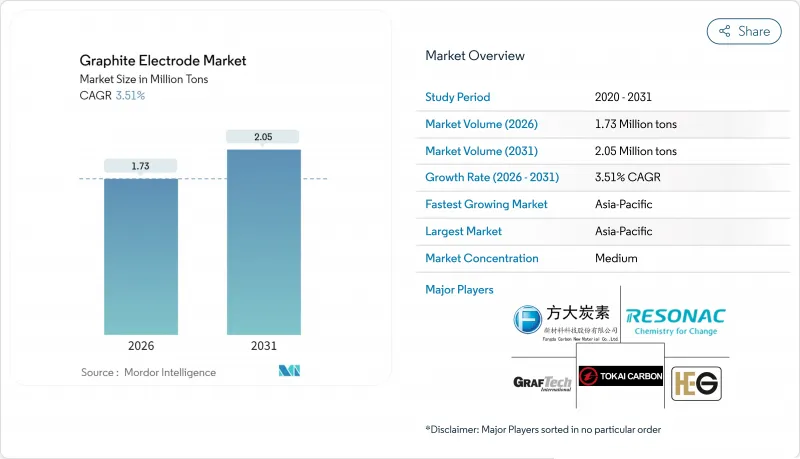
2026년 흑연 전극 시장 규모는 173만t으로 추정되며, 2025년 167만t에서 성장할 전망입니다.
2031년에는 205만 톤에 달하고, 2026년부터 2031년에 걸쳐 CAGR 3.51%를 나타낼 것으로 예상됩니다.
수요 증가의 배경은 철강 산업에서 전기 아크로(EAF) 기술로의 전환, 환경 규제 강화, 초고전력(UHP) 전극의 운영상의 이점을 포함합니다. 특히 중국과 유럽연합(EU)에서 제강의 탈탄소화를 위한 정책 압력 강화는 스크랩 기반 생산의 장기적인 보급을 뒷받침하고 있는 반면, 고품질 전극 등급은 제철소의 강철 1톤당 전력 소비 절감에 기여하고 있습니다. 니들 코크스 공급 리스크와 배터리 흑연과의 경쟁은 단기적인 생산 능력 확대를 제약하는 반면 수직 통합과 재활용 기술의 진전은 원료 비용 압력을 부분적으로 상쇄합니다. 아시아태평양은 대규모 철강 생산량, 급속한 EAF 도입, 비중국 공급업체들에게 유리한 무역 재편을 배경으로 주요 수요 기지로 남아 있습니다. 경쟁 전략은 원료 확보, 인공지능을 활용한 퍼니스 최적화, 사용된 전극의 폐쇄 루프 재활용의 상업화를 중심으로 전개되는 경향이 강해지고 있습니다.
전기 아크로 제강은 2025년 세계 생산량의 30%를 차지했고 고로 배출 규제 강화에 따라 2030년까지 40%에 이를 것으로 예측됩니다. 이 제법은 기존의 산소 고로법에 비해 CO2 배출량을 최대 70% 삭감하고 유럽과 동아시아에서 기업의 넷 제로 목표 달성을 지원합니다. 중국은 2024년 상반기에 신규 석탄 기반 제철 프로젝트를 금지하고 제철 능력의 지속적인 증가에도 불구하고 이러한 동향을 강화했습니다. EAF의 유연성으로 전력 가격이 급등했을 때 생산량을 조정할 수 있기 때문에 에너지 시장이 불안정한 지역에서 유용합니다. 이러한 전환은 높은 전류 밀도를 견디는 고성능 전극의 장기적인 수요를 지속시켜 흑연 전극 시장을 강화합니다.
수십년전에 건설된 인프라의 수명이 다함에 따라 스크랩 풀이 확대되고 북미와 유럽에서 2차 제강의 원료 공급이 증가하고 있습니다. 선별 기술의 진보에 의해 스크랩의 순도가 향상되어, 제철소는 익지않는 철광석을 사용하지 않고 엄격한 품질 사양을 충족하는 것이 가능하게 되었습니다. 아시아태평양 국가에서는 가정용 및 산업용 스크랩을 수집 및 처리하는 현대적인 파쇄 설비와 물류 네트워크에 대한 투자가 가속화되고 있습니다. 전기로강 1톤당 1-2kg의 흑연 전극을 소비하기 때문에 스크랩유통량의 확대는 흑연 전극 시장 예측 가능한 수요와 성장을 창출합니다. 이 동향은 코크스용 석탄에의 의존도를 저감해, 탈탄소화의 목표에도 합치합니다.
침상 코크스는 전극 생산 비용의 최대 60%를 차지하며 매우 적은 수의 플랜트에 집중하는 특수 석유 정제 능력에 의존합니다. 2024년 미국 코크스 생산량 3% 감소로 공급이 희박한 가운데 전지 섹터 수요가 공급 압력을 더욱 증폭시켰습니다. 유황 함유량이나 열팽창 계수 등의 품질 사양에 의해 사용 가능한 원료가 한정되어 대체가 곤란합니다. 스팟 가격은 12개월 동안 40% 이상 변동했기 때문에 전극 제조업체는 가능한 한 위험 회피와 장기 계약으로 보장해야합니다. 신규 니들 코크스 프로젝트의 지연으로 2027년까지 흑연 전극 시장은 희박한 상태가 계속될 전망입니다.
초고압전극은 2025년에 흑연 전극 시장의 69.88%를 차지했고 2031년까지 연평균 복합 성장률(CAGR) 4.06%로 확대될 것으로 예측됩니다. 이 부문은 열당 400톤 이상의 대형 전기로(EAF)를 도입함으로써 혜택을 누리고 있습니다. 이러한 노는 구조적 무결성을 유지하면서 높은 전류 밀도를 필요로 합니다. 제철소가 총소유비용(TCO)을 중시하는 경향이 있기 때문에 전극수명의 연장과 교환시의 다운타임 삭감이 프리미엄 가격설정을 정당화하고 있습니다. 흑연 전극 시장은 고전력(SHP) 및 정상 전력(RP) 등급에서 UHP 등급으로 계속 전환하고 있으며, 기술이 성숙함에 따라 평균 판매 가격(ASP)의 차이가 감소하는 경향이 있습니다.
초고전력 전극의 제조에는 최고급 니들 코크스와 복수회의 흑연화 사이클이 불가결하며, 수직 통합형 제조업체는 자사 코크스로와 선도 계약에 의한 원료 확보를 추진하고 있습니다. 신규 진출기업은 자본면에서의 장벽과 엄격한 품질 검증에 직면하고 있으며, 이로써 흑연 전극 시장에서의 현행 경쟁 구도가 유지되고 있습니다. 특히 인도와 동남아시아 지역의 고로·산소 취입로에서 전기로(EAF)로의 전환이 UHP 수요의 점증을 지지하고 있습니다. 탄소 실적에 대한 지속가능성 인증은 조달 심사를 엄격하게 하고 사업 운영에 있어서 폐쇄 루프 재활용과 재생에너지 이용을 실증하는 공급자를 우대하는 경향이 있습니다.
본 「흑연 전극 시장 보고서」는 전극 등급(초고전력(UHP), 고전력(SHP), 통상 전력(RP)), 용도(전기 아크로, 기본 산소로, 비철금속), 지역(아시아태평양, 북미, 유럽, 남미, 중동, 아프리카)별로 분석했습니다. 시장 예측은 수량(톤) 단위로 제공됩니다.
2025년 아시아태평양은 흑연 전극 시장을 독점하여 59.12%의 점유율을 차지했으며 2031년까지 연평균 복합 성장률(CAGR) 4.58%라는 가장 빠른 성장을 기록했습니다. 중국의 석탄 기반 신규 제철소 건설에 대한 정책 규제와 인도의 야심적인 인프라 계획이 이 지역의 성장을 지원하고 있습니다. 2025년 3월에 발효한 중국제 전극에 대한 일본의 95.2%의 수입 관세에 의해 현지 바이어는 국내 및 한국 공급자에의 조달처 다양화를 강요받아, 아시아 역내의 무역 흐름이 변화하고 있습니다. 한국의 고급 강재 부문은 자동차 등급 생산에 초고순도 전극을 의존하고 있으며, 확대되는 배터리 재료 생태계가 폐쇄 루프 재활용 협업을 촉진하고 있습니다.
북미에서는 견조한 스크랩 회수 네트워크와 전기로 제철소의 지속적인 효율화로 인해 중간 정도의 단일 자리 수요 증가가 지속되고 있습니다. 중서부 및 남동부의 풍부한 셰일 가스 유래 전력은 낮은 운영 비용을 지원하고 주요 미니 밀에 의한 생산 능력 확대를 촉진합니다. 캐나다에서는 온타리오주와 퀘벡주에서 수력발전을 활용한 전기로를 가동시켜 스코프2 배출량 저감 목표를 달성. 이로 인해 고품위 전극의 조달 수요가 높아지고 있습니다. 멕시코는 미국으로부터의 스크랩 공급원에 가까워 자동차 생산의 급증도 함께 지역 전체의 전극 수입량이 증가하는 경향이 있습니다.
유럽에서는 거시경제의 연조가 계속되고 있습니다만, 2025년 이후는 복수년에 걸친 축소를 거쳐, 겉보기의 철강 소비량이 2.20% 회복할 것으로 예측되고 있습니다. 급등하는 에너지 비용이 제철소를 디지털로 최적화와 유연한 생산 스케줄링으로 이끌고 있어, 모두 신뢰성이 높은 초고순도 전극을 필요로 합니다. EU 배터리 규정 2023/1542는 사용된 전극을 애노드 재료로 재활용하는 관심 증가를 뒷받침하고, 철강과 배터리공급 체인을 통합함으로써 흑연 전극 시장을 강화합니다. 폴란드와 튀르키예를 포함한 노동 비용이 낮고 건설 부문이 성장하고 있는 동유럽 국가들은 새로운 전기로 투자를 획득하고 전극 출하량을 2020년대 후반까지 밀어 올립니다.
Graphite Electrode market size in 2026 is estimated at 1.73 million tons, growing from 2025 value of 1.67 million tons with 2031 projections showing 2.05 million tons, growing at 3.51% CAGR over 2026-2031.
Demand growth stems from the steel industry's pivot toward electric-arc-furnace (EAF) technology, stronger environmental regulations, and the operational advantages of ultra-high-power (UHP) electrodes. Intensifying policy pressure to decarbonize steelmaking, especially in China and the European Union, supports long-run uptake of scrap-based production, while premium electrode grades help mills cut electricity consumption per ton of steel. Needle coke supply risk and competition from battery-grade graphite constrain short-term capacity additions, yet vertical integration and recycling advances partially offset raw-material pressure. Asia-Pacific remains the principal demand hub, underpinned by large steel output, rapid EAF adoption, and trade realignments favoring non-Chinese suppliers. Competitive strategies increasingly revolve around securing feedstock, deploying AI-enabled furnace optimization, and commercializing closed-loop recycling for spent electrodes.
EAF steelmaking represents 30% of global output in 2025 and is expected to reach 40% by 2030 as policy mandates tighten on blast furnace emissions. The route emits up to 70% less CO2 than the traditional blast-oxygen pathway, supporting corporate net-zero commitments in Europe and East Asia. China banned new coal-based steel projects in H1 2024, reinforcing the trend despite continued additions of ironmaking capacity. EAF flexibility lets mills modulate production when electricity prices spike, useful in regions with volatile energy markets. The shift sustains long-run demand for high-performance electrodes that tolerate higher current densities, strengthening the graphite electrode market.
Scrap pools grow as infrastructure built decades earlier reaches end-of-life, boosting feedstock for secondary steelmaking in North America and Europe. Advances in sorting improve scrap purity, letting mills hit tight quality specifications without virgin iron ore. Asia-Pacific nations accelerate investment in modern shredding and logistics networks that collect and process household and industrial scrap. Each ton of EAF steel consumes 1-2 kg of graphite electrodes, so expanding scrap flows create predictable electrode demand and growth in the graphite electrode market. The trend also reduces reliance on coking coal, aligning with decarbonization goals.
Needle coke constitutes up to 60% of electrode production cost and relies on specialized petroleum refining capacity concentrated in a handful of plants. A 3% drop in U.S. coke output in 2024 tightened supply, while battery-sector demand compounds pressure on availability. Quality specifications involving sulfur and the coefficient of thermal expansion narrow the pool of acceptable material, limiting substitution. Spot prices fluctuated by more than 40% within twelve months, forcing electrode makers to hedge and lock in long-term contracts wherever possible. Delays in greenfield needle-coke projects keep the graphite electrode market tight through 2027.
Other drivers and restraints analyzed in the detailed report include:
For complete list of drivers and restraints, kindly check the Table Of Contents.
UHP electrodes accounted for a dominant 69.88% graphite electrode market share in 2025 and are estimated to grow at a 4.06% CAGR through 2031. The segment benefits from the rollout of mega-EAF units exceeding 400 tons per heat, which require elevated current densities while maintaining structural integrity. Mills' focus on total cost of ownership; consequently, longer electrode life and reduced change-out downtime justify premium pricing. The graphite electrode market continues shifting volume from high-power (SHP) and regular-power (RP) grades toward UHP, compressing ASP differentials over time as technology matures.
Production of UHP electrodes demands top-tier needle coke and multiple graphitization cycles, prompting vertically integrated players to secure feedstock via captive cokers and forward contracts. New entrants confront capital hurdles and stringent quality validation, preserving current competitive hierarchies in the graphite electrode market. Regional blast-oxygen furnace retrofits to EAF, especially in India and Southeast Asia, sustain incremental UHP demand. Sustainability certifications on carbon footprint intensify procurement scrutiny, favoring suppliers who demonstrate closed-loop recycling and renewable-energy usage in their operations.
The Graphite Electrode Market Report is Segmented by Electrode Grade (Ultra High Power (UHP), High Power (SHP), Regular Power (RP)), Application (Electric Arc Furnace, Basic Oxygen Furnace, Non-Steel), and Geography (Asia-Pacific, North America, Europe, South America, Middle East and Africa). The Market Forecasts are Provided in Terms of Volume (Tons).
Asia-Pacific dominated the graphite electrode market in 2025, holding 59.12% share and registering the fastest 4.58% CAGR through 2031. China's policy curbs on new coal-based ironmaking combined with India's ambitious infrastructure pipeline underpin regional growth. Japanese import tariffs of 95.2% on Chinese electrodes, effective March 2025, prompt local buyers to diversify toward domestic and Korean suppliers, altering intra-Asian trade flows. South Korea's premium steel segment relies on UHP electrodes for automotive-grade outputs, while its expanding battery-material ecosystem fosters closed-loop recycling collaborations.
North America sustains mid-single-digit demand increases anchored by robust scrap collection networks and continuous efficiency upgrades at EAF mills. Abundant shale-gas electricity in the Midwest and Southeast supports low operating costs, encouraging capacity expansions by leading mini-mills. Canada leverages hydroelectric power to run EAFs in Ontario and Quebec, achieving low Scope 2 emissions targets that drive premium electrode procurement. Mexico's proximity to U.S. scrap and surging automotive production adds incremental tonnage to regional electrode imports.
Europe contends with lingering macro-economic softness; however, from 2025 the region anticipates a 2.20% recovery in apparent steel consumption after multi-year contraction. High energy costs propel mills toward digital furnace optimization and flexible production scheduling, both demanding reliable UHP electrodes. The EU Battery Regulation 2023/1542 boosts interest in recycling spent electrodes into anode material, integrating steel and battery supply chains reinforcing the graphite electrode market. Eastern European nations with lower labor costs and growing construction sectors, including Poland and Turkey, capture new EAF investments that lift electrode shipments into the late decade.