



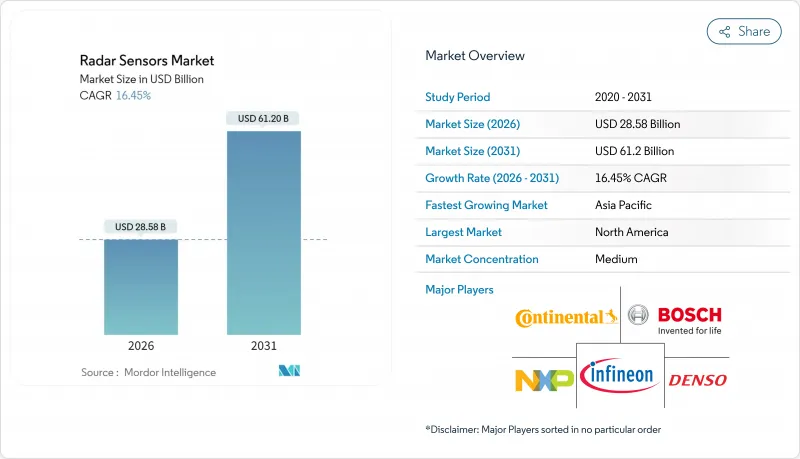
레이더 센서 시장은 2025년 245억 4,000만 달러로 평가되었고, 2026년에는 285억 8,000만 달러, 2026년부터 2031년까지 연평균 복합 성장률(CAGR) 16.45%로 성장하고, 2031년까지 612억 달러에 달할 것으로 예측되고 있습니다.
이 급속한 확대는 이 기술이 방위용도에서 자동차 안전, 산업 자동화, 드론 측량, 스마트 인프라 프로그램 등 대량 생산 분야로 이행하고 있음을 반영하고 있습니다. 유럽 연합의 일반 안전 규제(EU General Safety Regulation) 등 신차에 77-81GHz 레이더를 이용한 자동 긴급 브레이크의 탑재를 의무화하는 안전 규제가 채택을 뒷받침하고 있습니다. 공급 표면의 촉진요인으로는 저렴한 밀리미터파 칩셋과 질화 갈륨 파워 기기가 있습니다. 이들은 거리 분해능을 향상시키면서 크기, 중량, 전력 요건을 줄입니다. 아시아태평양의 탄탄한 군사 현대화, 유럽에서 5G 대응 도로 프로젝트 확대, 세계 기후 변화에 강한 기상 레이더 네트워크 구축이 잠재적인 수요를 더욱 확대하고 있습니다. 단기적인 과제로는 10GHz 미만 대역의 스펙트럼 혼잡, 이미징 어레이의 교정 비용, 중국의 생산 점유율 98%로 인한 갈륨 공급 위험이 중심입니다.
규제 당국과 자동차 제조업체는 기존 24GHz 장치보다 긴 감지 거리와 날카로운 각도 분해능을 제공하는 77-81GHz를 권장합니다. 콘티넨탈사의 ARS640은 300m를 넘는 검출 거리를 실현하여 레벨 2의 자동 운전에 적합한 물체 분류를 가능하게 합니다. 중국공업정보화부는 2022년 신규 24GHz 레이더의 인가를 중지하고 국내 OEM 업체에 주파수대의 이행을 다가왔습니다. 보쉬는 오토바이 분야에도 전개를 확대하여 KTM 오토바이에 210m 검지 거리의 레이더를 탑재, 어댑티브 크루즈 컨트롤과 사각 경보를 실현하고 있습니다. 이러한 움직임은 차량 클래스에 관계없이 센서의 꾸준한 보급을 뒷받침하고 레이더 센서 시장의 성장을 지원하고 있습니다.
멀티로터형 드론은 경량 합성 개구 레이더를 채택하여 광학식 페이로드가 기능하지 않는 식생이나 클라우드 영역에서도 서브미터급 고도 모델을 생성합니다. 조사에 의하면 광산 탐사 미션의 72.73%가 헬리콥터 플랫폼보다 멀티로터를 우선하고 있어 조사 비용을 60% 삭감하면서 공간 분해능을 향상시키고 있습니다. 미국 지질조사소의 이동식 레이더 관측소는 산불 발생 몇 분 후에 강우 유출 데이터를 취득하여 긴급 대응을 지원하고 있습니다. 이러한 실증 사례는 고대역폭 칩셋과 온보드 처리 기술에 대한 R&D 투자를 촉진하고 레이더 센서 시장의 확대를 뒷받침하고 있습니다.
레이더 개발 기업은 10GHz 미만의 제한된 주파수 대역을 통신 사업자와 위성 사업자와 경쟁합니다. 미국 방총성은 3GHz 미만에서 120기 이상의 레이더를 운용하고 있으며, 민간에 의한 주파수 재사용 가능성을 제한하고 있습니다. 연방통신위원회(FCC)는 국제적인 규제를 충족하기 위해 최근 24GHz 대역의 대역외 한계를 강화하고 설계 변경을 강요하고 있습니다. 인증 대기열은 9개월이나 제품 출시 지연과 단기적인 레이더 센서 시장의 보급 억제로 이어지고 있습니다.
비촬영 장치는 2025년 수익의 70.35%를 차지했으며 주차 지원 및 기본 적응형 크루즈 컨트롤에서 정착된 이용 상황을 보여줍니다. 그러나 레벨 2 이상의 자동 운전이 보급됨에 따라 이미징 솔루션은 2031년까지 18.12%의 연평균 복합 성장률(CAGR)로 성장할 것으로 예측됩니다. NXP와 sinPro의 48채널 엔트리 레벨 4D 유닛은 방위각 1도, 프레임당 2,000포인트 클라우드를 실현해, 고해상도 지각 기술의 보급을 시사하고 있습니다. 이미징 기능을 통해 자동 브레이크 시스템은 보행자와 도로 표지판을 식별할 수 있으며, OEM 탑재가 고급 차종을 넘어 확대되고 있습니다. 이미징 대응 모듈의 레이더 센서 시장 규모는 2031년까지 197억 6,000만 달러에 달할 것으로 예측되어 소프트웨어 정의 차량의 예산 확대를 견인합니다. 한편, 비용 최적화된 비이미징 카테고리는 식별 정확도가 중요하지 않은 배송 로봇, 지게차 충돌 경보, 강우량 추정 분야에서 우위를 유지합니다. 제조업체는 부품 비용 절감과 레이더 센서 시장의 확대 유지를 위해 간단한 FMCW 다이와 패키지 내장 안테나 설계를 조합한 제품을 제공합니다.
경쟁 로드맵은 현재 임베디드 신호 프로세서와 에지 AI 가속을 결합하여 지연을 줄입니다. Continental의 ARS640은 신경망 필터링을 통합하고 취약한 도로 사용자를 실시간으로 분류하여 기능 안전 지표를 향상시키고 있습니다. 재료면에서는 실리콘 게르마늄제 프론트엔드가 GaAs 기존 제품에 과제를 갖고 있어 대량 생산시에는 10달러 미만의 다이 가격을 실현할 전망입니다. 이 비용 곡선은 중급차에 있어서의 단계적인 이미징 기능의 향상을 지지해, 스쿠터나 마이크로모빌리티 분야에의 레이더 센서 시장 진입의 길을 열고 있습니다.
77-81GHz 대역은 전송 손실과 안테나 개방 면적의 균형이 최적이기 때문에 2025년 매출의 42.55%를 차지했습니다. 이 대역은 250m의 자동차 감지를 가능하게 하면서 비용 효율을 유지합니다. 유럽, 중국, 북미의 규제 조화로 인증 프로세스가 간소화되고 레이더 센서 시장이 확대되었습니다. ST 마이크로 일렉트로닉스의 77GHz 송수신기는 눈과 먼지에서도 성능을 유지하고 가혹한 환경에서 도로 측 장치에 적용을 입증합니다. 94GHz 이상에서는 초광대역 채널이 포장 균열 감시 및 의료용 마이크로 도플러 영상 진단에 필요한 서브센티미터급 해상도를 실현합니다. 웨이퍼 스케일 GaN 파워 앰프의 성숙에 따라, 94GHz 이상의 출하 대수는 2031년까지 3배 이상으로 증가해, 21.25%의 연평균 복합 성장률(CAGR)이 전망됩니다.
10GHz 이하의 주파수 대역은 포화 상태에 직면하고 있으며, 개발자는 더 높은 주파수 대역으로의 전환을 촉발하고 있습니다. 중국에서는 신규 24GHz 자동차 레이더 승인이 중단되어 세계의 주파수대 전환이 가속화되고 있습니다. 단거리 60GHz 기기는 차내 센싱, 승차 감지, 제스처 제어가 뛰어나 텍사스 기기의 싱글 칩 레이더는 카메라 없이 아이의 존재 감지 정밀도를 98%로 향상시켰습니다. 복합 멀티밴드 구성에서는 24GHz 코너 유닛, 77GHz 프론트 유닛, 60GHz 실내 유닛이 채택되어 레이더 센서 시장이 복수층으로 확대되고 있습니다.
2024년에도 북미는 선진운전지원시스템의 도입과 대규모 방위장비 갱신에 힘입어 최대의 지역공헌지역으로 계속되었습니다. 그러나 갈륨 공급 위험은 6,020억 달러에 달하는 미국 경제 생산을 위협하고 있으며 정책 입안자들은 GaN 에피택시의 현지화와 스크랩 재활용을 추진하고 있다(csis.org). 미국에서는 인증 지연에 의한 소비자용 전개의 지연도 과제가 되고 있습니다만, 캐나다에서는 자동차용 레이더 시험 시설의 확충이 진행되고, 멕시코에서는 Tier 1 생산 라인의 니어 쇼어링에 의한 혜택을 받고 있습니다.
유럽은 통일된 안전 규정과 대규모 스마트 도로 투자로 가장 높은 미래 CAGR을 기록하고 있습니다. EU의 AEB 의무화에 의해 전차종으로 센서 설치가 통일되어, 각국 도로 기관은 정체 분석용 레이더를 도입하고 있습니다. smartmicro UK는 도로 옆 설치 유닛 1,000기를 돌파하여 통합자의 기세를 보여줍니다(smartmicro.com). 공급망의 국내 회귀가 반도체 부족에 대항하고, 5G 회랑에서는 레이더와 V2X 비콘이 연계하여 통합되어 있습니다.
아시아태평양은 방위·기상 분야의 지출을 견인하고 있습니다. 일본의 AN/SPY-7 도입과 한국의 L-SAM II 프로젝트는 국내 GaN 파운드리 성장을 견인하는 고예산 프로그램의 전형적인 예입니다. 중국이 24GHz 자동차 레이더에서 77GHz로의 전환을 추진하는 정책 전환으로 현지 OEM 공장 전체에서 전환이 가속화되고 있습니다. 인도의 5,000만 달러 규모의 기상 레이더 주문은 정밀 기상 관측에 대한 공공 부문 수요의 높이를 보여줍니다. 이러한 노력이 결합되면서 레이더 센서 시장은 소비자를 위한 이동성 분야를 넘어 확대되고 있습니다.
The radar sensor market is expected to grow from USD 24.54 billion in 2025 to USD 28.58 billion in 2026 and is forecast to reach USD 61.2 billion by 2031 at 16.45% CAGR over 2026-2031.
The rapid scaling reflects the technology's migration from exclusive defense use to high-volume automotive safety, industrial automation, drone mapping, and smart infrastructure programs. Adoption is propelled by safety regulations such as the European Union General Safety Regulation, which mandates automatic emergency braking using 77-81 GHz radar in new vehicles. Supply-side catalysts include affordable millimeter-wave chipsets and gallium-nitride power devices that enhance range resolution while lowering size, weight, and power requirements. Robust military modernization in Asia-Pacific, expanding 5G-enabled road projects in Europe, and climate-resilient weather radar networks worldwide deepen addressable demand. Near-term challenges center on below-10 GHz spectrum congestion, calibration expenses for imaging arrays, and gallium supply risks stemming from China's 98% production dominance.
Regulators and automakers endorse 77-81 GHz because it delivers longer detection ranges and sharper angular resolution than legacy 24 GHz devices. Continental's ARS640 exceeds 300 m range and enables object classification fit for Level 2+ autonomy. China's Ministry of Industry and Information Technology halted new 24 GHz radar approvals in 2022, compelling local OEMs to shift frequency bands. Bosch extended the band to motorcycles, equipping KTM bikes with 210 m range radar for adaptive cruise and blind-spot warning. These developments reinforce steady sensor penetration across vehicle classes, underpinning radar sensor market growth.
Multirotor drones use lightweight synthetic-aperture radars to generate sub-meter elevation models even in vegetation or cloud cover where optical payloads fail. Research shows 72.73% of mining exploration missions now favor multirotor over helicopter platforms, cutting survey cost by 60% while improving spatial granularity. The U.S. Geological Survey's mobile radar observatory captures rainfall-runoff data minutes after wildfires, supporting emergency response. Such proof points fuel R&D investment in higher-bandwidth chipsets and on-board processing, broadening the radar sensor market.
Radar developers compete with telecom and satellite operators for scarce sub-10 GHz slots. The U.S. Department of Defense runs more than 120 radars below 3 GHz, limiting civilian spectrum re-farm potential. The FCC recently tightened 24 GHz out-of-band limits to satisfy global rulings, forcing design changes. Certification queues can stretch nine months, delaying product launches and curbing near-term radar sensor market adoption.
Other drivers and restraints analyzed in the detailed report include:
For complete list of drivers and restraints, kindly check the Table Of Contents.
Non-imaging devices represented 70.35% of 2025 revenue, illustrating entrenched use in parking assistance and basic adaptive cruise. Imaging solutions, however, are forecast to post an 18.12% CAGR through 2031 as Level 2+ autonomy proliferates. NXP and sinPro's 48-channel entry-level 4D unit reaches 1-degree azimuth and 2,000 point clouds per frame, signaling democratization of high-resolution perception. Imaging capability lets automated brakes distinguish pedestrians from roadside signs, pushing OEM fitment beyond luxury trims. The radar sensor market size for imaging-enabled modules is projected to reach USD 19.76 billion by 2031, capturing escalating software-defined vehicle budgets. Conversely, the cost-optimized non-imaging category retains dominance in delivery robots, forklift collision alerts, and rainfall estimation where identification finesse is less critical. Manufacturers bundle simple FMCW dies with antenna-in-package designs to lower bill-of-material cost and sustain the wider radar sensor market.
Competitive roadmaps now combine embedded signal processors with edge AI acceleration to shrink latency. Continental's ARS640 integrates neural network filtering to classify vulnerable road users in real time, raising functional safety metrics. On the materials side, silicon germanium front-ends challenge GaAs incumbents, promising sub-USD 10 die price at high volumes. This cost curve supports incremental imaging upgrades in mid-segment cars and paves the way for radar sensor market penetration in scooters and micro-mobility.
The 77-81 GHz tier held 42.55% 2025 revenue due to a sweet spot between path loss and antenna aperture, enabling 250 m automotive detection while remaining cost-effective. Regulatory harmonization in Europe, China, and North America cut certification complexity and boosted the radar sensor market. STMicroelectronics' 77 GHz transceiver sustains performance in snow or dirt, validating use in harsh roadside units. Above 94 GHz, ultra-wideband channels achieve sub-centimeter resolution prized in pavement crack monitoring and medical micro-Doppler imaging. With a 21.25% CAGR, >=94 GHz shipments are set to more than triple by 2031 as wafer-scale GaN power amplifiers mature.
Spectrum below 10 GHz faces saturation, pushing developers to migrate upward. China no longer approves new 24 GHz automotive radars, accelerating global pivot. Short-range 60 GHz gear excels in cabin sensing, occupancy detection, and gesture control; Texas Instruments' single-chip radar improves child presence alert accuracy to 98% without cameras. Blended multi-band architectures deploy 24 GHz corners, 77 GHz front units, and 60 GHz interiors, expanding the radar sensor market across multiple tiers.
The Radar Sensor Market is Segmented by Type (Imaging Radar, Non-Imaging Radar), Frequency Band (More Than 10 GHz, 24 GHz ISM Band, and More), Range (Short-Range Radar Sensor, Medium-Range Radar Sensor, and More), Technology (Pulsed Radar, Phased-Array / AESA Radar, and More), End-User and Geography. The Market Forecasts are Provided in Terms of Value (USD).
North America remained the largest regional contributor in 2024, supported by advanced driver-assistance deployment and sizable defense upgrades. Gallium supply risk, however, threatens USD 602 billion of U.S. economic output, pushing policymakers to localize GaN epitaxy and recycle scrap csis.org. The United States also grapples with certification delays that slow civilian rollouts, while Canada scales automotive radar test facilities and Mexico benefits from near-shoring Tier-1 production lines.
Europe posts the highest forward CAGR due to unified safety laws and expansive smart-road investments. The EU's AEB mandate ensures uniform sensor installation across vehicle classes, while national road agencies deploy radar for congestion analytics. smartmicro UK surpassed 1,000 roadside units, illustrating integrator momentum smartmicro.com. Supply-chain reshoring counters semiconductor scarcity, and 5G corridors embed radar hand-in-hand with V2X beacons.
Asia-Pacific leads defense and weather spending. Japan's AN/SPY-7 roll-out and South Korea's L-SAM II project typify high-budget programs driving domestic GaN foundry growth. China's policy shift away from 24 GHz automotive radar accelerates migration to 77 GHz across local OEM plants. India's USD 50 million weather radar order demonstrates public-sector appetite for precision meteorology. Collectively, these initiatives expand the radar sensor market beyond consumer mobility.