



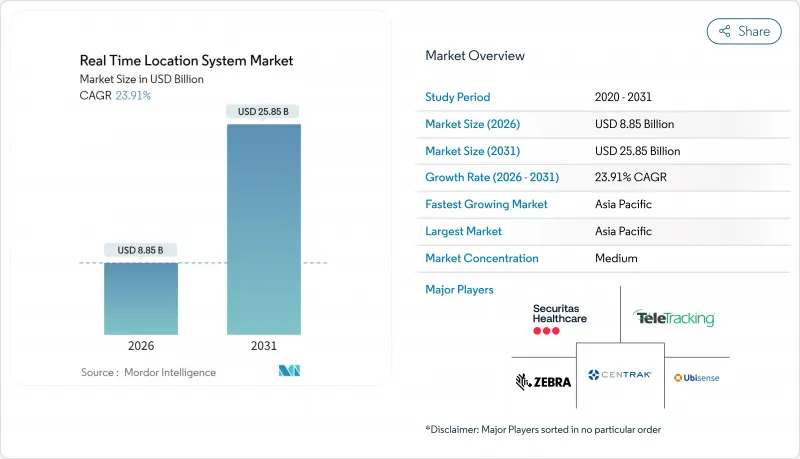
실시간 위치추적 시스템 시장은 2025년 71억 4,000만 달러에서 2026년에는 88억 5,000만 달러로 성장해 2026년부터 2031년에 걸쳐 CAGR 23.91%를 나타낼 전망입니다. 2031년까지 258억 5,000만 달러에 이를 것으로 예상됩니다.

의료 분야의 도입 의무화, 초광대역(UWB) 기술의 정밀도 향상, 디지털 트윈의 도입 확대가 실시간 위치추적 시스템 시장 수요 증가를 지원하는 한편, 관리 서비스와 클라우드 제공 모델이 벤더의 수익 구조를 변화시키고 있습니다. 최종 사용자가 사후 대응 자산 관리에서 예측 워크플로우 조정으로 전환하는 동안 경쟁 우위는 정확성, 상호 운용성 및 사이버 보안 보증에 달려 있습니다. UWB, 블루투스 저에너지(BLE), 하이브리드 플랫폼의 도입 옵션이 넓어져 환자 안전과 직장 규정 준수에 대한 규제 기세가 도입 장벽을 낮추고 있습니다. 기업이 신속한 가치 실현과 확장 가능한 분석을 추구하면서 자본 지출은 소프트웨어와 컨설팅에 기울고 있습니다.
병원에서는 장비 추적만으로 연간 절약액이 20만 달러에 육박한다고 보고되었으며, 한때 임상 시프트의 30%를 차지했던 자산 검색 시간을 삭감하고 있습니다. 제조 공장에서는 RTLS를 디지털 트윈 대시보드에 겹쳐 병목 현상을 파악하여 다운타임을 10% 줄이는 예지보전을 실현하고 있습니다. AI 알고리즘은 실시간 위치 데이터를 분석하고 숨겨진 프로세스의 낭비를 시각화. 인력 부족 환경에서 측정 가능한 ROI를 실현합니다. 이러한 효과는 인건비 상승과 공급망 변동으로 인한 이익률 압박이 현저한 분야에서 특히 두드러지며, RTLS는 효율화를 위한 전략적 수단으로 자리매김하고 있습니다.
미국 병원협회(AHA)는 환자 동선 관리, 직원 부담 경감, 감염 대책에 대응하는 의료용 RTLS의 수익이 2032년까지 4배로 확대될 것으로 예측했습니다. RTLS 정밀도와 연계한 긴급 버튼은 구급 대응 시간을 30% 단축합니다. 배지와 연동한 손가락 위생 모니터링은 의료 관련 감염을 40% 이상 억제합니다. 규제 프레임워크가 RTLS를 필수 인프라로 자리매김하는 움직임이 가속화되어 예산 승인의 신속화와 도입 계획의 표준화가 진행되고 있습니다. 가치 기반 의료 지불 모델은 보다 광범위한 RTLS 업계에서 비즈니스 가시성과 재무 실적 간의 연관성을 더욱 강화합니다.
기존 공장에서는 대역폭 제한이 있는 독자적인 프로토콜을 사용하는 경우가 많으며, RTLS 데이터 스트림을 저해하고, 비용이 많이 드는 네트워크 업그레이드나 단계적인 도입을 강요하고 있습니다. 통합의 복잡성은 서비스 지출을 부풀리고 도입 주기를 장기화하고 예산에 민감한 부문을 멀리합니다. 클라우드 네이티브 RTLS와 오버레이 네트워크는 현재 리노베이션의 길을 제공하지만, 완전한 이점은 광범위한 IT 현대화를 통해 처음으로 실현됩니다.
2025년 시점에서 의료 분야는 실시간 위치추적 시스템 시장 규모의 41.62%를 차지했고 생태계 혁신을 지원하는 기간 분야로서의 역할을 강화했습니다. 환자 동선 대시보드는 위치 텔레메트리를 전자 건강 기록과 연동시켜 구급 부서의 대기 시간을 단축하고 상환 지표를 향상시킵니다. 예측 기간 동안 운송 및 물류분야는 라스트마일 시각화와 콜드체인 준수 요구에 힘입어 24.72%의 연평균 복합 성장률(CAGR)로 가장 급격한 수익성장을 기록할 전망입니다. 제조업은 아시아태평양에서 Industry 4.0 리노베이션이 정책지원을 받으면서 이에 이어집니다.
의료 분야가 실시간 위치추적 시스템 시장에서 큰 점유율을 차지하는 배경에는 감염 관리 및 직원 안전에 관한 규제 강화가 있어 임상 등급의 정밀도 솔루션에 대한 지속적인 수요를 창출하고 있습니다. 한편, 물류 사업자는 컨테이너 및 트레일러에 대규모 배포를 위해 견고한 태그와 저전력 BLE 비콘을 선호합니다. 소매업체는 선반 단위의 추적으로 품절 손실 대책을 실시해, 방위 기관은 스푸핑 내성이 뛰어난 UWB를 활용한 자율형군 네비게이션의 시험 운용을 진행하고 있습니다.
2025년 하드웨어는 실시간 위치추적 시스템 시장 점유율의 40.08%를 차지했습니다. 이것은 지속적인 앵커 업데이트 사이클과 태그 소형화 프로젝트가 견인하고 있습니다. 그러나 매니지드 서비스의 수익은 28.13%의 연평균 복합 성장률(CAGR)로 확대되고 있으며, 하드웨어, 소프트웨어, 분석 기능을 포괄한 성과 기반 계약을 구매자가 선호하는 경향을 반영하고 있습니다. 에지 호환 앵커 펌웨어는 교정 작업을 줄이고 통합자를 구독 모델로 안내합니다.
하드웨어 혁신은 현재 시스템 온칩 UWB 라디오와 다년간 배터리 수명을 갖춘 BLE 5.3 태그에 중점을 둡니다. 한편, 클라우드 오케스트레이션 제품군은 원시 XYZ 데이터를 히트 맵 및 예측 경고로 변환하여 부서 횡단 ROI를 제공하고 서비스 업데이트율을 유지합니다. 중견 시장 구매자의 진입에 따라 턴키형 'RTLS-as-a-service' 제공으로 설비투자를 삭감하고 협상 사이클을 단축하고 있습니다.
북미는 의료 분야의 디지털화 추진과 OSHA 준수 노동자 안전 규제를 배경으로 2025년 시점에서 실시간 위치추적 시스템 시장 점유율의 43.76%를 차지했습니다. 미국 공급자는 가치 기반 상환을 최적화하기 위해 RTLS를 도입하고 캐나다 병원에서는 HL7 통합형 위치 정보 피드의 표준화가 진행되고 있습니다. 멕시코의 물류 사업자는 트레일러 텔레매틱스에 투자하여 지역 밀도를 확대하고 있습니다.
아시아태평양에서는 중국의 스마트 공장 지원책에 의한 UWB 앵커 설치 보조와 일본 자동차 제조업체의 린 생산 라인에의 실시간 추적 통합에 의해 2031년까지 연평균 복합 성장률(CAGR) 22.88%를 나타낼 것으로 전망됩니다. 인도는 관민연계를 통한 병원 근대화를 가속화하고 한국은 반도체 공장에서 자율주행 지게차를 제어하기 위해 RTLS와 프라이빗 5G를 통합하고 있습니다.
유럽에서는 GDPR(EU 개인정보보호규정) 준수 설계와 산업용 IoT 프레임워크를 배경으로 꾸준한 보급이 진행되고 있습니다. 독일 자동차 제조업체는 바디 인 화이트 공장에 하이브리드 UWB-BLE 그리드를 도입하고 영국의 NHS 트러스트는 환자 동선 관리의 파일럿 사업을 확대하고 있습니다. 중동 및 아프리카에서는 석유 및 가스 분야의 안전존닝으로 초기 성과가 확인되고, 남미 광산에서는 지하 작업자 추적에 RFID를 도입하는 등 다양한 성장 경로가 제시되고 있습니다.
The Real Time Location System Market is expected to grow from USD 7.14 billion in 2025 to USD 8.85 billion in 2026 and is forecast to reach USD 25.85 billion by 2031 at 23.91% CAGR over 2026-2031.
Healthcare mandates, ultra-wideband (UWB) accuracy gains, and digital-twin rollouts underpin demand expansion in the real time loaction system market, while managed services and cloud delivery models reshape vendor revenue streams. Competitive advantage hinges on precision, interoperability, and cybersecurity assurance as end users migrate from reactive asset handling to predictive workflow orchestration. UWB, Bluetooth Low Energy (BLE), and hybrid platforms widen deployment choices, and regulatory momentum around patient safety and workplace compliance lowers adoption barriers. Capital spending tilts toward software and consulting as enterprises seek quick time-to-value and scalable analytics.
Hospitals cite annual savings nearing USD 200,000 from equipment tracking alone, cutting asset search time that once absorbed 30% of clinical shifts . Manufacturing plants overlay RTLS on digital-twin dashboards to flag bottlenecks and enable predictive maintenance that trims downtime by 10%. AI algorithms mine live location data to reveal hidden process waste, delivering measurable ROI in labor-constrained settings. These gains resonate most where payroll inflation and supply-chain volatility squeeze margins, positioning RTLS as a strategic lever for efficiency.
The American Hospital Association expects healthcare RTLS revenue to quadruple by 2032 as systems tackle patient flow, staff duress, and infection control. Panic buttons tied to RTLS precision cut emergency response times by 30%. Hand-hygiene monitoring integrated with badges curbs healthcare-associated infections by more than 40%. Regulatory frameworks increasingly label RTLS as essential infrastructure, accelerating budget approvals and standardizing deployment blueprints. Value-based care payment models further reinforce the link between operational visibility and financial performance within the broader RTLS industry.
Brown-field factories often run on proprietary protocols with bandwidth limits that choke RTLS data streams, forcing costly network upgrades and phased rollouts. Integration complexity inflates services spend and prolongs deployment cycles, deterring budget-sensitive sectors. Cloud-native RTLS and overlay networks now offer retrofit pathways, but full benefits materialize only after broader IT modernization.
Other drivers and restraints analyzed in the detailed report include:
For complete list of drivers and restraints, kindly check the Table Of Contents.
Healthcare generated 41.62% of the real-time location system market size in 2025, reinforcing its role as the anchor vertical that finances ecosystem innovation. Patient flow dashboards tie location telemetry to electronic health records, shortening emergency department wait times and elevating reimbursement metrics. Over the forecast horizon, transportation and logistics will post the steepest revenue climb at a 24.72% CAGR, propelled by last-mile visibility and cold-chain compliance needs. Manufacturing follows as Industry 4.0 retrofits gain policy support in Asia-Pacific.
Healthcare's heavy share of the real-time location system market underscores its regulatory push around infection control and staff safety, creating durable demand for clinical-grade accuracy solutions. Conversely, logistics operators favor ruggedized tags and battery-sipping BLE beacons to scale across containers and trailers. Retailers apply shelf-level tracking to fight out-of-stock losses, while defense agencies pilot autonomous swarm navigation that leans on UWB's resilience to spoofing.
Hardware captured 40.08% of the real-time location system market share in 2025, led by ongoing anchor refresh cycles and tag miniaturization projects. Yet managed services revenue is expanding at 28.13% CAGR, reflecting buyers' preference for outcome-based contracts that bundle hardware, software, and analytics. Edge-ready anchor firmware reduces calibration labor, steering integrators toward subscription models.
Hardware innovation now centers on system-on-chip UWB radios and BLE 5.3 tags with multi-year battery life. Meanwhile, cloud orchestration suites translate raw X-Y-Z data into heatmaps and predictive alerts, unlocking cross-departmental ROI and sustaining services renewal rates. As mid-market buyers enter, turnkey "RTLS-as-a-service" offerings lower capex and shorten negotiation cycles.
The Real-Time Location System (RTLS) Market Report is Segmented by End-User Vertical (Healthcare, Transportation and Logistics, and More), Component (Hardware, Software, Services, and More), Technology (RFID, Wi-Fi, and More), Application (Asset Tracking, Work-In-Process Tracking, and More), and Geography (North America, South America, and More). The Market Forecasts are Provided in Terms of Value (USD).
North America contributed 43.76% of the real-time location system market share in 2025 on the back of extensive healthcare digitization and OSHA-aligned worker safety rules. U.S. providers adopt RTLS to optimize value-based reimbursement, while Canadian hospitals standardize on HL7-integrated location feeds. Logistics carriers across Mexico invest in trailer telematics, widening regional density.
Asia-Pacific is forecast for a 22.88% CAGR through 2031 in the real-time location system (RTLS) market as Chinese smart-factory incentives subsidize UWB anchor installs and Japanese automakers embed real-time tracking in lean production lines. India accelerates hospital modernization via public-private partnerships, while South Korea combines RTLS with private 5G to steer autonomous forklifts in semiconductor fabs.
Europe records steady uptake driven by GDPR-compliant design and industrial IoT frameworks. German automakers deploy hybrid UWB-BLE grids in body-in-white shops, and British NHS trusts expand patient-flow pilots. Middle East and Africa see early wins in oil-and-gas safety zoning, whereas South American miners deploy RFID for underground personnel tracking, signaling diversified growth corridors.