



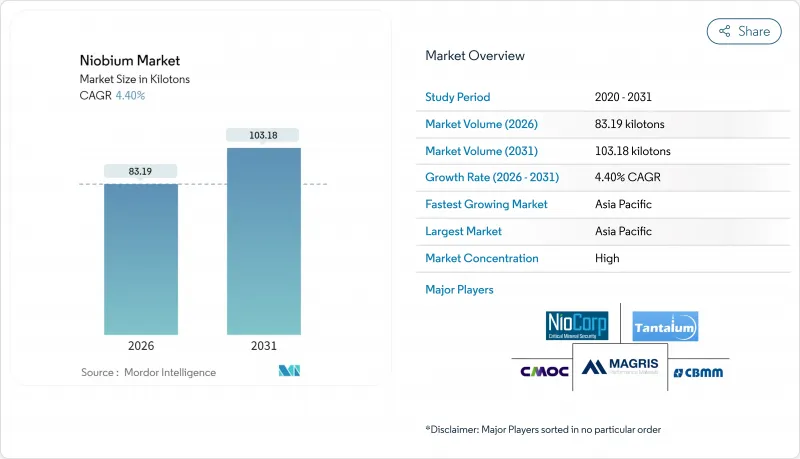
니오븀 시장은 2025년 79.68킬로톤에서 2026년에는 83.19킬로톤으로 성장해 2026년에서 2031년에 걸쳐 CAGR 4.4%를 나타낼 전망입니다. 2031년까지 103.18킬로톤에 달할 것으로 예측되고 있습니다.
건설 및 자동차 제조 분야에서 고강도 저합금강(HSLA)에 대한 지속적인 수요가 이 확대를 뒷받침하고 있습니다. 니오븀의 미량 첨가에 의해 용접성을 유지하면서 인장 강도를 최대 30% 향상시킬 수 있기 때문입니다. 브라질을 중심으로 한 공급 기반의 집중화로 Kg당 45-50달러라는 가격 안정성이 유지되고 있어 대규모 인프라 프로젝트에서 조달 위험을 줄이는 장기 공급 계약 체결을 촉진하고 있습니다. 니오븀 첨가 전지 음극재, 양자 등급 초전도체, 수소 대응 파이프라인 강재에 대한 관심 증가가 최종 시장의 다양화를 촉진하고, 철강 사이클의 감속 위험으로부터 니오븀 시장을 보호하고 있습니다. 캐나다와 미국공급원 다양화 노력은 브라질의 지배력과 관련된 지정학적 위험을 줄이고 국내 중요 광물 전략을 강화하는 것을 목표로 합니다.
건축 기준의 개정에 의해 내진성 향상을 위해 보다 높은 강도 중량비가 의무화되고 있어, 0.02-0.05%의 니오븀을 포함한 HSLA강은 종래의 강종에 비해 20-30%의 강도 향상을 실현하는 것과 동시에, 필요톤수를 삭감합니다. 중국의 2024년 내진 기준에서는 고층 건축용으로 니오븀 미량 합금강을 명시적으로 규정했으며, 인도네시아나 멕시코에서도 같은 개정을 검토했습니다. 재료 비용의 프리미엄은 5-8%이면서 구조용 강재의 사용량은 최대 20% 감소하기 때문에 엔지니어링 기업은 장기 인프라 계획에 니오븀 사양을 포함하고 있습니다. 아시아와 아프리카의 새로운 도시화 파도가 가속화됨에 따라 건설 수요는 니오븀 총 소비량의 49% 이상을 차지하며 니오븀 시장의 안정적인 기반을 강화하고 있습니다. 규제 기세로 고강도 저합금강(HSLA)의 채용은 10년 이내에 실질적으로 돌이킬 수 없게 될 것입니다.
보다 엄격한 연비 목표와 선박 배출 규제가 적극적인 경량화 전략을 촉진하고 있습니다. 니오븀를 배합한 선진 고강도강은 현재 프리미엄 부문 차량의 60% 이상에 채용되어 OEM 제조업체가 충돌 안전성과 배터리에 의한 중량 증가의 밸런스를 취하는 가운데, 양산차 플랫폼에도 보급이 진행되고 있습니다. 조선 분야에서는 니오븀 첨가의 극저온용 HSLA 강판이 -162℃에서의 LNG 수송선의 파괴 인성 요건을 충족하고, 한국이나 카타르에서의 선대 갱신을 지지하고 있습니다. 상용 트럭과 철도 차량 제조업체도 마찬가지로 니오븀 강화 빔과 섀시 부품을 채용하는 경향이 있으며, 설계의 대폭적인 검토 없이 적재 효율을 향상시키고 있습니다. 이 크로스모달 채용 사이클을 통해 니오븀 시장은 단일 부문에 의존하지 않고 여러 산업에 걸친 시너지 효과를 기대할 수 있는 입장에 있습니다.
니오븀 광석은 종종 토륨과 우라늄과 공존하기 때문에 채굴시 엄격한 방사선 모니터링이 필요합니다. 브라질에서는 현재 규제 당국이 허가 갱신 전에 지하수 기준선 조사와 동위원소 매핑을 의무화하고 있으며, 컴플라이언스 비용이 15-25% 증가하고 있습니다. 원주민 거주 지역을 둘러싼 논의가 신규 광구 인가를 더욱 지연시키고 있어 캐나다의 링 오브 파이어 지역에서도 같은 지역사회와의 관계에 관한 과제가 발생하고 있습니다. 산업 노출 수준에서 만성 독성의 사례는 보고되지 않지만, 공중의 인식 위험은 설비 투자 판단에 영향을 주고 공급 측의 기동성을 억제할 수 있습니다.
2025년 세계 공급량의 95.85%를 차지한 탄산염암광상은 2031년까지 연평균 복합 성장률(CAGR) 4.43%를 나타낼 것으로 전망되어 니오븀 시장 규모의 성장 궤도를 지지하고 있습니다. 브라질의 알라샤 광산은 낮은 스트립비와 거친 파이로크로어를 특징으로 하며, 선광을 간소화함으로써 경쟁력 있는 운영 비용으로 페로니오븀를 생산하고 있습니다.
현재, 탐광 투자는 그린란드와 탄자니아의 미탐사 카르보나타이트를 타겟으로 하고 있습니다만, 알라샤 광산 규모의 발견에는 이르지 않고, 기존공급 집중 경향이 계속되고 있습니다. 예측 가능한 광물 조성과 수십년에 걸친 야금 기술의 축적이 안정된 처리량을 가능하게 하고, 장기 공급 계약의 기반을 굳히는 동시에, 니오븀 시장의 가격 안정성을 강화하고 있습니다. 일본과 독일의 전략적 비축 기업은 합금 공장의 품질 관리를 효율화하는 일관된 불순물 프로파일에서 탄산염 원료를 지속적으로 우선시하고 있습니다.
페로니오븀는 2025년 출하량의 92.75%를 차지했고 2031년까지 연평균 복합 성장률(CAGR) 4.35%를 나타낼 것으로 예측되고 있으며, 이는 세계의 조강 수요 패턴을 반영하고 있습니다. 일반적으로 65%의 니오븀을 포함한 마스터 합금은 기본 산소 용해로의 공정에 원활하게 통합되어 용해 공장의 기술자가 결정 입경과 석출 속도를 미세 조정할 수 있습니다. 니오븀 산화물은 현재 점유율은 작고, 전지 및 유전체 세라믹 수요 증가에 따라 성장을 가속화하고 있으며, CBMM사의 전용 산화물 라인은 2030년까지 연간 4만톤의 생산 능력을 목표로 하고 있습니다.
진공용 금속 및 특수 합금 분말은 항공우주 엔진, MRI 자석, 양자 디바이스에 공급되어 소량 생산하면서 고단가를 유지하고 있습니다. 적층 조형 기술의 보급에 따라, 구상 C-103 분말 수요가 판재·봉재를 능가할 전망이며, 가공업자의 수익원을 다양화시킵니다. 그 결과, 페로니오븀가 주력 제품인 것을 계속하는 한편, 고순도 파생품이 니오븀 업계 전체의 이익률 동향을 좌우할 것입니다.
본 니오븀 보고서는 광상종별(탄산염암류 및 관련광상, 콜론바이트·탄탈라이트), 제품종별(페로니오븀, 산화니오븀 등), 용도별(철니오븀, 초전도자석·콘데 기타, 최종사용자 산업별(건설, 자동차·조선, 항공우주 및 방위, 기타), 지역별(아시아태평양, 북미, 유럽, 남미, 중동 및 아프리카)으로 분류되어 있습니다.
아시아태평양은 2025년 세계 생산량의 60.10%를 차지했으며, 2031년까지 연평균 복합 성장률(CAGR) 4.71%로 확대되어 니오븀 시장에서 가장 규모가 큰 지역 점유율을 유지할 것으로 예측됩니다. 중국의 방대한 철강 생산량과 진화하는 내진 기준이 대량 수요를 지지하는 한편, 니오븀·실리콘 합금을 검토하는 항공우주 프로그램이 차세대 추진 시스템에의 채용을 확대하고 있습니다.
북미의 성장은 두 가지 주제에 따라 달라집니다. 운송 차량의 탈탄소화와 방어 주도의 극초음속 기술 개발입니다. EPA의 연비 규제 강화와 주 레벨의 제로 에미션 의무화에 의해 OEM 제조업체는 차체 경량화를 위해 니오븀 강화 강재를 채용해, 중량 증가하는 배터리 시스템과의 밸런스를 도모하고 있습니다. 캐나다의 니오벡 광산은 세계 생산량의 약 8-10%를 공급하고 있습니다만, 미국 정책 당국자는 브라질로부터의 수입 의존도를 억제하기 위해, 엘크 크릭 광산을 통한 공급원의 다양화를 전략적 과제로 포착하고 있습니다.
유럽에서는 니오븀 미량 합금화 API X70 등급을 필요로 하는 수소 파이프라인의 확장으로 넷 제로 목표를 추진. 자동차 분야에서는 엄격한 CO2 배출 규제에 의해 고장력 강판의 프레스 가공에의 채용이 지속되고 있습니다. 독일의 자동차 클러스터에서는 페로니오븀 첨가에 의해 경량인 바디 인 화이트 조립을 실현. 한편 노르웨이의 광물 전략에서는 개정 허가 규칙 하에서 국내 탐사 우선 자원으로서 니오븀를 지정. 이 지역에서는 CERN 가속기 업그레이드용 니오부스즈 초전도체의 기초연구도 지원되어 광범위한 니오븀 시장 내에서 연구 주도의 틈새 시장이 유지되고 있습니다.
The Niobium market is expected to grow from 79.68 kilotons in 2025 to 83.19 kilotons in 2026 and is forecast to reach 103.18 kilotons by 2031 at 4.4% CAGR over 2026-2031.
Sustained demand for high-strength low-alloy (HSLA) steel in construction and automotive manufacturing anchors this expansion because micro-additions of the element raise tensile strength by up to 30% while preserving weldability. Price stability between USD 45-50 per kilogram, maintained by a concentrated supply base led by Brazil, encourages long-term offtake agreements that lower procurement risk for large infrastructure projects. Rising interest in niobium-doped battery anodes, quantum-grade superconductors, and hydrogen-ready pipeline steels is broadening end-market diversity, cushioning the niobium market against potential slowdowns in the steel cycle. Supply-side diversification efforts in Canada and the United States aim to mitigate geopolitical risk tied to Brazil's dominance and to reinforce domestic critical-minerals strategies.
Building-code revisions now mandate higher strength-to-weight ratios for seismic resilience, and HSLA steels containing 0.02-0.05% niobium deliver 20-30% strength gains over conventional grades while cutting tonnage requirements. China's 2024 seismic standards explicitly cite niobium-microalloyed steels for high-rise projects, and similar updates are under review in Indonesia and Mexico. Because material cost premiums remain 5-8% yet structural steel volumes fall by up to 20%, engineering firms are embedding niobium specifications across long-term infrastructure plans. As new urbanization waves in Asia and Africa accelerate, construction demand anchors more than 49% of overall niobium consumption, reinforcing a stable baseline for the niobium market. Regulatory momentum makes HSLA adoption essentially irreversible within a decade horizon.
Stricter fuel-economy targets and maritime emission limits foster aggressive mass-reduction strategies. Advanced high-strength steels incorporating niobium now appear in over 60% of premium-segment vehicles and are migrating into mass-market platforms as OEMs balance crashworthiness with battery-induced weight penalties. In shipbuilding, cryogenic-grade HSLA plate with niobium additions satisfies LNG-carrier requirements for fracture toughness at -162 °C, supporting fleet renewal across South Korea and Qatar. Commercial trucking and railcar builders likewise gravitate toward niobium-enhanced beam and chassis components, improving payload efficiency without major design overhauls. The cross-modal adoption cycle positions the niobium market for multi-industry synergies rather than single-sector dependency.
Niobium ores often coexist with thorium and uranium, necessitating strict radiological surveillance during mining. Regulatory authorities in Brazil now require groundwater baselines and isotopic mapping before license renewals, adding 15-25% to compliance costs. Indigenous-territory debates further delay greenfield approvals, and similar community-engagement hurdles appear in Canada's Ring of Fire region. While no chronic-toxicity cases have been documented at industrial exposure levels, public perception risks can influence capex decisions, tempering supply-side agility.
Other drivers and restraints analyzed in the detailed report include:
For complete list of drivers and restraints, kindly check the Table Of Contents.
Carbonatite-hosted deposits held 95.85% of the 2025 global supply and are set to expand at a 4.43% CAGR through 2031, underpinning the niobium market size growth trajectory. Brazil's Araxa mine exemplifies low-strip ratios and coarse-grained pyrochlore that simplify beneficiation, yielding ferroniobium at competitive opex levels.
Exploration spending now targets undercover carbonatites in Greenland and Tanzania; however, no discovery approaches Araxa's scale, reinforcing existing supply concentration. Predictable mineralogy and decades of metallurgical know-how translate into steady throughput, anchoring long-term delivery contracts and reinforcing the niobium market's pricing stability. Strategic stockpilers in Japan and Germany continue to favor carbonatite feed due to consistent impurity profiles that streamline alloy-shop quality control.
Ferroniobium accounted for 92.75% of 2025 shipments and is forecast to post a 4.35% CAGR through 2031, mirroring global crude-steel demand patterns. The master alloy, usually containing 65% niobium, integrates seamlessly into basic-oxygen furnace practices, enabling melt-shop engineers to fine-tune grain size and precipitation kinetics. Niobium oxide, while representing a minor share today, is pacing up on the back of battery and dielectric-ceramic uptake; CBMM's dedicated oxide line targets 40,000 tons annual capacity by 2030.
Vacuum-grade metal and specialty alloy powders feed aerospace engines, MRI magnets, and quantum devices, commanding premium unit values in spite of small tonnages. As additive manufacturing spreads, demand for spherical C-103 powder is likely to outpace bulk plate and bar, diversifying revenue streams for converters. Consequently, ferroniobium will remain the volume anchor, but high-purity derivatives will shape margin dynamics across the niobium industry.
The Niobium Report is Segmented by Occurrence (Carbonatites and Associates and Columbite-Tantalite), Type (Ferroniobium, Niobium Oxide, and More), Application (Steel, Super-Alloys, Superconducting Magnets and Capacitors, and More), End-User Industry (Construction, Automotive and Shipbuilding, Aerospace and Defense, and More), and Geography (Asia-Pacific, North America, Europe, South America, and Middle-East and Africa).
Asia-Pacific held 60.10% of 2025 global volume and is forecast to grow at a 4.71% CAGR to 2031, securing the largest regional slice of the niobium market. China's gargantuan steel output and evolving seismic codes sustain bulk demand, while aerospace programs exploring niobium-silicon alloys extend uptake into next-generation propulsion systems.
North America's growth hinges on dual themes: decarbonization of transport fleets and defense-driven hypersonic development. Tightened EPA fuel-economy rules and state-level zero-emission mandates push OEMs toward niobium-enriched steels for chassis mass reduction, counterbalancing heavier battery systems. Canada's Niobec mine supplies roughly 8-10% of global output, but U.S. policymakers continue to view diversification via Elk Creek as a strategic imperative to curb reliance on Brazilian imports.
Europe targets net-zero targets by expanding hydrogen pipelines that demand niobium-microalloyed API X70 grades, and stringent vehicle CO2 limits sustain high-strength steel penetration in automotive stamping. Germany's auto clusters integrate ferroniobium additions to deliver lighter body-in-white assemblies, while Norway's mineral strategy lists niobium as a priority for domestic exploration under revised permitting rules. The region also supports fundamental research into niobium-tin superconductors for CERN's accelerator upgrades, sustaining a research-driven niche inside the broader niobium market.