



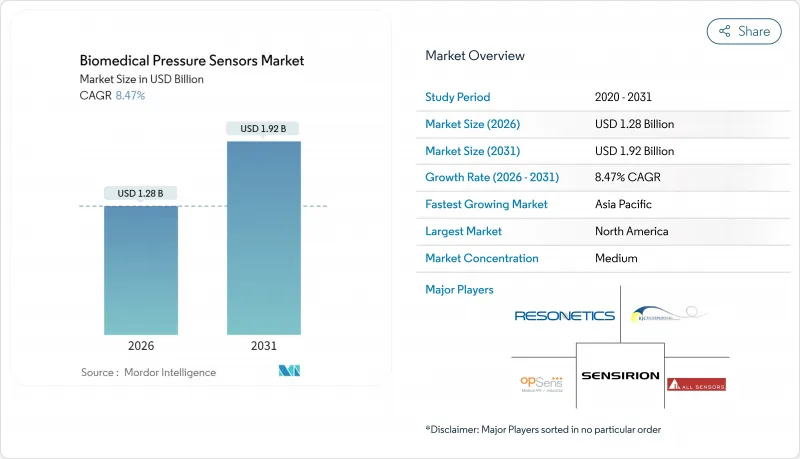
생체 압력 센서 시장은 2025년 11억 8,000만 달러로 평가되었으며, 2026년 12억 8,000만 달러에서 2031년까지 19억 2,000만 달러에 이를 것으로 예상됩니다.
예측 기간(2026-2031년)에 있어서 CAGR은 8.47%를 나타낼 전망입니다.
소형화·무선화·임상 정밀도를 겸비한 센서에 대한 강한 수요가 이 성장을 지지하고 있어, 규제의 정합화와 가치에 근거한 의료 인센티브가 병원이나 재택치료에서의 도입을 가속시키고 있습니다. MEMS 기술의 성숙에 의해 정밀도를 손상시키지 않고 서브mm급의 센서 사이즈가 실현되어, 저침습·임베디드형 디바이스로의 이용이 확대되고 있습니다. 북미는 첨단 의료 인프라를 배경으로 생체 압력 센서 시장을 선도하고 있지만 아시아태평양은 제조 능력과 디지털 건강 투자 증가에 따라 가장 빠른 지역 확대를 기록하고 있습니다. 의료기기 대기업이 반도체 기업과 제휴해 분석 기능, 클라우드 접속성, 배터리 불필요한 동작을 통합함으로써 차별화된 엔드 투 엔드 솔루션을 창출하고 있기 때문에 경쟁의 격화가 진행되고 있습니다.
의료 시스템 전체의 가격 저하 압력으로 임상 정밀도를 유지하면서 단가 10달러 미만의 센서에 조달이 진행되고 있습니다. 200mm MEMS Fab의 수율 향상으로 2024년 이후 연간 약 15%의 생산 비용 절감을 실현하여 자원 제약 환경에서의 광범위한 도입이 가능해졌습니다. 향상된 허메틱 패키징은 평균 고장 간격(MTBF)이 10년 이상에 도달하여 생체액에 노출되는 임베디드 디바이스에 매우 중요합니다. 특히 아시아태평양의 공립 병원에서는 유니버설 헬스 커버리지의 일환으로 지속적인 모니터링을 도입하는 움직임이 가속화되어 비용 경쟁력이 변화를 일으키고 있습니다. 이러한 동향이 결합되어 예측 CAGR 에 1.8% 포인트의 증가 효과를 가져왔습니다.
6억 5,500만 명 이상이 심혈관 질환을 앓고 생활하고 있으며, 측정값을 클라우드 대시보드에 전송하는 웨어러블 기기에 의한 혈압의 지속적인 추적이 촉진되고 있습니다. 당뇨병 관리는 마찬가지로 정확한 복용량을 보장하기 위해 내장 압력 센서에 의존하는 인슐린 펌프로 이동합니다. 2050년까지 65세 이상의 인구가 16억 명에 이를 것으로 예상되는 가운데 대상 환자층은 급격히 확대됩니다. 지속적인 모니터링은 예상치 못한 입원을 줄이고 가치 기반 의료에 대한 지불자 인센티브와 일치하기 때문에 생체 압력 센서 시장의 성장 궤도를 추정 2.1퍼센트 포인트 올릴 전망입니다.
보상되지 않으면 0.5%/℃에 도달하는 온도 계수는 임상적으로 심각한 오차를 초래할 수 있으며 제조업체는 칩의 교정 저항과 소프트웨어 기반 선형화 기능을 통합해야 합니다. 열대 지역 시장에서 높은 습도는 폴리머 씰 열화를 가속화하고 새로운 방습 층 설계를 촉진합니다. MRI 실내의 전자기장은 특수한 차폐를 필요로 하며 센서 시스템 설계를 복잡하게 하고 부품 비용을 증가시킵니다. 이러한 요인이 결합되어 생체 압력 센서 시장의 CAGR을 1.2% 밀어 내립니다.
무선 수동형 센서는 현시점에서는 시장 점유율이 작은 것, 전지 불필요한 동작에 의해 적출 수술을 불필요하게 하는 이점으로부터, 9.35%의 연평균 복합 성장률(CAGR)로 다른 모든 기술을 능가할 것으로 예측됩니다. 무선 수동 솔루션의 생체 압력 센서 시장 규모는 2031년까지 4억 1,500만 달러 이상에 달할 것으로 예측됩니다. 압저항 소자 장치는 입증된 생산 라인과 단위당 1달러 미만의 경제성으로 인해 수량 기준으로 우위를 유지합니다. 광섬유 센서는 MRI 대응이라는 틈새 이용 사례에 대응하여 전자기 내성이 필수적인 장면에서 신뢰성을 높입니다. 용량 소자와 압저항 소자를 결합한 하이브리드 칩은 드리프트 안정화에 기여하여 심장 디바이스 OEM 제조업체에 샘플을 제공하기 시작했습니다.
생체 압력 센서 시장에서는 MEMS 제조업체가 압력 감지와 온도 및 유량 측정을 통합한 단일 칩 바이탈 사인 모듈을 제공하는 등 기술 융합이 진행되고 있습니다. 펌웨어에 내장된 자체 교정 루틴은 30초 미만에서 열 드리프트를 보정할 수 있어 투석기의 유지 보수 사이클을 단축했습니다. 서브GHz대 무선을 탑재한 텔레메트리 센서는 체외 통신 거리를 2미터 이상으로 확대. 환자가 병동 사이를 이동하는 외래 수술 워크 플로우에서 매우 중요합니다.
2025년에 있어서도 모니터링 용도는 29.25%의 점유율을 유지해 임상의사는 지속적인 동맥 라인 대체 수단을 활용하여 조기에 혈행동태의 불안정성을 검출했습니다. 생체 압력 센서 모니터링 분야 시장 점유율은 집중 치료실에서 24시간 혈압 동향 측정을 의무화하는 병원 프로토콜을 반영합니다. 진단 용도는 여전히 크며, 특히 카테터를 이용한 심장 치료 분야에서는 실시간 압력 데이터가 스텐트 유치를 유도합니다. 주입 펌프와 같은 치료 시스템은 정확한 약물 투여를 보장하기 위해 폐쇄 루프 압력 제어를 채택하여 일상적인 수요량을 지원합니다.
소비자 건강 관리 장치는 주요 스마트폰 브랜드가 카프레스 혈압 웨어러블 단말기를 출시하고 측정치를 개인 건강 기록에 기록하는 움직임으로 CAGR 9.60%를 나타낼 전망입니다. 이미징 시스템 제조업체는 조영제 주입기에 마이크로 센서를 통합하여 투여 정확도를 향상시키고 부작용을 줄입니다. 예측 기간 동안 용도 경계는 모호해집니다. 진단용으로 판매된 장치에 치료 기능이 내장되는 경우가 증가하고, 규제 당국은 복합 제품의 지침을 정밀화해야 합니다.
북미는 2025년 수익의 38.40%를 차지하며 연간 2,000억 달러 규모의 의료기기 연구개발비, 견고한 상환제도, 확립된 병원 네트워크가 견인했습니다. 지역 구매 컨소시엄은 센서와 클라우드 대시보드를 번들한 기업 전체 계약의 협상을 증가시키고 있으며, 3년마다 예측 가능한 업그레이드 사이클을 창출하고 있습니다. 미국 대학 병원은 심부전 관리 시험을 위한 임베디드 압력 센서의 조기 도입을 주도하고 지역 병원 구매에 영향을 미치는 참조 사이트로 확립하고 있습니다.
아시아태평양은 중국이 2030년까지 1조 달러를 투입하는 의료 근대화 프로젝트에 의해 병상수를 확대하고 1차 의료 클리닉의 디지털화를 진행함으로써 CAGR 11.32%를 나타낼 것으로 예측됩니다. 일본의 65세 이상 인구는 국민의 30% 이상을 차지하고, 장기 요양 시설 입소를 늦추는 재택 혈압 모니터링 수요가 높아지고 있습니다. 인도의 '아유슈만 바랏' 계획은 5억 명 이상의 수혜자를 커버하고 원격 의료 상담에 대응한 저비용 웨어러블 센서의 공적 조달을 가속화하고 있습니다. 한국과 대만은 300mm MEMS 팹에 투자하여 공급망의 현지화를 진행시켜 기술 보급을 촉진하고 있습니다.
유럽은 고성능 센서의 생산을 지원하는 독일과 스위스의 정밀 공학 클러스터에 견인되어 견조한 점유율을 유지하고 있습니다. 2025년 EU 의료기기 규제가 전면 시행되면서 종합적인 임상적 증거를 가진 공급업체에 조달이 진행되고 다시설 공동시험에 자금을 제공할 수 있는 대기업 기존 기업이 간접적으로 유리하게 되었습니다. EU 지역 내의 디지털 건강 이니셔티브는 상호 운용 가능한 센서 데이터 표준을 추진하고 국경을 넘어서는 원격 의료 파일럿 사업을 장려하고 있습니다. 중동 및 아프리카는 특히 걸프 협력 회의(GCC) 회원국에서 병원 건설 프로그램을 추진하고 있습니다. 한편, 라틴아메리카는 분산된 농촌 주민들에게 서비스를 제공하기 위해 원격 의료를 점차 확대하고 있습니다.
The biomedical pressure sensors market was valued at USD 1.18 billion in 2025 and estimated to grow from USD 1.28 billion in 2026 to reach USD 1.92 billion by 2031, at a CAGR of 8.47% during the forecast period (2026-2031).
Strong demand for miniaturized, wireless, and clinically accurate sensors underpins this growth, while regulatory convergence and value-based care incentives accelerate hospital and home-care adoption. MEMS technology maturity has driven sub-millimeter sensor footprints without compromising accuracy, expanding use in minimally invasive and implantable devices. North America leads the biomedical pressure sensors market due to its advanced healthcare infrastructure, whereas the Asia-Pacific region records the fastest regional expansion as manufacturing capacity and digital health investments rise. Competitive intensity is rising as medical-device majors partner with semiconductor firms to integrate analytics, cloud connectivity, and battery-free operation, creating differentiated end-to-end solutions.
Downward pricing pressure across healthcare systems is steering procurement toward sensors that remain clinically precise while costing below USD 10 per unit. Yield improvements in 200 mm MEMS fabs have reduced production costs by approximately 15% per year since 2024, enabling broader deployment in resource-constrained settings. Enhanced hermetic packaging now delivers a mean time between failures of above 10 years, which is pivotal for implantables exposed to biofluids. Cost competitiveness is particularly transformative in Asia-Pacific public hospitals adopting continuous monitoring as part of universal health coverage. These dynamics collectively add 1.8 percentage points to the forecast CAGR.
More than 655 million people live with cardiovascular disease, fostering continuous blood-pressure tracking through wearables that transmit readings to cloud dashboards. Diabetes care has similarly shifted toward insulin pumps that rely on embedded pressure sensors for accurate dosing. With the global population aged >=65 expected to hit 1.6 billion by 2050, the addressable patient pool expands sharply. Continuous monitoring reduces unplanned hospitalizations and aligns with payer incentives for value-based care, elevating the biomedical pressure sensors market trajectory by an estimated 2.1 percentage points.
Temperature coefficients reaching 0.5% per °C can introduce clinically significant errors if left uncompensated, forcing manufacturers to integrate on-chip calibration resistors and software-based linearization. High humidity in tropical markets accelerates polymer-seal degradation, prompting the design of new moisture-barrier layers. MRI-suite electromagnetic fields demand specialized shielding, complicating sensor-system design and increasing bill-of-materials costs. Collectively, these factors shave 1.2% points off the biomedical pressure sensors market CAGR.
Other drivers and restraints analyzed in the detailed report include:
For complete list of drivers and restraints, kindly check the Table Of Contents.
Wireless passive sensors, though accounting for a smaller slice today, are expected to outpace all other technologies at a 9.35% CAGR, lifted by battery-free operation that eliminates explant surgeries. The biomedical pressure sensors market size for wireless passive solutions is projected to surpass USD 415 million by 2031, reflecting aggressive hospital purchase programs in North America and pilot deployments in Europe. Piezoresistive devices maintain volume dominance due to time-tested manufacturing lines and sub-USD 5 unit economics. Fiber-optic sensors address niche MRI-compatible use-cases, adding resilience where electromagnetic immunity is mandatory. Hybrid chips combining capacitive and piezoresistive elements help stabilize drift and have begun sampling to cardiac-device OEMs.
The biomedical pressure sensors market is witnessing technology convergence as MEMS houses integrate pressure sensing with temperature or flow measurement to offer single-chip vital-sign modules. Self-calibration routines embedded in firmware now compensate for thermal drift in under 30 seconds, cutting maintenance cycles for dialysis machines. Telemetric sensors with sub-GHz radios extend off-body communication ranges beyond 2 meters, vital for ambulatory-surgery workflows where patients move between wards.
Monitoring applications retained a 29.25% share in 2025, with clinicians leveraging continuous arterial-line substitutes to detect hemodynamic instability early. The biomedical pressure sensors market share for monitoring reflects hospital protocols that mandate 24-hour blood-pressure trending in critical-care units. Diagnostic uses remain sizable, especially in catheter-based cardiology, where real-time pressure data guides stent placement. Therapeutic systems such as infusion pumps employ closed-loop pressure control to ensure accurate drug delivery, reinforcing daily demand volumes.
Consumer wellness devices drive a 9.60% CAGR as leading smartphone brands launch cuff-less blood-pressure wearables that log readings into personal health records. Imaging-system manufacturers integrate micro-sensors into contrast injectors, improving dosing precision and reducing adverse events. Over the forecast window, application boundaries blur; devices originally sold for diagnostics increasingly embed therapy features, prompting regulators to refine combination-product guidance.
The Biomedical Pressure Sensors Market Report is Segmented by Technology (Self-Calibrating, Fiber-Optic, and More), Application (Diagnostic, Therapeutic, Medical Imaging, Monitoring, and More), End-User (Hospitals and Clinics, Ambulatory Surgery Centres, and More), Sensor Type (Invasive and Non-Invasive), and Geography. The Market Forecasts are Provided in Terms of Value (USD).
North America generated 38.40% of 2025 revenue, driven by USD 200 billion in annual medical device R&D spending, robust reimbursement frameworks, and a well-established hospital network. Regional buying consortia increasingly negotiate enterprise-wide contracts that bundle sensors with cloud dashboards, creating predictable upgrade cycles every three years. U.S. academic hospitals lead the early adoption of implantable pressure sensors for heart-failure management trials, establishing reference sites that influence community hospital purchasing.
The Asia-Pacific region is forecast to advance at an 11.32% CAGR as China deploys USD 1 trillion in healthcare modernization projects by 2030, expanding bed capacity and digitizing primary-care clinics. Japan's population over 65 represents more than 30% of its citizens, intensifying demand for at-home pressure monitoring to defer long-term care admission. India's Ayushman Bharat scheme covers over 500 million beneficiaries, accelerating public tenders for low-cost wearable sensors compatible with tele-health consults. South Korea and Taiwan invest in 300 mm MEMS fabs to localize supply chains, amplifying technology diffusion.
Europe maintains a solid share driven by precision-engineering clusters in Germany and Switzerland that support high-performance sensor production. The full enforcement of the EU Medical Device Regulation in 2025 directs procurement toward suppliers with comprehensive clinical evidence, indirectly favoring large incumbents that can finance multi-center trials. Intra-EU digital health initiatives promote interoperable sensor data standards, encouraging cross-country remote care pilots. The Middle East and Africa are pursuing hospital-building programs, particularly across Gulf Cooperation Council states, whereas Latin America is slowly scaling up telemedicine to serve dispersed rural populations.