


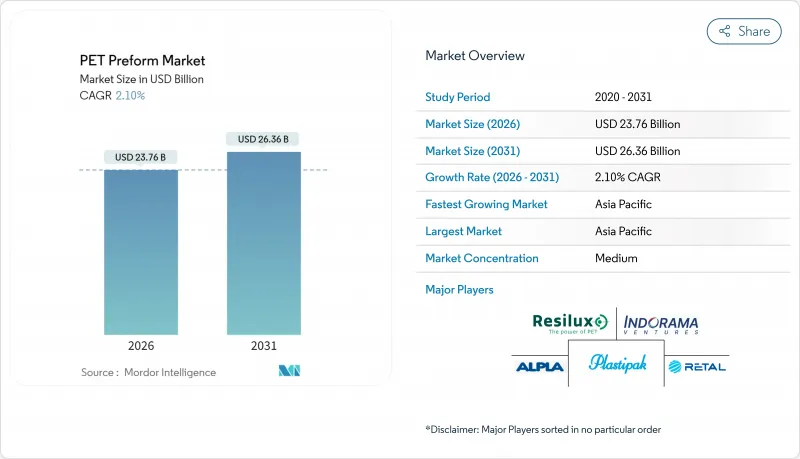
PET 프리폼 시장은 2025년 232억 7,000만 달러로 평가되었으며, 2026년 237억 6,000만 달러에서 2031년까지 263억 6,000만 달러에 이를 것으로 예측됩니다.
예측기간(2026-2031년)의 CAGR은 2.10%로 전망됩니다.
이러한 성장 궤도는 음료 분야의 수요 증가, 재활용 의무 확대, 지속적인 경량화 프로그램이 결합되어 완만하지만 견조한 확대를 지원하고 있기 때문입니다. 신흥경제국의 가처분소득 증가, 유럽연합(EU)이 2030년까지 음료병에 30%의 재활용 소재 사용을 의무화하는 방침, 그리고 현지 전동 블로우 성형 기술의 꾸준한 진전이 컨버터(가공업자)를 재료면에서 효율적인 설계와 수직 통합형 재활용 네트워크로 인도하고 있습니다. 한편, 정제 테레프탈산(PTA) 및 모노에틸렌글리콜(MEG)의 원료 가격 변동이 격화되고 있으며, 이익률에 대한 영향이 계속되고 있습니다. 이로 인해 전략적 조달 제휴와 위험 회피 기술의 도입이 진행되고 있습니다. 한편, 테더드캡 기술의 급속한 상용화로 엔지니어링 지원과 높은 공동을 갖는 금형 능력을 결합한 솔루션을 제공할 수 있는 공급업체를 우대하는 금형 업그레이드가 추진되고 있습니다. 경쟁 차별화는 추적 가능한 재생 PET(rPET) 스트림, 공장 에너지 최적화, 다층 장벽 기술에 관한 노하우를 중심으로 전개되어, 사업 규모와 프로세스 혁신을 중시하는 시장 환경을 뒷받침하고 있습니다.
견조한 음료 판매는 특히 도시화에 따라 1인당 탄산음료와 주스 소비량이 증가하고 있는 신흥 경제국에서 PET 프리폼 시장의 수량 성장을 뒷받침하고 있습니다. 브라질의 식품 가공업 수익은 2024년에 2,310억 달러에 이르렀으며, 이는 프리폼 컨버터에게 유리한 포장 수요 증가를 뒷받침하고 있습니다. 경량화는 여전히 중요한 전략적 수단이며, 차세대 금형 냉각 기술과 개선된 수지 IV 제어의 조합으로 탑로드 강도를 손상시키지 않고 그램 단위의 중량 감소를 실현하고 있습니다. 컨버터는 또한 높은 투명성과 산소 흡수 첨가제가 필요한 프리미엄 영양 보조 음료 등 RTD 음료 시장에 주력하고 있습니다. 음료 충전업자와 기계 공급업체의 연계로 설계부터 시장 투입까지의 사이클이 단축되고, 디지털 트윈 시뮬레이션에 의해 병목 마감 성능이 향상되어 프로토타입 횟수가 줄어들고 있습니다. 다양화하는 고객층의 확대는 주요 설비 제조업체의 금형 업그레이드 및 애프터서비스 수익을 밀어 올리고 있습니다.
남아시아 및 동남아시아에서는 도시 수도 인프라의 정비가 여전히 불균일하기 때문에 PET 프리폼에 대한 수요가 증가하고 있습니다. 인도, 인도네시아, 베트남의 도시에서는 브랜드 병생수의 소비량이 두 자릿수의 성장을 기록하고 있으며, 현지에서는 2025년 이후 재활용 소재 함유가 의무화될 전망입니다. SKC그룹의 베트남에서의 1억 달러 규모 생분해성 플라스틱 공장 등 최근 자본 투자는 투자자가 버진 수지와 재생 수지의 양적 공급이 가능한 비용 우위의 입지를 모색하고 있는 실태를 나타내고 있습니다. 지속가능성에 대한 논의가 활발해지고 있는 한편, 많은 도시에서는 안전한 식수에 대한 접근성 확보가 당면 우선 과제이며, 고성능 제품의 수주를 유지하는 소비 패턴을 강화하고 있습니다. 그러나 높은 비용 민감도로 인해 각 컨버터는 슬림한 운영을 유지하며 2024년 이후 확대된 PTA 및 MEG 가격 변동을 헤지할 수 없습니다.
유럽의 생산자들은 현재 영국의 플라스틱 세금(423파운드/톤)과 독일의 일회용 플라스틱 기금 과징금을 예산으로 계상하고 있으며, 이들을 합치면 EBITDA 마진을 최대 150베이시스 포인트까지 밀어내릴 가능성이 있습니다. 또한 고분자의 기원을 추적하고 재활용 함량 보고를 검증하기 위해 IT 시스템에 투자함으로써 관리비도 증가하고 있습니다. 대규모 다국적 기업은 다양한 포트폴리오로 비용을 상각할 수 있지만, 지역 중소기업은 단위당 컴플라이언스 부담으로 인해 전략적 제휴와 인수에 대한 움직임이 가속화되고 있습니다.
2025년 시점에서는 버진 PET가 PET 프리폼 시장의 75.38%를 차지하였습니다. 이는 확립된 공급망과 고속 성형을 용이하게 하는 안정된 용융 특성에 의해 뒷받침된 결과입니다. 그러나 재활용 PET는 2031년까지 연평균 복합 성장률(CAGR) 3.18%로 확대될 것으로 예측되며, 이는 소재 중에서 가장 빠른 성장입니다. 이는 브랜드 소유자가 순환성 목표를 추구하고 규제 당국이 rPET의 최소 사용률을 의무화하는 움직임 때문입니다. 재생 등급 PET 프리폼 시장의 규모는 식품 접촉에 적합한 단량체를 재생하는 화학적 재활용 기술의 발전으로 시장 전체의 성장을 능가할 전망입니다. DePoly와 같은 투자자들이 스위스에서 탈중합 처리 능력을 위한 자금 조달로 2,300만 달러를 유치한 사례는 첨단 재활용 기술의 경제성에 대한 신뢰를 강화하고 있습니다.
2030년 이후 원료 스케일업의 과제가 완화되면 바이오 PET의 보급이 더욱 진행될 가능성이 있습니다. SpecialChem의 보고에 따르면 Neste, ENEOS, Mitsubishi Corporation은 신재생 나프타를 전구체 원료로 한 파일럿 가동을 시작했으며 저탄소 펠릿 공급의 미래를 열었습니다. 현재, 높은 생산 비용과 제한된 생산량으로 인해 바이오 PET는 틈새 프리미엄 분야로 제한됩니다. 그러나, 기술 로드맵은 화석 자원에서 벗어나는 장기적인 다양화의 길을 보여줍니다. 궁극적으로 재료 조성의 변동성은 라인 정지 없이 변동하는 점도 지수(IV)나 색조 사양에 대응 가능한 유연한 건조, 계량 및 검사 시스템으로 이어집니다.
PET 프리폼 시장의 보고서는 재료 유형(버진 PET, 재생 PET(rPET), 바이오 PET), 용도(탄산음료 및 물, 식품 및 유제품, 퍼스널케어 및 화장품, 알코올 음료, 기타 용도), 지역(아시아태평양, 북미, 유럽, 남미, 중동 및 아프리카)별로 분류되어 있습니다. 시장 예측은 금액, 달러로 제공됩니다.
아시아태평양은 PET 프리폼 시장의 핵심이며, 2025년에는 46.20%의 수익 점유율을 차지하였고 2031년까지 연평균 복합 성장률(CAGR) 2.78%로 추이할 것으로 예측됩니다. 중국은 비용 경쟁력이 있는 수지와 금형을 공급하고 있는 한편 인도에서는 2025년 4월에 음료병의 재생재 함유율 30% 의무화가 시행되면서 세정 및 파렛타이징 라인에 대한 전례 없는 투자가 촉진되고 있습니다. Indorama Ventures, Dhunseri, Varun Beverages는 rPET공급 부족 해소와 향후 규제 기한 대응을 목적으로 인도 전역에 여러 재활용 거점을 설치하는 합작 사업을 설립했습니다.
유럽은 여전히 규제가 가장 엄격한 시장입니다. 회수 인프라는 이미 PET 병의 4분의 3을 확보하고 있지만, 식품 등급 rPET의 공급 압박이 프리미엄 가격을 계속 뒷받침하고 있습니다. 2024년 시행된 테더드캡 규정은 대규모 병목 형상 변경을 촉진하고 수지 사용량을 10-15% 절감하는 경량화 재설계와 연동하는 케이스가 많아지고 있습니다. 적극적인 플라스틱 세금제도와 진화하는 환경조정요금 체계에 의해 충전업자는 장거리 물류 비용의 재평가나 리필 유리 용기의 시험 도입을 검토하고 있습니다. 효소 재활용 기술의 연구 개발도 병행하여 진행되고 있으며, 이 지역이 세계의 폴리머 순환형 사회에서 모범사례를 주도하려는 의욕을 뒷받침하고 있습니다.
북미에서는 병생수와 기능성 음료의 견조한 수요에 더해 재생 소재에 대한 지불 의향이 높아지고 있습니다. 화학적 재활용을 담당하는 신흥기업은 엄청난 벤처 자금을 획득했으며, 주 수준의 EPR법은 현재 캘리포니아주, 오레곤주, 콜로라도주로 확대되고 있습니다. 브라질이 주도하는 활발한 식품 가공 부문이 중심인 남미에서는 통화 변동이나 간헐적인 정치적 불확실성에 의해 억제되면서도 꾸준한 확대를 볼 수 있습니다.
The PET Preform Market was valued at USD 23.27 billion in 2025 and estimated to grow from USD 23.76 billion in 2026 to reach USD 26.36 billion by 2031, at a CAGR of 2.10% during the forecast period (2026-2031).
This forward trajectory stems from incremental demand in beverages, expanding recycling mandates and ongoing lightweighting programs that collectively support modest but resilient expansion. Rising disposable incomes in emerging economies, the European Union's 30% recycled-content requirement for beverage bottles by 2030, and steady progress in electrified on-site blow-molding are steering converters toward material-efficient designs and vertically integrated recycling networks. Intensified feedstock volatility for purified terephthalic acid (PTA) and mono-ethylene glycol (MEG) continues to compress margins, prompting strategic procurement alliances and hedging practices. Meanwhile, the rapid commercialization of tethered-cap technology is driving tooling upgrades that favor suppliers able to bundle engineering support with high-cavitation mold capabilities. Competitive differentiation increasingly revolves around traceable recycled PET (rPET) streams, factory energy optimization, and multi-layer barrier know-how, underpinning a market environment that rewards operational scale and process innovation.
Robust beverage sales continue to anchor volume growth for the PET preforms market, especially in emerging economies where per-capita soft-drink and juice consumption rises alongside urbanization. Brazil's food-processing revenues touched USD 231 billion in 2024, underscoring a packaging pull that benefits preform converters. Lightweighting remains a critical strategic lever, enabled by next-generation mold cooling and improved resin IV control that together shave gram weight without compromising top-load strength. Converters also capitalize on premium ready-to-drink nutraceutical beverages, which demand preforms with high clarity and oxygen-scavenging additives. Partnerships between beverage fillers and machinery suppliers shorten design-to-market cycles, while digital twin simulations improve neck-finish performance and reduce trial runs. This evolving customer mix boosts tooling upgrades and after-sales service revenues for leading equipment makers.
Persistently uneven municipal water infrastructure fuels PET preform demand in South and Southeast Asia. Urban centers in India, Indonesia, and Vietnam record double-digit volume gains for branded bottled water, with local mandates now requiring minimum recycled content beginning in 2025. Recent capital commitments, such as SKC Group's USD 100 million biodegradable-plastic plant in Vietnam, demonstrate how investors scout for cost-advantaged sites capable of supplying both virgin and recycled resin streams. Although sustainability discourse intensifies, the immediate priority in many cities remains access to safe drinking water, reinforcing a consumption pattern that sustains high-performance order books. Cost sensitivity, however, forces converters to maintain lean operations and hedge PTA and MEG price swings that have widened since 2024.
European producers now budget for the United Kingdom's GBP 423/t plastics tax and Germany's Single-Use Plastics Fund levy, which together can erode EBITDA margins by up to 150 basis points. Administrative overhead also rises as firms invest in IT systems to track polymer origin and validate recycled content declarations. While large multinationals amortize costs across diverse portfolios, smaller regional players confront steeper per-unit compliance burdens, accelerating the flight toward strategic partnerships or acquisitions.
Other drivers and restraints analyzed in the detailed report include:
For complete list of drivers and restraints, kindly check the Table Of Contents.
Virgin PET dominated 75.38% of the PET preforms market in 2025, leveraged by entrenched supply chains and consistent melt properties that simplify high-speed molding. Recycled PET is, however, forecast to deliver a 3.18% CAGR to 2031, the swiftest rise among materials, as brand owners chase circularity targets and regulators mandate minimum rPET thresholds. The PET preforms market size for recycled grades is expected to outpace overall growth, driven by chemical-recycling breakthroughs that regenerate drop-in monomers compatible with food contact. Investors such as DePoly recently gathered USD 23 million to fund depolymerization capacity in Switzerland, reinforcing confidence in advanced recycling economics.
Beyond 2030, bio-based PET could gain more traction once feedstock scaling challenges abate. SpecialChem reports that Neste, ENEOS and Mitsubishi Corporation have started pilot runs using renewable naphtha as precursor feedstock, opening future avenues for low-carbon pellet supply. For now, high production costs and limited volumes confine bio-based PET to niche premium segments, yet the technology roadmap signals a long-term diversification path away from fossil resources. Ultimately, material-mix volatility places a premium on flexible drying, dosing and inspection systems able to handle variable IV and color specs without line stoppages.
The PET Preforms Report is Segmented by Material Type (Virgin PET, Recycled PET (rPET), and Bio-Based PET), Application (Carbonated Soft Drinks and Water, Food and Dairy, Personal Care and Cosmetics, Alcoholic Beverages, and Other Applications), and Geography (Asia-Pacific, North America, Europe, South America, and Middle-East and Africa). The Market Forecasts are Provided in Terms of Value (USD).
Asia-Pacific possesses the fulcrum of the PET preforms market, harnessing 46.20% revenue share in 2025 and tracking a 2.78% CAGR to 2031. China supplies cost-advantaged resin and molds, while India's April 2025 mandate for 30% recycled content in beverage bottles spurs unprecedented investment in washing and pelletizing lines. Indorama Ventures, Dhunseri and Varun Beverages formed a joint venture aimed at multiple recycling hubs across India to close the rPET gap and meet incoming compliance deadlines.
Europe follows as the most regulation-intensive market. Collection infrastructure already secures three-quarters of PET bottles, but tight food-grade rPET availability continues to underpin premium pricing. The tethered-cap law, effective 2024, triggered large-scale neck-finish conversions, often bundled with lightweight redesigns that trimmed resin use by 10-15%. Aggressive plastic-tax frameworks and evolving eco-modulation fee schedules encourage fillers to re-evaluate long-haul logistics costs and explore refillable glass pilots. Parallel research and development into enzymatic recycling underlines the region's aspiration to lead global polymer circularity best practices.
North America is characterized by solid demand for bottled water and functional beverages alongside increasing willingness to pay for recycled content. Chemical-recycling startups secure substantial venture funding, while state-level EPR legislation now extends to California, Oregon and Colorado. South America, dominated by Brazil's vibrant food-processing sector, registers steady expansion tempered by currency volatility and sporadic political uncertainty.