



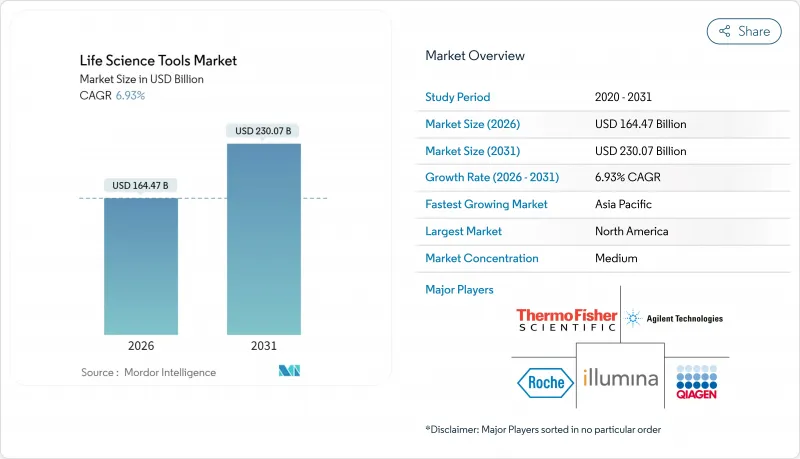
생명과학 툴 시장은 2025년 1,538억 1,000만 달러에서 2026년에는 1,644억 7,000만 달러로 성장하고 2026년에서 2031년에 걸쳐 CAGR 6.93%로 성장을 지속하여 2031년까지 2,300억 달러에 이를 전망입니다.
정밀의료 분석, 차세대 시퀀싱(NGS) 플랫폼, AI 탑재형 연구실 자동화 시스템의 지속적인 도입으로 자본 설비 및 소모품에 대한 지출은 견조한 성장 궤도를 유지하고 있습니다. 미국 의회가 2025년도에 제안한 880억 달러 규모의 생명공학 지원책 등 공공 부문의 지출 증가와 FDA에 의한 연구실 개발 검사(LDT)의 엄격한 감시 강화가 더하여 컴플라이언스 요건이 재구축되고 검증된 기기에 대한 새로운 수요가 창출되고 있습니다. 북미는 2024년에도 생명과학 툴 시장의 40.6%를 차지하면서 기간지역으로 남아 있는 반면 중국, 인도, 한국 및 싱가포르의 대규모 인프라 투자를 배경으로 아시아태평양이 CAGR 11.1%로 성장을 견인합니다. 경쟁의 기세는 여전히 높으며, 기존 공급자는 합병 및 인수나 제품 라인의 확충에 의해 점유율 방어와 신규 채널 개척을 진행하고 있습니다. 그러나 공급망의 취약성이 잔존하고, 숙련된 생물정보학자의 부족이 단기적인 전망을 억제하고 있습니다.
대분자 치료제에 대한 주목의 고조로 인해, 연구소에서는 단백질 특성 평가용 고도의 질량 분석 장치나 세포 치료 연구용 고파라미터 플로우 사이토미터의 확보가 급선무가 되고 있습니다. 미국의 ARPA-H가 획기적인 의료 플랫폼에 25억 달러의 예산을 배분한 것은 정부가 최첨단 장비에 대한 투자를 중시하고 있음을 보여줍니다. 유럽의 벤처 자금도 마찬가지로 증가하고 있으며 이전에는 자사 내에서 처리되고 있던 전문적인 분석 업무를 맡는 위탁연구기관(CRO)에 대한 주문을 촉진하고 있습니다. 이러한 요인들이 결합되어 설비투자와 소모품의 지속적인 지출이 가속화되고 생명과학 툴 시장의 성장 전망을 더욱 견고하게 하고 있습니다.
WHO의 감시 시스템은 2024년 원숭이두창과 조류 인플루엔자의 활동성 상승을 지적하고, 공중위생연구소에 PCR 검사능력 확충과 다중 NGS 패널 비축을 강요했습니다. 더불어 영국에서는 전국 규모의 희귀질환 스크리닝에 의해 유전체 검사에 대한 접근성이 25% 확대해 자동화 샘플 전처리 시스템의 수요를 밀어 올렸습니다. 감염성 위협과 유전성 질환의 이중 부담은 확장성이 뛰어나고 신속한 결과를 제공할 수 있는 플랫폼의 필요성을 강화하고 임상 환경과 조사 환경 모두에서 생명과학 툴 시장을 추진하고 있습니다.
주로 사용되는 질량분석 플랫폼은 100만 달러를 초과하기 때문에 소규모 연구소에 도입하기가 어렵습니다. 학술기관의 예산으로는 기기 업그레이드와 인원 확보의 양립이 어렵고, 많은 기관이 서비스 제공형 코어 시설에 의존할 수밖에 없습니다. 이러한 예산 압박이 도입을 늦추고 단기적인 생명과학 툴 시장의 확대 궤도를 둔화시키고 있습니다.
서비스 분야는 CAGR 11.35%로 가장 빠르게 확대되고 있습니다. 이는 의약품 개발 기업이 고정비 억제와 전문 지식 활용을 위해 분석 업무를 외부로 위탁하기 때문입니다. 계약 연구 기관은 현재 고성능 유전체학 단백질체학 플랫폼을 장비하고 있으며, 종래에는 거액의 사내 투자가 필요한 턴키 워크플로를 제공합니다. 제약기업 고객은 신속한 처리 능력 확장과 세계의 거점 네트워크를 중시하고 있으며, 이는 지속적인 서비스 수입을 촉진하고 생명과학 툴 시장을 확대하고 있습니다.
장비 분야는 2025년에도 생명과학 툴 시장에서 최대 점유율인 43.60%를 유지했습니다. 주요 제약회사와 연구 대학의 설비 투자 패턴은 견고함을 유지하며 주요 공급업체의 경상 수익의 약 60%를 소모품이 차지했습니다. 하드웨어와 서비스를 조합한 렌탈 방식의 하이브리드 모델이 정착되고 있어, 일괄 설비 구입을 예측 가능한 운영 지출로 변환하는 것과 동시에, 고객의 매출 누적을 강화하고 있습니다.
차세대 시퀀싱(NGS) 기술은 16.9%의 연평균 복합 성장률(CAGR)로 기술 확장을 견인했습니다. 임상 연구실에서는 단일 유전자 PCR 검사에서 다중 유전자 NGS 패널로의 이행이 진행되어 검사의 집약화와 실용적인 변이의 발견이 가능해지고 있습니다. 미국에서 싱가포르에 이르는 인구 규모의 유전체 프로그램은 장비 업데이트 사이클을 가속화하고 컴퓨팅 인프라 업그레이드를 촉진하며 생명과학 툴 시장을 지원합니다.
PCR 및 qPCR은 성장세 하락에도 불구하고 2025년에도 생명과학 툴 시장 규모의 22.65%를 차지했습니다. 신속한 병원체 검출과 유전자 발현 분석에서의 확고한 역할이 안정적인 소모품 수요를 유지하고 있습니다. 유동 세포 계측법, 질량 분석 및 첨단 분리 시스템과 같은 보완 기술은 사용자의 선택을 넓혀 공급자에게 다양한 수익 기반을 확보하고 있습니다.
북미는 2025년에 생명과학 툴 시장의 40.10%를 차지했습니다. 이는 미국 국립위생연구소(NIH)의 자금 제공과 미국에 본사를 두고 있는 세계 기기 제조업체의 집중에 의해 뒷받침된 것입니다. 보스턴과 샌프란시스코의 바이오테크 회랑으로의 견조한 벤처 캐피탈 유입이 장비 업그레이드 사이클을 강화하고 있지만, 노후화하는 캠퍼스 인프라와 격화하는 조성금 경쟁으로 성장률은 중간 정도의 한 자릿수에 머물 수 있습니다.
아시아태평양은 10.95%의 연평균 복합 성장률(CAGR)로 성장하여 가장 성장이 빠른 지역입니다. 중국은 2024년에 150억 달러 이상을 생명공학 프로그램에 투입했으며 인도는 24억 달러를 분산형 백신 및 바이오로직 거점의 지원에 충당했습니다. 한국과 싱가포르는 세계 수준의 시퀀싱 및 세포 치료 허브를 계속 구축하고 있습니다. 이러한 노력은 고용량 차세대 시퀀싱(NGS), 질량분석, 자동화 바이오프로세싱에 대한 장기 투자를 기반으로 하며, 세계의 생명과학 툴 시장에 가치를 더하고 있습니다.
유럽에서는 거시경제의 불확실성과 에너지 비용이 신규 자본 프로젝트에 가중되면서 안정적인 한 자릿대 중반의 성장을 보였습니다. 브렉시트 이후 영국은 연구의 기세를 유지하기 위해 미국과의 제휴를 모색했고 프랑스와 스위스는 생물제제 분석의 견고한 거점이 되었습니다. 폴란드와 체코 공화국의 신규 센터에서는 모듈식 연구실 형식이 채택되어 컴팩트 기기와 엔트리 레벨 소모품에 대한 새로운 수요가 탄생했습니다.
The life science tools market is expected to grow from USD 153.81 billion in 2025 to USD 164.47 billion in 2026 and is forecast to reach USD 230.07 billion by 2031 at 6.93% CAGR over 2026-2031.
Sustained uptake of precision-medicine assays, next-generation sequencing (NGS) platforms, and AI-enabled laboratory automation keeps capital equipment and consumables spending firmly on a growth path. Rising public-sector outlays-such as the United States Congress' proposed USD 88 billion biotechnology package for 2025-coupled with stricter FDA oversight of lab-developed tests (LDTs) are reshaping compliance needs and driving fresh demand for validated instruments. North America continues to anchor the life science tools market with a 40.6% share in 2024, while Asia-Pacific leads growth at an 11.1% CAGR thanks to large-scale infrastructure investment in China, India, South Korea, and Singapore. Competitive momentum remains strong; established suppliers deploy mergers, acquisitions, and portfolio extensions to defend share and open new channels, yet lingering supply-chain fragilities and shortages of trained bioinformaticians temper the near-term outlook.
Escalating focus on large-molecule therapeutics pushes laboratories to secure advanced mass spectrometers for protein characterization and high-parameter flow cytometers for cell therapy research. The U.S. ARPA-H budget of USD 2.5 billion earmarked for breakthrough health platforms underscores the government's commitment to cutting-edge instrumentation. European venture funding similarly rose, fueling orders for contract research organizations that now handle specialized analytics once kept in-house. Together, these forces accelerate capital buys and recurring consumables spend, reinforcing the life science tools market growth outlook.
WHO surveillance flagged heightened monkeypox and avian influenza activity in 2024, compelling public-health labs to broaden PCR testing capacity and stock multiplex NGS panels. In parallel, nationwide rare-disease screening in the United Kingdom expanded genomic testing access by 25%, boosting demand for automated sample-prep systems. The dual burden of infectious threats and hereditary conditions strengthens the case for scalable, rapid-turnaround platforms, advancing the life science tools market in clinical and research environments alike.
Flagship mass spectrometry platforms surpass USD 1 million, placing acquisition out of reach for smaller laboratories. Academic budgets struggle to reconcile instrument upgrades with staffing needs, leading many to rely on fee-for-service core facilities. Such budget pressures slow adoption and dilute the near-term life science tools market expansion trajectory.
Other drivers and restraints analyzed in the detailed report include:
For complete list of drivers and restraints, kindly check the Table Of Contents.
Services rose fastest at 11.35% CAGR as drug developers externalized analytics to control fixed costs and tap specialized expertise. Contract research organizations, now equipped with premium genomics and proteomics platforms, offer turnkey workflows that once demanded heavy in-house investment. Pharmaceutical clients value rapid capacity scaling and global site reach, propelling recurring fee income and enlarging the life science tools market.
Instruments maintained the largest 43.60% stake of the life science tools market share in 2025. Capital expenditure patterns remained resilient among top-tier pharma firms and research universities, while consumables supplied roughly 60% of recurring revenue for leading vendors. Hybrid models-leasing hardware bundled with services are taking hold, converting lump-sum equipment purchases into predictable operating outlays, and deepening customer lock-in.
Next-Generation Sequencing led technology expansion at 16.9% CAGR. Clinical labs increasingly swap single-gene PCR assays for multi-gene NGS panels that consolidate testing and uncover actionable variants. Population-scale genomics programmes from the United States to Singapore intensify instrument refresh cycles and spur computational infrastructure upgrades, sustaining the life science tools market.
PCR & qPCR, despite ceded growth momentum, still delivered 22.65% of the life science tools market size in 2025. Its entrenched role in rapid pathogen detection and gene-expression analysis preserves a steady consumables flow. Complementary technologies such as flow cytometry, mass spectrometry, and advanced separation systems broaden user options, ensuring diversified revenue pillars for suppliers.
The Life Science Tools Market Report is Segmented by Type (Instruments, Consumables, Services), Technology (PCR & QPCR, Sanger Sequencing, Separation Technologies, and More), Application (Proteomics Technology, Genomic Technology, and More), End User (Research Laboratories, Diagnostic Laboratories, and More), and Geography (North America, Europe, Asia Pacific, and More). The Market Forecasts are Provided in Terms of Value (USD).
North America accounted for 40.10% of the life science tools market in 2025, buoyed by National Institutes of Health funding and a cluster of global tool makers headquartered in the United States. Robust venture capital flows into Boston and San Francisco biotech corridors reinforce equipment refresh cycles, though ageing campus infrastructure and intensifying grant competition may nudge growth toward mid-single digits.
Asia-Pacific, advancing at an 10.95% CAGR, is the fastest-growing region. China directed more than USD 15 billion to biotech programmes in 2024, while India's USD 2.4 billion infusion supported distributed vaccine and biologics sites. South Korea and Singapore continue building world-class sequencing and cell-therapy hubs. These initiatives anchor long-run investments in high-capacity NGS, mass spectrometry, and automated bioprocessing, adding heft to the global life science tools market.
Europe posts stable, mid-single-digit gains as macroeconomic uncertainties and energy costs weighed on new capital projects. Post-Brexit, the United Kingdom sought U.S. partnerships to maintain research momentum, while France and Switzerland remained strongholds for biologics analytics. Emerging centers in Poland and the Czech Republic adopted modular lab formats, providing fresh demand for compact instruments and entry-level consumables.