



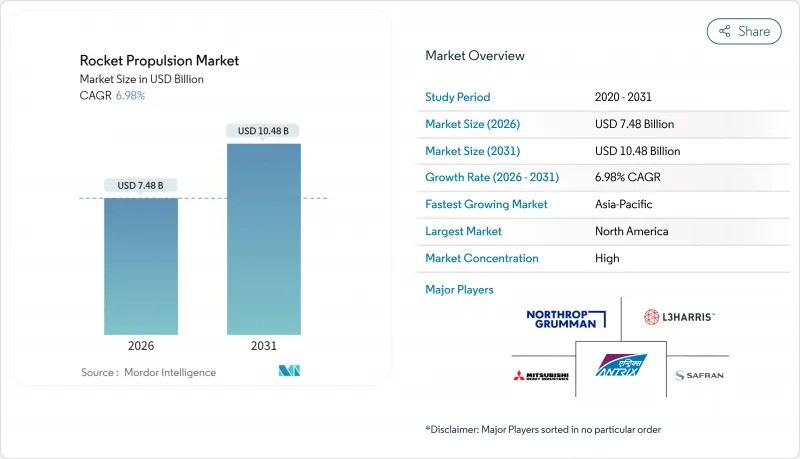
로켓 추진 시장은 2025년에 69억 9,000만 달러로 평가되었으며, 2026년 74억 8,000만 달러에서 2031년까지 104억 8,000만 달러에 이를 것으로 예측됩니다.
예측기간(2026-2031년)의 CAGR은 6.98%로 전망됩니다.
재사용 가능한 발사 시스템을 통한 비용 절감, 메가 컨스텔레이션 전개에 필요한 높은 발사, 방위 지출 증가가 함께 수요 및 공급의 우선순위를 재구축하고 있습니다. 액체 엔진은 높은 비추력과 스로틀링 정밀도로 정확한 궤도 투입을 가능하게 하기 때문에 여전히 우위를 유지하고 있습니다. 그러나 제조업체가 액체 기술과 고체 기술의 저비용 조합을 모색하는 가운데 하이브리드 솔루션이 주목을 받고 있습니다. 현재 북미가 수량면에서 주도적 입장에 있지만 중국과 인도가 발사 인프라를 확대하는 가운데 아시아태평양이 가장 급격한 성장 궤도를 보이고 있습니다. 에코시스템 전체적으로는 적층 제조 기술에 의해 부품 점수가 최대 98% 감소하여 경쟁 우위성이 자체 프린터를 보유한 수직 통합형 제조업체로 이행하고 있습니다.
팔콘 9와 같은 부스터 회수 프로그램의 성공으로 발사 비용은 이미 50% 이상 절감되었으며, 추진 시스템의 우선순위는 단일 사용 피크 성능에서 신속한 리노베이션으로 전환하고 있습니다. 엔진은 견고한 터보 펌프, 첨단 연소실 냉각 시스템 및 내장형 건강 모니터링 센서를 요구하여 비행 간 턴어라운드 시간을 수개월에서 수일로 단축했습니다. 제조업체는 기술자가 발사대에서 교환할 수 있는 모듈식 서브시스템으로 대응하고 있으며, 이 설계 사상은 위성 추진 시스템으로도 파급되고 있습니다. 이로 인해 위성 컨스텔레이션 운영자는 낮은 배포 예산의 혜택을 누릴 수 있습니다. 이 경제적인 파급효과로 소규모 발사 사업자가 재사용 마이크로 발사기로 시장에 진입하는 움직임이 가속화되고 있습니다. 그 결과 부품 공급업체는 고사이클 피로 테스트 및 자동화된 비파괴 검사 라인에 투자하고 촉박한 스케줄 내에서 재비행 하드웨어를 검증합니다.
수천대의 우주기를 필요로 하는 컨스텔레이션 계획은 추진 시스템 공장에 기존을 크게 넘는 로트 규모의 확대를 필요로 합니다. 생산율이 높은 상단 엔진 제조는 안정된 주차 발사 주기를 지원하고, 궤도상에서의 자세 유지용 전동 스러스터는 자동차 산업 스타일의 생산 셀로 이행합니다. 표준화된 엔진 패밀리는 인증 부담을 줄이고 일괄 가격을 확보하는 여러 발사 계약을 가능하게 합니다. 위성 제조업체는 동시에 지상에서 취급 위험이 적은 추진제의 조합을 요구하여 통합 흐름의 효율화를 도모하고 있습니다. 이 수요 확대는 시험대, 극저온저장탱크, 항공전자기기에 대한 2차적인 수요를 창출하고 로켓 추진 시장 전체에서 높은 설비 가동률을 유지하는 광범위한 산업 순환을 형성하고 있습니다.
액체 수소(LH2)와 액체 산소(LOX)의 생산량은 발사 페이스를 따라잡지 못하고, 공유 발사대에서의 스케줄 경쟁을 일으켜, 비용이 높은 이동식 저장 시설의 수요를 촉진하고 있습니다. 기존 공급업체는 대량 구매의 주요 고객을 선호하기 때문에 소규모 발사 기업은 특히 심각한 영향을 받고 있습니다. 인프라 확장은 종종 긴 허가 취득 기간과 지역사회의 감시에 직면하게 됩니다. 보일오프 손실은 환경규제 강화와 모순되는 정비 증가와 배출량에 직결되므로 일부 사업자는 메탄과 그린 단일 성분 추진제의 도입을 검토하고 있습니다. 생산 능력이 따라잡기 전까지는 추진 시스템의 일정 유연성이 경쟁 차별화 요인이 될 것입니다.
액체 엔진은 2025년 로켓 추진 시장에서 63.22%의 점유율을 차지하였고 정밀한 궤도 투입에 필수적인 부문 고유의 스로틀 제어 정밀도를 유지하기 때문에 앞으로도 주도적 지위를 유지할 것으로 예측됩니다. 3D 프린팅 구리 연소실과 같은 혁신 기술은 부품 수를 98% 절감하여 제조 시간과 비용을 크게 줄였습니다. 한편, 하이브리드 추진 시스템은 CAGR 8.91%로 확대될 것으로 예상되고 고체 연료와 액체 산화제를 조합한 신형 로켓에 의해 간편성과 재점화 능력 간의 밸런스를 도모하고 있습니다. 고체 모터는 전술 미사일이나 장기 보관 용도에서 비추력보다 보존 기간의 신뢰성이 우선시되는 분야에서 계속 중요성을 유지합니다.
로켓 추진 시장은 재사용 단계에서 재장전의 용이성과 저독성으로 인해 메탄산소 조합이 인기를 얻으면서 지속적으로 재균형화가 진행되고 있습니다. 하이브리드 엔진은 첨단 와류 인젝터를 채택하여 연소 효율을 향상시키고, 고체 모터는 고에너지 추진제 화학의 혜택을 받아 기체 크기를 확대하지 않고 사정거리를 연장합니다. 액체 시스템은 적층 제조 기술로 제조된 폐사이클 터보 펌프를 도입하여 질량 감소와 추력 중량비 개선을 실현하고 있습니다. 배출가스 저감을 위한 규제 강화로 환경친화적인 2원 성분 추진제에 대한 수요가 더욱 높아지고, 액체 추진제 공급업체는 인증취득 과정에서 선행 우위를 확보하고 있습니다.
2025년 시점에서 민간 및 상업 부문은 로켓 추진 시장에서 58.95%를 차지하였으나, 군사 및 정부 프로그램은 7.86%의 연평균 복합 성장률(CAGR)을 나타내 현재는 시장 전체를 웃도는 성장을 보이고 있습니다. 극초음속 활공체, 미사일 방어 요격기, 대응 우주 계획에서는 고체 로켓 모터와 상단 엔진이 대량으로 소비됩니다. 국방예산은 비상 시에 증산 라인을 신속하게 개시할 수 있는 계약자를 우대하기 때문에 버지니아주, 아칸소주, 앨라배마주에 모듈식 플랜트에 대한 투자가 진행되고 있습니다.
한편 민간사업자는 Kg당 비용과 발사빈도에 중점을 두고 있습니다. 이들의 조달 정책은 여러 기체 유형에 대해 공통성을 제공하는 엔진 패밀리를 높이 평가합니다. 정부기관은 기술적 돌파구에서 여전히 매우 중요하며 궁극적으로 상업 심우주 물류에 이익을 주는 핵전기 추진과 핵열 추진의 실증을 뒷받침하고 있습니다. 국방 고객이 대항 위협에 대한 견고성을 우선시하는 가운데 추진 시스템 제조업체는 로켓 추진 시장 내에서 내구성과 저렴한 가격이 상충되는 기준을 충족하기 위해 제품 라인을 구분해야 합니다.
북미는 성숙한 제조 클러스터와 미 국방부(DoD)의 대규모 지출에 힘입어 최대 점유율을 차지합니다. L3Harris사의 새로운 시설은 2029년까지 연간 25,000기의 고체 로켓 모터 생산을 목표로 전략 미사일과 요격 미사일 모두에 충분한 재고를 확보합니다. SpaceX의 캘리포니아 및 텍사스주 수직 통합 엔진 라인은 발사 서비스 밸류체인 전반에 걸친 비용 효율성의 좋은 예입니다. 수출관리체제는 고도의 노하우를 국내에 집중시켜 미국의 시험설비와 극저온 공급업체의 높은 가동률을 유지하고 있습니다.
아시아태평양은 가장 급속한 성장을 보이고 있으며, 그 배경에는 중국의 국가 지원에 의한 발사 계획과 궤도 슬롯을 민간 사업자에게 개방하는 인도의 우주 경제에 대한 규제 완화가 있습니다. 국내의 추진 시스템 스타트업 기업은 국산 기술을 우선하는 정부 조달 프레임의 혜택을 받고 있습니다. 호주에서는 복합재료 엔진연구센터의 설립이 시작되고 있으며, 일본은 고강도 세라믹 매트릭스 노즐에 대한 연구개발 보조금을 추진하고 있습니다. 지역적 능력 경쟁은 액체 산소 플랜트와 시험장에 관한 협력 협정도 촉진하여 투자를 여러 나라에 분산시키고 있습니다.
유럽은 환경 관리를 선호하는 다양한 공급 기반을 유지하고 있습니다. 아리안 그룹의 재사용 단계로의 전환은 EU 기후 지침과 일치하며 메탈록스(메탄+산소)와 환경 친화적인 단일 성분 추진제를 차별화 요소로 자리매김하고 있습니다. 프랑스와 독일의 국가기관은 비EU산 금속에 대한 의존도 감소를 위해 적층제조센터에 대한 공동출자를 실시했습니다. 소규모 유럽 국가들은 서브시스템 전문화에 참여하여 대형 엔진 패밀리용 밸브와 센서를 공급하고 있습니다. 발사량은 북미에 비해 여전히 적지만 선진 재료와 엄격한 인증 기준에 주력하여 프리미엄 가격 설정이 가능합니다.
The rocket propulsion market was valued at USD 6.99 billion in 2025 and estimated to grow from USD 7.48 billion in 2026 to reach USD 10.48 billion by 2031, at a CAGR of 6.98% during the forecast period (2026-2031).
Cost savings from reusable launch systems, the cadence required for mega-constellation roll-outs, and stepped-up defense spending collectively reshape demand and supply priorities. Liquid engines retain primacy because their higher specific impulse and throttling precision enable accurate orbital insertions. Yet, hybrid solutions are gaining traction as manufacturers seek lower-cost blends of liquid and solid technologies. North America currently dominates the volume, but the Asia-Pacific region shows the steepest trajectory as China and India expand their launch infrastructure. Across the ecosystem, additive manufacturing cuts component counts by up to 98%, redirecting competitive advantage toward vertically integrated producers with in-house printers.
Successful booster recovery programs, such as Falcon 9, have already cut launch costs by more than 50% and shifted propulsion priorities toward rapid refurbishment rather than single-use, peak performance. Engines now require robust turbopumps, advanced chamber cooling, and built-in health-monitoring sensors, allowing turn-time between flights to drop from months to days. Manufacturers respond with modular subsystems that technicians can swap on the pad, a design philosophy spilling over to satellite propulsion, where constellation operators benefit from lower deployment budgets. The economic ripple encourages smaller launch providers to enter the market with reusable micro-launchers. Component suppliers consequently invest in high-cycle fatigue testing and automated non-destructive inspection lines to validate re-flown hardware within compressed schedules.
Constellation plans involving thousands of spacecraft force propulsion factories to scale well beyond historic lot sizes. High-rate upper-stage engine production supports steady weekly launch rhythms, while electric thrusters for in-orbit station-keeping move toward automotive-style production cells. Standardized engine families reduce qualification burdens and enable multi-launch contracts that secure bulk pricing. Satellite makers simultaneously request propellant combinations with fewer ground-handling hazards to streamline integration flows. The boom fuels secondary demand for test stands, cryogenic storage tanks, and avionics, creating an expansive industrial loop that maintains high capacity utilization across the rocket propulsion market.
Liquid-hydrogen (LH2) and liquid-oxygen (LOX) production have not kept pace with launch tempo, causing scheduling conflicts at shared pads and driving demand for costly mobile storage farms. Smaller launch companies feel the pinch most acutely because existing suppliers prioritize high-volume anchor customers. Infrastructure expansion often faces lengthy permitting timelines and scrutiny from local communities. Boil-off losses translate to stranded costs and emissions that conflict with emerging environmental regulations, prompting some operators to consider methane or green monopropellants. Until production capacity catches up, propulsion scheduling flexibility will continue to be a competitive differentiator.
Other drivers and restraints analyzed in the detailed report include:
For complete list of drivers and restraints, kindly check the Table Of Contents.
Liquid engines captured 63.22% of the rocket propulsion market share in 2025 and are expected to hold leadership as the segment's inherent throttling accuracy remains indispensable for precise orbital insertions. Innovations such as 3D-printed copper chambers reduce part counts by 98%, significantly slashing build times and costs. Hybrid propulsion, however, is projected to grow at a 8.91% CAGR, aligning with new launchers that blend solid fuel grains and liquid oxidizers to balance simplicity with restart capability. Solid motors remain relevant for tactical missiles and long-term storage needs, where shelf-life reliability takes precedence over specific impulse.
The rocket propulsion market continually rebalances as methane-oxygen combinations gain favor for their lower toxicity and ease of reloading on reusable stages. Hybrid engines utilize advanced swirl injectors to enhance combustion efficiency, while solid motors benefit from high-energy propellant chemistries that extend range without increasing airframe size. Liquid systems also utilize closed-cycle turbopumps fabricated through additive manufacturing, which reduces mass and improves thrust-to-weight ratios. Regulatory pushes toward cleaner emissions will further elevate green bipropellants, giving liquid suppliers a head start in certification pathways.
Civil and commercial customers maintained 58.95% of the rocket propulsion market size in 2025, yet military and government programs exhibit an 7.86% CAGR that now outpaces the broader market. Hypersonic glide vehicles, missile defense interceptors, and responsive-space initiatives consume large numbers of solid motors and upper-stage engines. Defense budgets favor contractors that can stand up surge lines during crises, prompting investments in modular plants across Virginia, Arkansas, and Alabama.
Commercial operators, meanwhile, focus on cost per kilogram and launch cadence. Their procurement policies reward engine families offering commonality across multiple vehicle classes. Government agencies remain pivotal to technology breakthroughs, underwriting nuclear-electric and nuclear-thermal demonstrations that will ultimately benefit commercial deep-space logistics. As defense customers prioritize robustness against peer threats, propulsion makers must partition product lines to meet divergent durability versus affordability benchmarks within the rocket propulsion market.
The Rocket Propulsion Market Report is Segmented by Propulsion Type (Solid, Liquid, and Hybrid), End User (Civil and Commercial, and Military and Government), Component (Motor Casing, Nozzle, Propellant, and Other Components), Type (Rocket Motor and Rocket Engine), and Geography (North America, Europe, Asia-Pacific, South America, and the Middle East and Africa). The Market Forecasts are Provided in Terms of Value (USD).
North America commands the largest slice of revenue, driven by mature manufacturing clusters and substantial US Department of Defense (DoD) outlays. L3Harris's new facilities aim to produce 25,000 solid rocket motors annually by 2029, ensuring sufficient inventory for both strategic missiles and interceptors. SpaceX's vertically integrated engine lines in California and Texas exemplify cost efficiencies that ripple through the launch services value chain. Export-control regimes concentrate advanced know-how inside domestic borders, sustaining high utilization rates for US test stands and cryogenic suppliers.
The Asia-Pacific region exhibits the fastest growth, underpinned by China's state-backed launch manifest and India's deregulated space economy, which opens orbital slots to private operators. Indigenous propulsion start-ups benefit from government procurement quotas that favor homegrown technology. Australia has begun seeding composite-motor research centers, and Japan directs R&D subsidies toward high-strength ceramic matrix nozzles. The regional race for capacity also triggers cooperative agreements on liquid-oxygen plants and test ranges, distributing investment across multiple nations.
Europe maintains a diversified supplier base that prioritizes environmental stewardship. ArianeGroup's shift toward recoverable stages dovetails with EU climate directives, positioning methalox and green monopropellants as differentiators. National agencies in France and Germany co-fund additive-manufacturing centers to strengthen autonomy from non-EU metals. Smaller European states participate via subsystem specialization, supplying valves and sensors for large engine families. Although launch volume remains modest compared to North America, the continent's emphasis on advanced materials and stringent certification standards allows premium pricing.