



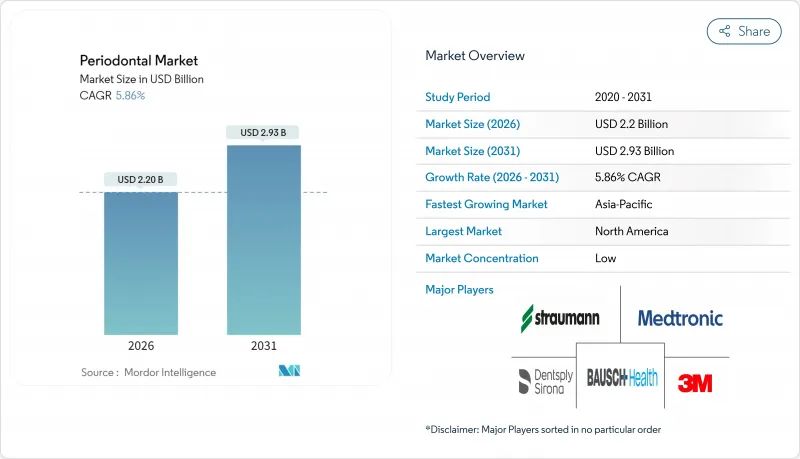
치주 질환 시장은 2025년 20억 8,000만 달러로 평가되었고, 2026년에는 22억 달러로 성장할 것으로 예측됩니다. 2026-2031년에 걸쳐 CAGR 5.86%로 성장할 것으로 보이며, 2031년까지 29억 3,000만 달러에 달할 전망입니다.
재생 의료 기기의 발전, 치과 보험 가입률 증가, 그리고 최소 침습 치료로의 뚜렷한 전환이 수요를 가속화하고 있습니다. 심각한 치주염 환자가 2021년 10억 명에서 2050년 15억 6천만 명으로 증가할 것으로 예상되는 고령화 세계 인구는 장기적인 시술량을 뒷받침합니다. 치주 질환 시장은 또한 소셜 미디어 주도 미용 치과의 붐, 보험 정책에서 구강 건강과 전신 건강 간의 강화된 연계성, 진료 시간을 단축하는 지속적인 신제품 출시로 혜택을 보고 있습니다. 반면 신흥 경제국의 높은 치료 비용과 농촌 지역의 전문 의료진 부족은 성장 모멘텀을 제약하고 있습니다.
급속한 인구 고령화로 질병 부담 증가 : 고소득 국가 65세 이상 성인의 약 70%가 치주염 증상을 보이며, 노화 세포는 표준적 치태 제거만으로는 해결되지 않는 염증을 악화시킵니다. 의료 시스템은 만성 질환 관리 프로그램에 치주 검진을 통합하며, 장기적으로 치주 질환 시장을 지탱할 견고한 수요 기반을 강화하고 있습니다.
화상회의 문화와 소셜미디어 노출이 환자들의 기대치를 매끄러운 기능성과 얼굴 조화로 재조정했습니다. 디지털 스캐너와 진료실 내 3D 프린팅 기술로 치과의사들은 재생 치주 수술과 미소 디자인 워크플로우를 결합할 수 있게 되어 젊은 층을 치주 치료 시장으로 끌어들이고 있습니다. 보험사들은 전신 건강상의 이점이 입증될 경우 미용 목적의 치주 시술 비용을 보상해 주어 잠재적 시장 규모를 더욱 확대하고 있습니다.
인도에서는 인구의 5%만이 고급 구강 치료를 감당할 수 있으며, 80%는 치과를 방문한 적이 없어 접근성 격차가 매우 큽니다. 수입 의존도는 장비 가격을 상승시키고, 민간 지불 모델이 주류를 이룹니다. 현지 제조업체들이 규모를 확장하고 있지만, 경제성 장벽은 남아시아 및 동남아시아 전역에서 치주 질환 시장 확대 속도를 계속 늦추고 있습니다.
2025년 치주 질환 시장에서 장비 부문은 55.05%를 차지했으며, 전동 스케일러, 레이저, CBCT 영상 장비가 종합 치료의 표준으로 자리 잡았습니다. 피에조 시스템의 지속적인 업그레이드와 다이오드 레이저의 보급률 증가는 평균 판매 가격을 견고하게 유지하고 있습니다. 소모품 부문은 규모는 작지만 재생막 및 나노 하이드록시아파타이트 이식재 등 의료진이 자주 재주문하는 제품에 힘입어 6.05%의 연평균 성장률(CAGR)로 가장 빠르게 성장하는 분야입니다. 재생 이식재 시장의 규모는 빠른 골유착에 대한 임상적 증거에 힘입어 꾸준히 확대될 전망입니다.
의약품 하위 부문은 국소 투여 항균제로 전환 중이며, 이는 전신 노출 없이 치주낭 내 약물 농도를 지속 가능하게 합니다. 이러한 역학은 치과 진료소가 경쟁력을 유지하기 위해 자본 장비와 반복적 소모품 모두에 투자함에 따라 치주 질환 시장의 성장 궤도를 강화합니다.
2025년 치주 질환 시장 규모에서 치은염 부문은 46.40% 점유율을 유지했는데, 이는 일상적 예방 치료가 광범위한 환자층을 대상으로 하기 때문입니다. 공중보건 캠페인과 고용주 지원 치과 건강관리로 조기 발견이 증가하여 이 부문은 여전히 상당한 규모를 유지하고 있습니다. 공격성 치주염은 규모는 작지만, 개선된 유전자 및 바이오마커 진단을 통해 급속히 진행되는 파괴성 사례에 대해 임상의가 조기에 개입할 수 있게 되어 2031년까지 연평균 6.42%의 성장률을 기록할 전망입니다.
만성 치주염은 수명 연장과 함께 지속적으로 증가하는 반면, 괴사성 및 약물 관련 질환은 면역조절 보조제 분야의 혁신을 촉진하는 특수한 틈새 시장을 형성합니다. 이러한 다양한 질병 경로는 치주 질환 시장을 유연한 제품 포트폴리오가 성과를 거둘 수 있는 다각화된 분야로 만듭니다.
북미는 2025년 매출액의 41.70%를 차지하고 메디케이드 확대와 민간보험 확충에 의해 성인의 치주 질환 치료 급부가 확대되었습니다. 그러나 주요 도시권 이외에서는 의료 제공업체의 부족이 보급 속도를 제한하고 있어 이동 진료소나 원격 치과 진료의 파일럿 사업이 추진되고 있습니다. 캐나다에서는 2024년에 시작된 연방 정부의 보험 적용이 종합적인 치주 질환 치료를 지원하고 시장은 견조하게 추이하고 있습니다.
아시아태평양 지역은 2031년까지 연평균 7.66% 성장률(CAGR)로 주요 성장 동력입니다. 중국의 임플란트 붐과 디지털 기반 임플란트 주변 유지 관리가 장비 업그레이드를 촉진하는 반면, 라크스미 덴탈의 이식재 생산과 같은 국내 제조는 인도의 수입 비용을 절감합니다. 태국과 한국으로의 의료 관광 흐름은 치주 검진을 포함하는 정부 건강검진 보조금 패키지로 인해 치주 질환 시장을 더욱 확대시키고 있습니다.
유럽은 보편적 보험과 엄격한 의료기기 규제로 임상 기준을 보호하는 혜택을 누립니다. 독일과 스위스는 생체재료 개발을 선도하며, Geistlich의 콜라겐 막은 복잡한 결손 치료에 주목받고 있습니다. 남유럽 경제권은 EU 회복 기금으로 진료소가 현대화되며 더 빠른 성장을 경험하고 있습니다. 라틴 아메리카와 중동은 꾸준한 수요를 보이며, 특히 도시 중심지에서 프리미엄 미용 치과 치료가 지향적인 소비자층과 공감대를 형성하고 있으나, 통화 변동성이 단기적으로 치주 질환 시장의 잠재력을 제한하고 있습니다.
The periodontal market is expected to grow from USD 2.08 billion in 2025 to USD 2.2 billion in 2026 and is forecast to reach USD 2.93 billion by 2031 at 5.86% CAGR over 2026-2031.
Advancing regenerative devices, rising dental-insurance penetration, and a pronounced shift toward minimally invasive care are accelerating demand. An aging global population-with severe periodontitis cases projected to climb from 1 billion in 2021 to 1.56 billion by 2050-anchors long-term procedure volumes. The periodontal market is also benefitting from cosmetic dentistry's social-media-driven boom, stronger links between oral and systemic health in reimbursement policy, and continuous product launches that shorten chair time. Conversely, high treatment costs in emerging economies and shortages of specialized clinicians in rural areas restrain growth momentum.
Rapid population ageing is elevating disease burden: nearly 70% of adults over 65 in high-income economies exhibit some periodontitis, while senescent cells intensify inflammation that standard debridement alone cannot resolve. Healthcare systems are integrating periodontal screening into chronic-disease programmes, reinforcing a solid demand pipeline that sustains the periodontal market over the long term.
Video-conferencing culture and social-media visibility have recalibrated patient expectations toward seamless function and facial harmony. Digital scanners and chairside 3-D printing enable clinicians to merge regenerative periodontal surgery with smile-design workflows, drawing younger cohorts into the periodotal treatment market. Insurers now reimburse aesthetic-linked periodontal procedures when systemic health benefits are documented, further widening the addressable base.
In India only 5% of the population can afford advanced oral care; 80% have never visited a dentist, demonstrating a vast access gap. Import dependence inflates equipment prices, and private payment models dominate. Although local manufacturers are scaling, the affordability barrier continues to slow periodontal market uptake across South and Southeast Asia.
Other drivers and restraints analyzed in the detailed report include:
For complete list of drivers and restraints, kindly check the Table Of Contents.
Equipment contributed 55.05% to the periodontal market in 2025 as power-driven scalers, lasers, and CBCT imaging became standard for comprehensive care. Ongoing upgrades in piezoelectric systems and the rising penetration of diode lasers keep average selling prices resilient. Consumables, though smaller, are the fastest advancing slice at a 6.05% CAGR, propelled by regenerative membranes and nano-hydroxyapatite grafts that clinicians reorder frequently. The periodontal market size for regenerative graft materials is set to expand steadily, supported by clinical proof of faster osseointegration.
The medication sub-segment is pivoting toward locally delivered antimicrobials, enabling sustained drug concentrations in periodontal pockets without systemic exposure. Together, these dynamics reinforce the periodontal market trajectory as practices invest in both capital equipment and recurring consumables to stay competitive.
Gingivitis retained 46.40% share of the periodontal market size in 2025 because routine prophylaxis addresses a broad patient base. Public-health campaigns and employer-sponsored dental wellness have increased early detection, keeping this segment sizeable. Aggressive periodontitis, although smaller, is set to post a 6.42% CAGR to 2031 as improved genetic and biomarker diagnostics allow clinicians to intervene earlier in rapid-destructive cases.
Chronic periodontitis continues to climb with longevity, while necrotizing and medication-related conditions create specialized niches that stimulate innovation in immunomodulatory adjuncts. These multiple disease pathways make the periodontal market a diversified field that rewards flexible product portfolios.
The Periodontal Market Report is Segmented by Product (Equipment, Consumables, Medication), Disease (Gingivitis, Chronic Periodontitis, Aggressive Periodontitis, Other Diseases), Treatment (Non-Surgical Treatment, Surgical Treatment), End User (Hospitals, Dental Clinics, Academic & Research Institutes), and Geography (North America, Europe, and More). The Market Forecasts are Provided in Terms of Value (USD).
North America retained 41.70% of 2025 turnover as Medicaid expansions and private-insurance upgrades broadened adult periodontal benefits. Yet provider shortages outside major metros limit penetration speed, prompting mobile clinics and teledentistry pilots. The periodontal market remains robust across Canada, where federal coverage launched in 2024 underwrites comprehensive periodontal services.
Asia-Pacific is the primary growth engine at 7.66% CAGR through 2031. China's implant boom and digitally enabled peri-implant maintenance propel equipment upgrades, while domestic manufacturing-exemplified by Laxmi Dental's graft production-shrinks import costs for India. Medical-tourism flows to Thailand and South Korea further swell the periodontal market, supported by governmental health-check subsidies that bundle periodontal screening into inbound packages.
Europe benefits from universal insurance and stringent device regulations that safeguard clinical standards. Germany and Switzerland pioneer biomaterial development, with Geistlich's collagen membranes gaining traction for difficult defects. Southern European economies experience faster growth as EU recovery funds modernize clinics. Latin America and the Middle East show steady demand, especially in urban centers where premium cosmetic dentistry resonates with aspirational consumers, although currency volatility tempers the periodontal market's potential in the near term.