



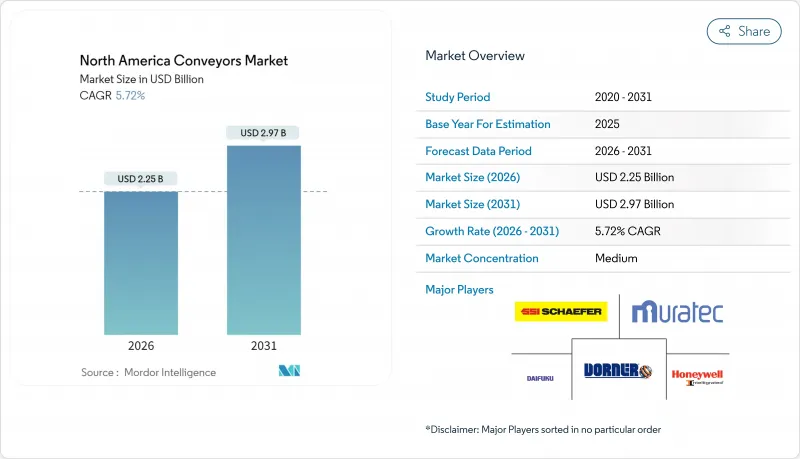
북미의 컨베이어 시장의 규모는 2026년에 22억 5,000만 달러로 추정되고 있으며, 2025년 21억 3,000만 달러에서 계속 성장하고 있습니다.
2031년 예측은 29억 7,000만 달러에 이르렀으며, 2026년부터 2031년까지 연평균 복합 성장률(CAGR) 5.72%로 확대될 것으로 전망됩니다.

자동화 자재관리 기술에 대한 투자 증가, 전자상거래 소포 배송의 지속적 성장, 국내 제조업 활성화를 목적으로 한 연방의 세제 우대조치가 신규 도입과 업그레이드에 대한 자본 유입을 지속적으로 촉진하고 있습니다. 60만명 이상의 공장 인력 부족과, 창고업의 이직률이 49% 이상인 점 등 노동력 부족이 심각화하고 있는 상황은 수작업의 접점을 최소화하는 컨베이어의 도입 장점을 더욱 견고하게 하고 있습니다. 제조업체는 또한 로봇 및 창고 관리 소프트웨어와의 통합이 용이하며 인력 추가 없이 처리 능력을 향상시키는 관점에서 컨베이어를 선호합니다. 한편, 최종 사용자는 에너지 효율적인 구동장치와 예지보전 분석을 통해 원재료 가격이 변동해도 평생 운용 비용이 절감된다는 것을 인식하고 있습니다. 이러한 요인이 더하여 꾸준한 업그레이드 수요를 뒷받침하고 한정된 도시의 부지에 적합하는 혁신적인 수직 모듈러 레이아웃의 여지를 창출하고 있습니다.
풀필먼트 센터는 현재 시간당 10,000개 이상의 소포를 운반할 수 있으며, 벌크 처리와 개별 피킹 워크플로 사이를 원활하게 전환할 수 있는 컨베이어가 도입되었습니다. 모듈식 고처리량 분류기는 메자닌과 다층 빌딩에 이상적입니다. 이러한 임대 공간의 연간 임대료는 일반적으로 평방 피트 당 USD 15 이상입니다. 컴퓨터 비전 스캐너와 AI 장착 센서는 수하물의 크기에 따라 벨트 속도와 분기 각도를 동적으로 조정하여 분류 실수율과 운영자의 작업 부담을 줄입니다. 클릭 앤 콜렉트 및 매장 배송 프로그램을 확대하는 소매업체는 재고를 수초 안에 재분배할 수 있는 유연한 시스템을 필요로 하며, 이를 통해 당일 배송 약속을 확실히 수행할 수 있습니다. 제약회사 및 자동차 부품 공급업체도 설치 면적을 확대하지 않고 SKU 증가를 관리하기 위해 이러한 고속 설계를 모방하고 있습니다. 인터롤사가 최근 발표한 컴팩트 크로스벨트 구분기는 프레임의 소형화와 에너지 효율이 높은 구동 장치로의 이행 동향을 뒷받침하고 있어 전력 소비를 억제하면서 소포의 처리 능력을 향상시키고 있습니다.
엣지 센서가 장착된 네트워크 컨베이어는 진동, 온도, 전류 소비에 대한 연속 데이터를 수집하여 클라우드 분석 시스템으로 전송합니다. 이를 통해 최대 10일간의 고장을 예측할 수 있어 예기치 않은 정지를 30% 줄일 수 있습니다. 무선 프로토콜에 의해 인접 존이 자동으로 속도를 조정하여 정체를 방지하고 전체 라인의 흐름을 균일하게 유지합니다. 디지털 트윈 시뮬레이션에 의해 레이아웃 변경 계획을 검증하여, 시운전 시간을 단축하고, 하드웨어 도착 전에 병목을 특정 및 해결합니다. 음성 지원 휴먼 머신 인터페이스는 여러 작업 영역을 모니터링하면서 핸즈프리로 지시할 수 있어 라인 리더의 조정 사이클을 단축합니다. 컨베이어와 자율이동 로봇(AMR)을 결합한 시설은 피킹 경로와 이송 지점을 실시간으로 조정하여 컨베이어와 AMR이 대체품이 아닌 보완적인 자산으로 최적으로 작동함을 입증합니다.
턴키 방식의 자동화 컨베이어 라인은 전기 설비의 업그레이드 및 바닥 보강을 제외하고 5만 달러에서 50만 달러의 가격 범위 내에 있습니다. 연간 보수 계약비는 구매 가격의 10-15%에 상당하는 경우도 있어, 이익률이 낮은 기업에서는 투자 회수율(ROI)의 산출이 복잡합니다. 많은 중소 제조업체는 모듈식 접근법을 채택하여 우선 기본 벨트 섹션을 구입하고 나중에 분류 모듈을 추가하지만 이는 레이아웃의 타협을 초래할 수 있습니다. 설비 리스와 SBA(중소기업청) 보증대출은 현금흐름 부담을 줄이지만, 여전히 소유자가 핵심 생산기계에 충당하기 원하는 신용 프레임을 구속합니다. 이러한 장벽이 있음에도 불구하고 인건비 절감과 품질 향상의 효과를 더하면 투자 회수 기간은 3년 미만이며 금리가 안정되면 자금 조달에 관한 협의도 용이해집니다.
2024년에 도시 부동산 비용이 평방 피트당 15달러에 이르면서 천장식 컨베이어에 대한 관심이 높아졌으며, 이 부문은 2031년까지 연평균 복합 성장률(CAGR) 7.06%로 확대될 것으로 전망됩니다. 벨트 유닛은 조립,창고, 포장 라인과의 폭넓은 호환성으로 2025년 시점에서 북미의 컨베이어 시장의 44.15%를 차지했으며, 여전히 주류로 이용되고 있습니다. 롤러형 모델은 자동차 프레스 가공에서 일반적인 피트당 1,000 파운드를 초과하는 중량물 운반에 필수적입니다. 파렛트 시스템은 표준화된 유닛 하역에 대응하고, 체인식, 스크류식, 공압식 등의 특수 시스템은 세정이나 방폭 기능이 필요한 식품 및 의약품 환경에 대응합니다. 경량 합금제 트럭과 저마찰 구동 장치에 의해 천장 설치형 루프가 실현되어 바닥 면적을 효율화합니다. 통합 리프트 섹션은 리프트나 AGV를 필요로 하지 않고 계층 간의 토트 이동을 가능하게 하여 피킹 경로를 단축하고 이동 시간을 줄입니다. 밀폐형 체인 리턴 및 자동 윤활 스테이션과 같은 안전 기능 향상을 통해 오버헤드 레이아웃은 엄격한 OSHA 지침을 준수하고 수동 유지보수로 인한 다운타임을 줄입니다.
혁신의 핵심은 기계적 마모를 실질적으로 제거하는 자기 부상 궤도에 있으며, 파일럿 도입은 클래스 100 클린 룸 기준으로 미립자를 금지하는 전자 장비 조립 분야에 중점을 두고 있습니다. 상업 전개는 제한적이지만, 공급업체는 향후 10년간 생산량 확대에 따라 비용 곡선이 저하되어 민감한 분야에서 체인식 오버헤드 설계를 대체할 가능성이 있다고 예측했습니다.
유닛 핸들링 시스템은 2025년 북미 컨베이어 시장의 59.20%를 차지했습니다. 유닛 핸들링 시스템의 이점은 전자상거래 및 의약품 포장에서의 개별 제품 흐름에 뒷받침되었습니다. 이 지역의 제조업이 저부가가치 상품에서 다품종 소량 생산으로 전환하는 가운데 6.18%의 연평균 복합 성장률(CAGR)로 성장할 전망인 유닛 핸들링은 벌크 핸들링을 웃돌고 있습니다. 비전 가이드형 분기 장치는 이동 중인 바코드를 읽고 mm 단위 이하의 정밀도로 골판지를 적절한 슈트로 유도합니다. 이는 전자 부품과 자동차 부품에서 매우 중요합니다. 서부 지방의 광업지대에서는 여전히 벌크시스템이 광석과 곡물을 1,000톤/시간으로 수송하고 있지만, 자본예산에서는 SKU 증가에 대응할 수 있는 유연한 유닛 라인이 우선되어, 대규모 업그레이드를 필요로 하지 않는 설계가 높이 평가되고 있습니다. 모듈형 섹션은 퀵 커넥트 샤프트로 연결되어 성수기 시 주말 단기간에 재구성이 가능합니다. WMS 플랫폼과의 통합은 실시간 재고 상황 파악과 자동 보충을 실현하여 안전 재고에 구속되는 운전 자금을 줄입니다. 고밀도 축적 구역은 하류 파렛타이저를 버퍼링하여 라벨링 및 포장 공정 지연으로 인한 라인 정지를 방지합니다.
첨단 알고리즘이 구역별 체류 시간을 추적하고 제품 체류 시간이 설정 값을 초과하면 업스트림 벨트가 자동으로 감속합니다. 이는 흐름을 평준화하고 수동 개입의 필요성을 없앱니다. 이러한 실시간 조정은 깨지기 쉬운 식품 포장의 무결성을 보장하고 재작업을 최소화합니다.
The North America conveyors market size in 2026 is estimated at USD 2.25 billion, growing from 2025 value of USD 2.13 billion with 2031 projections showing USD 2.97 billion, growing at 5.72% CAGR over 2026-2031.
Rising investment in automated material-handling technology, continuous growth in e-commerce parcel shipments, and federal tax incentives aimed at revitalizing domestic manufacturing continue to drive capital toward new installations and retrofits. Persistent labor shortages, leaving more than 600,000 factory positions vacant and warehouse turnover rates above 49%, reinforce the business case for conveyors that minimize manual touchpoints. Manufacturers also favor conveyors because they integrate easily with robotics and warehouse management software, improving throughput without requiring an increase in headcount. Meanwhile, end users see energy-efficient drives and predictive maintenance analytics lowering lifetime operating costs, even when raw material prices fluctuate. Together, these factors anchor steady replacement demand and create headroom for innovative vertical and modular layouts that fit tight urban footprints.
Fulfillment centers now feature conveyors capable of moving more than 10,000 parcels per hour, switching seamlessly between bulk and individual-pick workflows. Modular, high-throughput sorters are ideal for mezzanine and multi-level buildings, where rented space typically commands USD 15+ per square foot annually. Computer-vision scanners and AI-enabled sensors dynamically adjust belt speed and diverter angles based on package size, reducing mis-sort rates and operator touches. Retailers extending click-and-collect and ship-from-store programs require flexible systems that can redirect inventory within seconds, ensuring they keep same-day delivery promises. Pharmaceutical and automotive suppliers mimic these high-velocity designs to manage SKU proliferation without enlarging footprints. Recent compact cross-belt sorters launched by Interroll underscore the trend toward narrower frames and energy-efficient drives that reduce power consumption while increasing parcel throughput.
Networked conveyors equipped with edge sensors collect continuous data on vibration, temperature, and current draw, which is then fed into cloud analytics that predict failures up to 10 days in advance, resulting in a 30% reduction in unplanned stops. Wireless protocols enable adjacent zones to auto-throttle their speed to avoid jams, maintaining a balanced flow across the entire line. Digital-twin simulations model proposed layout changes, reducing commissioning time and ensuring bottlenecks are identified and resolved before hardware arrives. Voice-enabled human-machine interfaces shorten adjustment cycles for line leaders who can issue hands-free commands while monitoring multiple work areas. Facilities that pair conveyors with autonomous mobile robots (AMRs) orchestrate pick paths and transfer points in real-time, demonstrating that conveyors and AMRs operate best as complementary assets rather than substitutes.
A turnkey automated conveyor line ranges from USD 50,000 to USD 500,000, excluding electrical upgrades or floor reinforcements. Annual service contracts can equal 10-15% of purchase cost, complicating ROI models for firms with thin margins. Many small manufacturers adopt a modular approach, buying basic belt sections first and adding sort modules later, though that can create layout compromises. Equipment leasing and SBA-backed loans ease cash-flow strain yet still tie up credit lines that owners prefer to earmark for core production machinery. Despite these hurdles, payback periods often fall below three years once labor savings and quality gains are tallied, making financing conversations easier when interest rates stabilize.
Other drivers and restraints analyzed in the detailed report include:
For complete list of drivers and restraints, kindly check the Table Of Contents.
Overhead conveyors garnered faster interest as tight urban real estate costs reached USD 15 per sq ft in 2024, catalyzing a 7.06% CAGR through 2031 for this category. Belt units still dominated the North America conveyor market, with a 44.15% share in 2025, due to their broad compatibility across assembly, warehousing, and packaging lines. Roller models remain indispensable for handling heavy loads exceeding 1,000 lb per linear foot, which is common in automotive stamping. Pallet systems serve standardized unit loads, while niche variants, such as chain, screw, or pneumatic systems, address food or pharma environments that require wash-down or explosion-proof features. Lightweight alloy tracks and low-friction drives enable ceiling-mounted loops, freeing valuable floor area. Integrated lift sections now transfer totes between tiers without the need for lifts or AGVs, thereby compressing pick-path length and reducing travel time. Safety upgrades, including enclosed chain returns and auto-lube stations, help overhead layouts meet strict OSHA guidelines, reducing downtime for manual maintenance.
Innovation centers on magnetic-levitation tracks that virtually eliminate mechanical wear; pilot deployments focus on electronics assembly, where class-100 clean-room standards prohibit particulates. While commercial rollout remains limited, suppliers expect cost curves to fall as volume scales over the decade, potentially displacing chain-based overhead designs in sensitive sectors.
Unit handling systems held a 59.20% share of the North America conveyor market in 2025, a lead driven by discrete-item flows in e-commerce and pharma packaging. Growth at 6.18% CAGR outpaces bulk handling as the region's manufacturing pivots from low-value commodities toward high-mix, low-volume goods. Vision-guided diverters read barcodes on the fly, steering cartons into the correct chutes with sub-millimeter accuracy, which is crucial for electronics and auto parts. While bulk systems still move ore and grain at 1,000 t/h in the mining belts of the western provinces, capital budgeting increasingly rewards flexible unit lines that allow SKU proliferation without requiring overhauls. Modular sections lock together via quick-connect shafts, allowing for weekend reconfiguration during seasonal peaks. Integration with WMS platforms provides real-time inventory snapshots and triggers automated replenishment, trimming working capital tied up in safety stock. High-density accumulation zones buffer downstream palletizers, preventing line starve-outs when labeling or wrapping slows.
Advanced algorithms track dwell time per zone; if product backups exceed parameters, upstream belts automatically decelerate, smoothing the flow and eliminating the need for manual intervention. This real-time tuning ensures that fragile food packages remain intact and minimizes rework.
The North America Conveyors Market Report is Segmented by Product Type (Belt, Roller, Pallet, and More), Conveyor Class (Unit Handling Conveyors and Bulk Handling Conveyors), Drive Mechanism (AC Electric Motor Driven, DC Electric Motor Driven, and More), End-User Industry (Airport, Retail and E-Commerce Fulfillment, Automotive, and More), and Country. The Market Forecasts are Provided in Terms of Value (USD).