



태아 및 신생아 모니터링 시장은 2025년 98억 1,000만 달러에서 2026년에는 104억 7,000만 달러로 성장하고, 2026년에서 2031년에 걸쳐 CAGR 6.71%로 추이하여, 2031년에는 144억 9,000만 달러에 이를 전망입니다.

수요는 세계적인 조산율 상승, AI 탑재 심음 모니터링의 보급, 병원 및 가정 치료 인프라의 꾸준한 개선에 의해 견인되고 있습니다. 각 공급업체는 단일 기능 장비에서 베드사이드, 클라우드, 스마트폰 인터페이스를 연결하는 통합 플랫폼으로 전환하여 가격 경쟁의 양상을 바꾸고 서비스 기반 수익 모델을 홍보하고 있습니다. 아시아태평양의 대규모 민간 병원 체인은 신생아 집중 치료실의 병상 증설을 계속하는 한편, 북미의 의료 시스템은 평균 재원 일수를 단축하는 원격 모니터링 프로그램에 주력하고 있습니다. 동시에 소비자의 웨어러블 태아 벨트 수용 확대로 기존 병원 채널을 넘어 잠재 수요가 확대되고 있습니다.
2024년 미국의 조산아 비율은 출생아 전체의 10.4%에 이르렀고, 인종 간에 현저한 격차가 확인되었습니다. 조산아에 대한 첫 해 의료비는 평균 4만 9,140달러인 반면, 정상 신생아에 대해서는 1만 3,024달러였습니다. 의료 시스템이 사후 대응형에서 예측형 의료 모델로 이행하는 가운데, 이러한 수치가 태아 및 신생아 모니터링 시장의 중요성을 높이고 있습니다. 병원에서는 표준 스크리닝보다 수주 빨리 임신 위험을 경고하는 분석 소프트웨어의 도입이 증가하고 있습니다. 의료기기 제조업체는 보험 지불자와의 제휴를 통해 조기 발견을 평가하는 성과 연동형 기준과 연동한 환급 제도의 구축에 임하고 있습니다.
컴퓨터 CTG 플랫폼은 태아 두정위 판정에서 94.5%의 정확도를 달성하여 주관적인 시각적 해석에 대한 의존도를 감소시켰습니다. 산모 맥박 데이터와 태아 심박 파형을 통합하여 신생아 뇌손상 위험을 1.6배 줄일 수 있으며 이는 복합 센서의 임상적 유용성을 강화하고 있습니다. 각 공급업체는 고압 분만실에서 임상의를 안내하는 실시간 신호 경고 기능을 통합합니다. 이러한 시스템을 도입한 병원에서는 긴급 제왕절개수술에서 '판단에서 절개까지의 시간'이 단축되었다고 보고되었으며, 이는 태아 및 신생아 모니터링 기기 시장에서의 반복 구입과 장기 서비스 계약 강화로 이어지고 있습니다.
기니비사우의 "Casa das Maes" 프로그램은 2025년까지 9만 4,000명의 여성을 지원했지만, 많은 지방 의원에서는 여전히 베드사이드 모니터에 대한 안정적인 전원 공급 능력이 부족합니다. 운송 지연 및 불안정한 모바일 통신 네트워크가 원격 데이터 업로드를 방해하여 원격 모니터링의 이점을 제한합니다. 기증자 기금을 통한 파일럿 프로젝트는 자금 조달 주기 종료 후 정체되는 경우가 많으며 시설은 지원되지 않는 장비를 보유하고 있습니다. 따라서 태아 및 신생아 모니터링 시장은 오프라인으로 작동하고 통신 환경이 허용할 때 동기화되며 내구성이 높고 유지보수가 적은 설계에 의존합니다. 태양전지 충전식 배터리와 다국어 사용자 인터페이스를 지원하는 제조업체는 선도기업의 지위를 획득하고 있습니다.
신생아 모니터링 기기는 12.92%의 연평균 복합 성장률(CAGR)을 보일 것으로 예측되며, 이는 태아 및 신생아 모니터링 시장의 전체 성장률의 약 두 배에 해당합니다. 이는 생후 1주일 후 결과에 대한 임상적 관심 증가를 반영합니다. 이 부문의 심전 모니터는 현재 비접촉식 영상 광전식 맥파계를 도입하고 있으며 심박수를 ±0.2박/분 이내의 정밀도로 계측합니다. 이 비약적인 진보는 극저체중 신생아의 피부 자극 위험을 완화합니다. 태아 및 신생아 모니터링 시장에서 신생아용 산소포화도 측정기 시장의 규모는 2026년에 13억 5,000만 달러에 이르고 2031년까지 23억 달러로 확대될 것으로 예측됩니다. 이는 접착으로 인한 화상을 방지하는 소프트 센서 기술이 견인하고 있습니다. 카프노그래프는 이산화탄소(CO2) 변화를 머신러닝 경보와 통합하여 산소 포화도가 감소하기 전에 무호흡 발작을 예측하므로 간호사의 대응 시간을 확보합니다. 혈압 측정 모듈은 팽창식 커프와 광학 센서를 결합하여 교정 시간을 단축하고 조작 스트레스를 줄일 수 있습니다. 각 공급업체는 이러한 센서를 클라우드 대시보드와 통합하는 경우가 증가하고 있으며, 가입자층을 구축하여 신생아 1인당 평생 수익을 향상시키고 있습니다. 고해상도 동영상 분석 기술은 표준 생체 신호 측정과 점점 융합되어 동일 플랫폼 내에서 조기 단계의 망막증 모니터링을 가능하게 함과 동시에 태아 및 신생아 모니터링 시장에서 신생아용 제품의 점유율 확대에 기여하고 있습니다.
2025년 태아 모니터링 기기는 분만실에서 확립된 심음도 프로토콜을 뒷받침하면서 태아 및 신생아 모니터링 시장에서 65.92%의 점유율을 유지했습니다. AI 오버레이 기술은 전통적인 CTG 플롯을 실용적인 위험 지표로 변환하여 하드웨어의 전반적인 교체가 아닌 소프트웨어 업그레이드에 대한 수요를 창출합니다. 낮은 도입 비용과 긴 수명 배터리를 특징으로 하는 휴대용 도플러 장치는 자원 제약이 있는 의원에서 주력 기기로서의 지위를 유지하고 있습니다. 다국어 대응 음성 프롬프트 기능의 추가로 신규 조산사가 심박변동을 해석하기 쉬워지고 새로운 지방 판로가 개척되고 있습니다. 단일 공급업체의 표준화를 요구하는 3차 의료기관에서는 초음파와 CTG를 통합한 워크스테이션에 대한 수요가 증가하고 있습니다. 이러한 동향이 융합하는 가운데, 태아 및 신생아 모니터링 시장은 양극화 경향을 유지하고 있으며 선진 시설에서는 하이엔드 디지털 스위트가 급증하는 한편, 초진 의료 현장에서는 기본형 도플러가 주류가 되고 있습니다.
아시아태평양은 2031년까지 연평균 복합 성장률(CAGR) 8.05%를 보일 것으로 예측되며, 태아 및 신생아 모니터링 시장에서 가장 높은 지역 성장률을 나타낼 전망입니다. 인도, 인도네시아, 베트남 정부는 임산부 건강 목표와 자본 설비 보조금을 연동하여 공립 병원에서 통합형 태아 및 신생아 모니터링 시스템의 표준화를 진행하고 있습니다. 민간 산부인과 체인은 다년간의 서비스 계약을 포함한 일괄 구매 계약을 확보하고, 현지 스타트업 기업은 간호사의 기술 습득을 촉진하는 이중 언어 사용자 인터페이스를 제공합니다. 도시 지역의 불임 치료 센터는 분만 중 환자의 이동성을 향상시키는 무선 CTG 벨트에 투자하여 경쟁이 심한 도시 시장에서 차별화를 도모하고 있습니다.
북미는 2025년 시점에서 31.96%의 수익 점유율을 유지하고 있었으며, AI 분석 기술의 조기 도입과 강력한 보험 적용 범위에 뒷받침되고 있습니다. 병원에서는 '가상 병동' 프로그램을 추진해, 안정된 상태의 미숙아를 가정용 연결 키트와 함께 퇴원시키고 있습니다. 북미의 클라우드 서비스의 태아 및 신생아 모니터링 시장 내 점유율은 장비 제조업체가 연장 보증과 구독 요금을 통합함으로써 상승할 것으로 예측됩니다. 강화된 사이버 보안 요구사항으로 암호화 및 패치 지원 능력이 입증된 공급업체로의 전환이 진행되고 있습니다. 벤처 캐피탈은 소프트웨어 중심의 기업을 대상으로 하며, 물리적 창고 확장 없이 주 경계를 넘어 확장 가능한 자산 경량형 비즈니스 모델을 중시하고 있습니다.
유럽에서는 의료기기 규제의 조화로 인해 일관된 품질 기준이 촉진되어 중간 정도의 단일 자릿수 성장을 보이고 있습니다. 스칸디나비아의 의료 시스템은 재입원률 저감에 대해 공급자에게 보너스를 지급하는 성과 연동형 조달을 시험적으로 도입하고 알고리즘 개량을 촉진하는 피드백 루프를 구축하고 있습니다. 남유럽 시장에서는 EU가 자금을 지원하는 부흥 조성금을 농촌의 원격 산부인과 의료에 투자하여 도시와 농촌의 격차를 해소함과 동시에 지금까지 보급이 진행되지 않았던 지역으로 태아 및 신생아 모니터링 시장을 확대하고 있습니다. 독일의 보험 회사는 원격 태아 모니터링 세션에 대해 조산사에게 보상을 지불하고 있으며 이는 보험 적용이 주류가 되고 있음을 보여줍니다.
중동 및 아프리카는 두 가지 길을 따라 진보하고 있습니다. 걸프 협력 회의(GCC) 회원국은 최고급 무선 모니터를 수입하여 고급 분만실과 함께 고급 틈새 시장을 개척하고 있습니다. 사하라 이남의 아프리카는 더위와 먼지에 견딜 수 있는 태양광 발전 도플러와 견고한 산소포화도 측정기에 중점을 두고 있습니다. 개발 기관은 단위 비용을 낮추기 위해 대량 구매를 조정하고 지구 병원 전체에서 태아 및 신생아 모니터링 시장을 점차 확대하고 있습니다. 라틴아메리카는 디지털 헬스의 도입을 가속하고 있으며, 2024년에는 조사 대상 시설의 82%가 임산부 서비스에 정보통신 기술을 이용했습니다.
The fetal and neonatal monitoring market is expected to grow from USD 9.81 billion in 2025 to USD 10.47 billion in 2026 and is forecast to reach USD 14.49 billion by 2031 at 6.71% CAGR over 2026-2031.
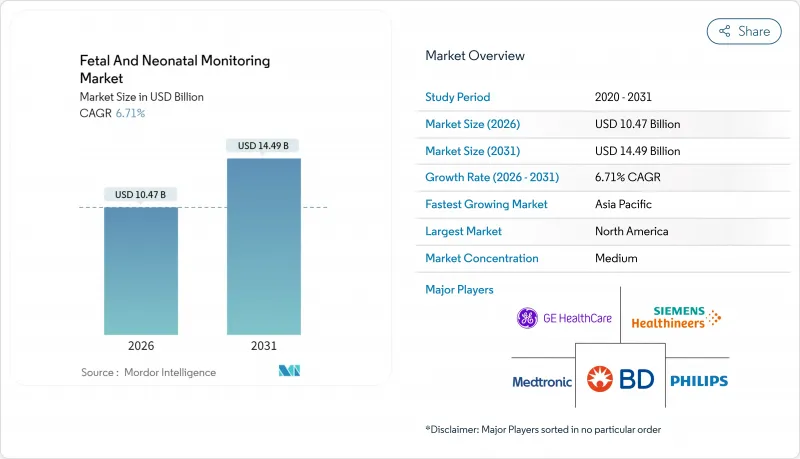
Demand is propelled by a global rise in pre-term deliveries, the spread of AI-enabled cardiotocography, and steady improvements in hospital and home-care infrastructure. Vendors are shifting from single-function machines to integrated platforms that connect bedside, cloud, and smartphone interfaces, which reshapes price competition and encourages service-based revenue models. Large private hospital chains in Asia-Pacific continue to add neonatal intensive-care beds, while North American health systems focus on remote monitoring programs that shorten average length of stay. At the same time, consumer acceptance of wearable fetal belts is expanding total addressable demand beyond the traditional hospital channel.
Pre-term births rose to 10.4% of live births in the United States during 2024, with notable racial disparities. The direct medical cost of care for these infants averaged USD 49,140 in the first year versus USD 13,024 for full-term infants. These figures elevate the fetal and neonatal monitoring market as health systems move from reactive to predictive care models. Hospitals increasingly purchase analytics software that flags pregnancy risk weeks earlier than standard screening. Device makers are partnering with payers to align reimbursements with outcome-based thresholds that reward early detection.
Computerized CTG platforms now reach 94.5% accuracy in identifying fetal head position, reducing reliance on subjective visual interpretation. Integrating maternal pulse data with fetal heart-rate traces cuts neonatal encephalopathy risk by 1.6-fold, which strengthens the clinical case for combined sensors. Vendors embed real-time traffic-light alerts that guide clinicians in high-pressure delivery rooms. Hospitals adopting these systems report shorter decision-to-incision times for emergency Caesarean sections, which reinforces repeat procurement and long-term service contracts within the fetal and neonatal monitoring devices market.
Guinea-Bissau's Casa das Maes program reached 94,000 women by 2025, yet many rural posts still lack stable power supply for bedside monitors. Transport delays and patchy mobile networks hinder remote data uploads, restricting tele-monitoring benefits. Donor-funded pilot projects often stall once grant cycles end, leaving facilities with unsupported equipment. The fetal and neonatal monitoring market therefore relies on durable, low-maintenance designs that operate offline and synchronize when network strength permits. Manufacturers responding with solar-charged batteries and multilingual user interfaces gain early mover advantage.
Other drivers and restraints analyzed in the detailed report include:
For complete list of drivers and restraints, kindly check the Table Of Contents.
Neonatal monitoring devices are projected to grow at a 12.92% CAGR, almost double the overall fetal and neonatal monitoring market growth rate, reflecting intensifying clinical focus on first-week outcomes. Cardiac monitors within this category now use contactless imaging photoplethysmography that registers heart rate within -0.2 beats per minute, a leap that lessens skin irritation risk in very-low-birth-weight infants. The fetal and neonatal monitoring market size for neonatal pulse oximeters stood at USD 1.35 billion in 2026 and is forecast to rise to USD 2.3 billion by 2031, buoyed by soft-sensor technologies that avoid adhesive burns. Capnographs integrate CO2 trends with machine-learning alerts that predict apnea episodes before oxygen saturation dips, giving nurses a longer response window. Blood-pressure modules now pair inflatable cuffs with optical sensors, which cuts calibration time and reduces handling stress. Vendors increasingly bundle these sensors with cloud dashboards, creating subscription layers that elevate lifetime revenue per newborn. High-resolution video analytics further merge with standard vitals, allowing early-stage retinopathy surveillance within the same platform and enlarging the neonatal share inside the fetal and neonatal monitoring market.
Fetal monitoring devices retained 65.92% fetal and neonatal monitoring market share in 2025, supported by entrenched cardiotocography protocols across labor wards. AI overlays transform legacy CTG plots into actionable risk indexes, prompting procurement of software upgrades rather than outright hardware replacement. Portable dopplers remain mainstays in resource-constrained clinics due to their low acquisition cost and long battery life. The addition of voice prompts in multiple languages helps new midwives interpret heart-rate variability, which opens new rural sales channels. Demand for integrated ultrasound-CTG workstations is rising among tertiary hospitals seeking single-vendor standardization. As these trends converge, the fetal and neonatal monitoring market maintains a dual-speed profile, where high-end digital suites surge in advanced centers while basic dopplers furnish first-contact care sites.
The Fetal and Neonatal Monitoring Market Report is Segmented by Product (Fetal Monitoring Devices [Heart Rate Monitors, Pulse Oximeters, and More] and Neonatal Monitoring Devices [Cardiac Monitors, Capnographs, and More]), End-User (Hospitals, Neonatal Care Centers, and More), and Geography (North America, Europe, Asia-Pacific, and More). The Market Forecasts are Provided in Terms of Value (USD).
Asia-Pacific is forecast to record an 8.05% CAGR through 2031, the highest regional pace within the fetal and neonatal monitoring market. Governments in India, Indonesia, and Vietnam link maternal-health goals with capital-equipment subsidies, leading public hospitals to standardize on integrated fetal and neonatal suites. Private maternity chains secure bulk-purchase agreements that include multi-year service contracts, while local start-ups provide bilingual user interfaces that accelerate nurse uptake. Urban fertility centers invest in wireless CTG belts that improve patient mobility during labor, adding differentiation in competitive metro markets.
North America retained 31.96% revenue in 2025, sustained by early adoption of AI analytics and strong payer coverage. Hospitals advance "virtual ward" programs that discharge stable premature infants with connected home kits. The fetal and neonatal monitoring market share for North American cloud services is projected to rise as device makers embed subscription fees into extended warranties. Heightened cyber-security mandates push providers toward suppliers with track records in encryption and patch support. Venture capital targets software-first firms, favouring asset-light business models that can scale across state lines without physical warehouse expansion.
Europe shows mid-single-digit growth, underpinned by harmonized Medical Device Regulation that promotes consistent quality standards. Scandinavian health systems pilot outcome-based procurement where suppliers receive bonuses for reduced readmission rates, creating a feedback loop that spurs algorithm refinement. Southern European markets invest EU-funded recovery grants into rural tele-obstetrics, closing urban-rural gaps and spreading the fetal and neonatal monitoring market to previously under-penetrated regions. German insurers compensate midwives for remote fetal monitoring sessions, signalling mainstream reimbursement acceptance.
Middle East and Africa progress along two paths. Gulf Cooperation Council members import top-tier wireless monitors and bundle them with luxury birthing suites, carving a premium niche. Sub-Saharan Africa focuses on solar-powered dopplers and rugged pulse oximeters that can tolerate heat and dust. Development agencies coordinate volume purchases to lower unit costs, gradually enlarging the fetal and neonatal monitoring market across district hospitals. Latin America accelerates digital health adoption, with 82% of surveyed facilities using information and communication technologies for maternal services in 2024.