


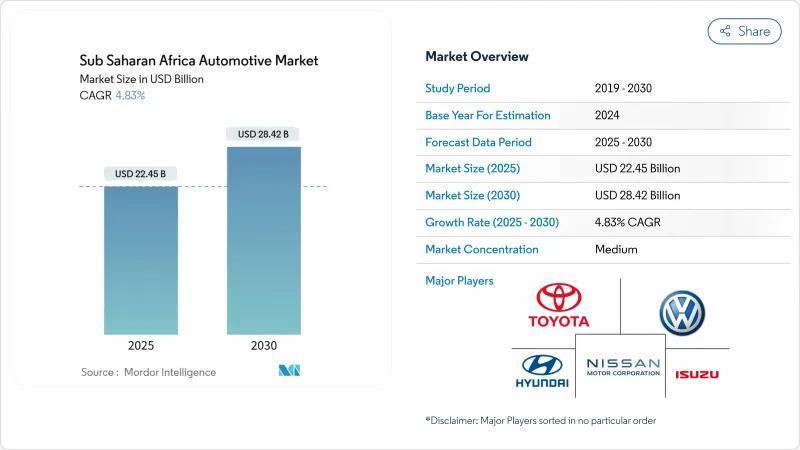
사하라 이남 아프리카의 자동차 시장 규모는 2025년에 224억 5,000만 달러로 평가되었고, 2030년에 284억 2,000만 달러에 이를 것으로 예측되며, 예측 기간 중 CAGR은 4.83%를 나타낼 전망입니다.
지속적인 통화 변동성과 인프라 격차에도 불구하고, 가속화되는 도시화, 급증하는 차량 호출 서비스 차량, 그리고 현지 조립에 대한 정부의 인센티브가 종합적으로 성장 모멘텀을 유지하고 있습니다. 에티오피아와 남아프리카공화국의 전기화 추진은 수요 구조의 다각화를 시사하지만, 확립된 연료 물류 및 서비스 네트워크로 인해 디젤 플랫폼이 여전히 우위를 점하고 있습니다. 비공식 수입 활동은 공식 딜러 판매량을 계속해서 억제하고 있으나, 체계적인 차량 금융 프로그램은 차량 공유 사업자 사이에서 신차 보급률을 높이고 있습니다. 아프리카 대륙 자유무역협정(AfCFTA) 관세 인하로 뒷받침되는 현지 조립업체와의 전략적 OEM 파트너십은 지역 공급망 통합을 강화하고 있습니다.
연간 4.1%의 도시 인구 증가로 구매력이 딜러 네트워크, 금융 옵션, 애프터마켓 서비스가 집약된 대도시권으로 이동하고 있습니다. 나이지리아, 케냐, 가나의 중산층 가구는 경제적인 모델을 선호하여 중국과 인도 OEM 간 경쟁을 심화시키고 있습니다. 소형 SUV와 해치백은 혼잡한 도로의 기동성으로 선호되는 반면, 도시 근교 소비자들은 증가하는 도시 내 중고차 거래 흐름에 힘입어 유입되는 중고차 재고에 의존합니다. 대출 기관들은 고용 집적지를 따라 움직여, 100만 명 이상 도시에서는 농촌 지역보다 최대 5배 많은 자동차 대출 상품을 제공합니다. 현지 통화 가치 하락이 수입차 구매력을 약화시키지만, 자원 개발 부문과 연계된 임금 상승이 가격 압박을 부분적으로 상쇄하여 수요를 유지합니다.
Moove와 같은 업체의 체계적인 차량 금융 프로그램은 승차 공유 운전자들이 기존 신용 장벽을 우회할 수 있게 하여 사하라 이남 아프리카 자동차 시장의 다년간 기준 수요를 끌어올리고 있습니다. 라이드헤일링 차량은 하루 8-12시간 운행되며, 이는 개인용 차량 대비 약 4배에 달하는 이용률로 교체 주기를 3-4년으로 단축시킵니다. 이러한 예측 가능한 주기는 OEM이 재고 계획을 플랫폼 조달 일정과 연계할 수 있게 하여 소비자 심리가 위축될 때 판매량을 보호합니다. 2025년 기준 나이지리아, 케냐, 남아프리카공화국에는 총 45만 명 이상의 활성 차량 공유 운전자가 존재하며, 플랫폼의 2차 도시 확장은 잠재 수요를 확대합니다. 정부 기관들은 이러한 차량 군을 교통 서비스 정규화의 촉매제로 인식하며, 에티오피아와 가나에서는 차량 공유용 저배출 차량에 관세 감면을 제공합니다. 이에 따른 차량 군 증가는 다수 시장에서 제한된 소매 금융 접근성의 위험을 완화합니다.
아프리카 자동차 제조업체 협회(AAAM)에 따르면, 2024년 사하라 이남 아프리카 전역의 경량 차량 등록 대수 중 중고차 비중은 83%를 기록했습니다. 남아프리카 국세청 관세 자료에 따르면 중고차와 신차 간 45-60%의 가격 격차가 구매자 선호도를 좌우하며, 현지 통화 가치 하락으로 전시실 가격표가 상승할 때마다 이 격차는 더욱 확대됩니다. 선진국의 내연기관 차량 등록 말소 예상량으로 2030년까지 연간 1,500만 대의 수출 가능 차량이 추가될 전망이며, 수입 품질 규제가 강화되지 않는 한 해당 지역의 고배출 차량 비중이 지속될 수 있습니다. UNECE(유엔 유럽 경제위원회)의 도로 적합성 규정은 기준 미달 차량 유입을 차단하기 위한 것이나, 국경 검문소별 시행 격차로 인해 여전히 효과성이 약화되고 있습니다.
스포츠 유틸리티 차량(SUV)은 2024년 사하라 이남 아프리카 자동차 시장의 36.75%를 차지했으며, 다양한 도로 조건에 적합한 다목적 주행 높이와 2030년까지 5.04%의 연평균 성장률(CAGR) 전망이 이를 뒷받침합니다. 세단은 전문직 및 차량 구매 시장에서 여전히 관련성을 유지하고 있으나, 소비자들이 크로스오버 실루엣으로 이동함에 따라 점유율 하락이 지속되고 있습니다. BYD, Chery 등 중국 기업들은 현지 조립 PHEV SUV를 일본 기존 업체 대비 할인된 가격으로 출시하며 경쟁을 심화시키고, 이를 통해 구매 의욕이 높은 소비자층의 채택률을 확대하고 있습니다. 케냐와 가나에서는 혼잡한 도로망이 소형 차체를 선호하는 환경을 조성하여 해치백이 입문형 시장을 주도하고 있습니다. 정규 대중교통 시스템이 부재한 도시 근교 지역에서는 다목적 밴이 상업적 인력 이동 수요를 충족시키며, 사하라 이남 아프리카 자동차 시장의 차체 스타일 모자이크를 강화하고 있습니다.
인프라 현실은 높은 지상고 모델의 매력을 유지 : 수도 외곽의 포장도로 밀도는 여전히 낮으며, 주기적인 홍수 발생으로 차체 하부 내구성이 구매 결정의 핵심 요소가 됩니다. 보안 고려사항 역시 SUV 채택을 선호하게 하는데, 높은 운전석 시야는 교통 정체 시 취약성을 줄여주기 때문입니다. 사하라 이남 아프리카 SUV 파생차량 시장 규모는 개인 소유와 차량 공유 서비스(ride-hailing) 차량 도입 모두에 힘입어 2030년까지 성장할 전망입니다.
승용차는 2024년 사하라 이남 아프리카 자동차 시장 물량에서 74.33% 점유율을 유지했으며, 중산층 확대에 힘입어 연평균 5.65% 성장할 것으로 전망됩니다. 경상용차(LCV)는 전자상거래 가속화의 수혜를 보는데, 특히 나이지리아와 케냐에서 밀집된 도시 노선에 최적화된 소형 밴을 임대하는 라스트마일 배송 업체들이 이를 주도합니다. 중대형 트럭은 남아프리카공화국, 잠비아, 앙골라의 원자재 수출 주기에 묶여 전체 시장 성장률을 따라가지 못하고 있습니다. 차량 공유 업체들은 선불 비용 부담을 낮추는 구조화된 금융 프로그램을 통해 세단 및 해치백 재고를 흡수하며 승용차 수요를 꾸준히 뒷받침하고 있습니다.
에티오피아의 정책 주도 전기화 정책은 승용차 구성을 재편 : 신규 등록 차량의 60%가 전기차여야 하며, 이는 전용 조립 사업과 공공 부문 조달을 촉진하고 있습니다. 반면 상용차 전동화는 적재량-주행거리 제약으로 뒤처지고 있으나, 요하네스버그 시범 사업에서는 도시 물류 주행 사이클 하의 배터리 전기 밴을 테스트 중입니다. 승용차 부문의 지속적 성장 동력은 사하라 이남 아프리카 자동차 시장 전반의 통화 안정성과 진보적 신용 접근 개혁에 달려 있습니다.
The Sub Saharan Africa automotive market size stands at USD 22.45 billion in 2025 and is projected to reach USD 28.42 billion by 2030, expanding at a 4.83% CAGR during the forecast period.
Accelerating urbanization, surging ride-hailing fleets, and government incentives for local assembly collectively sustain momentum despite persistent currency volatility and infrastructure gaps. Electrification initiatives in Ethiopia and South Africa signal a structurally diversifying demand mix, while diesel platforms remain dominant because of established fuel logistics and service networks. Grey-import activity continues to temper authorized-dealer volumes, yet structured fleet financing programs unlock new-vehicle penetration among ride-hailing operators. Strategic OEM partnerships with local assemblers, supported by AfCFTA tariff reductions, reinforce regional supply-chain integration.
An annual 4.1% urban-population uptick shifts purchasing power toward metropolitan nodes where dealer networks, financing options, and aftermarket services coalesce. Middle-income households in Nigeria, Kenya, and Ghana gravitate towards affordable models, intensifying competition between Chinese and Indian OEMs. Compact SUVs and hatchbacks hold favor for maneuverability in congested corridors, whereas peri-urban consumers rely on incoming used stock propelled by rising urban trade-in flows. Lenders follow employment clusters, resulting in cities above 1 million inhabitants offering up to five times more car-loan products than rural districts. Although local-currency depreciation erodes import affordability, wage growth linked to extractive sectors partially offsets price pressure, sustaining demand.
Structured fleet-financing programs from providers such as Moove enable ride-hailing drivers to bypass conventional credit hurdles, lifting multi-year baseline demand for the Sub Saharan Africa automotive market. Ride-hailing vehicles operate 8-12 hours daily, roughly quadrupling private-use utilization, which shortens replacement cycles to 3-4 years. This predictable cadence allows OEMs to align inventory planning with platform procurement schedules, protecting volumes when consumer sentiment dips. Nigeria, Kenya, and South Africa collectively host over 450,000 active ride-hailing drivers in 2025, and platform expansion into secondary cities deepens addressable demand. Government agencies increasingly recognize such fleets as catalysts for formalizing transport services, offering duty rebates on low-emission vehicles deployed for ride-hailing in Ethiopia and Ghana. Resultant fleet growth moderates the risk of limited retail financing reach in many markets.
Used vehicles represented 83% of all light-duty vehicle registrations across Sub Saharan Africa in 2024, according to the African Association of Automotive Manufacturers . South African Revenue Service customs data show That 45-60% price gaps between used and new models tilt buyer preference, a disparity magnified whenever local-currency depreciation inflates showroom tags. Projected deregistrations of ICE cars in wealthier economies could add 15 million exportable units annually by 2030, prolonging the region's high-emission fleet unless stricter import-quality rules take hold. UNECE roadworthiness protocols aim to stem sub-standard flows, but uneven enforcement across border posts still dilutes effectiveness.
Other drivers and restraints analyzed in the detailed report include:
For complete list of drivers and restraints, kindly check the Table Of Contents.
Sport-Utility Vehicles accounted for 36.75% of the Sub Saharan Africa automotive market in 2024, underpinned by a versatile ride height suited to mixed-quality roads and a 5.04% CAGR outlook through 2030. Sedans maintain relevance in professional and fleet procurement, yet share erosion persists as consumers migrate to crossover silhouettes. Chinese entrants such as BYD and Chery intensify rivalry by launching locally assembled PHEV SUVs at discounts versus Japanese incumbents, widening adoption among aspirational buyers. Hatchbacks dominate entry-level tiers in Kenya and Ghana, where congested grids reward compact footprints. Multi-purpose vans fill commercial people-movement gaps in peri-urban districts absent formal mass-transit systems, reinforcing the body-style mosaic across the Sub Saharan Africa automotive market.
Infrastructure realities sustain the appeal of higher-clearance models: paved-road density outside capitals remains low, and periodic flooding events make underbody robustness a decisive buying filter. Security considerations likewise favor SUV adoption because elevated driver sightlines reduce vulnerability in traffic slowdowns. The Sub Saharan Africa automotive market size for SUV derivatives is projected to grow by 2030, supported by both private ownership and ride-hailing fleet uptake.
Passenger cars preserved a 74.33% share of Sub Saharan Africa automotive market volume in 2024 and are forecast to grow at a 5.65% CAGR as middle-income cohorts expand. Light commercial vehicles (LCVs) benefit from e-commerce acceleration, especially in Nigeria and Kenya, where last-mile delivery providers lease small vans optimized for dense urban routes. Medium and heavy trucks trail overall market growth, tethered to commodity-export cycles in South Africa, Zambia, and Angola. Ride-hailing fleets underpin steady passenger-car demand, absorbing sedan and hatchback stock through structured financing programs that lower upfront cost burdens.
Policy-driven electrification in Ethiopia reshapes the passenger-car mix: 60% of newly registered cars must be EVs, catalyzing dedicated assembly ventures and public-sector procurement. Conversely, commercial-vehicle electrification lags because of payload-range constraints, though pilot programs in Johannesburg test battery-electric vans under urban logistics duty cycles. Sustained momentum within the passenger-car segment remains contingent on currency stability and progressive credit-access reforms across the Sub Saharan Africa automotive market.
The Sub Saharan Africa Automotive Market Report is Segmented by Body Style (Hatchback, Sedan, and More), Vehicle Type (Passenger Cars, Light Commercial Vehicles, and More), Fuel Type (Gasoline, Diesel, and More), Propulsion Technology (Internal Combustion Engine (ICE), Hybrid Electric Vehicle (HEV), and More), Sales Channel, and Country. The Market Forecasts are Provided in Terms of Value (USD) and Volume (Units).