



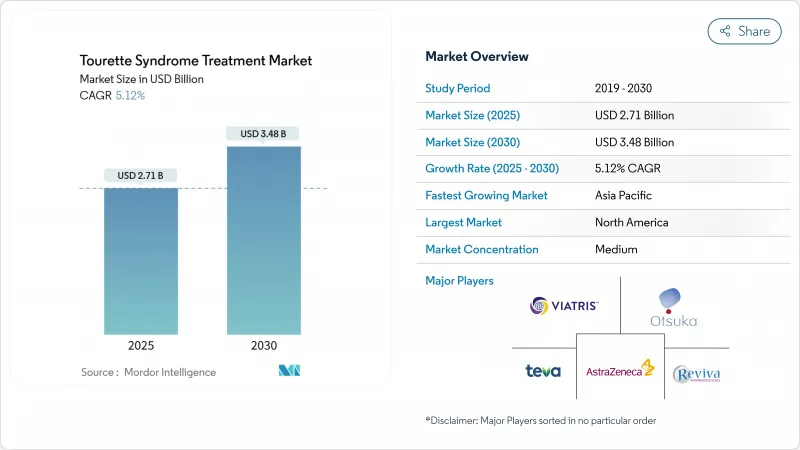
투렛 증후군 치료 시장 규모는 2025년에 27억 1,000만 달러, CAGR 5.12%로 성장하고, 2030년에는 34억 8,000만 달러에 이를 것으로 예측되고 있습니다.
조기 진단, VMAT-2 억제제의 급속한 임상 채택, 행동 요법에 대한 지불자 부담의 확대가 성장을 지원합니다. 온라인 약국을 중심으로 디지털 조제 채널의 병행 진전으로 접근 마찰이 저하되었습니다. 오판 약물(희귀의약품)의 인센티브에 의해 강화된 프레시젼 메디신 파이프라인은 치료 클래스를 재정의하는 한편, 유전자 및 세포 기반 후보약은 후기 단계의 연구소에서 인큐베이션되고 있습니다. 하지만 도파민 차단제를 둘러싼 고액의 자기 부담 비용이나 안전성에 대한 우려가 남아 있기 때문에 본격적인 도입에는 이르지 않습니다.
스크리닝 프로토콜의 강화는 한때 잘못 분류 된 성인의 틱을 발견하고 매년 수천 명의 환자를 등록합니다. 피질 개재 뉴런의 결손을 상세하게 보여주는 바이오마커의 발견은 주관적인 평가 척도를 넘는 객관적인 확인 도구를 제공합니다. 원격 진찰은 전문의의 전문 지식을 지방으로 보내 신경학적 평가의 대기 시간을 단축합니다. 병존에 초점을 맞춘 평가는 중복 ADHD와 OCD의 증상을 포착하고 치료 수요를 확대합니다. 조기 개입은 행동 요법의 반응성을 향상시키고 장기적인 어드히어런스를 향상시킵니다.
VMAT-2 억제의 획기적인 변화는 광범위한 도파민 차단에서 정밀한 조절로의 전환을 보여줍니다. 엠마렉스 바이오사이언스의 3단계 성공은 50년 만에 새로운 툴렛 클래스를 도입하여 기록적인 벤처 자금 유입을 촉진합니다. 뉴로클라인 스튜어드십에 의한 2세대 화합물은 제1파에서의 과제를 극복하고, 베네핏과 리스크의 비율을 개선. CANNA-TICS 시험에 제시된 칸나비노이드 연구는 전통적인 요법이 실패할 경우 증상을 완화시킵니다. 이러한 혁신을 결합하면 약리학적 치료 주기 업데이트에 대한 임상의의 신뢰를 높일 수 있습니다.
종합적인 투렛 치료비는 연간 1만 5,000달러를 넘어 APAC와 남미의 중앙소득을 웃돕니다. 뇌 심부 자극 요법은 장비 유지 보수를 포함하면 10만 달러를 초과합니다. VMAT-2 약물의 고가격 설정은 희귀질환의 연구개발비를 반영하고 있지만, 가격에 민감한 의료제도에서는 보급을 억제하고 있습니다. 항정신병제의 제네릭 의약품은 저렴한 가격으로 판매되지만 대사성 부작용으로 인한 다운스트림 공정 비용이 절약을 침식하고 있습니다. 공적 보험의 보급이 제한적이기 때문에 자기 부담액이 증가하고 지속적인 치료 계속이 과제가 되고 있습니다.
2024년의 투렛 증후군 치료 시장 점유율에서 항정신병제은 58.54%를 차지하여 제1선택약으로서의 지위를 확립하고 있습니다. 하지만 VMAT-2 억제제가 CAGR 7.34%를 넘어서고 수요의 기세가 바뀌고 있습니다. 이것은 임상가가 좁은 범위에서 도파민을 조절하고 대사로 인한 벌금을 줄이기를 원한다는 것을 반영합니다. 비정형 제제는 피라미드 외로계의 유해 사건이 적기 때문에 정형 제제를 상회하고 있습니다. 그럼에도 불구하고 체중 증가의 위험은 더 슬림한 프로파일을 찾는 데 도움이 됩니다. α2 작용제는 틱과 ADHD의 이중 증상에 대해 중요한 틈새를 유지하며, 벤조디아제핀은 만성 요법보다는 일시적인 위기에 대응합니다.
VMAT-2는 환자의 내약성이 높고 복용 기간이 길기 때문에 부작용 관리가 완화되고 약국 예산이 상쇄됩니다. CANNA-TICS 데이터에서 영감을 받은 칸나비노이드 후보 약물은 규제 당국의 공중에 떠 있는 채로 남아 있지만, 심각한 경우에는 동정적인 처방이 이루어집니다. 수용체 선택적 아키텍처를 가진 도파민 조절제는 효능과 심장 대사 시스템의 안전성의 균형을 목표로 후기 단계의 파이프라인에 나란히 있습니다. 제네릭 의약품을 이용할 수 있기 때문에 많은 공공 의료 제도에서 항정신병제가 필수적임에도 불구하고, 전체적으로 치료제의 대체는 항정신병제의 처방량을 위협하고 있습니다. 진화하는 클래스 믹스는 투렛 증후군 치료 시장 내 경쟁의 유동성을 돋보이게합니다.
2024년 투렛 증후군 치료 시장 규모의 81.34%를 약리학적 접근이 차지하고 있는데 이는 약물 치료에 근거한 증상조절에 대한 임상의의 안심감을 반영하고 있습니다. 심부 뇌 자극 요법은 여전히 틈새이지만, 틱의 중증도 변동에 맞게 전극 출력을 최적화하는 반응성 자극 요법 연구에 뒷받침되었으며, CAGR은 가장 빠른 7.55%를 기록했습니다. 난치성 사례에 대한 보험 적용의 의욕이 환자에게 길을 넓히고 있습니다. 동시에 CBIT는 가이드라인 승인과 보험 상환을 받고 실험적 치료에서 주류 치료로 전환합니다.
유전자 요법과 세포 요법은 초기 단계에 있지만, 미래의 벡터 타겟으로 피질 개재 뉴런의 결손을 매핑 한 메이요 클리닉의 지견의 혜택을 받고 있습니다. 원격 의료는 행동 요법과 원활하게 통합되어 지리적 제한 없이 일주일에 한 번의 CBIT 세션을 가능하게 하고 완료율을 높입니다. 약리적 이점은 성숙한 장치 및 행동 치료 분야와 공존하며, 투렛 증후군 치료 시장 전반에 걸쳐 케어 저니를 개인화하는 멀티 모달 경로를 만들어 냅니다.
북미는 2024년 투렛 증후군 치료 시장 점유율의 42.45%를 차지하며 성숙한 보험 제도와 풍부한 임상시험 네트워크를 활용하고 있습니다. 메이요 클리닉의 바이오마커에 의한 약진이 이 지역의 연구 권위를 확고하게 하고, FDA의 희귀의약품(오팬 드래그) 패스웨이가 이노베이터 시장 투입까지의 시간을 단축하고 있습니다. 그러나, 신약의 고액의 자기 부담은 복약 준수를 저하시켜, 자기 부담 지원 프로그램의 제창을 촉구하고 있습니다. 미국과 캐나다는 국경을 넘어서는 원격 의료 협정을 맺고 있으며 전문의의 컨설팅을 풀어 환자에 대한 도달범위를 넓히고 있습니다.
유럽에서는 국가의 의료 시스템에 의해 지원되는 일관된 프로토콜 주도 케어가 제공됩니다. 다시설 공동 연구 CANNA-TICS는 대체 치료에 대한 유럽 대륙의 협력적인 자세를 대표하며, 칸나비노이드에 대한 접근성 확대에 관한 정책 논쟁에 박차를 가하고 있습니다. 북유럽 보험 상환 기준에서 CBIT는 쉽게 다루어지며 최근에는 반응성 DBS도 다루어집니다. 다양한 지불자 정책이 제조업체에 회원국별 가격 수량계약을 촉구하고 투렛 증후군 치료시장에서 가미시 주문 전략에 영향을 미치고 있습니다.
아시아태평양에서는 중국과 인도의 Tier2 도시에서 진단률이 상승하고 2030년까지의 CAGR은 6.45%가 됩니다. 일본 전문가의 컨센서스 가이드라인은 세계에서 가장 상세한 투여 프레임워크를 제공하여 VMAT-2 억제제의 임상 도입을 가속화합니다. 각국 정부는 유전자 스크리닝과 원격 CBIT 아웃리치를 결합한 탁월한 신경의료센터에 투자하고 있습니다. 제네릭 항정신병제의 국산화에 의해 진입비용은 저하되지만, 신규약제의 수입 의존은 국내 라이선스가 따라갈 때까지 계속됩니다. 문화적 스티그마가 여전히 장벽이 되고 있지만, 소셜 미디어에 의한 어드보카시가 도시의 밀레니얼 세대의 조기 진찰을 촉구해, 치료 대상자의 밑단을 넓히고 있습니다.
The tourette syndrome treatment market size stood at USD 2.71 billion in 2025 and is forecast to reach USD 3.48 billion by 2030, reflecting a 5.12% CAGR.
Growth is sustained by earlier diagnosis, rapid clinical adoption of VMAT-2 inhibitors, and expanding payer coverage for behavioral therapy. Parallel progress in digital dispensing channels, particularly online pharmacies, is lowering access frictions. Precision-medicine pipelines, reinforced by orphan-drug incentives, are redefining therapeutic classes while gene- and cell-based candidates incubate in late-stage laboratories. Nevertheless, high out-of-pocket costs and lingering safety concerns surrounding dopamine-blocking drugs temper full-scale uptake.
Enhanced screening protocols now uncover adults whose tics were once misclassified, adding thousands of patients to registries each year. Biomarker discoveries detailing cortical interneuron deficits provide objective confirmation tools that move beyond subjective rating scales. Teleconsultations funnel specialist expertise into rural regions, reducing wait-times for neurological evaluation. Comorbidity-focused assessments capture overlapping ADHD and OCD symptoms, expanding therapeutic demand. Early intervention improves behavioral-therapy responsiveness, strengthening long-term adherence trajectories.
Breakthroughs in VMAT-2 inhibition illustrate the move from broad dopamine blockade toward precision modulation. Emalex Biosciences' Phase 3 success introduces the first novel Tourette class in five decades, inspiring record venture inflows. Second-generation compounds under Neurocrine stewardship refine benefit-risk ratios after first-wave challenges. Cannabinoid research, showcased in the CANNA-TICS trial, delivers symptomatic relief where legacy regimens fail. Combined, these innovations elevate clinician confidence in pharmacologic renewal cycles.
Comprehensive Tourette management can surpass USD 15,000 annually, eclipsing median incomes across much of APAC and South America. Deep-brain stimulation implantation crosses USD 100,000 when device maintenance is included. Premium pricing for VMAT-2 agents reflects rare-disease R&D expense yet curtails uptake in price-sensitive health systems. While generic antipsychotics offer lower sticker prices, downstream costs from metabolic side effects erode savings. Limited public insurance penetration keeps out-of-pocket shares elevated, challenging sustained therapy adherence.
Other drivers and restraints analyzed in the detailed report include:
For complete list of drivers and restraints, kindly check the Table Of Contents.
Antipsychotics held 58.54% of the Tourette syndrome treatment market share in 2024, underscoring their entrenched status as first-line pharmacotherapy. Yet demand momentum is shifting as VMAT-2 inhibitors outpace at a 7.34% CAGR, reflecting clinicians' appetite for narrower dopamine modulation with fewer metabolic penalties. Atypical formulations surpass typical compounds because of reduced extrapyramidal adverse events. Still, weight-gain risk propels search for leaner profiles. Alpha-2 agonists preserve a valued niche for dual tic-and-ADHD presentations, while benzodiazepines serve episodic crises rather than chronic regimens.
VMAT-2 uptake accelerates despite higher acquisition costs because patients tolerate them better and adhere longer, offsetting pharmacy budgets via lower adverse-event management. Cannabinoid candidates, inspired by CANNA-TICS data, trail in regulatory limbo yet attract compassionate-use prescriptions in severe cases. Dopamine-modulating agents with receptor-selective architectures line late-stage pipelines, aiming to balance efficacy with cardiometabolic safety. Overall, therapeutic substitution threatens antipsychotic volume even as those legacy agents remain indispensable in many public systems because of generic availability. The evolving class mix highlights competitive fluidity inside the Tourette syndrome treatment market.
Pharmacological approaches accounted for 81.34% of the Tourette syndrome treatment market size in 2024, reflecting clinician comfort with medication-based symptom control. Deep-brain stimulation, though still niche, records the fastest 7.55% CAGR, supported by responsive-stimulation research that optimizes electrode output for tic severity fluctuations. Insurance willingness to cover refractory cases widens patient funnels. Concurrently, CBIT earns guideline endorsement and payer reimbursement, moving from experimental to mainstream practice.
Gene and cell therapies reside in early-phase inquiry yet benefit from Mayo Clinic findings that map cortical interneuron deficits as future vector targets. Telemedicine integrates seamlessly with behavioral regimens, enabling weekly CBIT sessions without geographic limits and boosting completion rates. Pharmacologic dominance therefore coexists with maturing device and behavioral segments, creating multimodal pathways that personalize care journeys throughout the Tourette syndrome treatment market.
The Tourette Syndrome Treatment Market Report is Segmented by Drug Class (Typical Antipsychotics, Atypical Antipsychotics, and More), Treatment Modality (Pharmacological Therapies, and More), Age Group (Children & Adolescents, and More), Distribution Channel (Hospital Pharmacies, and More), Geography (North America, Europe, and More). The Market Forecasts are Provided in Terms of Value (USD).
North America accounted for 42.45% of the Tourette syndrome treatment market share in 2024, leveraging mature insurance systems and prolific clinical-trial networks. Mayo Clinic's biomarker breakthrough cements the region's research authority, while FDA orphan-drug pathways shorten time-to-market for innovators. Yet high co-pays on newer agents spark adherence drop-offs, prompting advocacy for copay-assistance programs. Cross-border telehealth agreements between the United States and Canada enable specialist consult pooling, widening patient reach.
Europe delivers consistent, protocol-driven care anchored by national health systems. The multicenter CANNA-TICS study typifies the continent's collaborative posture toward alternative therapeutics, spurring policy debate on wider cannabinoid access. Northern European reimbursement standards readily cover CBIT and, increasingly, responsive DBS, whereas Southern markets still ration device spending. Diverse payer policies encourage manufacturers to tailor price-volume agreements per member state, influencing launch sequencing strategies within the Tourette syndrome treatment market.
Asia-Pacific posts a 6.45% CAGR through 2030 as diagnosis rates rise in China and India's tier-two cities. Japan's expert-consensus guidelines deliver some of the world's most detailed dosing frameworks, accelerating clinician uptake of VMAT-2 inhibitors. Governments invest in neurology centers of excellence that couple genetic screening with tele-CBIT outreach to remote prefectures. Local production of generic antipsychotics lowers entry costs, though import dependency for novel agents persists until domestic licensing catches up. Cultural stigma remains a barrier, but social-media advocacy drives earlier care-seeking among urban millennials, enlarging the treated base.