


전자코 시장 규모는 2025년에 1억 4,628만 달러로 평가되고, 2030년에는 2억 6,272만 달러에 이르며, 기간 중 12.42%의 연평균 복합 성장률(CAGR)을 나타낼 것으로 예측됩니다.

소형화된 MEMS 센서 어레이, 뉴로모픽 AI 알고리즘, 헬스케어, 식품안전, 환경 모니터링에 있어서 전개 증가에 의해 강한 기세가 발생하고 있습니다. 고속 냄새 검출은 이제 밀리초 단위의 응답 시간으로 포유류의 후각에 필적하고 실시간 진단에 이용 가능한 기술이 되고 있습니다. 북미는 호기 진단에 대한 지지적인 규제 프레임워크를 배경으로 2024년 전자코 시장 점유율의 30.5%를 차지했습니다. 한편, 아시아태평양은 CAGR 14.0%로 급성장하고 있으며, 제조업과 농업에서의 품질관리 수요에 힘쓰고 있습니다. 최종 사용자별로 식품 및 음료가 35.3%의 매출을 차지하는 반면 건강 관리는 13.6%의 연평균 복합 성장률(CAGR)을 나타내며 효과적인 호기 기반 질병 검사가 견인하고 있습니다.
MEMS 기반 시스템은 현재 95% 이상의 검출 정밀도를 유지하면서 신용카드의 실적에 맞는다. 중국, 한국, 대만에서 반도체 패키징의 표준화와 웨이퍼 팹의 확대로 2022년 이후 단가가 40-60% 삭감되었습니다. 삼산화텅스텐 나노로드 히터는 기존의 10-30초 플랫폼을 훨씬 능가하는 0.5-1초의 식별을 가능하게 합니다. 듀티 사이클 전략은 전력 소비를 250°C에서 160µW로 줄여 배터리 구동 및 웨어러블 이용 사례를 확장합니다. 이로 인해 진입 장벽이 떨어지고 전자코 시장은 가전, 원격 의료 및 스마트 홈 생태계에 침투합니다.
포유류 후각구를 모델링한 스파이킹 신경망은 1mW ASIC에서 16ms 미만의 대기 시간으로 97% 이상의 분류 정확도를 달성합니다. 대규모 언어 모델의 확장은 화학적 서명과 컨텍스트 메타데이터를 융합하여 중복 VOC 프로파일의 선택성을 날카롭게 합니다. 에지 구현은 광업 및 공정 플랜트의 위험 가스 경보에 중요한 클라우드 트래픽을 줄입니다. 온라인 능동 학습 루프는 센서 드리프트에 대항하여 수동 재교정 없이 장기 정밀도를 90% 이상으로 유지합니다. 이러한 돌파구는 방위, 건강 관리, 산업 안전에 걸친 자율적인 냄새 분석기의 다음 파도를 지원합니다.
금속 산화물 센서는 습도 및 온도 변동 하에서 현저한 기준선 드리프트를 나타내며 분기별 재캘리브레이션을 강요하며 운영 비용이 증가합니다. 정유소의 굴뚝과 매립지에서는 센서 교체가 필요한 성능 저하가 7년간의 실지조사에서 확인되었습니다. 웨이블릿 분해 및 머신러닝을 통한 보정은 1년 단위로 100%의 식별율을 달성하지만 임베디드 컴퓨팅 파워를 필요로 하며 부품 비용이 상승합니다. 원클래스 드리프트 방식은 캘리브레이션 샘플을 70% 줄이는 것, 여전히 제어된 트레이닝 사이클에 의존합니다. 석유화학처리 등 24시간 365일 가동이 필요한 업계에서는 이러한 유지보수 부담이 채용의 장벽이 되고 있습니다.
헬스케어는 2030년까지 연평균 복합 성장률(CAGR)이 13.6%를 나타낼 것으로 예측됩니다. 미국과 독일에서 유리한 상환 조종사에 의해 지원되며 호기 기반 종양학 스크리닝과 천식 모니터 장비가 수요를 견인합니다. 식음료는 여전히 가장 큰 업종이며, 육류의 신선도, 와인의 산화, 유제품의 혼합 체크에 e-noses를 활용하고 있습니다. 가공 공장에서 퀵 서비스 레스토랑까지 채용이 넓어져 클라우드 대시보드를 매일 제품 감사에 통합하고 있습니다.
군사, 방위, 국토 안보는 2025년 매출의 9.1%를 차지하며, NATO와 아시아태평양 방위의 현대화에 있어서 유독 가스 검출 요건에 추진되고 있습니다. 폐기물 처리업체는 EU 회원국의 매립지 배출 규정을 준수하기 위해 냄새 센서를 도입하고 있습니다. 산업 안전 및 HVAC 기업은 24시간 365일 CO2 및 VOC 추적을 위해 환기 시스템에 어레이를 통합하여 시크하우스 불만을 줄입니다. 전반적으로 건강 관리의 CAGR은 높으며 2030년 이후에는 식품 및 음료 판매를 능가합니다.
북미는 전자코 시장의 30.5%를 차지하고 있으며, NIH 보조금과 호기진단의 조기 FDA 인가에 의해 지원되고 있습니다. 화학적 위협 감지에 대한 국방비와 국토 안보비가 수요를 더욱 자극하고 있습니다. 스탠포드 대학과 매사추세츠 공과 대학(MIT) 등의 산학 연계가 신제품 파이프라인을 가속화합니다.
중국, 일본, 인도가 식품 공급 체인과 스마트 공장 라인을 디지털화함에 따라 아시아태평양의 CAGR은 가장 빠른 14.0%를 나타낼 것으로 예측됩니다. 대만과 한국의 반도체 제조 허브는 MEMS 다이를 위한 비용 효율적인 공장을 제공하고 지역 ASP를 인하하고 있습니다. 심천과 벵갈루루의 현지 신흥 기업은 카레의 신선도, 쌀 와인 품질, 도시의 대기 오염과 같은 이용 사례를 위해 에지 AI를 사용하여 저비용 모듈을 조정합니다.
유럽에서는 EN 13725 : 2022에 따른 악취 배출 규제가 있으며 산업 시설에 지속적인 모니터링이 필요합니다. 이 지역의 농산물 수출업체는 중동과 아시아와의 무역을 보호하기 위해 바이오보안 프로토콜에 e-noses를 통합하고 있습니다. 남미와 중동, 아프리카에서는 전자코 수요가 농산물 수출 검사와 석유 및 가스의 메탄 감지에 의해 각각 견인되고 있지만, 그 베이스는 낮습니다.
The electronic nose market size is valued at USD 146.28 million in 2025 and is forecast to reach USD 262.72 million by 2030, expanding at a 12.42% CAGR over the period.
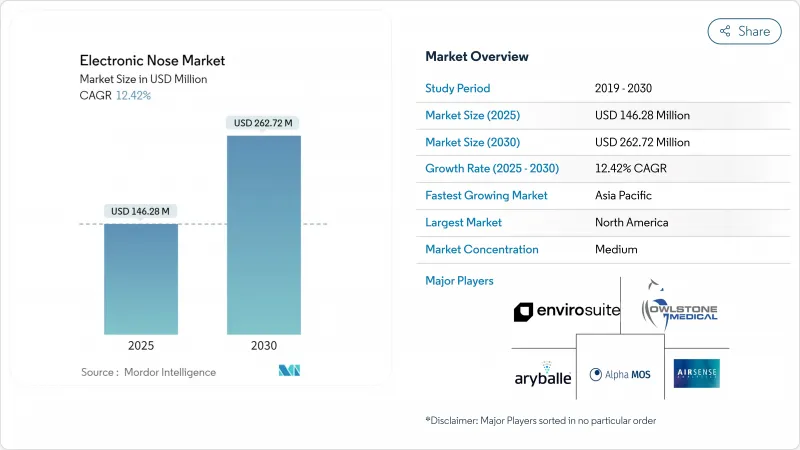
Strong momentum arises from miniaturized MEMS sensor arrays, neuromorphic AI algorithms, and increasing deployment across healthcare, food safety, and environmental monitoring. High-speed odor detection now matches mammalian olfaction with millisecond response times, making the technology viable for real-time diagnostics. North America holds a 30.5% electronic nose market share in 2024 on the back of supportive regulatory frameworks for breath diagnostics. Meanwhile, the Asia-Pacific is the fastest-growing region at 14.0% CAGR, fueled by quality control demands in manufacturing and agriculture. Across end-user verticals, food and beverage commands 35.3% revenue while healthcare shows the highest 13.6% CAGR, driven by validated breath-based disease tests.
MEMS-based systems now fit on credit-card footprints while maintaining >95% detection accuracy. Standardized semiconductor packaging and expanded wafer fabs in China, South Korea, and Taiwan have shaved 40-60% off unit costs since 2022. Tungsten-trioxide nanorod heaters enable 0.5-1 s identification, far outpacing legacy 10-30 s platforms.Duty-cycling strategies cut power draw to 160 µW at 250 °C, opening battery-operated and wearable use cases. The net result: entry barriers fall and the electronic nose market penetrates consumer electronics, telehealth, and smart-home ecosystems.
Spiking neural networks modeled on the mammalian olfactory bulb accomplish >97% classification accuracy with <16 ms latency on 1 mW ASICs. Large-language-model extensions fuse chemical signatures with contextual metadata, sharpening selectivity for overlapping VOC profiles. Edge implementations trim cloud traffic, critical for hazardous-gas alerts in mining and process plants. Online active-learning loops counter sensor drift, keeping long-term accuracy above 90% without manual recalibration. These breakthroughs underpin the next wave of autonomous odor-analysis devices across defense, healthcare, and industrial safety.
Metal-oxide sensors exhibit pronounced baseline drift under humidity and temperature swings, forcing quarterly recalibration that inflates operating costs. Seven-year field studies confirm performance erosion necessitating sensor replacement in refinery stacks and landfills. Wavelet-decomposition and machine-learning compensation reach 100% identification over one-year horizons but demand embedded computing power, raising the bill of materials. While one-class drift schemes cut calibration samples by 70%, they still rely on controlled training cycles. Industries requiring 24/7 uptime, such as petrochemical processing, view these maintenance burdens as adoption barriers.
Other drivers and restraints analyzed in the detailed report include:
For complete list of drivers and restraints, kindly check the Table Of Contents.
Healthcare is projected to post a 13.6% CAGR through 2030. Breath-based oncology screening and asthma-monitoring devices drive demand, supported by favorable reimbursement pilots in the United States and Germany. Food and beverage remains the largest vertical, leveraging e-noses for meat freshness, wine oxidation, and dairy adulteration checks. Adoption spreads from processing plants to quick-service restaurants, integrating cloud dashboards for daily product audits.
Military, defense, and homeland security made up 9.1% revenue in 2025, propelled by toxic-gas detection requirements within NATO and Asia-Pacific defense modernization. Waste-management operators deploy odor sensors to comply with landfill emission caps in EU member states. Industrial safety and HVAC companies embed arrays in ventilation systems for 24/7 CO2 and VOC tracking, reducing sick-building complaints. Overall, healthcare's elevated CAGR positions it to eclipse food and beverage revenue post-2030.
The Electronic Nose Market Report is Segmented by End-User Vertical (Military and Defense, Healthcare, Food and Beverage, and More), Sensor Technology (Metal-Oxide Semiconductor, Quartz Crystal Microbalance, and More), Application (Disease Diagnosis, Quality Control and Shelf-Life Prediction, and More), and Geography (North America, South America, Europe, and More). The Market Forecasts are Provided in Terms of Value (USD).
North America generated 30.5% of the electronic nose market, underpinned by NIH grants and early FDA clearances for breath diagnostics. Defense and homeland-security spending on chemical-threat detection further stimulates demand. Academic-industry collaborations at institutions such as Stanford and MIT accelerate new-product pipelines.
Asia-Pacific is projected to clock the fastest 14.0% CAGR as China, Japan, and India digitize food-supply chains and smart-factory lines. Semiconductor manufacturing hubs in Taiwan and South Korea offer cost-effective fabs for MEMS die, lowering regional ASPs. Local start-ups in Shenzhen and Bengaluru use edge AI to tailor low-cost modules for curry freshness, rice-wine quality, and urban air pollution use cases.
Europe is sustained by EN 13725:2022 odor-emission enforcement that obliges industrial sites to deploy continuous monitoring. The region's agri-exporters integrate e-noses in bio-security protocols to protect trade with the Middle East and Asia. In South America and the Middle East, and Africa, the demand for electronic nose is driven by agricultural export inspection and oil-and-gas methane detection respectively, albeit from a lower base.