



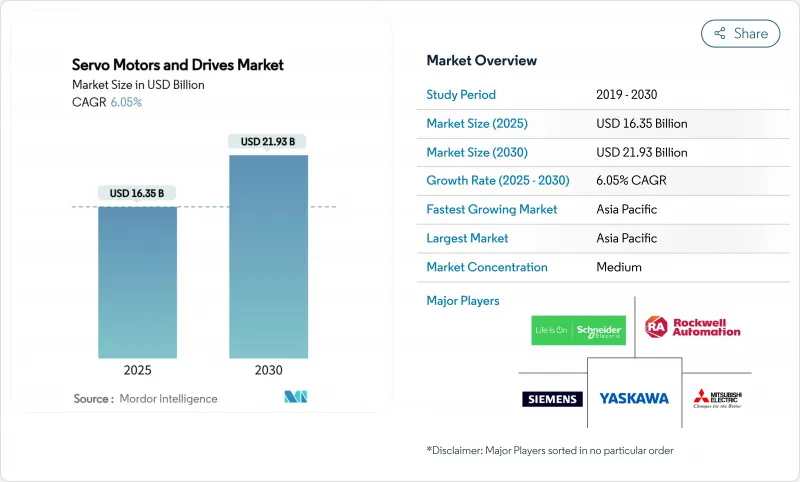
세계의 서보 모터 및 드라이브 시장 규모는 2025년 163억 5,000만 달러, 2030년까지 219억 3,000만 달러에 이를 것으로 예측되고, 이 기간의 CAGR은 6.05%로 예상됩니다.
실리콘 카바이드 파워 일렉트로닉스, 디지털 트윈 시뮬레이션, 협력 로봇을 결합한 네트워크화된 모션 시스템으로 업그레이드한 공장이 성장을 가져왔습니다. 반도체 공장과 정밀 패키징 라인은 기계적 변환을 없애기 위해 선형 설계를 채택했으며 자동차 제조업체는 배터리 및 E 액슬 조립을 위해 중전압, 고출력 솔루션에 투자했습니다. 에너지 효율에 관한 법규제에 의해 제조업체는 인덕션 유닛을 IE4 클래스의 서보 패키지로 대체하게 되었고, 800V의 전기자동차 아키텍처의 확대가 고전압 드라이브 수요에 박차를 가했습니다. 실리콘 카바이드 전문가와 사이버 보안 공급업체와의 경쟁이 치열해지면서 기존의 기존 기업은 기계적 전문 지식과 디지털 인텔리전스의 융합을 강요했습니다.
2024년 독일의 자동차 그룹은 다축 로봇 셀을 디지털 트윈 플랫폼에 연결하여 라인 교환 시간을 단축하여 처리량을 향상시켰습니다. Closure Systems International은 Fanak의 서보 구동 라인을 도입하여 예기치 않은 다운타임을 2.5%로 줄인 후 전체 설비의 효율성을 97.5%로 높였습니다. EtherCAT 지원 드라이브는 마이크로초 단위로 움직임을 동기화하고, 유연한 제조를 지원하며, 5G 기반 기계 조정을 위한 길을 엽니다.
코봇에는 토크 감지 기능이 내장된 컴팩트하고 안전한 액추에이터가 필요합니다. Yaskawa의 HC 시리즈는 임베디드 모니터링을 통해 ISO/TS 15066:2016의 힘 제한을 충족시켜 조립 라인에서 인간과 직접 상호 작용할 수 있습니다. Kollmorgen이 제공하는 고토크 밀도 모터는 세계 약 100만 개의 로봇 관절에 전력을 공급하고 서보 모터 및 드라이브 시장이 가볍고 사용자 친화적인 플랫폼으로 이동하고 있음을 입증합니다.
인도와 동남아시아의 소규모 제조업체들은 프리미엄 서보 패키지와 가변 주파수 구동 인덕션 세트를 비교하고 후자를 선택하는 경우가 많았습니다. 그러나 Packaging World에 의한 조사에서는 평생 에너지와 유지 보수의 절약으로 서보에 지지가 기울어져 공기압을 전동 액추에이터로 대체했을 때 연간 운전 비용은 7,320달러에서 388.8달러로 떨어졌습니다.
AC 유닛은 2024년 서보 모터 및 드라이브 시장의 65.5%를 차지했는데, 이는 삼상 그리드와 성숙한 제조 라인이 회전식 설계를 지지했기 때문입니다. 리니어형은 반도체 패키징, 리소그래피, 고속 카토닝을 획득해 CAGR 9.8%로 확대했습니다. Delkor의 카트닝 라인은 로터리에서 선형으로의 변환을 없애고 더 높은 처리량을 달성했습니다.
선형 모델은 간단한 위치 결정에 그치지 않습니다. 트로마틱 서보 프레스는 유압의 50%에 비해 80%의 효율을 실현하고, 위생적이고 오일 프리의 모션을 필요로 하는 패키징 기업을 매료했습니다. 플랫폼 공급업체는 Rockwell Automation의 ArmorKinetix와 같은 분산형 드라이브를 지원하여 케이블 배선을 90%, 설치 시간을 30% 줄였습니다.
저전압 설치 점유율은 62.4%였지만 공장이 케이블 크기와 열을 줄이기 위해 고전압 아키텍처를 채택했기 때문에 1-35kV 클래스는 매년 7.2% 증가했습니다. Arrow Electronics는 저손실 및 높은 스위칭 주파수에서 동작하는 실리콘 카바이드 MOSFET에 주목했습니다. 중전압 드라이브는 EV 모터 하우징에 사용되는 100kW 이상의 공작기계를 지원하여 증가하는 토크 수요에 대응했습니다.
Siemens는 안전한 24-48V 레벨을 필요로 하는 자율 이동 로봇을 위한 초저전압 유닛 MICRO-DRIVE를 발표했습니다. 반대로 800V EV 라인은 도체 직경을 줄이고 저항 손실을 줄이기 위해 중간 전압 서보를 배치하고 서보 모터 및 드라이브 시장에서 틈새 시장에서 점유율을 늘리고 있습니다.
서보 모터 및 드라이브 시장 보고서는 제품 유형(모터, 드라이브), 전압 범위(저전압<=1kV, 중전압 1kV-35kV, 고전압 35kV 초과), 최종 사용자 산업(자동차 및 EV 제조, 석유 및 가스, 헬스케어 및 의료기기, 포장 및 라벨링, 기타), 정격전력(1kW-5k, 15kW 초과), 지역별로 분류되어 있습니다.
아시아태평양은 중국의 전자 제품 생산, 일본 기술 리더십 및 인도 공장 확장을 배경으로 2024년 세계 매출의 46.3%를 차지했습니다. ASEAN 국가들이 경쟁력을 높이기 위해 자동화를 장려했기 때문에 지역별 성장률은 CAGR 7.8%로 가장 빠르게 유지했습니다. 희토류 공급에서 중국의 이점은 현지 비용을 낮추었지만 해외 구매자는 수출 규제 위협에 노출되었습니다. 일본의 Harmonic Drive Systems는 도쿄와 나가노의 기술 클러스터를 강화해 2026년도까지 900억엔의 순매출을 목표로 했습니다.
북미에서는 공급의 탄력성을 높이기 위해 리쇼어링 프로그램을 증가 시켰습니다. Mitsubishi Electric가 켄튀르키예 주에 건설한 1억 4,350만 달러의 압축기 공장은 현지 생산과 리드 타임 단축의 동향을 보여줍니다. Hitachi에 의한 Joliet Electric Motors 인수는 애프터마켓 서비스를 확대하여 설치된 플릿 전체의 라이프사이클 가치를 지원했습니다. 미국에서는 협동 로봇의 이용률이 상승하여 중공업의 연조를 상쇄했습니다.
유럽은 탈탄소화와 디지털 트윈 분석에 주력. 독일과 북유럽에서는 IE4의 의무화에 의해 개수가 촉진되었고, ABB Drive Composer와 Rockwell PowerFlex의 펌웨어는 CISA에 의해 취약성이 지적되었기 때문에 사이버 보안 문제가 감사를 촉구했습니다. 중전압 드라이브는 바이에른 주와 피에몬테 주 자동차 클러스터에 침투했고 OEM은 800V 배터리 라인으로 이동하여 거시 경제의 압력에도 불구하고 한 자리 대 중반의 성장을 유지했습니다.
The servo motors and drives market size stood at USD 16.35 billion in 2025 and was forecast to reach USD 21.93 billion by 2030, reflecting a 6.05% CAGR over the period.
Growth stemmed from factories upgrading to networked motion systems that combine silicon-carbide power electronics, digital twin simulation and collaborative robotics. Semiconductor plants and precision packaging lines adopted linear designs to eliminate mechanical conversions, while automotive producers invested in mid-voltage, high-power solutions for battery and e-axle assembly. Energy-efficiency legislation prompted manufacturers to replace induction units with IE4-class servo packages, and the expanding 800 V electric-vehicle architecture spurred demand for higher-voltage drives. Intensifying competition arrived from silicon-carbide specialists and cybersecurity vendors, pressuring traditional incumbents to blend mechanical expertise with digital intelligence.
During 2024, automotive groups in Germany connected multi-axis robotic cells to digital-twin platforms, cutting line-change times and increasing throughput. Closure Systems International lifted overall equipment effectiveness to 97.5% after installing FANUC servo-driven lines that dropped unplanned downtime to 2.5%. EtherCAT-enabled drives synchronised motion within microseconds, supporting flexible manufacturing and paving the way for 5G-based machine coordination.
Cobots require compact, safety-rated actuators with integrated torque sensing. Yaskawa's HC series met ISO/TS 15066:2016 force limits through embedded monitoring, allowing direct human interaction on assembly lines. High-torque-density motors supplied by Kollmorgen powered almost 1 million robotic joints worldwide, demonstrating the servo motors and drives market's shift toward lighter, user-friendly platforms.
Small manufacturers in India and Southeast Asia compared premium servo packages with variable-frequency-drive induction sets and frequently chose the latter. Yet studies by Packaging World showed lifetime energy and maintenance savings tilting favour back toward servos, with annual operating cost dropping from USD 7,320 to USD 388.8 when pneumatics were replaced by electric actuators.
Other drivers and restraints analyzed in the detailed report include:
For complete list of drivers and restraints, kindly check the Table Of Contents.
AC units kept 65.5% of the servo motors and drives market in 2024 because three-phase grids and mature manufacturing lines favoured rotary designs. Linear variants captured semiconductor packaging, lithography and high-speed cartooning, expanding at 9.8% CAGR. Delkor's cartoning lines achieved higher throughputs by eliminating rotary-to-linear conversions.
Linear models extended beyond simple positioning. Tolomatic servo presses delivered 80% efficiency versus 50% for hydraulics, attracting packaging firms that needed hygienic, oil-free motion. Platform suppliers responded with distributed drives such as Rockwell Automation's ArmorKinetix, cutting cabling 90% and installation time 30%.
Low-voltage installations held 62.4% share but the 1-35 kV class grew 7.2% annually as plants adopted higher-voltage architectures to reduce cable size and heat. Arrow Electronics highlighted silicon-carbide MOSFETs running at higher switching frequencies with lower losses. Medium-voltage drives supported 100 kW-plus machine tools used for EV motor housings, matching growing torque demands.
Siemens introduced MICRO-DRIVE extra-low-voltage units for autonomous mobile robots that need safe 24-48 V levels. Conversely, 800 V EV lines deployed mid-voltage servos to shrink conductor diameters and lower resistive loss, holding a niche but rising share in the servo motors and drives market.
The Servo Motors and Drives Market Report is Segmented by Product Type (Motor, and Drive), Voltage Range (Low Voltage <=1kV, Medium Voltage 1kV-35kV, and High Voltage >35kV), End-User Industry (Automotive and EV Manufacturing, Oil and Gas, Healthcare and Medical Devices, Packaging and Labelling, and More), Power Rating (<=1kW, 1kW-5kW, 5kW-15kW, and >15kW), and Geography.
Asia-Pacific captured 46.3% of global revenue in 2024 on the back of Chinese electronics production, Japanese technology leadership and India's factory expansions. Regional growth remained the fastest at 7.8% CAGR as ASEAN nations incentivised automation to raise competitiveness. China's dominance in rare-earth supply lowered local costs but exposed foreign buyers to export controls. Japan's Harmonic Drive Systems aimed for JPY 90 billion net sales by FY 2026, reinforcing the technology cluster in Tokyo and Nagano.
North America increased its reshoring programmes to improve supply resilience. Mitsubishi Electric's USD 143.5 million compressor plant in Kentucky illustrated the trend toward localised production and shorter lead times. Hitachi's purchase of Joliet Electric Motors broadened aftermarket services, supporting lifecycle value across installed fleets. Rising collaborative-robot utilisation in the United States offset softness in heavy industry.
Europe focused on decarbonisation and digital-twin analytics. IE4 mandates spurred retrofits in Germany and the Nordics, while cybersecurity concerns prompted audits after CISA flagged vulnerabilities in ABB Drive Composer and Rockwell PowerFlex firmware. Medium-voltage drives penetrated automotive clusters in Bavaria and Piedmont as OEMs migrated to 800 V battery lines, sustaining mid-single-digit growth despite macroeconomic pressures.