



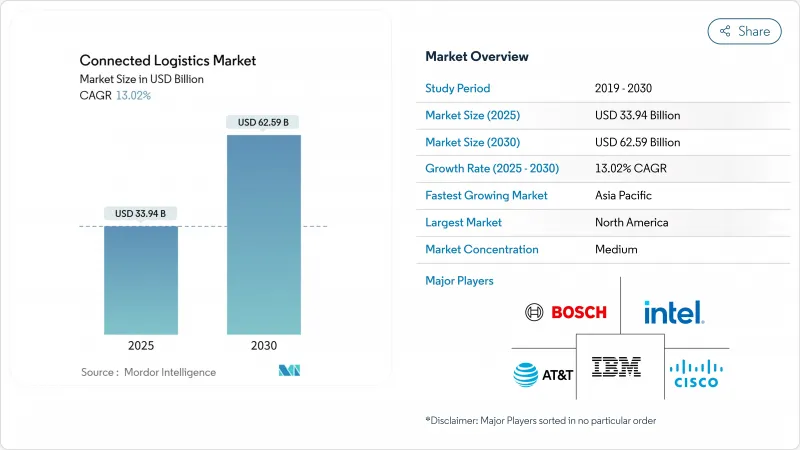
커넥티드 물류 시장은 2025년 339억 4,000만 달러에 이르고, 2030년에는 625억 9,000만 달러에 달할 것으로 예상됩니다.
화물의 엔드 투 엔드 화물 투명성을 고집하고, IoT 센서의 급속한 보급, 항만과 야드에서의 5G 사설망의 등장이 이 확대를 지원하고 있습니다. 플랫폼 공급업체는 자산 추적, 실시간 시각화 및 예측 분석을 통합한 제품군을 제공하여 운송업체와 화물의 총 소유 비용을 절감합니다. 사이버 탄력성과 데이터 주권 컴플라이언스는 여전히 중심 설계 기준이며 공급자를 제로 트러스트 아키텍처와 지역 데이터 처리 노드로 안내합니다. 디지털 트윈을 통해 공급망의 리스크를 경감하는 경쟁은 특히 제조 거점과 수출 지향 경제권에서 AI를 활용한 파괴 예측에 대한 시험적 투자를 가속시킵니다.
저소비전력 센서와 세계 LPWAN 커버리지로 기업은 위치, 온도, 충격을 실시간으로 감시할 수 있게 되어 일부 LoRaWAN 전개에서는 배터리 수명이 10년까지 연장됩니다. BMW는 블루투스 비콘을 사용하여 창고의 차량을 추적하고 검색 시간을 크게 단축했습니다. Cardinal Health의 스마트 센서 파일럿은 병원 공급실에서 마감일 관리를 개선합니다. AI 애널리틱스는 과거 데이터를 예측 유지보수 경보로 변환하여 차량을 리액티브에서 프로액티브 조정으로 이동시킵니다.
FourKites가 TrackX Yard Solutions를 인수함에 따라 야드 관리 데이터와 거리에서의 가시성이 결합되어 화물처는 트레일러의 위치 정보를 매시간 업데이트할 수 있습니다. 자동차 마무리 센터에 RFID를 도입하면 OEM의 ERP 시스템에 라이브 상태를 스트리밍하고 엄격한 저스트 인 타임 지표를 충족합니다. 생명과학의 화주 기업은 다중 센서 태그를 배포하고 적정 유통 규범 하에서 연속 온도 로깅 규칙을 충족합니다. 2028년까지 물류 KPI 보고의 1/4을 처리할 것으로 예상되는 생성형 AI 경로 최적화 포털에 가시성을 제공합니다.
랜섬웨어가 플리트 텔레매틱스와 전자 로깅 디바이스를 표적으로 한 것으로, 2024년에 보고된 침해는 181% 증가했습니다. 화물 도둑질은 4억 5,500만 달러에 이르고, 대부분의 경우 브로커가 스푸핑하여 트럭 화물 전체를 루트로 변경쟁니다. 물류의 CISO는 현재 2037년까지 366억 달러라는 마스크의 예측을 반영하여 보안 지출의 2자리 성장을 예산화하고 있습니다. 멀티 테넌트 SaaS 플랫폼은 테넌트 분리를 복잡하게 하여 수평 리스크를 증가시킵니다.
에셋 매니지먼트는 2024년 커넥티드 물류 시장 규모의 41.0%를 차지하며 유휴 시간 절감과 컨테이너 회전율 향상으로 기업은 즉시 ROI를 얻었습니다. 기업은 RFID, GNSS, 환경 센서를 통합 대시보드에 통합하여 실시간으로 미가동 트레일러와 온도 상승에 플래그를 세웁니다. 스트리밍 애널리틱스는 CAGR 16.45%를 나타낼 전망입니다. 트럭의 ETA 차이와 체류 시간 핫스팟에 대한 초 이하의 인사이트가 기업에 요구되고 있으며, 예측적 리루트 엔진에 연료를 공급하고 있습니다.
진화하는 창고 IoT 오버레이는 피커 지침에서 기후 최적화까지 이용 사례를 확대하여 콜드체인 SKU의 부패율을 줄입니다. 보안 분석 제품군은 비정형 데이터 패킷 흐름을 분석하고 장치 침해의 조기 지표를 감지합니다. Microsoft가 Edge AI 툴킷을 물류 게이트웨이로 확장하면 공급자는 자산의 건전성과 교통 예측을 단일 권장 엔진으로 통합합니다.
디바이스 관리는 2024년에 44.0%의 점유율을 획득했지만, 이는 펌웨어에 패치를 적용하고 수천 개의 트랙, 팔레트 및 야드 센서를 인증하는 복잡성을 반영합니다. 제로 터치 온보딩 툴은 트랙 독의 시작 시간을 단축하고 대규모 업데이트 사이클을 지원합니다. 연결 관리는 사설 5G 및 위성 링크가 자산별로 오케스트레이션해야 하는 구독 프로파일을 증가시키기 때문에 CAGR 15.67%를 나타낼 전망입니다.
용도 관리 플랫폼은 클라우드 영역과 에지 게이트웨이 간에 워크로드를 이동시켜 대기 시간 예산 및 데이터 잔여 제약에 대응합니다. 텐센트와 삼성의 특허 출원은 차량 속도에 따라 무선 파라미터를 적응시키는 새로운 트래픽 우선순위 결정 알고리즘을 설명합니다. 블록체인 대응 디바이스에 암호 모듈이 탑재되어 디바이스 라이프 사이클 오케스트레이션의 수준이 높아집니다.
2024년 커넥티드 물류 시장 점유율의 38.5%는 라스트원 마일 네트워크의 고밀도화와 텔레매틱스의 성숙으로 도로가 차지했습니다. 카메라 기반 ADAS와 ELD의 의무화는 운전자의 안전과 규정 준수를 향상시키는 데이터 흐름에 연료를 공급합니다. 해상 운송은 스마트 컨테이너 텔레메트리 및 자동화된 터미널 업무에 힘입어 CAGR 15.10%를 나타낼 것으로 예측됩니다.
철도는 바퀴의 펑크를 예측하는 노측 센서 어레이로 현대화되어 노선 운행의 중단을 줄입니다. 항공사는 ULD 트래커와 AI를 활용한 슬롯 관리 툴을 화물 허브에 도입합니다. 유로 테너 탱크 컨테이너 원격 측정은 가열 사이클을 단축하여 공급망 비용을 40% 절감합니다. 오로라 혁신의 댈러스 휴스턴 간 운전자 없는 화물 통로는 인간 운영자 없이 1,200마일을 기록했습니다.
커넥티드 물류 시장 보고서는 소프트웨어 솔루션(자산 관리, 보안, 기타), 제품 유형(장치 관리, 용도 관리, 기타), 운송 모드(도로, 철도, 기타), 최종 사용자 산업(자동차, 제조, 기타), 서비스 유형(관리 서비스, 기타), 배포 모드(클라우드, 하이브리드, 기타), 조직 규모(대기업, 기타), 지역별
북미는 2024년에 35.2%의 점유율을 유지해 견고한 고속도로망과 자율주행차 파일럿을 위한 지원적 혁신 샌드박스에 의해 지원되었습니다. 아마존은 40억 달러를 투자하여 4,000개의 농촌 지역에 익일 배송 서비스를 확대하고 인프라 투자 규모를 강조하고 있습니다. UPS에 의한 안드라우어 헬스케어 그룹의 인수는 이 지역에서 콜드체인의 전문성을 높이는 것입니다. 사이버 리스크는 여전히 심각하지만, 벤처 기업의 자금 조달과 관민의 테스트 베드가 기술의 보급을 가속화하고 있습니다.
아시아태평양은 2030년까지 연평균 복합 성장률(CAGR) 13.5%로 성장을 이끌 것으로 예측됩니다. 일본 교통부는 도쿄와 오사카를 연결하는 500km의 자동화물 운송 링크를 평가합니다. 호주 물류 자동화 지출은 40억 달러를 넘어 창고 로봇 공학과 조차장 자동화에 이르고 있습니다. GEODIS는 4조 5,000억 달러의 지역 물류 부문을 예상하여 싱가포르에서 중국까지 GPS 추적이 가능한 도로 회랑을 확장하고 있습니다. 베트남은 2025년 FIATA 세계회의 개최를 통해 ASEAN 물류의 요점으로 자국을 자리매김합니다.
유럽은 엄격한 데이터 보호 규칙과 함대가 전기자동차와 지속 가능한 항공 연료를 사용하도록 추진하는 탈탄소화의 의무화와 균형을 이룹니다. CEVA는 23대의 전기 트럭을 추가하고 저탄소 함대는 1,100대를 넘었습니다. DHL은 SAF 공급 모델에서 네스테와 협력하여 EU의 넷 제로 운송 목표를 지원합니다. 유럽 위원회는 지역 물류 경제를 8,780억 유로로 추정하고, 국경을 넘는 사무 작업을 줄이기 위한 규칙의 조화를 계속합니다.
The connected logistics market reached USD 33.94 billion in 2025 and is forecast to climb to USD 62.59 billion by 2030, reflecting a solid 13.02% CAGR.
Shippers' insistence on end-to-end freight transparency, the rapid roll-out of IoT sensors, and the rise of 5G private networks in ports and yards underpin this expansion. Platform vendors are merging asset tracking, real-time visibility, and predictive analytics into unified suites that lower total cost of ownership for carriers and shippers alike. Cyber-resilience and data-sovereignty compliance remain central design criteria, nudging providers toward zero-trust architectures and regional data-processing nodes. The race to de-risk supply chains through digital twins accelerates pilot investments in AI-driven disruption forecasting, especially in manufacturing hubs and export-oriented economies.
Low-power sensors and global LPWAN coverage let companies monitor location, temperature, and shock in real time, extending battery life to a decade in some LoRaWAN deployments. BMW's use of Bluetooth beacons to trace vehicles across warehouses cut search times dramatically. Cardinal Health's smart-sensor pilots improve expiry management in hospital supply rooms. Converging AI analytics transform historical data into predictive maintenance alerts, shifting fleets from reactive to proactive coordination.
FourKites' purchase of TrackX Yard Solutions pairs yard-management data with over-the-road visibility, giving shippers sub-hourly updates on trailer locations. RFID deployments in automotive finishing centers stream live status to OEM ERP systems, satisfying strict just-in-time metrics. Life-science consignors deploy multi-sensor tags to meet continuous-temperature logging rules under Good Distribution Practice. Visibility feeds generative-AI route optimization portals expected to handle one-quarter of logistics KPI reporting by 2028.
Reported breaches in transport rose 181% in 2024, with ransomware targeting fleet telematics and electronic logging devices. Cargo theft hit USD 455 million, often via broker impersonation that reroutes entire truckloads. Logistics CISOs now budget double-digit growth in security spend, mirroring Maersk's forecast of USD 36.6 billion by 2037. Multi-tenant SaaS platforms complicate isolation-of-tenants, elevating lateral-movement risks
Other drivers and restraints analyzed in the detailed report include:
For complete list of drivers and restraints, kindly check the Table Of Contents.
Asset Management represented 41.0% of the connected logistics market size in 2024 thanks to the immediate ROI firms gain by trimming idle time and improving container turns. Enterprises mesh RFID, GNSS, and environmental sensors into unified dashboards that flag under-utilized trailers and temperature excursions in real time. Streaming Analytics is advancing at 16.45% CAGR as organizations demand sub-second insight into truck ETA variance and dwell-time hot spots, fueling predictive rerouting engines.
Evolving warehouse IoT overlays expand use cases from picker guidance to climate optimization, cutting spoilage rates for cold-chain SKUs. Security analytics suites analyze atypical data-packet flows to detect early indicators of device compromise. As Microsoft extends edge AI toolkits into logistics gateways, providers stitch asset health and traffic forecasts into single recommendation engines.
Device Management captured 44.0% share in 2024, reflecting the complexity of patching firmware and certifying thousands of truck, pallet, and yard sensors. Zero-touch onboarding tools reduce truck-dock activation times, supporting large-scale refresh cycles. Connectivity Management is rising at a 15.67% CAGR as private 5G and satellite links multiply subscription profiles that must be orchestrated per asset.
Application Management platforms move workloads between cloud regions and edge gateways to honor latency budgets and data-residency constraints. Patent filings by Tencent and Samsung illustrate new traffic-prioritization algorithms that adapt radio parameters by vehicle speed. Blockchain-enabled devices now embed cryptographic modules, raising the bar for device-lifecycle orchestration
Roadways held 38.5% of the connected logistics market share in 2024 due to dense last-mile networks and mature telematics retrofits. Camera-based ADAS and ELD mandates fuel data flows that improve driver safety and regulatory compliance. Seaways is expected to post a 15.10% CAGR, propelled by smart-container telemetry and automated terminal operations.
Railways modernize with wayside-sensor arrays that predict wheel-flat defects, reducing line-haul interruptions. Airways integrate ULD trackers and AI-driven slot-management tools at cargo hubs. Eurotainer's tank-container telemetry cut supply-chain costs 40% by shrinking heating cycles. Aurora Innovation's driverless freight corridor between Dallas and Houston logged 1,200 miles without a human operator
The Connected Logistics Market Report is Segmented by Software Solution (Asset Management, Security, and More), Product Type (Device Management, Application Management, and More), Transportation Mode (Roadways, Railways, and More), End-User Industry (Automotive, Manufacturing and More), Service Type (Managed Services and More), Deployment Mode (Cloud, Hybrid, and More), Organization Size (Large Enterprises and More), and Geography.
North America retained 35.2% share in 2024, buoyed by robust highway networks and supportive innovation sandboxes for autonomous vehicle pilots. Amazon is investing USD 4 billion to extend next-day coverage to 4,000 rural communities, underscoring the scale of infrastructure spend. UPS's purchase of Andlauer Healthcare Group deepens cold-chain specialization in the region. Cyber-risk remains acute, yet venture funding and public-private testbeds accelerate technology diffusion.
Asia Pacific is projected to lead growth at a 13.5% CAGR through 2030. Japan's transport ministry is evaluating a 500-kilometer automated freight link between Tokyo and Osaka. Australia's logistics-automation outlays exceed USD 4 billion, spanning warehouse robotics and yard automation. GEODIS is extending GPS-tracked road corridors from Singapore to China in anticipation of a USD 4.5 trillion regional logistics sector. Vietnam positions itself as an ASEAN logistics pivot by hosting the 2025 FIATA World Congress.
Europe balances stringent data-protection rules with decarbonization mandates that push fleets toward EVs and sustainable aviation fuels. CEVA added 23 electric trucks, raising its low-carbon fleet beyond 1,100 vehicles cevalogistics.com. DHL collaborates with Neste on SAF supply models, supporting the EU's net-zero transport goal. The European Commission estimates the regional logistics economy at EUR 878 billion and continues harmonizing rules to cut cross-border paperwork