



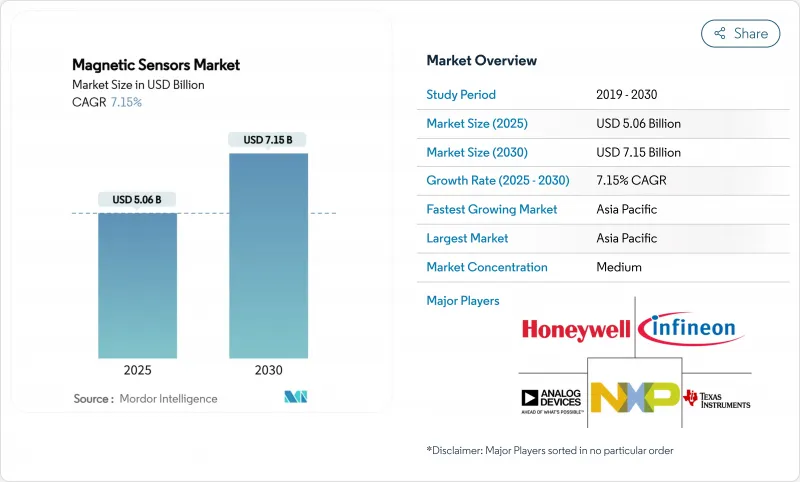
자기센서 시장 규모는 2025년에 50억 6,000만 달러로 추정되고, CAGR 7.15%로 성장할 전망이며, 2030년에는 71억 5,000만 달러에 이를 것으로 예측되고 있습니다.
전기자동차 드라이브 트레인 의무화, 인더스트리 4.0 생산 라인의 진전, 소비자용 기기에서 3축 센싱의 확대가 이 꾸준한 성장을 지원하고 있습니다. 자동차 제조업체는 기능 안전 목표를 달성하기 위해 고정밀 위치 센서 및 전류 센서를 지정하고 스마트폰 및 웨어러블 브랜드는 증강현실과 실내 내비게이션 기능을 위해 소형 터널 자기 저항(TMR) 다이를 통합합니다. 데이터센터 사업자는 스토리지 밀도를 높이기 위해 양자 등급 TMR 헤드를 지원하고 공급업체를 고급스럽고 민감한 설계로 밀어 올리고 있습니다. 희토류 자석을 둘러싼 공급망 위험은 여전히 높으며 기업은 재활용, 현지 가공 및 대체 재료에 대한 투자를 강요하고 있습니다. 선도적인 공급업체는 홀 효과로 인한 가격 하락 환경 하에서 금리를 보호하기 위해 수직 통합, TMR 포트폴리오 확대, 디지털 출력 로드맵에 초점을 맞추고 경쟁의 치열함이 완만합니다.
유럽 연합(EU)과 캘리포니아의 전기자동차 규제는 로터 위치 및 온도 추적에서 배터리 관리 서브시스템에 이르기까지 광범위한 센서 배치에 박차를 가하고 있습니다. 콘티넨탈 e-Motor 로터 온도 센서는 측정 공차를 3℃로 억제하여 설계자가 성능을 보호하면서 희토류 자석 함량을 줄일 수 있도록 합니다. 이러한 정확도는 전체 EV 플랫폼의 컴플라이언스 목표와 비용 억제 전략을 모두 지원합니다.
휴대폰 공급업체는 3차원 자기센서를 통합하여 증강현실 오버레이 및 정확한 실내 네비게이션을 제공합니다. 소형 TMR 다이는 각도 정밀도와 전력 소비 요구 사항을 충족하고 이업종 간 수요의 파급을 촉진합니다. TDK의 Nivio(TM) xMR 컴포넌트는 실험실 등급의 SQUID보다 작은 실적로 생체 자기장을 측정하여 의료기기에 파급될 가능성을 시사합니다.
홀 효과 장치는 저비용 중국 팹과의 경쟁 격화에 직면하고 있습니다. 2024년 이후 네오디뮴 가격이 42% 하락함에 따라 한때 프리미엄 공급업체가 보유하고 있던 재료 비용면에서의 우위성이 손상되어 압력이 높아지고 있습니다. 따라서 벤더는 차별화된 TMR과 GMR 라인에 연구개발을 돌리거나 신호 처리 블록을 통합하여 가격 경쟁력을 유지하고 있습니다.
TMR 센서는 CAGR 8.80%로 확대되었으며 주요 기술 중 가장 빠른 속도입니다. 홀 효과 솔루션은 성숙한 금형과 매력적인 가격 설정으로 2024년에도 자기센서 시장 점유율의 48.0%를 차지했습니다. 그러나, 자동차의 안전 시스템이나 인더스트리 4.0 로봇은 TMR이 자랑으로 하는 -40℃-150℃의 범위에서, 도 이하의 각도 정밀도를 지정하게 되어 있습니다. Allegro MicroSystems는 홀 효과에 비해 10배의 감도와 50%의 저소비 전류를 실현한 XtremeSense(TM)를 판매하고 있습니다.
GMR은 TMR과 같은 비용 프리미엄 없이 감도 향상을 요구하는 고객을 위한 중간 제품이며, AMR은 단순한 신호 체인을 필요로 하는 산업용 리니어 엔코더의 틈새 제품입니다. 플럭스 게이트와 SQUID 디바이스는 하이 엔드 실험 장비, 방위 장비 및 의료 장비에 사용됩니다. 이러한 기술구성에서 비용 중시의 라인에서는 홀 효과의 우위가 계속되는 것으로 보이지만, 자기센서 시장에서는 TMR이 부가가치 창출의 대부분을 흡수할 것으로 보입니다.
2024년 자기센서 시장 규모의 56.0%는 자동차가 차지했습니다. 전동 파워트레인과 ADAS의 보급이 이 기반을 안정시키고 있지만, 두드러진 성장 스토리는 데이터센터입니다. HDD 및 SSD용 양자 등급 TMR 헤드는 하이퍼스케일러의 테라바이트 밀도 향상에 CAGR 9.60%로 기여하고 있습니다. 사업자는 또한 탈탄소화 목표에서 랙 수준의 에너지 사용을 최적화하기 위해 배전 장치에 홀 기반 전류 센서를 도입했습니다. 헬스케어에서는 TDK의 생체 자기 혁신에 힘입어 비침습 이미징과 임플란트 모니터링을 통해 새로운 가능성이 확산되고 있습니다.
자기센서 시장은 기술별(홀 효과, AMR, GMR, TMR, 기타 기술), 용도별(자동차, 가전, 기타), 최종 이용 산업별(자동차 OEM 및 Tier-1, 가전 OEM, 기타), 출력 신호별(디지털, 아날로그), 지역별로 분류되어 있습니다. 시장 예측은 금액(달러)으로 제공됩니다.
아시아태평양은 2024년에 42.0%의 점유율로 자기센서 시장을 선도했으며, 중국 반도체 공장과 일본의 정밀 센서 노하우에 의해 CAGR 9.40%로 향하고 있습니다. 중국의 희토류 수출 억제는 위협과 혜택을 모두 생성합니다. 국내 팹은 자석의 포로가 되는 공급을 얻는 한편, 수출 지향의 자동차 제조업체는 대체 조달에 분주합니다. 일본의 TMR 로드맵은 측정의 깊이를 살려 센서의 소형화를 추진해 자동차와 의료의 두 분야에 공헌합니다. 한국의 스토리지 디바이스 대기업은 고밀도 TMR 헤드에 대한 수요를 높이고 인도의 자동차 생산 대수 확대는 이 지역의 고객 기반을 확대합니다.
북미는 재료 공급에 통증에도 불구하고 여전히 매우 중요합니다. Allegro MicroSystems의 2024년 매출은 10억 5,000만 달러로 e-모빌리티 관련 38% 증가했습니다. 노베온 마그네틱스의 텍사스 공장과 같은 프로젝트는 국내 희토류 가공에 대한 주 우대 조치에 의해 지원되지만, 그 양은 수년간 아시아에 뒤처질 것입니다. 자동차 제조업체는 미국 도로 교통 안전국의 소프트웨어 업데이트 요구 사항을 충족하기 위해 현지 센서 설계 센터에 크게 의존하고 있습니다.
The magnetic sensor market size is worth USD 5.06 billion in 2025 and is forecast to reach USD 7.15 billion by 2030, reflecting a 7.15% CAGR.
Rising electric-vehicle drivetrain mandates, the advance of Industry 4.0 production lines, and expanding 3-axis sensing in consumer devices underpin this steady growth. Automakers are specifying higher-accuracy position and current sensors to meet functional-safety targets, while smartphone and wearable brands integrate miniature tunnel-magnetoresistance (TMR) dies for augmented-reality and indoor-navigation functions. Data-center operators champion quantum-grade TMR heads to lift storage density, pushing suppliers toward premium, high-sensitivity designs. Supply-chain risk around rare-earth magnets remains an overhang, forcing companies to invest in recycling, local processing, and substitute materials. Competitive intensity is moderate as leading vendors focus on vertical integration, TMR portfolio expansion, and digital-output roadmaps to protect margins in an environment of Hall-effect price erosion.
Electric-vehicle regulations in the European Union and California spur wider sensor deployment, stretching from rotor position and temperature tracking to battery-management subsystems. Continental's e-Motor Rotor Temperature Sensor trims measurement tolerance to 3 °C, allowing designers to cut rare-earth magnet content while protecting performance assemblymag.com. Such precision supports both compliance targets and cost-containment strategies across EV platforms.
Handset vendors embed 3-D magnetic sensors to deliver augmented-reality overlays and accurate indoor navigation. Miniature TMR dies meet the angular-accuracy and power requirements, stimulating cross-industry demand spillovers. TDK's Nivio(TM) xMR component measures biomagnetic fields in a footprint smaller than laboratory-grade SQUIDs, hinting at medical-device spill-over potential.
Hall-effect devices face rising competition from low-cost Chinese fabs. The 42% fall in neodymium prices since 2024 compounds pressure by eroding the material-cost moat once held by premium suppliers. Vendors therefore channel R&D into differentiated TMR and GMR lines or integrate signal-processing blocks to sustain pricing power.
Other drivers and restraints analyzed in the detailed report include:
For complete list of drivers and restraints, kindly check the Table Of Contents.
TMR sensors are expanding at 8.80% CAGR, the fastest pace among major technologies. Hall-effect solutions still hold 48.0% of the magnetic sensor market share in 2024 due to mature tooling and attractive pricing. Yet automotive safety systems and Industry 4.0 robots now specify sub-degree angular accuracy across -40 °C to +150 °C ranges, a window where TMR excels. Allegro MicroSystems markets XtremeSense(TM) implementations with 10 X sensitivity and 50% lower current draw than Hall-effect peers.
GMR represents a middle path for customers demanding enhanced sensitivity without the cost premium of TMR, while AMR retains a niche in linear industrial encoders requiring simple signal chains. Fluxgate and SQUID devices serve high-end laboratory, defense, and medical equipment. The technology mix suggests Hall-effect incumbency in cost-sensitive lines will persist, but TMR will absorb most incremental value creation within the magnetic sensor market.
Automotive accounted for 56.0% of the magnetic sensor market size in 2024. The proliferation of electric powertrains and ADAS keeps that base stable, yet the standout growth story is data centers. Quantum-grade TMR heads for HDDs and SSDs help hyperscalers raise terabyte density at a 9.60% CAGR. Operators also deploy Hall-based current sensors in power-distribution units to optimize rack-level energy use amid decarbonization targets. Industrial automation contributes steady volume as factories digitize assembly lines, while healthcare opens nascent upside through non-invasive imaging and implant monitoring supported by TDK's biomagnetic innovations.
Magnetic Sensor Market is Segmented by Technology (Hall-Effect, AMR, GMR, TMR, Other Technologies), Application (Automotive, Consumer Electronics, and More), End-Use Industry (Automotive OEMs and Tier-1s, Consumer Electronics OEMs, and More), Output Signal (Digital, Analog), and by Geography. The Market Forecasts are Provided in Terms of Value (USD).
Asia-Pacific led the magnetic sensor market with 42.0% share in 2024 and is heading toward a 9.40% CAGR, powered by China's semiconductor fabs and Japan's precision sensor know-how. Chinese export curbs on rare-earths create both threat and windfall: domestic fabs gain a captive magnet supply, while export-oriented carmakers scramble for alternate sourcing. Japan's TMR roadmap leverages metrology depth to push sensor miniaturization that feeds both auto and medical verticals. South Korea's storage-device majors lift demand for high-density TMR heads, and India's expanding vehicle output widens the regional customer base.
North America remains pivotal despite material-supply pain points. Allegro MicroSystems booked USD 1.05 billion sales in fiscal 2024, up 38% in e-mobility-linked lines. State incentives for domestic rare-earth processing underpin projects such as Noveon Magnetics' Texas plant, though volumes will lag Asia for several years. Automakers rely heavily on local sensor design centers to meet National Highway Traffic Safety Administration software-update requirements.