



프랑스의 당뇨병 기기 시장은 2025년에 13억 9,000만 달러에 이르고, 2030년에는 19억 1,000만 달러에 달할 것으로 예상됩니다.

이 기세는 2024년 중반에 Dexcom ONE의 보험 적용을 받은 10만명의 2형 당뇨병 환자를 포함한 모든 인슐린 사용자에 대한 지속적인 글루코스 모니터링(CGM) 환불을 프랑스가 세계 최초로 결정한 것을 반영합니다. 환불은 비용 장벽을 없애기 때문에 병원, 당뇨병 전문센터 및 일반 개업의는 치료 경로의 초기 단계에서 센서를 처방합니다. 프랑스 2030과 유럽보건공통중요프로젝트(IPCEI)를 통한 관민조성금은 국내 반도체 능력을 강화하고 외국제 센서에 대한 의존을 줄이고 공급체인을 안정시킵니다. 한편, "Mon Espace Sante" 플랫폼은 실시간 포도당 데이터를 전자 의료 기록과 통합하여 2022년부터 2024년 사이에 개업 의사들 사이에서 6배로 증가한 원격 상담을 간소화했습니다. 프랑스의 당뇨병 기기 시장은 상환, 국가의 자금 지원, 디지털 연결 등 거시 경제의 변동에 좌우되지 않는 구조적 성장 기반을 확립하고 있습니다.
프랑스 국민의 약 350만명이 당뇨병 환자이며, 2024년 수준에서 증가하고 남성의 당뇨병 유병률은 이미 3-5%에 달했습니다. 소아의 1형 당뇨병 이환율은 1994-2003년과 2013-2022년 사이에 거의 3배로 증가했습니다. 증례 수 증가, 수명의 연장, 합병증의 복잡화에 의해 CGM, 패치 펌프, 데이터 구동형 케어에 대한 내구성 있는 수요가 높아집니다. 노인 스마트폰의 보급에 따라 CGM 앱의 연령층이 확대되고 프랑스 당뇨병 기기 시장의 수익 풀이 확대됩니다.
국가가 운영하는 "Mon Espace Sante" 포털을 사용하면 환자가 CGM 데이터를 직접 의사에게 밀어 넣을 수 있으므로 가상 복용량 조정이 가능하며 이동 부담이 줄어 듭니다. COVID-19 이후 원격진찰은 6배로 급증하여 2023년 7월 진료보수규칙에 근거하여 원격지 처방의사도 디지털 후속 조치를 청구할 수 있게 되었습니다. 약사, 간호사, 영양사는 실시간 대시보드를 받고 어드히어런스를 향상시키고 급성기 입원을 줄이는 다직종 제휴 체제를 구축하고 있습니다. 이러한 변화는 특히 내분비 전문의가 적은 원격지에서 지속적인 CGM 재주문 사이클을 자극합니다.
의료기기 경제위원회는 임상 이익 점수에 연동된 가격 설정을 의무화하고 있으며, 획기적인 기기라도 할증 가격을 제한하고 있습니다. 병원은 기능보다 가격을 강조하는 경쟁 입찰을 실시해야하며 공급업체는 압박됩니다. 제조업체 각사는 애널리틱스나 코칭이 부가가치를 낳는 구독 모델로 변화함으로써 대응하고 있지만, 프랑스의 당뇨병 기기 시장 전체에서는 마진의 여유는 여전히 얇다.
2025년 매출액의 57.13%를 모니터링 장비가 차지하고 프랑스의 당뇨병 기기 시장에서 데이터가 중심적인 역할을 담당하고 있는 것으로 밝혀졌습니다. CGM은 보험 상환 확대와 함께 자기 혈당 측정(SMBG)을 추구하고, 덱스콤 원의 적용 범위만으로 10만명의 2형 유저가 추가되었습니다. 모니터링 디바이스 시장 규모는 2025년에 7억 9,000만 달러, 2030년에는 11억 달러 이상에 달할 것으로 예상, 평균 판매 가격 하락으로 센서 유닛의 CAGR은 시장 전체를 웃돌았습니다. 애봇사의 공장 교정이 끝난 리브레 3 센서는 지갑 확인 없이 14일간의 장착이 가능해, 신속한 교환 사이클을 서포트합니다. 프랑스 2030년 체제 하에 국내 공장 생산 능력은 2027년까지 BOM 비용을 낮추고 신규 진출기업이 가격에 민감한 부문을 공략하는 데 도움이 될 수 있습니다.
관리 장치(펜, 펌프, 폐쇄 루프 시스템)는 적은 베이스에서 연률 3.10%의 성장을 달성합니다. 2024년 가이드라인 업데이트는 AID를 새로운 환자층으로 확장하여 사용자 신뢰를 향상시켰습니다. 관리 장비의 프랑스의 당뇨병 기기 시장 규모는 2025년에 6억 달러에 이르고, 2030년에는 8억 1,000만 달러에 이를 수 있습니다. RADIANT와 같은 임상시험은 주사에서 완전 자동화로의 직접적인 도약을 평가하고 45만 명의 펌프 미사용 성인 파이프라인을 열 수 있습니다. 센서와 펌프가 번들됨에 따라 에코시스템 잠금이 강화되고 타사 앱 개발자는 프랑스의 당뇨병 기기 시장에서 사용자 선택을 보호하기 위해 상호 운용 가능한 블루투스 표준을 요구하게 됩니다.
본 보고서에서는 프랑스의 당뇨병 기기 시장 동향을 조사하여 디바이스 유형별(모니터링 디바이스, 관리 디바이스), 최종 사용자별(병원 및 클리닉, 재택치료 현장, 기타), 유통 채널별(병원 약국, 소매 약국, 온라인 판매)로 분류하고 있습니다. 시장 세분화는 위 부문의 금액(단위 : 달러)을 제공합니다.
The France diabetes devices market reached USD 1.39 billion in 2025 and is projected to attain USD 1.91 billion by 2030, equating to a 6.58% CAGR and pointing to steady mid-single-digit expansion over the next five years.
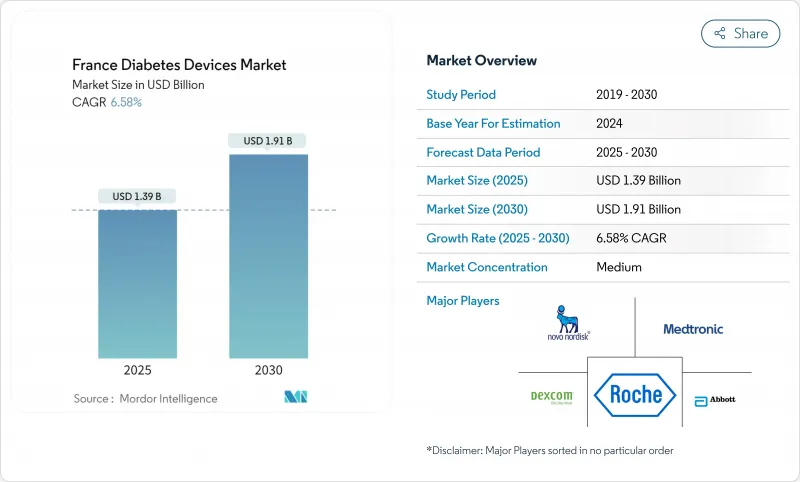
This momentum reflects the world-first decision by France to reimburse continuous glucose monitoring (CGM) for every insulin user, including the 100,000 people with Type 2 diabetes who received coverage for Dexcom ONE in mid-2024. Reimbursement removes cost barriers, so hospitals, diabetes specialty centers, and general practitioners prescribe sensors earlier in the care pathway. Public-private grants through France 2030 and the Important Project of Common European Interest (IPCEI) for Health reinforce domestic semiconductor capacity, cutting reliance on foreign sensors and stabilizing supply chains. Meanwhile, the "Mon Espace Sante" platform integrates real-time glucose data with electronic health records, streamlining teleconsultation, which rose six-fold among general practitioners between 2022 and 2024. Together, reimbursement, state funding, and digital connectivity give the France diabetes devices market a structural growth foundation that remains resilient to macro-economic swings.
Roughly 3.5 million French citizens live with diabetes, up from 2024 levels, and prevalence in men already ranges 3-5%. Incidence of Type 1 diabetes in children nearly tripled between the 1994-2003 and 2013-2022 periods. Higher case counts, longer lifespans, and more complex comorbidities boost durable demand for CGM, patch pumps, and data-driven care. As seniors adopt smartphones, CGM apps scale into older age brackets, widening revenue pools in the France diabetes devices market.
The state-run "Mon Espace Sante" portal lets patients push CGM data directly to physicians, enabling virtual dose adjustments and lowering travel burdens. Teleconsultations jumped six-fold since COVID-19, and remote prescribers can now bill for digital follow-ups under July 2023 reimbursement rules. Pharmacists, nurses, and dietitians receive real-time dashboards, creating a multidisciplinary continuum that raises adherence and reduces acute admissions. These changes stimulate sustained CGM reorder cycles, particularly in remote regions with fewer endocrinologists.
The Economic Committee for Health Products mandates pricing tied to clinical-benefit scores, limiting premium surcharges even for breakthrough devices. Hospitals must run competitive tenders that weigh price above features, squeezing suppliers. Manufacturers respond by shifting to subscription models where analytics and coaching carry extra value, but margin headroom remains thin across the France diabetes devices market.
Other drivers and restraints analyzed in the detailed report include:
For complete list of drivers and restraints, kindly check the Table Of Contents.
Monitoring devices generated 57.13% of revenue in 2025, underlining data's central role in the France diabetes devices market. CGM overtakes self-monitoring blood glucose (SMBG) as reimbursement widens; Dexcom ONE coverage alone added 0.1 million Type 2 users. The France diabetes devices market size for monitoring devices equaled USD 0.79 billion in 2025 and is forecast to exceed USD 1.10 billion by 2030, implying a sensor unit CAGR ahead of total market due to falling average selling prices. Factory-calibrated Libre 3 sensors from Abbott provide 14-day wear without finger-stick confirmation, supporting rapid replacement cycles. Domestic fab capacity under France 2030 could lower BOM costs by 2027 and help new entrants attack price-sensitive segments.
Management devices-pens, pumps, and closed-loop systems-grow 3.10% annually from a smaller base. Updated 2024 guidelines extend AID to new cohorts, improving user confidence. The France diabetes devices market size for management devices reached USD 0.60 billion in 2025 and may touch USD 0.81 billion by 2030. Trials like RADIANT assess direct leaps from injections to full automation, potentially opening a pipeline of 450,000 pump-naive adults. As sensors and pumps bundle, ecosystem lock-in intensifies, prompting third-party app developers to seek interoperable Bluetooth standards to safeguard user choice in the France diabetes devices market.
The Report Covers France's Diabetes Device Market Trends and It is Segmented by Device Type (Monitoring Devices and Management Devices), End User (Hospitals & Clinics, Home-Care Settings, and More), Distribution Channel (Hospital Pharmacies, Retail Pharmacies, and Online Sales). The Market Provides the Value (in USD) for the Above-Mentioned Segments.