



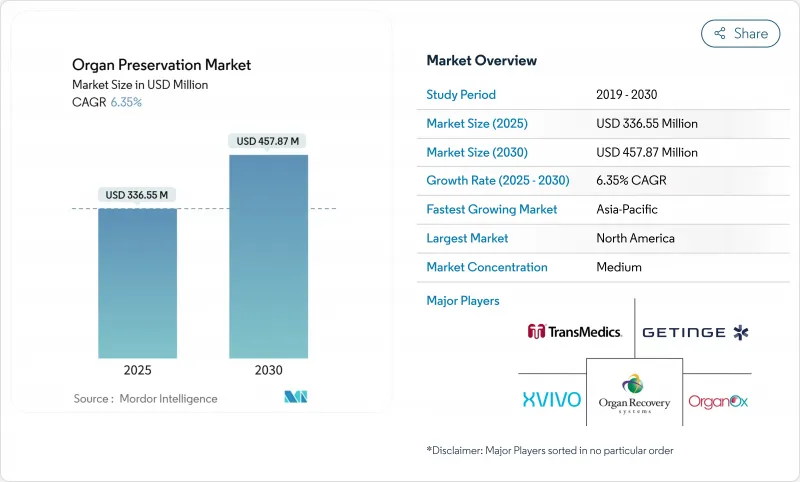
장기 보존 시장 규모는 2025년에 3억 3,655만 달러, 2030년에는 4억 5,787만 달러에 달할 것으로 예상되며, CAGR은 6.35%를 나타낼 전망입니다.

수요 증가는 이식의 필요성과 기증자 공급 간의 격차가 확대되고 있음을 반영하고 있으며, 미국에서는 10만 3,000명이 장기를 찾아 행렬을 만들고 있는 반면, 2024년 중에 이루어진 수술은 4만 8,000건에 그쳤습니다. 상온기계관류(NMP)는 FDA에 의한 장기 케어 시스템 하트의 허가에 반영된 바와 같이 외과의사에게 평가 시간을 늘리고 한번은 사용 불가능하다고 판단된 장기를 구제함으로써 임상적 기대를 재정의하고 있습니다. Medicare의 장기 이식 접근 증가 모델의 생체 외 관류에 대한 상환 코드는 병원 채택을 확대하는 재정적 촉매가됩니다. 한편, FDA가 의무화한 공급망의 안전 가드는 장비의 가용성을 향상시키는 한편 소모품과 자본 설비를 모두 조달해야 하는 병원에 있어서는 비용면에서의 압력이 됩니다. 고령자의 당뇨병, 심혈관 질환, 만성 신장 질환의 이환율 증가는 구조적인 수요를 더욱 증가시키고 제공된 이식편을 최대한 활용하도록 이식 프로그램을 추진하고 있습니다.
평균 수명이 늘어남에 따라 65세 이상의 노인층이 확대되고, 허약을 관리함으로써 수술 후 결과가 동등해진다는 증거 덕분에 이식 대상인 노인층이 증가하고 있습니다. 만성 신장병, 당뇨병, 심혈관계 질환은 모두 노화와 함께 증가하기 때문에 노인 증례에 전형적인 장시간의 작업에도 대응할 수 있는 신뢰성이 높은 보존에 대한 수요가 높아지고 있습니다. 따라서 병원은 장기간의 저온 허혈 중에도 장기를 보호하고 이식 전에 기능 평가를 할 수 있는 솔루션을 선호합니다. 정적 저온 보존은 여전히 널리 보급되어 있지만, 한계에 도달한 이식편을 소생시키는 기계 관류의 능력은 기증자의 나이가 상승한 경우 특히 가치가 있습니다. 현재 이식 프로토콜에는 노인 평가 도구가 포함되어 있어 복잡한 수술 일정을 수용할 수 있는 유연한 저장 창이 필요합니다.
기계 관류는 기증자의 장기를 생리적인 온도로 유지하고 최근 심장 연구에서 1차 이식편의 기능 장애를 28%에서 11%로 감소 시켰습니다. 과거에는 거의 사용되지 않았던 순환 사후 심장제공(DCD)은 현재 상온 국소 관류하에서 대규모로 실현 가능하며, 미국에서는 49개 기관조달기관에서 606명이 기록되어 있습니다. 장비 제조업체는 GPS 추적, 압력 조정 및 온도 원격 측정을 통합하여 팀이 운송 중에 라이브 경고를 수신할 수 있도록 합니다. X-Therma의 단백질 모방 얼음 차단제와 같은 냉동 보존 연구는 보존 기간을 몇 시간에서 몇 주로 이동시키는 것을 목표로합니다. 이러한 기술 혁신은 전체적으로 이식에 걸리는 시간을 단축하고, 폐기율을 낮추고, 외과의사가 기증자 기준을 확대하는 데 도움이 됩니다.
밀리맨의 추정에 따르면, 이식 에피소드의 총 비용은 65세 미만의 환자에서 매년 5.2% 증가하고 노인 코호트에서는 9.1% 증가합니다. 장기 관리 시스템 하트에서 병원 자본 지출은 25만 달러를 초과하고 일회용 세트는 한 번의 치료당 약 4만 달러를 추가합니다. 장기 보존법도 다양하다 : 위스콘신 대학의 보존액은 1리터당 120달러인 반면 마샬 제제는 10달러이며 일부 코호트에서는 이식편의 생존 점수가 동등함에도 불구하고 비용 의식이 높은 병원을 압박하고 있습니다. 따라서 개발도상지역에서는 NMP의 도입이 지연되고 정적냉장보존에 대한 의존이 장기화되고 있습니다. 또한 예산 제한으로 인해 고급 장비 사용 및 데이터 보고를 전제로 하는 직원 교육 및 인증이 지연될 수 있습니다.
정적 저온 보존 장치는 2024년 장기 보존 시장에서 62.25%의 점유율을 유지하면서 간편성, 저비용 및 모든 이식 프로그램에서 수십 년에 걸쳐 검증되었습니다. 그럼에도 불구하고 이식편의 기능 지연은 확장 기준 기증자에서 더 자주 발생하기 때문에 센터는 수송 중에 대사 기질을 새로 고치는 관류 애드온 시험을 촉구합니다. 정적 저온 보존으로 인한 장기 보존 시장 규모는 관류 채택이 기준선 성장을 능가함에 따라 소폭 증가하지만 점유율은 감소합니다.
상온기계관류는 다시설 데이터에서 심장이식편의 6개월 생존율이 얼음보존의 91%에 비해 94%이기 때문에 2030년까지 연률 10.45%의 성장이 예측됩니다. 저체온 관류는 관류액의 비용을 최소화하면서 이식편의 지연 기능, 특히 장기간 기준 이식편에 대해 측정가능한 이점을 제공함으로써 신장에 잘 도움이 됩니다. 2024년까지 미국에서 보고된 DCD 사례는 606명이었습니다. 수렴하는 툴킷을 통해 외과의사는 저온 보존, 저체온 관류, 상온상의 순서를 결정하고 기증자의 생리 기능과 이동 거리에 맞게 방법을 조정할 수 있습니다.
위스콘신 대학의 솔루션은 2024년 장기 보존 시장 점유율의 45.53%를 차지했습니다. 높은 삼투압에서 항산화 물질이 풍부한 프로파일은 세포 부종과 자유 라디칼로 인한 손상을 최소화하고 신장, 간 및 췌장 이식에 기본 사용법을 확립합니다. 그러나 높은 칼륨 함량과 점도가 소아에게 사용하기가 복잡하기 때문에 대체 약물이 필요합니다.
Custodiol HTK는 UW와 유사한 간 이식편의 생존율을 확인하는 테스트를 거쳤지만 세척 프로토콜은 단순화되었습니다. Celsior는 심장 이식편을 대상으로 하며 Perfadex Plus는 여전히 폐 표준입니다. 임상 심사 중 새로운 항산화 제 강화 제제는 허혈 재관류 장애의 추가 완화를 목표로합니다. 독자적인 산소 캐리어를 포함한 기계 관류용 특수 관류액은 장기 보존 시장에서 프리미엄 가격을 지원하는 증수층이 되고 있습니다.
북미는 2024년 장기 보존 시장에서 36.82%의 점유율을 유지했고 선진적인 인프라, 2026년까지 연간 이식 건수 6만건을 달성하겠다는 OPTN의 의무, 관류에 대한 지원적인 상환에 뒷받침되고 있습니다. 광범위한 임상시험, FDA(미국 식품 의약국)의 장비 승인, 견고한 기증자 등록 캠페인이 선행자 이익을 유지합니다. 캐나다의 국민 모두 보험 제도는 수요의 연속성을 보증하고, 멕시코는 공립 병원이 이식 서비스를 확대함에 따라 기기의 수입이 증가합니다.
유럽은 꾸준하지만 완만한 성장을 보여줍니다. 독일, 프랑스, 이탈리아, 스페인, 영국이 채용을 이끌고 있지만 비용 효율성 평가는 장비 가격에 하락 압력을 가하고 있습니다. 유럽 장기 이식 학회(European Society for Organ Transplantation)의 첨단 치료제 로드맵은 생물학적 증강 관류액의 전개를 연기할 수 있는 규제주의를 강조합니다. 그럼에도 불구하고 Eurotransplant와 Scandiatransplant 지역의 국경을 넘는 조달 네트워크는 기증자 병원과 수령 병원 간의 장거리 드라이브를 다루는 고성능 운송 시스템에 의존합니다.
아시아태평양은 가장 빠르게 성장하는 지역으로 중국, 인도, 일본에서 이식 프로그램의 용량이 가속화 되었기 때문에 CAGR은 10.62%를 나타낼 전망입니다. 중국의 COTRS 플랫폼은 자발적인 제공을 합법화하고 사회적 신용을 높이고 새로운 간 단위는 성숙한 구미 센터에 필적하는 조달률을 달성하고 있습니다. 인도의 의료 관광의 상승은 관류 장비의 국내 제조 장려책과 함께 양과 가격 경쟁을 격화시키고 있습니다. 고령화가 진행되는 일본에서는 신장과 심장 수요가 높고, 공적 보험사가 시험적 프로젝트에서 NMP를 상환하는 경우가 늘고 있습니다.
The organ preservation market size stands at USD 336.55 million in 2025 and is forecast to reach USD 457.87 million by 2030, advancing at a 6.35% CAGR.
Demand growth mirrors the widening gap between transplant need and donor supply, with 103,000 people queued for organs in the United States while only 48,000 procedures took place during 2024. Normothermic machine perfusion (NMP) is redefining clinical expectations by giving surgeons extra evaluation time and salvaging organs once deemed unusable, as reflected in the FDA clearance of the Organ Care System Heart. Reimbursement codes for ex-vivo perfusion under Medicare's Increasing Organ Transplant Access Model add a financial catalyst that broadens hospital adoption. Meanwhile, supply-chain safeguards mandated by the FDA improve device availability yet highlight cost pressures for hospitals that must procure both disposables and capital equipment. Rising rates of diabetes, cardiovascular disease, and chronic kidney disease in older adults further add structural demand, pushing transplant programs to maximize every donated graft.
Life expectancy gains have enlarged the cohort older than 65, a group increasingly eligible for transplantation thanks to evidence showing comparable post-operative outcomes when frailty is managed. Chronic kidney disease, diabetes, and cardiovascular disorders all scale with age, lifting demand for reliable preservation that can cope with longer work-ups typical in geriatric cases. Hospitals therefore prefer solutions that protect organs during extended cold ischemia and offer functional assessment before implantation. Static cold storage remains widespread, yet machine perfusion's ability to resuscitate marginal grafts is especially valuable when donor age rises. Transplant protocols now include geriatric assessment tools, reinforcing the need for flexible preservation windows that accommodate complex surgical schedules.
Machine perfusion keeps donor organs at physiologic temperature, cutting primary graft dysfunction from 28% to 11% in recent heart studies. Donation-after-circulatory-death (DCD) hearts, once rarely used, are now feasible at scale under normothermic regional perfusion, with 606 U.S. cases recorded across 49 organ-procurement organizations. Device makers integrate GPS tracking, pressure regulation, and temperature telemetry so that teams receive live alerts during transport. Cryopreservation research, such as X-Therma's protein-mimetic ice blockers, aims to shift preservation from hours to weeks. These innovations collectively shorten allocation times, lower discard rates, and help surgeons expand donor criteria.
Milliman estimates that total transplant episode expenses grow 5.2% annually for patients under 65, and 9.1% for older cohorts. The Organ Care System Heart requires hospital capital outlays above USD 250,000, and each disposable set adds roughly USD 40,000 per procedure. Preservation solutions also vary widely: University of Wisconsin solution costs USD 120 per liter versus USD 10 for Marshall's formulation, pressuring cost-conscious hospitals despite equivalent graft survival scores in select cohorts. Developing regions therefore lag in NMP adoption, prolonging reliance on static cold storage. Budget limitations can also delay staff training and certification, which are prerequisite for advanced device use and data reporting.
Other drivers and restraints analyzed in the detailed report include:
For complete list of drivers and restraints, kindly check the Table Of Contents.
Static Cold Storage retained 62.25% share of the organ preservation market in 2024 because of its simplicity, low cost, and decades-long validation in every transplant program. Even so, delayed graft function remains more frequent with extended criteria donors, prompting centers to trial perfusion add-ons that refresh metabolic substrates during transport. The organ preservation market size attributable to Static Cold Storage will grow modestly but cede share as perfusion adoption outpaces baseline growth.
Normothermic Machine Perfusion is projected to grow 10.45% annually through 2030 as multicenter data show 94% six-month heart graft survival versus 91% for ice storage. Hypothermic variants serve kidneys well by minimizing perfusate cost yet delivering measurable gains in delayed graft function, especially for extended criteria grafts. Regional perfusion in situ is rising too, with 606 U.S. DCD cases reported by 2024. The converging toolkit allows surgeons to sequence cold storage, hypothermic perfusion, and normothermic phases, tailoring methods to donor physiology and travel distance.
University of Wisconsin Solution accounted for 45.53% of the organ preservation market share in 2024. Its hyperosmolar, antioxidant-rich profile minimizes cellular edema and free-radical damage, establishing default use across kidneys, livers, and pancreas grafts. However, high potassium content and viscosity complicate pediatric use, inviting alternatives.
Custodiol HTK is expanding 9.35% CAGR on the appeal of low viscosity and cost parity for multi-organ procurement, with trials confirming similar liver graft survival to UW but simplified flushing protocols. Celsior targets cardiac grafts while Perfadex Plus remains standard for lungs, and new antioxidant-enhanced formulations under clinical review seek to further cut ischemia reperfusion injury. Specialized perfusates for machine perfusion, including proprietary oxygen carriers, represent an incremental revenue tier that supports premium pricing in the organ preservation market.
The Organ Preservation Market Report is Segmented by Technique (Static Cold Storage (SCS), and More), Preservation Solution (University of Wisconsin (UW) Solution, Celsior, and More), Product Type (Preservation Solutions, and More), Organ Type (Kidneys, Liver, and More), End User (Transplant Centers, Hospitals, and More) and Geography (North America, Europe, and More). The Market Forecasts are Provided in Terms of Value (USD).
North America retained 36.82% share of the organ preservation market in 2024, underpinned by advanced infrastructure, the OPTN mandate to reach 60,000 annual transplants by 2026, and supportive reimbursement for perfusion. Widespread clinical trials, FDA device clearances, and robust donor-registration campaigns sustain first-mover advantage. Canada's universal health coverage ensures demand continuity, while Mexico's device imports rise as public hospitals expand transplant services.
Europe exhibits steady but slower growth. Germany, France, Italy, Spain, and the United Kingdom lead adoption, yet cost-effectiveness assessments exert downward pressure on device prices. The European Society for Organ Transplantation's roadmap for Advanced Therapy Medicinal Products spotlights regulatory caution that may defer rollouts for biologic-enhanced perfusates. Nonetheless, cross-border procurement networks in Eurotransplant and Scandiatransplant regions rely on high-performance transport systems to cover long-haul drives between donor and recipient hospitals.
Asia-Pacific is the fastest-growing region, posting a 10.62% CAGR as transplant program capacity accelerates across China, India, and Japan. China's COTRS platform legitimized voluntary donation and raised public trust, while new liver units achieve procurement rates comparable to mature Western centers. India's rising medical tourism, coupled with domestic manufacturing incentives for perfusion devices, adds volume and price competition. Japan's aging population creates high kidney and heart demand, and public insurers increasingly reimburse NMP in pilot projects.