


군용 무인 지상 차량 시장의 규모는 2025년에 22억 달러로 추정되고, 2030년에는 30억 3,000만 달러에 이르고, CAGR 6.61%로 확대될 것으로 예측됩니다.
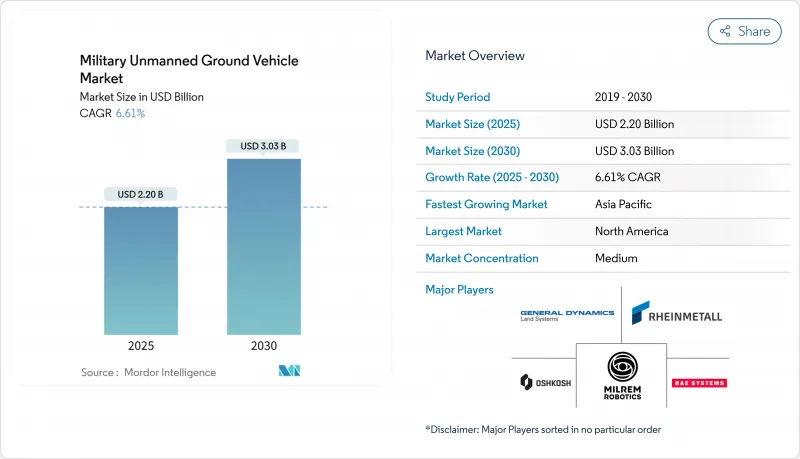
확대에는 NATO 국가와 인도 태평양 국가에서의 방위 예산의 꾸준한 증가, 위험이 높은 작업을 로봇이 대신하여 병사를 보호할 필요성이 높아지고 있는 점, GPS를 사용할 수 없는 환경에서도 자율 항행을 가능하게 하는 인공지능의 급속한 진보가 관련되어 있습니다. 동시에 군은 참신함보다 입증된 신뢰성, 사이버 보안 커맨드 링크, 안정된 군수를 선호하기 때문에 채용 속도는 폭발적이기보다는 오히려 순차적입니다. 전투 임무가 계속 수요의 대부분을 차지하고 있지만, 무인 유지와 양용 배치의 전략적 가치를 군이 인식하고 있기 때문에 물류와 재해 대응의 역할이 급속히 상승하고 있습니다. 프라임 계약자가 기존 차량군을 활용하는 반면, 로봇 전문 기업이 다리식 또는 하이브리드 모빌리티 컨셉으로 틈새 시장을 열기 때문에 경쟁의 격렬함은 적당합니다.
연합국의 지출 증가는 산업계에 명확한 수요 신호를 보내고 있습니다. 일본은 2025년도에 1,032억엔(7억1,400만 달러)을 무인자산의 방위능력에 확보했으며, 미국은 같은 회계 사이클에서 무인시스템에 101억 달러를 할당했습니다. 유럽은 2024년도에 군사비를 17% 늘려 유럽 방위 기금의 일부를 자율형 지상 플랫폼에 투입했습니다. 이러한 여러 해에 걸친 예산 증액은 장기적인 생산 계획을 뒷받침해 군용 무인 지상 차량 시장이 파괴적인 호불황을 반복하지 않고 확대하도록 하고 있습니다.
현대 독트린에서는 무인 시스템이 최전선에 배치됩니다. 우크라이나가 부상자 피난을 위해 Milrem Robotics THeMIS를 현지에서 사용함으로써 위험 지역에서 부대를 제거하는 개념이 검증되었습니다. 미국 육군의 자율형 운송 차량 시스템은 일상적인 보급을 로봇에 맡기면서 지속가능성 처리량이 50% 향상될 것으로 예상됩니다. 이러한 안전 정책은 특히 군수와 폭발성 투사물의 역할 때문에 중량 클래스 전반에 걸친 조달의 원동력이 되고 있습니다.
니어 피어의 적은 제어 채널을 방해하거나 스푸핑할 수 있는 강력한 전자 전투복을 사용하고 무인 차량을 도용하거나 미션을 방해합니다. 미국 공군은 현재 자율 플랫폼을 관리하는 모든 시스템에 제로 트러스트 원칙을 의무화하고 있으며 비용과 설계의 복잡성을 높이는 암호화 및 지속적인 인증 레이어를 추가하고 있습니다. 따라서 공급업체는 링크 중단 이벤트를 줄이기 위해 중복 통신과 온보드 자율성에 많은 투자를 해야 합니다.
전투 플랫폼은 2024년 군용 무인 지상 차량 시장의 54.65%를 차지했습니다. 이것은 군인을 지키면서 살상 능력을 발휘하는 것이 필수적임을 반영합니다. 미국 육군의 제너럴 다이내믹스사와 텍스트론사의 로봇 전투차의 프로토타입은 2028년까지 편대 수준의 시험이 예정되어 있습니다. 물류 UGV는 가장 높은 CAGR 전망 7.87%를 기록했습니다. 이는 지휘관이 수송부대의 노출을 줄이기 위해 자동 보급을 목표로 하기 때문입니다.
지속적인 정보, 감시, 정찰 미션은 UGV의 내구성과 저음향 시그니처를 이용하는 반면, 폭발물 처리는 Common Robotic System 시리즈 하에서 성숙한 조달 라인으로 유지되고 있습니다. 또한 지뢰나 장애물을 제거하는 공병 차량이나 경로 정리 차량, 부대의 준비를 지원하는 훈련 유닛과 미끼 유닛도 있습니다. 임무 확대는 군용 무인 지상 차량 시장의 지속적인 확대를 지원합니다.
원격조작유닛이 2024년 매출액의 65.12%를 차지하였으며 그 이유는 국방부 지령 3000.09가 여전히 살상 판단에 인간의 판단을 필요로 하기 때문입니다. 그럼에도 불구하고 운영자에게 중요한 승인만 요구하는 반자율 내비게이션이 급증하고 있습니다. 완전 자율형 차량은 센서 융합의 돌파구로 중단 없는 데이터 링크의 필요성이 감소하기 때문에 군용 무인 지상 차량 시장 내에서 가장 높은 CAGR 10.24%를 나타낼 것으로 예측됩니다.
하이브리드 제어 모드를 통해 승무원은 방해 전파와 지형 상황에 따라 수동 및 자율 행동을 전환할 수 있습니다. 미국 육군의 xTechOverwatch 대회는 이러한 유연한 운영 개념을 기본적으로 지원하는 AI 모듈을 제공하는 소규모 기업에 인센티브를 제공합니다.
북미는 2024년 군용 무인 지상 차량 시장에서 39.14%의 점유율을 유지하였으며, 무인 시스템에 대한 국방부의 101억 달러의 자금과 초소형 클래스에서 대형 클래스에 이르는 다중 서비스 실험에 뒷받침됩니다. 캐나다의 북극 물류 시험에는 극한 플랫폼에 대한 틈새 요구 사항이 추가됩니다.
아시아태평양은 일본의 1,032억엔(약 7억 2,000만 달러)의 무인 자산 항목과 자율 시스템을 위한 공동 AI 연구를 강조하는 인도의 INDUS-X 이니셔티브에 의해 견인되어 최고 CAGR 7.32%를 나타낼 것으로 예측됩니다. 중국은 민간과 군의 협력 하에서 개발을 가속화하고 있으며, 한국의 다목적 지상 로봇과 호주의 선택적 승무원 탑승 차량은 인도 태평양의 긴장 속에서 공급망 확보를 목표로 하고 있습니다.
유럽은 2024년 지출을 17% 증가한 6,930억 달러로 확대하였으며, 유럽 방위 기금은 NATO의 억지력을 강화하기 위해 자율 플랫폼에 보조금을 투입합니다. 독일이 AeroVironment사에 41대의 선진 EOD UGV를 주문한 것은 즉각적인 운영 수요를 나타냅니다. 중동에서는 UAE를 기반으로 하는 EDGE와 사우디아라비아의 Vision 2030을 통해 고유한 프로그램을 추구하고, 아프리카에서는 국경 경비 로봇을 연구하고 있으며, 이들은 안정적인 기회 풀에 공헌하고 있습니다.
The military unmanned ground vehicle market size is estimated at USD 2.20 billion in 2025, and is expected to reach USD 3.03 billion by 2030, expanding at a 6.61% CAGR.
Expansion is tied to steadily rising defense budgets across NATO and Indo-Pacific nations, the growing imperative to protect soldiers by delegating high-risk tasks to robots, and rapid advances in artificial intelligence that make autonomous navigation feasible in GPS-denied settings.At the same time, the pace of adoption remains disciplined rather than explosive because militaries prioritize proven reliability, cyber-secure command links, and stable logistics over headline-grabbing novelty. Combat missions continue to dominate demand, yet logistics and disaster-response roles are emerging rapidly as armies recognize the strategic value of unmanned sustainment and dual-use deployments. Competitive intensity is moderate because prime contractors leverage existing vehicle families, while specialist robotics firms carve niches through legged or hybrid mobility concepts.
Allied spending increases have sent clear demand signals to industry. Japan set aside JPY 103.2 billion (USD 714 million) for unmanned asset defence capabilities in FY 2025, while the US allocated USD 10.1 billion for uncrewed systems in the same fiscal cycle. Europe boosted military outlays by 17% in 2024, funneling part of the European Defence Fund into autonomous ground platforms. These multi-year budget uplifts underpin long-term production planning, allowing the military unmanned ground vehicles market to scale without disruptive boom-and-bust cycles.
Modern doctrine places unmanned systems on the front line of contact. Ukraine's field use of Milrem Robotics THeMIS for casualty evacuation validated the concept of removing troops from danger zones. The US Army's Autonomous Transport Vehicle System seeks a 50% uplift in sustainment throughput by offloading routine resupply to robots. This safety imperative fuels procurement across weight classes, particularly for logistics and explosive-ordnance roles.
Near-peer adversaries field powerful electronic-warfare suites that can jam or spoof control channels, exposing unmanned vehicles to hijack or mission failure. The US Air Force now mandates Zero Trust principles for any system managing autonomous platforms, adding encryption and continuous authentication layers that raise cost and design complexity. Vendors must therefore invest heavily in redundant communications and onboard autonomy to mitigate link interruptions.
Other drivers and restraints analyzed in the detailed report include:
For complete list of drivers and restraints, kindly check the Table Of Contents.
Combat platforms represented 54.65% of the military unmanned ground vehicles market in 2024, reflecting the imperative to project lethality while shielding soldiers. The US Army's Robotic Combat Vehicle prototypes from General Dynamics and Textron are scheduled for formation-level trials by 2028. Logistics UGVs recorded the fastest 7.87% CAGR outlook as commanders target automated resupply to reduce convoy exposure.
Persistent intelligence, surveillance, and reconnaissance missions exploit UGV endurance and low acoustic signatures, whereas explosive-ordnance disposal remains a mature procurement line under the Common Robotic System series. Engineering and route-clearance vehicles remove mines and obstacles, and training or decoy units support force preparation. The widening mission set underpins the continuous expansion of the military unmanned ground vehicles market.
Tele-operated units held 65.12% of 2024 revenue because the DoD Directive 3000.09 still requires human judgment for lethal decisions. Even so, semi-autonomous navigation that asks operators only for critical approvals is proliferating. Fully autonomous vehicles are projected to rise at a 10.24% CAGR, the fastest within the military unmanned ground vehicles market, as sensor-fusion breakthroughs reduce the need for uninterrupted data links.
Hybrid control modes allow crews to toggle between manual and autonomous behavior when jamming or terrain dictates. The US Army xTechOverwatch competition incentivizes small firms to deliver AI modules that natively support such flexible concepts of operation.
The Military Unmanned Ground Vehicle Market Report is Segmented by Application (Combat, Explosive Disposal (EOD), Logistics and Resupply, and More), Mobility (Wheeled, Tracked, and More), Mode of Operation (Tele-Operated and Autonomous), Weight Class (Micro, Small, and More) and Geography (North America, Europe, Asia-Pacific, South America, and the Middle East and Africa). The Market Forecasts are Provided in Terms of Value (USD).
North America retained 39.14% share of the military unmanned ground vehicles market in 2024, underpinned by USD 10.1 billion in DoD funding for uncrewed systems and by multi-service experimentation that spans micro to heavy classes. Canada's Arctic logistics trials add niche requirements for extreme-cold platforms.
Asia-Pacific is projected to register the highest 7.32% CAGR, driven by Japan's JPY 103.2 billion (~USD 0.72 billion) unmanned assets line item and India's INDUS-X initiative, emphasizing joint AI research for autonomous systems. China accelerates development under Military-Civil Fusion, while South Korea's multipurpose ground robots and Australia's optionally crewed vehicles aim to secure supply chains amid Indo-Pacific tensions.
Europe amplified spending by 17% to USD 693 billion in 2024, and the European Defence Fund channels grants into autonomous platforms to strengthen NATO deterrence. Germany's order for 41 advanced EOD UGVs from AeroVironment illustrated immediate operational demand. The Middle East pursues indigenous programs through UAE-based EDGE and Saudi Vision 2030, while Africa explores border-security robots, together contributing a modest but stable opportunity pool.