


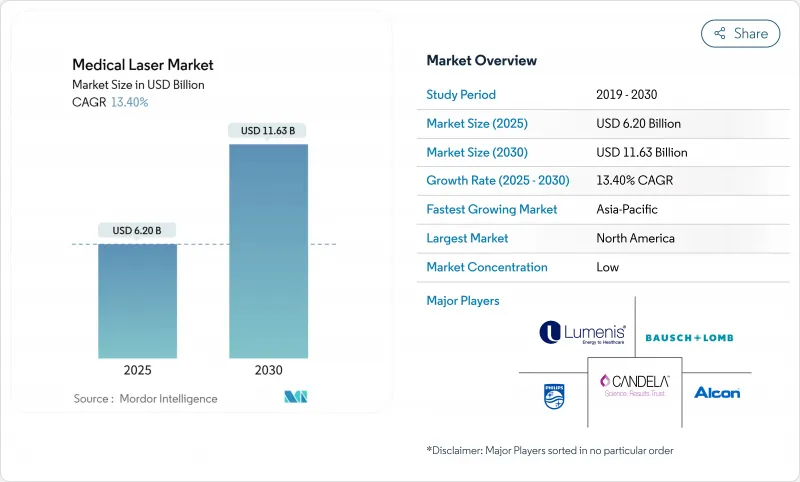
의료용 레이저 시장은 2025년에 62억 달러로 평가되었고, 2030년에는 CAGR 13.40%로 성장할 전망이며, 116억 3,000만 달러에 이를 것으로 예측됩니다.
이 성장은 안과와 미용의 시술량을 밀어 올리는 인구의 노령화, 솔리드 스테이트 및 다이오드 플랫폼의 효율 향상, 레이저 기반의 개입에 의존하는 외래 치료에 대한 지불자의 기호에 의합니다. 전문 클리닉의 꾸준한 증가, 다이오드 효율의 기술적 업그레이드, 광 바이오 모듈레이션 등의 새로운 적응증에 대한 규제 당국의 승인은 희토류 수출 규제와 관련된 공급망 위험에도 불구하고 수요를 견조하게 유지하고 있습니다. 경쟁의 격렬함은 중간 정도이지만, 펨토초, 광 바이오 모듈레이션, AI 대응 기능을 확보하기 위해 틈새 기업을 인수하는 리더 기업이 나왔기 때문에 경쟁은 격화하고 있습니다. 네트워킹 시스템의 사이버 보안 격차와 자본 비용의 압력이 과제로 남아 있지만, 외래수술센터(ASC)로의 수술 전환은 의료용 레이저 시장의 긍정적인 전망을 지원합니다.
외래수술센터(ASC)는 현재 미국의 모든 수술의 72%를 실시하고, 시설 비용을 45-60% 삭감하며, 회복 시간을 단축하는 레이저 기술로의 시프트를 가속화하고 있습니다. 알콘의 Unity VCS와 같은 펨토 세컨드 시스템은 유화 흡입의 에너지를 줄이고 안전과 수술실 회전율을 향상시킵니다. 높은 환자 만족도(외래에서는 92%)가 수요를 강화하고 공급자는 레이저 플랫폼의 도입을 강요받고 있습니다. 클리닉 보상 모델이 일괄 결제로 전환됨에 따라 임상의는 합병증과 재입원을 줄이는 치료법을 선호하고 의료용 레이저 시장에 지속적인 기세를 부여하고 있습니다. 소매 클리닉 체인의 확대에 의해 액세스의 민주화가 한층 더 진행되어, 일상적인 피부 및 안과 치료가 병원으로부터 이행할 수 있게 됩니다.
미국의 녹내장 이환율은 2025년 500만 명에서 2050년에는 630만 명으로 증가할 것으로 예측되며, 트라베크루스 성형술과 백내장 수술의 수술 건수가 증가합니다. 루미세라의 Valeda 광 바이오모듈레이션 플랫폼의 FDA 승인은 건조한 노인황반변성 치료로 처음 승인되었으며, 치료한 눈의 58%가 24개월 동안 5자 이상의 시력 향상을 보였습니다. 아시아태평양은 라이프 스타일 변화에 따른 당뇨병성 망막증의 압박에 직면하여 다이오드 레이저와 고체 안과용 레이저에 대한 투자를 유지하고 있습니다. 이러한 역학을 통해 예산의 제약이 있음에도 불구하고 의료용 레이저 시장은 정밀의료의 우선 순위를 확고하게 따라갑니다.
펨토 세컨드 백내장 플랫폼은 40-50만 달러의 가격표와 300-400 달러의 1회당 사용료가 있어 소규모 진료소에서는 예산이 늘어나고 있습니다. 엑시머 시스템은 24,011-19만 8,000달러로 연간 보수 비용은 구매액의 평균 3.13%로 인건비가 비용의 3분의 2를 차지합니다. 임대는 현금흐름을 편하게 하지만 평생 비용을 끌어올리기 때문에 신흥국의 도입이 제한되고 의료용 레이저 시장 전체의 성장도 억제됩니다.
솔리드 스테이트 플랫폼은 2024년 매출의 34.25%를 차지했으며, 고출력 절단 및 응고에 대한 신뢰성을 입증했습니다. 그러나 다이오드 시스템은 445nm와 880nm의 변형이 대형 설계와 동등한 성능에 도달함에 따라 의료용 레이저 시장 내에서 가장 빠른 CAGR 14.54%를 보일 것으로 예측됩니다. 다이오드 디바이스의 의료용 레이저 시장 규모는 휴대용 핸드피스가 사무실 기반 수술과 미용을 지원함에 따라 현저하게 확대될 것으로 예측됩니다.
다이오드는 냉각 요구가 낮다는 장점이 있으며, 원격 피부과 및 이동 안과 클리닉에 적합한 배터리 구동 옵션이 가능합니다. 가스 레이저와 염료 레이저는 자외선 치료와 얇은 선이 가장 중요한 혈관 병변으로 인해 틈새 위치를 차지합니다. 희토류 공급망의 제약은 다이오드 채용을 일시적으로 억제할 수 있지만, 효율 향상 및 공장 규모의 생산으로 인해 다이오드는 의료용 레이저 시장에서 장기적인 비용 우위를 가지고 있습니다.
본 보고서는 의료용 레이저 기업을 다루며 제품 유형별(고체 레이저 시스템, 가스 레이저 시스템, 염료 레이저 시스템, 반도체 레이저 시스템), 용도별(안과, 피부과 및 미용, 부인과 등), 최종 사용자별(병원, 외래수술센터(ASC) 등), 지역별로 분류하고 있습니다. 시장 규모 및 예측은 금액(달러)으로 제공됩니다.
북미는 2024년 의료용 레이저 시장의 41.54%를 차지했으며, 견고한 상환 경로와 ASC 네트워크의 밀도에 지지되고 있습니다. 고니오 렌즈없이 120 펄스를 공급하는 Voyager DSLT의 알콘의 신속한 개발은이 지역의 선발 문화를 상징합니다. 캐나다는 미국 동향을 반영하지만 자본주기가 엄격하고 임대 모델이 유리합니다.
유럽은 기술 혁신과 MDR 주도의 비용 부담의 균형을 유지하면서 안정을 유지하고 있습니다. 칼자이스 메디텍은 2025년 초에 EMEA에서 17.1%의 매출 성장을 기록해 굴절 교정 수술용 소모품에 지지를 받았습니다(3). 그러나 인증 획득까지의 기간이 연장됨에 따라 소규모 공급업체가 제약을 받을 수 있으며 의료용 레이저 시장이 기존 브랜드에 집약될 수 있습니다.
아시아태평양은 CAGR 14.87%에서 가장 빠르게 성장이 전망되는 지역입니다. 중국의 2024년 10.2% 레이저 분야 성장은 공공 병원의 정비와 미용 수요 증가를 반영합니다. 일본과 한국은 AI를 활용한 엑시머 시스템을 전개하고 인도는 관민의 안과 허브를 통해 전진합니다. ASEAN 국가들은 인프라가 제한되어 있는 것, 의료 관광을 유치하고, 지역의 의료용 레이저 시장 규모에 볼륨을 더하고 있습니다. 통화 변동과 수입 관세는 여전히 장애물이지만 인구 역학의 기세는 지속적인 확대를 시사합니다.
The medical laser market is valued at USD 6.20 billion in 2025 and is forecast to reach USD 11.63 billion by 2030, advancing at a 13.40% CAGR.
This growth rests on aging populations that push ophthalmic and aesthetic procedure volumes, efficiency gains in solid-state and diode platforms, and payers' preference for outpatient care that relies on laser-based interventions. A steady rise in specialty clinics, technological upgrades in diode efficiency, and regulatory approvals for new indications such as photobiomodulation keep demand strong despite supply-chain risks tied to rare-earth export restrictions. Competitive intensity is moderate but rising as leaders acquire niche players to secure femtosecond, photobiomodulation, and AI-enabled capabilities. Cybersecurity gaps in networked systems and capital cost pressures remain challenges, yet procedure migration to ambulatory surgery centers sustains the medical laser market's positive outlook.
Ambulatory surgery centers now conduct 72% of all US surgeries, cutting facility costs by 45-60% and accelerating the shift toward laser techniques that shorten recovery times . Femtosecond systems such as Alcon's Unity VCS reduce phacoemulsification energy, improving safety and operating-room turnover. High patient-satisfaction scores-92% in outpatient settings-reinforce demand, compelling providers to adopt laser platforms or risk losing volume to more agile competitors. As reimbursement models move toward bundled payments, clinicians favor modalities that lower complications and readmissions, giving the medical laser market sustained momentum. Expansion of retail-clinic chains further democratizes access, allowing routine skin and eye procedures to migrate away from hospitals.
Glaucoma incidence in the US is projected to climb from 5 million in 2025 to 6.3 million by 2050, raising procedure volumes for trabeculoplasty and cataract surgery. The FDA clearance of LumiThera's Valeda photobiomodulation platform marked the first approved treatment for dry age-related macular degeneration, with 58% of treated eyes gaining >=5 letters over 24 months. Asia-Pacific faces parallel pressure from diabetic retinopathy tied to lifestyle shifts, sustaining investment in diode and solid-state ophthalmic lasers. These dynamics keep the medical laser market firmly aligned with precision-medicine priorities despite budget constraints.
Femtosecond cataract platforms carry USD 400,000-500,000 price tags, plus per-use fees of USD 300-400, stretching budgets in smaller practices. Excimer systems range from USD 24,011 to USD 198,000, while annual maintenance averages 3.13% of purchase value, with labor forming two-thirds of expense. Leasing eases cash flow but boosts lifetime cost, limiting uptake in emerging economies and tempering overall medical laser market growth.
Other drivers and restraints analyzed in the detailed report include:
For complete list of drivers and restraints, kindly check the Table Of Contents.
Solid-state platforms controlled 34.25% of revenue in 2024, validating their reliability for high-power cutting and coagulation. Yet diode systems are projected to post a 14.54% CAGR, the fastest within the medical laser market, as 445 nm and 880 nm variants reach performance parity with bulkier designs. The medical laser market size for diode devices is forecast to expand notably as portable handpieces support office-based surgery and aesthetics.
Diodes benefit from lower cooling demands, allowing battery-powered options that fit tele-dermatology and mobile ophthalmology clinics. Gas and dye lasers hold niche positions for ultraviolet treatments and vascular lesions where narrow lines are paramount. Supply-chain constraints in rare-earths may temper diode adoption briefly; however, efficiency gains and factory-scale production give diodes a long-term cost edge in the medical laser market.
The Report Covers Medical Laser Companies and It Segmented by Product Type (Solid State Laser Systems, Gas Laser Systems, Dye Laser Systems, and Semiconductor Laser Systems), Application (Ophthalmology, Dermatology/Aesthetics, Gynecology, and More), End User (Hospitals, Ambulatory Surgical Centers, and More), and Geography. The Market Sizes and Forecasts are Provided in Terms of Value (USD).
North America held 41.54% of the medical laser market in 2024, underpinned by robust reimbursement pathways and a dense ASC network. Alcon's rapid roll-out of the Voyager DSLT, which delivers 120 pulses without a gonio lens, typifies the region's first-mover culture. Canada mirrors US trends, albeit with tighter capital cycles that favor lease models.
Europe remains stable, balancing innovation with MDR-driven cost burdens. Carl Zeiss Meditec posted 17.1% revenue growth in EMEA in early 2025, buoyed by refractive-surgery consumables [3]. However, extended certification timelines may constrain smaller vendors, potentially consolidating the medical laser market around established brands.
Asia-Pacific is the fastest-growing arena at a 14.87% CAGR. China's 10.2% 2024 laser-sector growth reflects public-hospital overhauls and rising aesthetic demand. Japan and South Korea deploy AI-enhanced excimer systems, while India advances through public-private ophthalmology hubs. ASEAN nations, though infrastructure-limited, attract medical tourism, adding volume to regional medical laser market size. Currency volatility and import duties remain hurdles, but demographic momentum signals sustained expansion.