



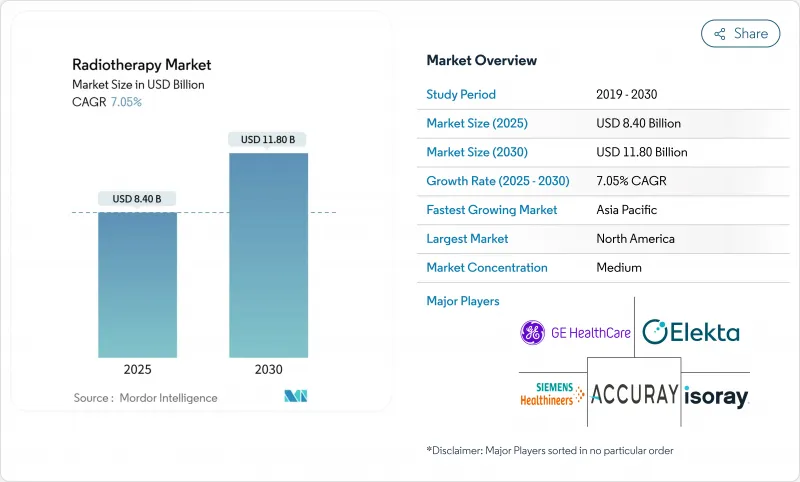
방사선 치료 시장 규모는 2025년에 84억 달러로 평가되었고, 예측기간(2025-2030년)의 CAGR은 7.05%를 나타낼 것으로 예측되며 2030년에 118억 달러에 달할 전망입니다.
성장은 전 세계적으로 증가하는 암 발병률, 초고속 FLASH 치료와 같은 정밀 치료법의 임상적 수용 확대, 그리고 양성자 및 탄소이온 시설의 꾸준한 확장에 기반을 두고 있습니다. 의료 시스템 수요는 또한 모든 종양학 환자의 50-60%가 치료 과정의 어느 단계에서 방사선 치료의 혜택을 받는다는 증거에 힘입어 증가하고 있습니다. 고소득 국가의 의료 제공자들은 실시간으로 치료를 조정하는 MRI 유도 선형가속기를 확대하고 있는 반면, 중소득 국가 시스템은 접근성 격차를 해소하기 위해 단일실 양성자 치료 장치를 우선적으로 도입하고 있습니다. 공급업체 통합이 경쟁 구도를 재편하고 있습니다. 지멘스 헬시니어스의 바리안 인수로 인해 해당 기업은 영상, 계획, 치료 하드웨어를 완전히 통합된 암 치료 경로로 묶을 수 있게 되었습니다. 한편 클라우드 기반 계획 플랫폼과 AI 기반 워크플로 도구는 소프트웨어 전문업체에 새로운 수익원을 열어주며, 신흥 생물학 기반 방사선 치료는 소수 전이성 질환에서 차별화된 성능을 약속합니다.
위장관 악성 종양은 10년간 연평균 2.16% 증가율을 보이며 생물학적 효능이 높은 치료법에 대한 수요를 촉진하고 있습니다. 탄소이온 방사선 치료(CIRT)는 종양 세포가 복구하기 어려운 집적된 DNA 손상을 유발하여, 척수종양의 5년 국소 통제율을 기존 광자 치료의 50-60% 대비 70-80%로 높입니다. 다기관 ETOILE 임상시험은 CIRT와 표준 치료를 비교하는 3등급 증거를 제공할 예정이며, 초기 기관 데이터는 특히 저산소성 병변에서 더 높은 종양 제어 확률을 이미 보여주고 있습니다. 이에 따라 일본, 독일, 중국의 의료 시스템은 혼합 입자 치료 센터 구축을 우선순위로 삼고 있습니다./p>
Elekta와 ViewRay가 선도한 실시간 MRI 유도 시스템은 기존 방사선 치료가 조사 중 해부학적 구조를 시각화하지 못하는 한계를 극복합니다. 적응형 워크플로로 의료진은 세션마다 치료 계획을 재최적화하여 안전 마진을 축소하고 정상 조직을 보존할 수 있습니다. 유럽과 미국의 학술 센터들은 측정 가능한 독성 감소 효과를 보고하고 있으나, 1,000만 달러 이상의 자본 비용으로 인해 3차 병원으로 도입이 제한되고 있습니다. 공급업체들은 현재 AI 기반 윤곽 추적 및 자동화된 품질 보증 기능을 번들로 제공하여 주기 시간을 단축하고 투자 수익률을 개선하고 있습니다.
저자원 환경의 기술자들을 대상으로 한 질적 조사에 따르면, 유연하지 않은 교육 체계와 제한된 실무 경험이 역량 확보의 주요 장벽으로 지적되었습니다. 미국 노동통계국 자료에 따르면 중간 연봉은 10만 1,990달러이지만 연간 예상 채택 규모는 800명에 불과해 수요를 크게 밑돌고 있습니다. 인력 부족은 설치된 장비의 활용도 저하 위험을 초래하며, 자동화, 원격 계획 허브, 가속화된 인력 양성을 위한 몰입형 시뮬레이션에 대한 관심을 촉진하고 있습니다.
방사선 치료 장비는 2024년 매출의 63.51%를 차지했으며, 이는 선형 가속기, 다엽 콜리메이터, 영상 보조 장비에 대한 지속적인 자본 지출을 반영합니다. 절대 규모는 작지만, 치료 계획 및 종양학 정보 소프트웨어는 AI 기반 자동화를 바탕으로 2030년까지 연평균 9.34% 성장할 것으로 전망됩니다. 소프트웨어 부문 방사선 치료 시장 규모는 2025년 26억 달러에 달했으며, 10년 말까지 두 배로 증가할 것으로 예상됩니다. 플랫폼 공급업체들은 딥러닝 기반 윤곽 추적 및 선량 예측 알고리즘을 활용해 계획 주기를 수 시간에서 수 분으로 단축함으로써 의료진의 업무 부담을 줄이고 처리량을 높이고 있습니다. 적응형 계획 모듈은 이제 콘빔 CT 또는 MRI 피드백을 세션별 계획에 통합하여 실시간으로 선량을 재계산합니다. 가치 기반 종양 치료를 추구하는 병원들은 종양학, 화학치료, 수술 기록을 통합하여 종단적 의사결정을 지원하는 벤더 중립적 클라우드 호스팅 솔루션을 점점 더 선호하고 있습니다.
하드웨어 분야에서는 지멘스 헬시니어스가 스펙트럼 CT 가이드 기능을 탑재한 프리미엄급 시스템에 집중하는 반면, 중저가 시장 진입업체들은 신흥 시장을 겨냥한 비용 최적화 가속기를 목표로 합니다. 하류 시장에서는 레이서치 랩스 같은 독립 소프트웨어 전문업체들이 오픈 API 생태계를 활용해 바리안의 ARIA나 엘렉트타의 MOSAIQ와 병행하여 새로운 분석 도구를 도입함으로써 방사선 치료 시장을 더욱 세분화하고 있습니다.
광자 기반 치료법은 2024년에도 77.84%의 매출 점유율 선두를 유지했으며, 이는 광범위한 임상적 친숙도와 분할당 비용 절감 효과에 기인합니다. 그럼에도 양성자 치료는 13.66%의 연평균 복합 성장률(CAGR)로 방사선 치료 시장에서 가장 빠르게 성장하는 분야로 자리매김했으며, 이는 소아 적응증 증가와 중요 구조물에 인접한 종양 치료 수요 확대로 촉진되고 있습니다. 양성자의 연필빔 특성은 최소한의 출구 선량으로 정형 방사선 치료를 가능하게 하여 장기적인 심폐 독성을 줄입니다. 2024년 한 해에만 유럽에 8개의 신규 센터가 문을 열었으며, 벨기에, 스페인, 영국, 노르웨이에서 추가 시설이 건설 중입니다. 한편 일본 방사선과학연구소의 주도하에 진행 중인 탄소이온 연구는 방사선 저항성 병변에 초점을 맞추고 있으며, 초기 데이터에 따르면 광자 대비 5년 국소 통제율에서 10-20% 포인트의 개선 효과를 보였습니다.
신흥 FLASH 치료은 정상 조직 보호 효과를 극대화하는 초고선속을 적용하며, 전임상 연구 결과 치료 기간을 6주에서 1일로 단축할 가능성을 시사합니다. 양성자 및 탄소빔을 결합한 하이브리드 다중 이온 갠트리 설계가 진행 중이며, 이는 향후 임상 의사가 개별 종양의 방사선 민감도에 맞춰 입자 종류를 선택할 수 있는 미래를 예고합니다.
북미는 42개의 가동 중 양성자 치료 센터, 상당한 보험 적용 범위, 그리고 견고한 임상 연구 생태계 덕분에 2024년 41.83%로 가장 큰 방사선 치료 시장을 차지합니다. 미국은 전 세계 MRI 유도 선형가속기 설치량의 절반 이상을 차지하지만, 시카고 대학 연구에 따르면 환자 방문 횟수를 줄일 수 있는 저분할 유방 치료 프로토콜에 대한 지속적인 사회경제적 장벽이 존재함을 강조합니다. 캐나다는 이중 에너지 선형가속기에 대한 주정부 투자와 인력 부족 완화를 위한 교차 훈련 프로그램을 통해 역량을 확대하고 있습니다.
유럽은 중앙 집중식 암 계획과 회원국 간 기술 확산을 촉진하는 공공 재정 모델로 두각을 나타내며 2위를 차지합니다. 2024년 8개의 양성자 치료 센터가 개소했으며, 벨기에, 스페인, 영국, 노르웨이에서 추가 시설이 건설 중입니다. 저분할 치료가 국가 지침에 광범위하게 반영되어 의료진이 3주 이내에 유방암 완치 치료를 시행할 수 있습니다. 유럽위원회의 지멘스-바리안 합병 규제 승인은 진단 영상과 치료 솔루션을 통합 제공할 수 있는 수직 통합 공급업체의 입지를 공고히 합니다.
아시아태평양은 상당한 미충족 수요와 증가하는 공공 보건 예산에 힘입어 2025-2030년 동안 10.26%의 연평균 복합 성장률(CAGR)로 가장 빠른 성장률을 보일 것으로 전망됩니다. 중국의 제14차 5개년 계획은 중이온 치료를 전략적 우선순위로 지정하여 광저우와 상하이에서 양성자-탄소 공동 시설 건설을 촉진하고 있습니다. 한국은 국민건강보험을 통해 탄소이온 치료 도입을 지원하고 있으며, 일본은 군마와 QST(질량분석과학기술연구소)의 지속적인 운영으로 선도적 위치를 유지하고 있습니다. 인도는 개선되고 있지만 여전히 779대의 원격치료기만 운영 중이며, 이는 수요에 훨씬 못 미쳐 치료비의 75%를 개인 부담해야 하는 상황입니다. 동남아시아 국가들은 최초 서비스 도입을 위해 소형 단일실 설계를 추진 중이며, 베트남과 태국은 지역 암 연구소와 협력하여 기술 이전을 진행하고 있습니다.
The Radiotherapy Market size is estimated at USD 8.40 billion in 2025, and is expected to reach USD 11.80 billion by 2030, at a CAGR of 7.05% during the forecast period (2025-2030).
Growth is underpinned by rising global cancer incidence, widening clinical acceptance of precision modalities such as ultrafast FLASH therapy, and the steady build-out of proton and carbon-ion facilities. Health-system demand is also buoyed by evidence that 50-60% of all oncology patients benefit from radiation at some stage of care. Providers in high-income countries are expanding MRI-guided linear accelerators that adapt treatment in real time, while middle-income systems prioritize single-room proton units to close access gaps. Vendor consolidation is reshaping competition; Siemens Healthineers' ownership of Varian positions the company to bundle imaging, planning, and treatment hardware into fully integrated cancer-care pathways. Meanwhile, cloud-based planning platforms and AI-driven workflow tools open new revenue pools for software specialists, and emerging biology-guided radiotherapy promises differentiated performance in oligometastatic disease.
Escalating early-onset cancer rates gastrointestinal malignancies rose at an annual percentage change of 2.16% over 10 years, stimulating demand for biologically potent modalities. Carbon-ion radiotherapy (CIRT) delivers clustered DNA damage that tumor cells struggle to repair, raising 5-year local control in chordoma to 70-80% compared with 50-60% for conventional photons. The multicentre ETOILE trial will provide level-III evidence comparing CIRT with standard care, and early institutional data already favor higher tumor-control probabilities, especially in hypoxic lesions. Health systems in Japan, Germany, and China are consequently prioritizing mixed-particle centers.
Real-time MRI-guided systems, pioneered by Elekta and ViewRay, overcome conventional radiotherapy's inability to visualize anatomy during beam-on time. Adaptive workflows let clinicians re-optimize plans session-by-session, shrinking margins and sparing normal tissue. Academic centers in Europe and the United States report measurable toxicity reductions, though capital costs above USD 10 million restrict uptake to tertiary hospitals. Vendors now bundle AI-driven contouring and automated quality assurance to shorten cycle times and improve return-on-investment.
A qualitative survey of technicians in low-resource settings cited inflexible training frameworks and limited hands-on exposure as prime barriers to competency. U.S. Bureau of Labor Statistics data show median salaries of USD 101,990 but only 800 projected openings per year, well below demand. Workforce deficits risk underutilization of installed capacity and drive interest in automation, remote planning hubs, and immersive simulation for accelerated onboarding.
Other drivers and restraints analyzed in the detailed report include:
For complete list of drivers and restraints, kindly check the Table Of Contents.
Radiotherapy equipment generated 63.51% of 2024 revenue, reflecting sustained capital spending on linear accelerators, multileaf collimators, and imaging accessories. Treatment-planning and oncology-information software, although smaller in absolute terms, is forecast to expand at 9.34% CAGR through 2030 on the back of AI-enabled automation. The radiotherapy market size for software reached USD 2.6 billion in 2025 and is projected to double by the end of the decade. Platform vendors leverage deep-learning contouring and dose-prediction algorithms that can cut planning cycles from hours to minutes, easing clinician workloads and elevating throughput. Adaptive planning modules now recalculate dose in real time, integrating cone-beam CT or MRI feedback into session-specific plans. Hospitals pursuing value-based oncology care increasingly prefer vendor-neutral, cloud-hosted solutions that integrate imaging, chemotherapy, and surgery records for longitudinal decision-support.
In hardware, Siemens Healthineers focuses on premium-tier systems embedding spectral CT guidance, while mid-range entrants target cost-optimized accelerators for emerging markets. Downstream, independent software specialists such as RaySearch Laboratories exploit open-API ecosystems to insert new analytics tools alongside Varian's ARIA or Elekta's MOSAIQ, further segmenting the radiotherapy market.
Photon-based modalities retained 77.84% revenue leadership in 2024, upheld by widespread clinical familiarity and lower cost per fraction. Nonetheless, proton therapy's 13.66% CAGR positions it as the fastest-rising component of the radiotherapy market, propelled by escalating pediatric indications and tumors abutting critical structures. The pencil-beam nature of protons enables conformal dosing with minimal exit dose, cutting long-term cardiopulmonary toxicity. Eight new European centers launched in 2024 alone, and additional facilities are under construction in Belgium, Spain, the United Kingdom, and Norway. Meanwhile, carbon-ion investigations spurred by Japan's National Institute of Radiological Sciences focus on radioresistant lesions, with early data showing 10-20 percentage-point gains in 5-year local control versus photons.
Emergent FLASH regimens apply ultra-high dose rates that exploit differential normal-tissue sparing; preclinical work indicates the potential to collapse course length from six weeks to one day. Hybrid multi-ion gantries combining protons and carbon beams are under design, signaling a future where clinicians can select particle species tailored to individual tumor radiosensitivity.
The Radiotherapy Market Report Segments the Industry Into by Product (Radiotherapy Equipment, and More), Technology (Photon Beam Therapy, and More), Therapy Type (External Beam Radiation Therapy, and More), Application (Breast Cancer, and More), End User (Hospitals, and More), and Geography (North America, Europe, Asia-Pacific, Middle East and Africa, South America). The Market Forecasts are Provided in Terms of Value (USD).
North America commands the largest radiotherapy market with 41.83% in 2024 owing to 42 operational proton centers, significant reimbursement coverage, and a robust clinical-research ecosystem. The United States accounts for more than half of global installations of MRI-guided linacs, although studies from the University of Chicago underscore lingering socioeconomic barriers to hypofractionated breast protocols that could reduce patient visits. Canada broadens capacity through provincial investments in dual-energy linacs and cross-training programs designed to mitigate workforce shortages.
Europe ranks second, distinguished by centralized cancer plans and public financing models that favor technology diffusion across member states. Eight proton centers opened in 2024, with additional capacity underway in Belgium, Spain, the United Kingdom, and Norway. Hypofractionation is widely embedded into national guidelines, allowing clinicians to deliver curative breast treatments in three weeks or fewer. The European Commission's regulatory clearance of the Siemens-Varian merger cements a vertically integrated supplier capable of bundling diagnostic imaging with therapy solutions.
Asia-Pacific is projected to deliver the fastest growth rate with 10.26% CAGR over 2025-2030, powered by significant unmet demand and escalating public health budgets. China's 14th Five-Year Plan designates heavy-ion therapy as a strategic priority, igniting construction of joint proton-carbon facilities in Guangzhou and Shanghai. South Korea subsidizes carbon-ion adoption under national insurance, while Japan maintains leadership through continuous operation at Gunma and QST. India, although improving, still operates only 779 teletherapy machinesbwell below needsbforcing 75% of treatment expenditure to be paid out-of-pocket. Southeast Asian nations pursue compact single-room designs to launch first-time services, with Vietnam and Thailand partnering with regional cancer institutes for skills transfer.