


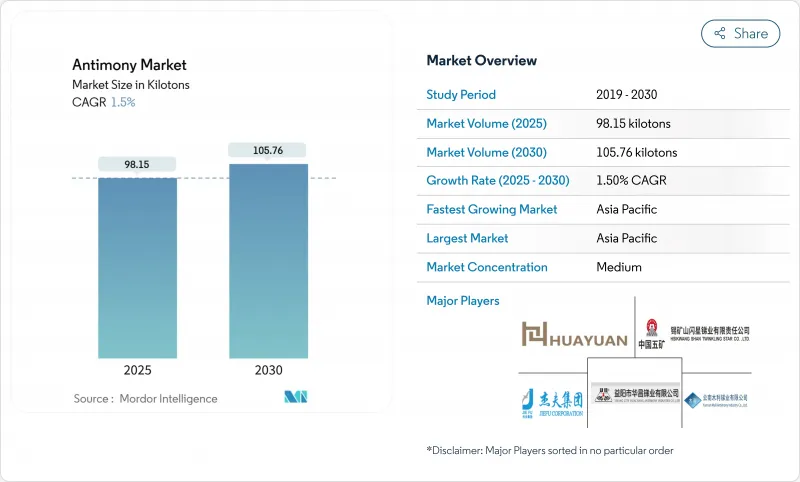
안티몬 시장 규모는 2025년에 98.15킬로톤으로 평가되었고, 예측 기간(2025-2030년)의 CAGR은 1.5%를 나타낼 것으로 예측되며 2030년에 105.76킬로톤에 이를 전망입니다.
확장 규모는 양적으로 소폭이지만 근본적 변화는 상당합니다. 2024년 9월 중국의 수출 통제로 글로벌 공급망이 차질을 빚으며 가격이 톤당 22,000달러까지 치솟았고, 단일 거래일 기준 40% 급등이 발생했습니다. 하류 산업은 원자재 공급처 다각화, 재활용 투자 확대, 안티몬 대체재 연구개발 가속화로 대응 중입니다. 유럽의 규제 강화로 난연제 제형에 압박이 가해지는 반면, 아시아태평양 지역의 대규모 배터리 보급 확대는 수요를 주도하고 있습니다. 에너지 저장 기술 혁신과 PET 수지 생산량 회복이 맞물려 환경 규제 강화 속에서도 소비량은 지속적으로 증가하고 있습니다.
건설, 자동차, 소비자 가전 분야의 화재 안전 규제로 인해 대규모 폴리머 물량이 안티몬 기반 난연 시스템으로 계속 이동하고 있습니다. PET 생산업체들은 여전히 높은 반응 속도와 우수한 색상을 제공하는 안티몬 촉매에 의존하고 있습니다. 비록 테스트된 음료의 40%에서 안티몬 용출량이 캘리포니아 공중보건 목표치를 초과하지만 말입니다. 규제 압박에도 불구하고 유사한 성능을 가진 비용 경쟁력 있는 촉매 대안은 아직 나오지 않아, 글로벌 폴리머 라인은 중기적으로 안티몬에 고정되어 있습니다. 이미 안티몬 소비량의 48%를 차지하는 플라스틱 부문은 따라서 안티몬 시장의 기본 수요를 뒷받침하고 점진적 성장을 지원하고 있습니다. 순환형 포장재로의 지속적인 전환은 역설적으로 수요를 증가시키는데, 재활용 PET는 폴리머 품질 유지를 위해 종종 추가 안티몬이 필요하기 때문입니다.
중국, 인도, 동남아시아의 전력사들은 간헐적 재생에너지와 기존 납축전지 시스템을 결합하고 있으며, 이 시스템에는 이제 사이클 수명 연장을 위해 최적화된 안티몬-납 합금이 적용됩니다. 전기음향 충전 및 합금 조정을 통해 유지보수가 감소하고 방전 깊이가 개선되어 납축전지가 특정 전력망 역할에 경쟁력을 갖추게 되었습니다. 이러한 프로젝트는 각 배터리 전력망 합금이 일반적으로 중량 기준으로 1-6%의 안티몬을 함유하기 때문에 지역 안티몬 수요를 촉진합니다. 북미에서도 유틸리티 기업들이 비용 효율적인 장시간 저장 솔루션을 모색하며 간접적 수요가 발생하고 있어 안티몬 시장에 구조적 수요가 추가되고 있습니다.
유럽 제조사들은 안티몬 시너지를 기반으로 한 브롬계 시스템을 단계적으로 폐기하고 인-질소 화합물로 대체 중입니다. 유럽화학물질청(ECHA)의 SVHC 목록은 현재 247개 물질을 포함하여 안티몬 화합물 및 하류 할로겐화 파트너 물질에 대한 모니터링를 강화하고 있습니다. OEM 선호도와 친환경 라벨이 이러한 전환을 공고히 하고 있으며, 이는 장기적으로 해당 지역의 안티몬 수요를 구조적으로 감소시킬 것입니다. 비록 글로벌 시장이 여전히 할로겐-안티몬(Sb) 제형에 의존하고 있음에도 불구하고 말입니다.
안티몬삼산화물은 2024년 물량 기준 57%를 차지하며 난연성 마스터배치용 화학물질 시장에서 가장 큰 비중을 유지했습니다. 삼산화물 소비량은 전체 산업 성장률에 근접한 속도로 증가하며 EU 규제 압박 속에서도 주도적 위치를 지속하고 있습니다. 금속 잉곳 및 오산화물 흐름은 특수 유리 및 배터리 용도에 집중되어 낮은 성장률이지만 안정적인 현금 흐름 특성을 보입니다.
반면, 합금 부문은 1.66%의 점유율에 불과하지만, 안티몬 개질 Zn-Mg-Al 코팅이 자동차 산업에서 수용되면서 비례 이상의 성장세를 보이고 있습니다. 파일럿 프로젝트를 통해 부식 저항성과 미세구조 개선 효과가 입증되어 노출된 차체 패널의 수명 연장을 가능케 합니다. 이 틈새 시장은 기본 시장 성장률을 상회할 것으로 예상되며, 안티몬 시장에서 맞춤형 합금 화학 성분을 공급하는 업체들에게 프리미엄 마진 잠재력과 높은 고객 충성도를 제공할 것입니다.
2024년 채굴 원료의 96.2%를 차지한 스티브나이트는 원자재 수준에서 안티몬 시장 규모의 압도적 다수를 구성합니다. 이 단일 황화광물에 대한 가공 의존도는 주요 매장지가 중국, 러시아, 타지키스탄에 위치한다는 점에서 지정학적 위험을 집중시킵니다. 해당 광석은 비소 함량이 높은 폐기물 유출을 발생시켜 전 세계적으로 환경 관리 비용을 증가시킵니다.
중국 외 매장지 탐사가 증가하고 있습니다. 미국 안티모니 코퍼레이션(United States Antimony Corporation)이 알래스카 스티브나이트 크릭(Stibnite Creek)에서 3,840에이커를 인수한 것은 국내 공급 탄력성을 뒷받침하기 위한 목적입니다. 호주와 캐나다의 유사한 다각화 추진은 안티모니 시장에서 스티브나이트 집중도를 희석시키려는 점진적 전환을 반영하며, 향후 10년간 공급 안정성 증대를 위한 기반을 마련하고 있습니다.
아시아태평양 지역은 2024년 안티몬 소비량의 88%를 차지했으며, 이는 플라스틱, 전자제품, 배터리 분야의 타의 추종을 불허하는 제조업 깊이를 반영합니다. 중국의 수출 허가 제도는 지역 무역 흐름을 뒤흔들었으며, 일본, 한국, 인도 구매자들은 공급 위험을 헤지하기 위해 대체 공급원과 장기 계약을 체결하고 있습니다. 지역별 에너지 전환은 납축 전지 저장 장치 및 고순도 반도체 화합물에 대한 새로운 구조적 수요를 창출하여, 안티몬 시장이 2030년까지 연평균 1.53%의 완만하지만 꾸준한 성장세를 유지할 것으로 전망됩니다.
북미는 물량 기준으로는 규모가 작지만 전략적으로 중추적 역할을 하며, 방위 및 핵심 인프라용 안티몬의 82%를 수입합니다. 아이다호주의 스티브나이트 광산 계획 승인으로 미국은 유일하게 허가된 1차 광상을 확보했으며, 광산 수명 기간 동안 총 1억 4,800만 파운드의 생산이 예상됩니다. 이 프로젝트는 알래스카 광구와 함께 안티몬 시장 공급망의 일부를 재내국화하기 시작하며 향후 수입 의존도를 완화할 수 있습니다.
유럽은 독특한 규제 압박에 직면해 있습니다. REACH 규정 준수 비용과 할로겐 프리 화학물질로의 전환이 안티몬삼산화물 수요를 억제하는 반면, 고성능 유리 및 세라믹 및 전자제품 분야는 틈새 수요를 유지하고 있습니다. 진행 중인 CoRAP(화학물질 평가 및 등록 계획) 평가로 인한 불확실성으로 유럽 구매자들은 안티몬 기반 화학물질 관련 대규모 투자에 신중한 태도를 보이고 있습니다. 그럼에도 필수적인 자동차 및 항공우주 응용 분야는 해당 지역이 글로벌 안티몬 시장에 계속 참여하도록 하며, 특수 분야가 일반화된 난연제 톤수 감소분을 상쇄하고 있습니다.
The Antimony Market size is estimated at 98.15 kilotons in 2025, and is expected to reach 105.76 kilotons by 2030, at a CAGR of 1.5% during the forecast period (2025-2030).
Expansion is modest in volume terms, yet underlying shifts are substantial: China's September 2024 export controls disrupted global supply, driving prices to USD 22,000 per ton and triggering a 40% single-day price jump. Downstream sectors are responding by searching for diversified raw-material sources, investing in recycling, and accelerating R&D on antimony substitutes. Regulatory tightening in Europe is pressuring flame-retardant formulations, while rapid grid-scale battery deployment in Asia-Pacific is reinforcing demand. Energy-storage innovation, coupled with a resurgence in PET resin output, continues to lift consumption even as environmental scrutiny intensifies.
Fire-safety rules in construction, automotive, and consumer electronics continue to move large polymer volumes toward antimony-based flame-retardant systems. PET producers still rely on antimony catalysts that deliver high reaction rates and favorable color even though antimony leaching exceeds California public-health goals in 40% of tested beverages. Regulatory pressure has not yet produced a cost-competitive catalyst alternative with similar performance, so global polymer lines are locked in for the medium term. The plastics sector, already holding 48% of antimony consumption, is therefore underpinning the baseline offtake and supporting incremental growth in the antimony market. Ongoing transition to circular packaging paradoxically lifts demand because recycled PET often requires additional antimony to preserve polymer quality.
Utilities in China, India, and Southeast Asia are pairing intermittent renewables with familiar lead-acid systems that now incorporate optimized antimony-lead alloys to extend cycle life. Electro-acoustic charging and alloy tweaks have reduced maintenance and improved depth-of-discharge, making lead-acid competitive for certain grid roles. These projects boost regional antimony pull-through because each battery grid alloy typically contains 1%-6% antimony by weight. Spillover procurement in North America is emerging as utilities seek cost-effective long-duration storage, adding a further layer of structural demand to the antimony market.
European producers are phasing out brominated systems that rely on antimony synergy, replacing them with phosphorus-nitrogen chemistries. The European Chemicals Agency's SVHC list now encompasses 247 substances, intensifying scrutiny on antimony compounds and downstream halogenated partners. OEM preferences and eco-labels are cementing this transition, which structurally erodes antimony demand in the region over the long run, even though global markets still rely on halogen-Sb formulations.
Other drivers and restraints analyzed in the detailed report include:
For complete list of drivers and restraints, kindly check the Table Of Contents.
Antimony trioxide commanded 57% of 2024 volume, underpinning the largest slice of the antimony market size for chemicals used in flame-retardant masterbatches. Trioxide consumption climbs at a pace near the overall industry, sustaining leadership even under EU regulatory headwinds. Metal ingot and pentoxide streams remain oriented to specialized glass and battery uses, showing low growth yet stable cash-flow characteristics.
In contrast, the alloys segment-holding only 1.66% share-shows outsized momentum as antimony-modified Zn-Mg-Al coatings gain automotive acceptance. Pilot projects demonstrate corrosion-resistance and microstructural improvements that unlock lifespan benefits for exposed body panels. This niche should outpace base-market growth, offering premium margin potential and higher customer stickiness for suppliers that deliver tailored alloy chemistries within the antimony market.
Stibnite contributed 96.2% of mined feedstock in 2024, translating to the vast majority of the antimony market size at the raw-material level. Processing reliance on this single sulfide mineral concentrates geopolitical risk, given that dominant deposits lie in China, Russia, and Tajikistan. The ore generates arsenic-rich waste streams, elevating environmental-management costs worldwide.
The exploration of non-Chinese deposits is rising. United States Antimony Corporation's acquisition of 3,840 acres at Stibnite Creek in Alaska aims to underwrite domestic supply resilience. Similar diversification drives in Australia and Canada reflect a gradual pivot intended to dilute the stibnite concentration in the antimony market, laying groundwork for incremental security of supply over the decade.
The Antimony Market Report Segments the Industry by Type (Metal Ingot, Antimony Trioxide, and More), Ore Type (Stibnite and Others), Application (Flame Retardants, Batteries, and More), End-Use Industry (Plastics and Polymers, Automotive and Transportation, and More), and Geography (Asia-Pacific, North America, Europe, South America, and Middle East and Africa). The Market Forecasts are Provided in Terms of Volume (tons).
Asia-Pacific held 88% of antimony consumption in 2024, reflecting unmatched manufacturing depth in plastics, electronics, and batteries. Chinese export permits have upended regional trade flows; Japanese, South-Korean, and Indian buyers now lock in long-term contracts with alternative sources to hedge supply risk. Regional energy transitions add new structural demand for lead-acid storage and high-purity semiconductor compounds, keeping the antimony market on a modest yet consistent expansion path of 1.53% CAGR to 2030.
North America is smaller by volume yet strategically pivotal, importing 82% of antimony for defense and critical infrastructure. Approval of the Stibnite Mine plan in Idaho gives the United States its only permitted primary deposit, with an anticipated output of 148 million pounds across the life-of-mine. This project, alongside Alaskan claims, begins to re-shore part of the antimony market supply chain and could temper future import reliance.
Europe faces unique regulatory compression. REACH compliance costs and the shift toward halogen-free chemistry curb trioxide volumes, while high-performance glass, ceramics, and electronics preserve niche demand. Ongoing CoRAP evaluations inject uncertainty, making European buyers cautious about large-scale investments tied to antimony-based chemistries. Nonetheless, essential automotive and aerospace applications keep the region engaged in the global antimony market, with specialty segments offsetting losses in commoditized flame-retardant tonnage.