



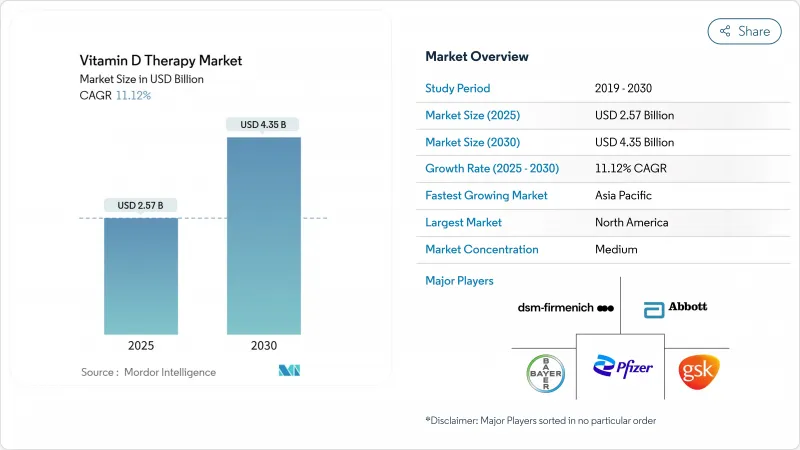
비타민 D 요법 시장 규모는 현재 2025년에 25억 7,000만 달러로 평가되었고, 2030년에 43억 5,000만 달러에 이를 것으로 예측되며, CAGR은 11.12%를 나타낼 전망입니다.
자가면역질환, 심혈관질환 및 면역기능 장애와의 연관성을 입증하는 증거가 축적되면서 반응적 보충에서 선제적 임상 관리로의 전환이 가속화되고 있습니다. 7-데하이드로콜레스테롤에 대한 공급망 압박이 심화되면서 유전자 조작 효모 발효 및 대체 D2 원료에 대한 투자가 증가해 원자재 변동성 속에서도 회복탄력성을 확보하고 있습니다. 가정용 검사 키트와 맞춤형 투여 플랫폼의 긴밀한 연동으로 복약순응도가 재정의되는 한편, 정부 주도의 공중보건 캠페인이 신흥국 수요를 주도하고 있습니다. 경쟁 동력은 이제 취약 계층의 흡수 한계를 해결하는 생체이용률 향상 칼시페디올과 지속형 주사제 형태에 집중되고 있습니다.
인구 고령화와 좌식 행동이 맞물리며 비타민 D 요법 시장의 치료 가능 환자 풀이 급격히 확대되고 있습니다. 65세 이상 성인의 피부 합성 능력은 젊은 연령대에 비해 75% 감소합니다. 현재 미국 성인의 18.5%만이 보충제를 복용하고 있어 잠재 수요가 크다는 점을 시사합니다. DSM-Firmenich는 흡수 기능이 저하된 노인 환자를 위해 신속 작용형 변이체를 개발 중입니다. 결핍률이 80%에 달하는 기관 치료 환경에서는 장기 대량 계약을 협상 중이며, 이는 기존 소매 환경을 넘어선 지속적인 수요 확보를 의미합니다.
아시아태평양 보건 당국은 이제 치료보다 예방을 강조하며, 필리핀 식품의약품안전처(FDA)는 2025년까지 보충제 일일 섭취량을 25mcg로 제한해 안전 기준을 통일할 예정입니다. 헤일론의 ‘본 업(Bone Up)’ 프로그램은 중국에서 필리핀과 한국으로 확대되며, 저소득층을 꾸준한 사용자로 전환시키는 확장 가능한 교육 모델을 입증했습니다. 공공-민간 협력은 기업 메시지를 국가적 결핍 목표와 연계해 도달 범위를 확대하며, 선도 브랜드에 선점자 우위를 부여합니다.
공격적인 강화 프로그램이 직접적인 대체 효과를 창출합니다. 바이엘의 유전자 편집 토마토는 일상 식단을 통해 치료용 D3 용량을 공급합니다. 미국 FDA가 비타민 D2 버섯 분말을 식품 첨가물로 심사 중이며, 이는 주류 수용이 확대되고 있음을 시사합니다. 강화가 일반 인구 수요를 축소할 수 있지만, 동시에 식품으로 치료 기준치에 도달할 수 없는 흡수 장애, 만성 신장 질환(CKD), 비만 수술 환자 등 고효능 틈새 시장을 열어줍니다.
경구 제형은 편의성과 가격 경쟁력으로 2024년 비타민 D 요법 시장의 87.54%를 차지했습니다. 그러나 비경구 제품이 13.45% CAGR로 성장 중이며, 이는 300,000 IU 단일 주사가 주간 경구 투여 대비 12주간 25-OH 수치를 더 높게 유지한다는 연구 결과에 힘입은 바 큽니다. 병원은 정형외과 환자의 수술 준비를 위해 근육 내 비타민 D를 사용하며, 중환자 치료 프로토콜은 신속한 정상화를 수용합니다.
흡수 장애 또는 만성 신장 질환 환자군에서 투여 횟수를 줄이고 복용 순응도를 보장하는 3개월 지속형 제형이 혁신을 주도하고 있습니다. VITdALIZE-KIDS 3상 임상시험은 소아 중환자 치료에서의 안전성을 평가 중이며, 잠재적으로 새로운 소아 적응증을 열 수 있습니다. 의료진이 약동학적 예측 가능성을 중시함에 따라, 비경구 투여 방식의 시장 침투는 급성 치료 환경을 넘어 가속화될 전망이며, 이는 비타민 D 요법제 시장의 성장 전망을 강화할 것입니다.
정제는 낮은 생산 비용과 제네릭의 보편화로 2024년 매출의 55.43%를 차지했습니다. 그러나 캡슐은 지용성 흡수를 향상시키는 리포솜 및 나노 전달 기술을 활용하여 13.67%의 연평균 성장률(CAGR)로 확장 중입니다. 분필 같은 정제에서 전환하는 소비자들은 맛과 인지된 효능을 구매 촉진요인으로 꼽습니다.
과거 비타민 D 안정성 문제로 제한받던 구미 형태 제품은 이제 미세 캡슐화된 활성 성분을 함유하여 가족 단위 수요를 확대하고 있습니다. 주사제 및 소프트젤 틈새 시장은 임상적 또는 고효능 요구를 충족시키며, 실험적인 구강 내 치약은 양치 시 매일 예방적 용량을 전달하여 습관적 복용 순응도를 강화합니다. 제형 다양성은 비타민 D 요법제 시장 전반에 걸쳐 제조사들이 사용자 중심 설계로 전환하고 있음을 보여줍니다.
북미는 2024년 매출의 44.35%를 차지했으며, 이는 비타민 D 처방을 일상적인 치료에 포함시키는 뿌리 깊은 검진 프로토콜과 보험 적용을 반영합니다. 미국에서는 가정용 검사 및 구독 프로그램이 번성하는 반면, 캐나다의 진단 승인은 정밀 투여 도입을 가속화하고 있습니다. 유럽은 EU의 2024년 칼시디올 모노하이드레이트 승인에 힘입어 2위를 차지했습니다. 이는 흡수 장애 사례에 더 빠르게 작용하는 대안을 제공합니다.
아시아태평양 지역은 정부 교육 캠페인과 중산층의 건강 지출 증가에 힘입어 12.45%의 연평균 성장률(CAGR)로 가장 빠르게 성장하는 지역입니다. ‘본 업(Bone Up)'과 같은 캠페인이 중국부터 필리핀까지 문화적 공감을 불러일으키는 메시지를 맞춤화하며 비타민 D 요법 시장 규모가 확대되고 있습니다. 일본의 기능성 식품 제도는 '기능성 표시 식품(Foods with Function Claims)’ 프로그램을 통한 강화 식품으로 유사한 성장을 제공합니다.
중동, 아프리카 및 남미는 높은 결핍 유병률과 점진적으로 개선되는 유통 인프라를 바탕으로 강력한 성장 잠재력을 보입니다. 멕시코와 브라질의 일반의약품 주사제 규제 완화로 접근성이 확대됩니다. 보충제 성장과 병행되는 강화된 주식 식품 투자는 비타민 D 요법 시장이 기존에 접근이 어려웠던 사회경제적 계층까지 침투하도록 보장합니다.
The vitamin D therapy market size currently generates USD 2.57 billion in 2025 and is forecast to reach USD 4.35 billion by 2030, expanding at an 11.12% CAGR.
The shift from reactive supplementation toward proactive clinical management is accelerating as mounting evidence links deficiency with autoimmune, cardiovascular, and immune dysfunction. Intensifying supply-chain pressures on 7-dehydrocholesterol have boosted investment in genetically engineered yeast fermentation and alternative D2 sources, supporting resilience despite raw-material volatility. Tight integration of home testing with personalized dosing platforms is redefining adherence, while government-backed public-health campaigns anchor demand in emerging economies. Competitive momentum now centers on bioavailability-enhanced calcifediol and depot injectable formats that address absorption limitations across vulnerable populations.
Demographic aging converges with sedentary behavior, sharply enlarging the treatable pool for the vitamin D therapy market. Skin synthesis capacity in adults over 65 drops 75% compared with younger cohorts. Only 18.5% of U.S. adults currently supplement, underlining latent demand. DSM-Firmenich is advancing fast-acting variants to serve elderly patients with compromised absorption. Institutional care settings, where deficiency reaches 80%, are negotiating long-term bulk contracts, ensuring sustained uptake beyond traditional retail settings.
Asia-Pacific health authorities now push prevention ahead of treatment, with the Philippines FDA capping supplement levels at 25 mcg/day in 2025 to standardize safety. Haleon's Bone Up program, expanded from China into the Philippines and South Korea, demonstrates scalable education that converts low-income groups into steady users. Public-private alliances amplify reach, aligning corporate messaging with national deficiency targets and granting first-mover advantage to brand leaders.
Aggressive fortification programs create direct substitution pressure. Bayer's genome-edited tomatoes deliver therapeutic D3 doses through daily diets. The U.S. FDA is reviewing vitamin D2 mushroom powder as a food additive, indicating growing mainstream acceptance. While fortification may shrink general-population demand, it simultaneously opens higher-potency niches for malabsorption, CKD, or bariatric patients where food cannot reach therapeutic thresholds.
Other drivers and restraints analyzed in the detailed report include:
For complete list of drivers and restraints, kindly check the Table Of Contents.
Oral formats retained 87.54% of the vitamin D therapy market in 2024 due to convenience and price leadership. Yet parenteral products are rising at 13.45% CAGR, helped by studies showing a single 300,000 IU injection keeps 25-OH levels higher for 12 weeks versus weekly oral doses. Hospitals use intramuscular vitamin D to prepare orthopedic patients for surgery, while intensive-care protocols embrace rapid normalization.
Innovation favors 3-month depot formulations that cut dosing visits and ensure compliance among malabsorption or CKD cohorts. VITdALIZE-KIDS phase III is evaluating safety in pediatric critical care, potentially unlocking new pediatric indications. As providers value pharmacokinetic predictability, parenteral penetration will likely accelerate beyond acute settings, reinforcing growth prospects for the vitamin D therapy market.
Tablets secured 55.43% revenue in 2024, underpinned by low production cost and generic ubiquity. Capsules, however, are expanding at 13.67% CAGR, leveraging liposomal and nano-delivery to enhance fat-soluble absorption. Consumers migrating from chalky tablets cite palatability and perceived efficacy as purchase drivers.
Gummy offerings, previously limited by vitamin D stability, now incorporate microencapsulated actives, widening family appeal. Injectable and softgel niches address clinical or high-potency needs, while experimental intraoral toothpaste aims to deliver daily prophylactic doses during brushing, reinforcing habitual adherence. Formulation diversity underscores manufacturers' pivot to user-centric design across the vitamin D therapy market.
The Vitamin D Therapy Market Report is Segmented by Route of Administration (Oral and Parenteral), Dosage Form (Tablets, Capsules, and More), Purchasing Pattern (Prescription and Over-The-Counter), Application (Osteoporosis, and More), Distribution Channel (Hospital Pharmacies, and More), End User (Adults, and More), Geography (North America, Europe, and More). The Market Forecasts are Provided in Terms of Value (USD).
North America generated 44.35% of 2024 revenue, reflecting ingrained screening protocols and insurance coverage that embed vitamin D prescriptions into routine care. Home testing and subscription programs flourish in the U.S., while Canada's diagnostic approval accelerates precision-dosing adoption. Europe ranks second, catalysed by the EU's 2024 clearance of calcidiol monohydrate, which provides a faster-acting alternative for malabsorption cases.
Asia-Pacific is the fastest-growing region at 12.45% CAGR, buoyed by government education drives and rising middle-class health spending. The vitamin D therapy market size is swelling as campaigns like Bone Up tailor culturally resonant messages, lifting awareness from China to the Philippines. Japan's functional-food regime offers parallel growth through fortified foods under the Foods with Function Claims program.
Middle East & Africa and South America show strong upside, anchored by high deficiency prevalence and gradually improving distribution infrastructure. Regulatory moves toward OTC injectables in Mexico and Brazil widen access. Investments in fortified staple foods run parallel to supplement growth, ensuring the vitamin D therapy market penetrates socio-economic tiers previously beyond reach.