



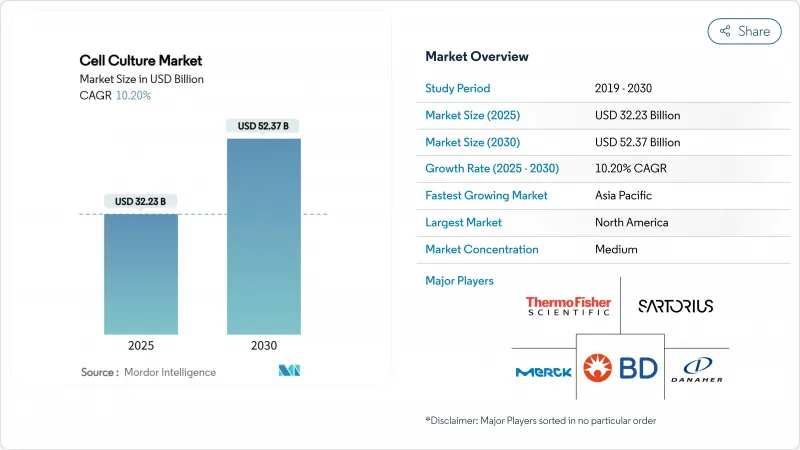
세계의 세포 배양 시장 규모는 2025년에 322억 3,000만 달러로 평가되었고, 2030년에는 523억 7,000만 달러에 이를 것으로 예측되며, 예측 기간 종료까지의 CAGR은 10.2%를 나타낼 전망입니다.
강력한 바이오제조 수요, 줄기세포 임상시험 급증, 재생의학 규제 시한 강화가 세포 배양 시장 전반의 자본 배분을 재편하고 있습니다. 자동화된 일회용 바이오리액터, 무혈청 배지 혁신, AI 기반 공정 분석 기술은 배치당 비용을 낮추면서 재현성을 향상시켜, 소규모 연구 환경에서 정체되었던 치료법 개발을 확장 가능하게 합니다. 주요 생명과학 업체들은 공급망 회복탄력성 강화와 기술 이전 주기 단축을 위해 장비, 소모품, 계약 서비스를 결합한 수직적 통합을 추진 중입니다. 한편 일본, 중국, 미국의 지역 산업 정책은 시설 확장을 가속화하여 생산을 환자 가까이에서 수행하고 국경 간 물류 위험을 줄이고 있습니다. 태아 소 혈청의 공급 제약과 지속가능성 요구사항은 규제 제출을 간소화하고 윤리적 병목 현상을 제거하는 화학적으로 정의된 동물성 성분 없는 시스템으로의 전환을 계속 촉진하고 있습니다.
비전염성 질환은 생물학적 제제 파이프라인을 지속적으로 확대하며, 단일클론 항체, 백신 및 GLP-1 치료제의 기반이 되는 배양 역량 확장을 제조사에 요구하고 있습니다. 사노피가 수직 통합형 인슐린 시설에 13억 유로를 투자한 것은 대규모 만성 질환 적응증이 세포 배양 시장 확장으로 직접 연결되는 방식을 보여줍니다. 종양학 분야는 이러한 압박을 더욱 가중시킵니다. 전 세계적으로 60건 이상의 유도만능줄기세포(iPSC) 임상시험이 진행 중이며, 이 중 약 3분의 1이 일본에서 이루어지고 있습니다. 일본의 신속 승인 제도는 연구실부터 환자 치료까지의 과정을 단축시킵니다. 계산은 명확합니다. 만성 질환 유병률이 증가함에 따라, 세포 배양 시장은 인구의 생산성을 유지하는 치료 기반을 공급해야 합니다.
폐쇄형 일회용 바이오리액터와 AI 기반 공정 제어의 급속한 도입은 오염 위험과 기술자 작업 시간을 줄이면서 배치 처리량을 두 배로 증가시킵니다. 코펜하겐의 확장 시설은 2,000L 용량의 일회용 용기 8개를 추가하여 연간 150배치를 추가 생산 가능하게 했으며, 이는 자동화가 기존 시설 확충 없이도 획기적인 생산량 증대를 실현할 수 있음을 입증했습니다. 드롭렛 마이크로플루이딕스는 세포주 개발 기간을 더욱 단축시켜 수주간의 수동 클론 선별을 몇 분의 디지털 선별 정확도로 대체합니다. 이러한 이점은 세포 배양 시장 손익계산서에 직접 반영되어, 스폰서가 경제적으로 소규모 환자 하위 집단을 대상으로 연구를 진행할 수 있게 합니다.
규정 준수 생물학적 제제 공장 건설 비용은 평방피트당 500-1,400달러에 달하며, 이는 신생 기업을 아웃소싱 모델로 몰아넣고 자금 제한 지역에서의 시설 구축을 지연시키는 장벽입니다. 후지필름(Fujifilm)과 론자(Lonza) 같은 자금력이 풍부한 기존 기업들조차 확장 시 10억 달러 규모의 비용을 감수해야 하며, 이는 세포 배양 시장 진입을 가로막는 재정적 부담을 강조합니다.
소모품 부문은 2024년 세포 배양 시장의 최대 비중(54.25%)을 차지했으며, 개발사들이 화학적으로 정의된 동물성 성분 없는 배지 제형으로 전환함에 따라 2030년까지 연평균 13.65%의 복합 성장률을 기록할 것으로 전망됩니다. 이러한 변화는 임박한 FBS(태아소혈청) 부족 사태로부터 운영자를 보호하며, 임상 자료에서 추적 가능한 성분을 선호하는 규제 기관의 요구와도 부합합니다. 장비 측면에서는 일회용 바이오리액터, 퍼퓨전 플랫폼, 인라인 센서가 시설 설계도를 재편하며 가동 중단 시간과 자본 집약도를 줄이고 있습니다. 써모 피셔의 41억 달러 규모 여과 장비 인수는 정제 하드웨어가 견고한 연속 공정에서 전략적 요소가 되었음을 보여줍니다. 자동화가 확산됨에 따라 장비에 기인한 세포 배양 시장 규모는 소모품이 더 큰 매출 기반을 유지하더라도 이전 주기보다 빠르게 성장할 것입니다.
연구실 역시 현미경과 이미징 시스템을 새롭게 도입 중입니다. 요코가와의 CQ3000은 실시간 3D 영상을 포착해 하류 AI 분석에 활용함으로써 분석법 개발 기간을 단축합니다. 일회용 튜빙, 필터, 샘플링 포트는 일회용 생태계를 완성하며, 새로운 바이오리액터 설치마다 예측 가능한 소모품 수요를 확보합니다. 이러한 변화들은 장비 혁신이 새로운 소모품 SKU를 창출하고, 반대로 소모품 수요가 장비 혁신을 촉진하는 피드백 루프를 공고히 하여 세포 배양 시장 가치 사슬을 풍부하게 합니다.
포유류 플랫폼은 2024년 세포 배양 시장 점유율의 62.32%를 차지했는데, 이는 주로 CHO 세포주가 단일클론 항체 생산의 주력으로 남아 있기 때문입니다. 그러나 줄기세포는 가장 빠른 성장세를 보이며, 2024년 말 글로벌 임상시험 건수가 115건에 달하면서 11.85%의 연평균 복합 성장률(CAGR)을 기록했습니다. 일본의 규제 가속화 및 공공 자금 지원으로 유도만능줄기세포(iPSC) 치료법이 상업적 승인 직전 단계에 이르렀으며, 이는 GMP 등급 줄기세포 배지, 매트릭스, 폐쇄형 수확 시스템에 대한 수요 전환점을 예고합니다.
포유류 세포주 내에서 1차 세포는 연구적 중요성을 차지하는 반면, 불멸화 세포주는 안정적인 생산 기반을 제공합니다. 미생물 및 곤충 세포 시스템은 포유류 세포주가 효율적으로 발현하지 못하는 특수 단백질 표적 및 백신 항원을 처리함으로써, 광범위한 세포 배양 시장 내 다양한 수요 패턴을 유지합니다.
북미는 2024년 전 세계 매출의 38.52%를 차지했으며, 머크의 10억 달러 가드실 원료 시설 및 애스트라제네카의 메릴랜드 3억 달러 세포 치료 공장 등 획기적인 확장으로 뒷받침되었습니다. 미국 규제 환경은 2025년부터 연간 20건의 첨단 치료제 승인을 예상하며, 새로 추가된 GMP 시설의 활용을 보장합니다. 캐나다는 CDMO를 유인하는 세액 공제로 지역 경쟁력을 강화하고, 멕시코는 대륙적 공급망을 지원하는 충전 및 완성 및 부품 성형 역량을 제공합니다. 2040년까지 미국 화학 수요의 30%를 지속 가능한 바이오제조로 충족하겠다는 연방 정부의 목표는 세포 배양 시장에 지속적인 정책적 호재를 제공합니다.
유럽은 강력한 추격 모멘텀을 보이고 있습니다. 독일의 바이오테크 자금 조달은 2024년 19억 유로로 급증했으며, 영국은 팬데믹 위험을 헤지하기 위해 4억 5,000만 파운드 규모의 백신 허브를 공개했습니다. EU의 GMP 부속서 개정 조화 노력은 국경 간 제품 출시를 간소화하고 범유럽 서비스 네트워크를 선호합니다. 또한 베를린에 설립된 바이엘의 유전자 및 세포 치료 센터와 같은 협력은 산업 파트너들을 공공-과학 생태계로 끌어들이고 있습니다.
아시아태평양은 CAGR은 12.8%를 기록하여 가장 빠른 상승을 보였습니다. 일본의 7억 6,000만 달러의 재생 의료 프로그램은 60개 이상의 iPSC 임상시험을 낳고, 정의된 배지, 폐쇄형 바이오리액터, 하류의 정제 스키드의 국내 수요를 환기하고 있습니다. 중국은 업스트림 항체 제조 플랜트와 신흥 mRNA 생산 라인의 규모를 확대하고 인도는 비용 우위를 활용하여 제형화 및 분석 위탁을 받고 있습니다. 한국과 호주는 각각 선진적인 줄기세포 제조와 지원적인 상환제도로 이 지역의 모자이크를 완성하고 있습니다. APAC의 인구역학(고령화, 만성 질환 이환율 증가)을 종합하면 세포 배양 시장 수요가 예측 기간을 넘어 확대될 수 있습니다.
The global cell culture market size is USD 32.23 billion in 2025 and is projected to reach USD 52.37 billion by 2030, advancing at a 10.2% CAGR to the end of the forecast period.
Robust biomanufacturing demand, a surge in stem-cell clinical trials, and tightening regulatory timelines for regenerative medicine are reshaping capital allocation across the cell culture market. Automated single-use bioreactors, serum-free media innovations, and AI-assisted process analytics are lowering per-batch costs while improving reproducibility, allowing developers to scale therapies that once stalled in small-volume research settings. Major life-science vendors now pursue vertical integration-combining equipment, consumables, and contract services-to strengthen supply-chain resilience and shorten technology-transfer cycles. Meanwhile, regional industrial policy in Japan, China, and the United States accelerates facility build-outs that push production closer to patients and reduce cross-border logistics risk. Supply constraints for fetal bovine serum, alongside sustainability mandates, continue to speed the transition toward chemically-defined, animal-component-free systems that simplify regulatory filings and remove ethical bottlenecks.
Non-communicable diseases continue to swell biologics pipelines, compelling manufacturers to expand culture capacity that underpins monoclonal antibodies, vaccines, and GLP-1 therapeutics. Sanofi committed EUR 1.3 billion to a vertically integrated insulin facility, highlighting how large-volume chronic disease indications directly translate to cell culture market expansion. Oncology heightens this pressure; more than 60 induced-pluripotent-stem-cell trials are active worldwide, nearly one-third in Japan, where fast-track approvals shorten the path from bench to bedside. The arithmetic is clear: as chronic disease prevalence scales, the cell culture market must supply the therapeutic backbone that keeps populations productive.
Rapid uptake of closed, single-use bioreactors and AI-orchestrated process control cuts contamination risk and technician hours while doubling batch throughput. An expansion in Copenhagen added eight 2,000 L single-use vessels, enabling 150 extra batches each year and proving that automation can deliver step-change capacity without conventional brick-and-mortar scale-up. Droplet microfluidics further compresses cell-line development timelines, replacing weeks of manual clone picking with minutes of digital selection accuracy. These gains flow straight to the cell culture market P&L, letting sponsors pursue smaller patient sub-groups economically.
Constructing a compliant biologics plant can cost USD 500-1,400 per square foot, a hurdle that pushes start-ups toward outsourcing models and slows facility deployment in cash-limited geographies. Even deep-pocketed incumbents such as Fujifilm and Lonza accept nine-figure price tags for expansions, underscoring the financial gravity that drags on cell culture market entry.
Other drivers and restraints analyzed in the detailed report include:
For complete list of drivers and restraints, kindly check the Table Of Contents.
Consumables retained the largest slice of the cell culture market in 2024 at 54.25%, and the segment is forecast to compound at 13.65% through 2030 as developers switch to chemically-defined, animal-free media formulations. This evolution protects operators against the looming FBS crunch and lines up with regulators who prefer traceable ingredients in clinical dossiers. On the equipment side, single-use bioreactors, perfusion platforms, and inline sensors are rewriting facility blueprints, trimming downtime and capital intensity. Thermo Fisher's USD 4.1 billion filtration acquisition underlines how purification hardware has become strategic to robust continuous processing. As automation proliferates, the cell culture market size attributable to equipment will rise faster than in prior cycles-even if consumables keep the larger revenue base.
R&D labs are likewise refreshing microscopes and imaging systems; Yokogawa's CQ3000 captures live 3D images that feed downstream AI analytics, shortening assay development. Disposable tubing, filters, and sampling ports complete the single-use ecosystem, locking in predictable consumables demand with every new bioreactor install. Together, these shifts cement a feedback loop where equipment innovation unlocks new consumables SKUs, and vice versa, enriching the cell culture market value chain.
Mammalian platforms generated 62.32% of the cell culture market share in 2024, in large part because CHO lines remain the workhorse for monoclonal antibodies. Yet stem cells post the fastest rise, tracking an 11.85% CAGR as global trials hit 115 at the end of 2024. Japan's regulatory accelerators and public funding have pulled induced-pluripotent-stem-cell therapies to the cusp of commercial approval, signaling a demand inflection for GMP-grade stem-cell media, matrices, and closed harvesting systems.
Within mammalian lines, primary cells win research relevance while immortalized lines supply reliable production titles. Microbial and insect cell systems address niche protein targets and vaccine antigens that mammalian lines fail to express efficiently, preserving a diversified demand pattern inside the broader cell culture market.
The Cell Culture Market Report is Segmented by Product (Equipment and Consumables), Cell Type (Mammalian Cells, and More), Technology (2-D Cell Culture and 3-D Cell Culture), Application (Biopharmaceutical Production, Drug Discovery & Development, and More), End-User (Pharmaceutical & Biotechnology Companies, and More), and Geography (North America, Europe, and More). The Market Forecasts are Provided in Terms of Value (USD).
North America held 38.52% of global revenue in 2024, supported by landmark expansions such as Merck's USD 1 billion Gardasil ingredient facility and AstraZeneca's USD 300 million cell-therapy plant in Maryland. The U.S. regulatory climate, forecasting 20 annual advanced-therapy approvals from 2025 onward, guarantees utilization of newly added GMP suites. Canada bolsters the region with tax credits that entice CDMOs, and Mexico offers fill-finish and component-molding capacities that support continental supply chains. Federal ambitions to meet 30% of U.S. chemical demand with sustainable biomanufacturing by 2040 provide an enduring policy tailwind for the cell culture market.
Europe presents strong catch-up momentum. German biotech financing rocketed to EUR 1.9 billion in 2024, and the United Kingdom unveiled a GBP 450 million vaccine hub to hedge pandemic risk. EU efforts to harmonize GMP annex updates streamline cross-border product release and favor pan-European service networks. Furthermore, collaborations such as Bayer's gene- and cell-therapy center in Berlin pull industrial partners into public-science ecosystems.
Asia-Pacific registers the fastest climb, clocking a 12.8% CAGR. Japan's USD 760 million regenerative-medicine program spawns more than 60 iPSC trials and primes domestic demand for defined media, closed bioreactors, and downstream purification skids. China scales both upstream antibody plants and emergent mRNA lines, while India monetizes cost advantages to capture contract formulation and analytics. South Korea and Australia round out the regional mosaic with advanced stem-cell manufacturing and supportive reimbursement regimes, respectively. Collectively, APAC's demographic profile-aging populations and growing chronic disease incidence-cements a demand runway for the cell culture market that stretches beyond the forecast period.