


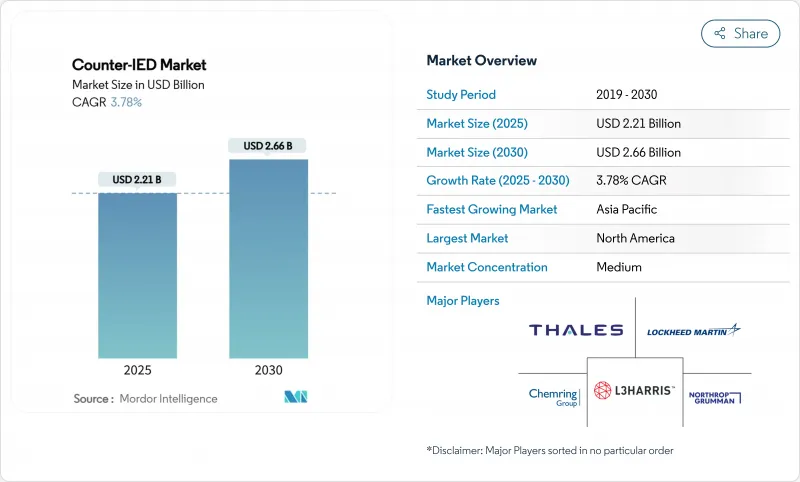
급조폭발물 대응(Counter IED) 시장 규모는 2025년에 22억 1,000만 달러로 추정되고, 2030년에는 26억 6,000만 달러에 이를 것으로 예측되며, CAGR 3.78%로 성장할 전망입니다.
비대칭 전쟁 대비 강화, 국방예산 증가, 대 UAS 기술과 급조폭발물 대응(Counter IED) 기술의 융합이 진행됨에 따라 수요는 증가의 길을 따라가고 있지만, 한편으로는 스펙트럼 관리의 병목과 GaN 부품 가격의 상승이 단기적인 전개율을 억제하고 있습니다. 북미는 지출의 주도권을 유지하고 있지만 인도 태평양 지역의 현대화 계획이 그 차이를 줄이고 있습니다. 감지 능력, 특히 멀티 센서 AI 지원 스위트가 현재의 조달의 대부분을 차지하고 있는데, 중화 기술, 즉 지향성 에너지 재머와 로보틱스의 급속한 성장은 능동적인 격파 솔루션에 대한 전략적 축족을 보여줍니다. 플랫폼의 유연성도 중요하며, 유인의 전술 트럭에서 무인 지상 차량으로 쉽게 이동할 수 있는 차량에 얽매이지 않는 방해 키트를 지정하는 구매자가 늘고 있습니다. 경쟁의 심각성은 중간 정도입니다. 방위 프라임은 기술적인 두께를 유지하고 있지만, 군이 보다 신속한 기술 혁신 사이클을 추구함에 따라 AI, 마이크로파 무기, 자율형 중기를 활용하는 전문 기업이 점유율을 획득하고 있습니다.
국방부는 현재 증가하는 많은 예산을 비대칭 위협 대책에 할당하고 있습니다. 미국의 2026년도 추정 요구는 1조 100억 달러를 넘어 테러 대책과 지뢰 제거 기술에 명확하게 자금을 제공합니다. 2024년 국내총생산(GDP)의 2% 이상의 방위 기준을 달성한 유럽의 NATO 회원국들은 우크라이나의 작전 교훈에 영향을 받으며 C-IED 프로그램에 점진적으로 자금을 투입하고 있습니다. 동아시아의 지출은 2023년에 4,110억 달러에 이르고 있으며, 현재도 증가 경향에 있으며, 감지 레이더, 핸드헬드 디스럽터, 루트 클리어형 UGV의 입찰이 새롭게 진행되고 있습니다. 예산이 증가함에 따라, 조달 기관은 성장하는 홈 메이드 장치에 앞서 오픈 아키텍처와 신속한 기술 업데이트를 강조합니다.
MUM-T 독트린은 프로토타입에서 실전 배치로 전환하고 있습니다. 미국 육군의 아파치 섀도우 그레이 이글의 실험은 차열의 자율적인 루트 확보를 입증하여 IED 토벌 임무를 위한 상호 운용 가능한 데이터 링크를 검증했습니다. 이스라엘 국방군은 현재 RobDozer 불도저와 M113 기반 자율 시스템을 고위험 중립화를 위해 운용하고 가자 국경 루트에서의 인적 피해를 줄이고 있습니다. 유럽의 지상부대는 라인메탈 UGV 콤보 리더를 도입한 영국과 프랑스의의 해상지뢰 대책 및 ELROB의 시험을 통해 이를 추종하고 있습니다. 그 결과, 확장 가능한 제어 소프트웨어와 유인과 로봇의 혼합 팀에 대응하는 표준화된 페이로드 베이가 선호되고 있습니다.
갈륨 나이트 라이드 파워 앰프는 GaN이 기존의 갈륨 비소 부품보다 높은 전자 이동도와 열 효율을 제공하고 소형 디바이스에서 멀티 옥타브 밴드에 걸쳐 킬로와트 클래스 출력을 푸시할 수 있기 때문에 CREW 송신기가 5G 시대의 광범위한 위협 엔벨로프를 커버 할 수 있게 합니다. 단점은 제조입니다. : GaN 층은 유기 금속 화학 기상 성장로에서 고가의 탄화 규소 기판 상에 성장하지만, 웨이퍼 수율은 여전히 한 자릿수이기 때문에 프로브 테스트를 통과 한 다이의 가격은 비쌉니다. 미국과 유럽의 신뢰할 수 있는 주조공장에는 한계가 있기 때문에 프라임은 같은 에피택시 테두리를 둘러싸고 상업 통신 구매자와 경쟁할 수밖에 없고, L-band의 평균 판매가격은 와트당 20달러를 크게 웃돌고 있습니다. 노스롭 그라만의 엔지니어링 브리프에 따르면 2027년까지 새로운 150mm 리액터와 자동화된 백엔드 라인이 가동되지 않는 한 다년간의 자금 조달 라이 없는 소규모 동맹국의 경우 여단 규모 이상의 대량 구매가 1년 이상 지연될 수 있으며 일부 방위성은 레거시 실리콘 재머를 계획보다 오래 보유하도록 촉구하고 있습니다.
2024년 급조폭발물 대응(Counter IED) 시장 매출에서 가장 큰 비율을 차지한 것은 감지 솔루션으로 급조폭발물 대응(Counter IED) 시장 점유율 59.70%에 해당합니다. 고해상도 합성 개구 알고리즘과 결합된 지중 관통 레이더는 현재 걷는 속도로 교란된 토양을 식별하고, 수동 RF 스니퍼는 트리거 회로에 플래그를 지정합니다. 교리가 적극적인 격퇴로 이동함에 따라 급조폭발물 대응(Counter IED) 대책 시장 규모는 2030년까지 매년 4.65% 증가할 것으로 예측됩니다.
대책 수요의 중심은 20MHz에서 6GHz를 커버하는 광대역 CREW 송신기와 광속으로 위협을 무력화하는 아이언 빔 레이저와 같은 지향성 에너지 무기입니다. IAI RobDozer와 같은 장갑 EOD UGV는 15 톤의 쟁기 블레이드와 원격 조작의 디스 랩터를 채택하여, 서퍼를 노출시키지 않고 적지에서의 루트 확보를 가능하게 하고 있습니다.
차량 탑재형 시스템은 2024년 급조폭발물 대응(Counter IED) 시장 규모의 67.21%를 차지하였고, 전술 트럭에 재머, 카메라, 레이더를 탑재하는 차열 보호 독트린에 지지되고 있습니다. 이 접근법은 온보드 파워와 탄도 차폐를 제공하며 여단의 이동과 군수 보급의 기본이 되었습니다.
그러나 성장의 기세는 하늘로 향하고 있습니다. 공중 포드는 유인 헬리콥터나 그룹 4UAV 아래에 탑재되더라도 CAGR이 5.35%로 배포 카테고리에서 가장 빠른 것을 기록할 것으로 예측됩니다. 미국 해군의 초기 ALMDS 지뢰 감지 포드와 육군의 NERO EW 페이로드는 광역을 커버하고 거리에서 매복을 최소화하며 새로운 전역으로 신속한 재배치를 가능하게 하는 매력을 보여줍니다. 하차병은 도시의 골목에서 색적을 확보하기 위해 11kg의 GMJ9500과 같은 휴대용 디스 랩터에 의존합니다.
북미는 2024년 급조폭발물 대응(Counter IED) 시장 수익의 49.80%를 차지했으며, 1조 달러의 국방 예산과 이라크 및 아프가니스탄에서 깊은 작전 노하우에 지지를 받고 있습니다. 국방부는 멀티도메인 보호 프로토타입을 사용자 평가에 투입하고 취득 주기를 단축하여 지역 리더십을 유지하고 있습니다. 캐나다는 국경 경비를 강화하고 멕시코는 조직 범죄의 IED에 중점을 둡니다.
아시아태평양의 급조폭발물 대응(Counter IED) 시장은 남중국해와 동중국해에서의 영토 분쟁을 배경으로 2030년까지의 CAGR이 5.21%로 예측되어 가장 빠른 존이 될 전망입니다. 인도는 긴급 조달 규칙에 따라 이스라엘 레이더, 도로 옆 방해기, 로봇 지뢰 제거기에 투자하고 호주는 국방 전략 검토의 일환으로 무인 루트 확보에 자금을 투입하고 있습니다. ASEAN 국가는 도시 교통 요건을 보호하기 위해 저비용 휴대용 디스 랩터를 채택하여 지역 고객 기반을 확대합니다.
유럽은 NATO의 전방 전개 강화 및 우크라이나 분쟁을 계기로 한 재군비의 가속으로 구매세를 유지합니다. 브뤼셀의 다국적 프로그램은 테스트 프로토콜과 라이프사이클 지원을 조정하고 고유한 C-IED 실험실이 없는 소규모 회원국을 지원합니다. 중동 및 아프리카에서 조달은 여전히 단편적이지만 석유 수출의 이익으로 걸프 국가는 최고급 지향성 에너지 시스템을 구입할 수 있으며, 사헬의 유엔 평화 유지 임무는 견고한 검출 키트에 대한 수요를 부추기고 있습니다.
The counter-IED market size is estimated at USD 2.21 billion in 2025 and is forecasted to reach USD 2.66 billion by 2030, translating into a 3.78% CAGR.
Heightened asymmetric-warfare preparedness, rising defense appropriations, and the growing convergence between counter-UAS and counter-IED technologies keep demand elevated, while spectrum-management bottlenecks and high GaN component prices temper short-term deployment rates. North America maintains spending leadership, but Indo-Pacific modernization programs are closing the gap. Detection capabilities, especially multi-sensor AI-enabled suites, account for the bulk of current procurement, yet rapid growth in neutralization technologies-directed-energy jammers and robotics-signals a strategic pivot toward active defeat solutions. Platform flexibility also matters; buyers increasingly specify vehicle-agnostic jamming kits that migrate easily from manned tactical trucks to unmanned ground vehicles. Competitive intensity is moderate: defense primes hold technology depth, but specialist firms exploiting AI, microwave weapons, and autonomous heavy equipment win share as armed forces pursue faster innovation cycles.
Defense ministries now allocate larger slices of rising budgets to irregular-threat capabilities. The US FY 2026 request tops USD 1.01 trillion, explicitly funding counter-terrorism and demining technologies. European NATO members that exceeded the 2% of GDP defense benchmark in 2024 continue to channel incremental funds toward C-IED programs, influenced by operational lessons from Ukraine. East Asian expenditure reached USD 411 billion in 2023 and is still climbing, translating into fresh tenders for detection radars, handheld disruptors, and route-clearance UGVs. As budgets grow, procurement agencies emphasize open architectures and rapid technology refresh to stay ahead of proliferating homemade devices.
MUM-T doctrine has moved from prototypes to field deployment. The US Army's Apache-Shadow-Gray Eagle experiments demonstrated autonomous convoy route-clearance, validating interoperable data links for IED defeat missions. Israel Defense Forces now operate RobDozer bulldozers and M113-based autonomous systems for high-risk neutralization, cutting human exposure on Gaza border routes. European ground forces follow suit through the Franco-British Maritime Mine Counter Measures and ELROB trials that showcased Rheinmetall's UGV convoy leader. The resulting demand favors scalable control software and standardized payload bays compatible with mixed manned and robotic teams.
Gallium-nitride power amplifiers let CREW transmitters cover wide 5G-era threat envelopes because GaN offers higher electron mobility and thermal efficiency than older gallium-arsenide parts, allowing smaller devices to push kilowatt-class output across multioctave bands. The downside is manufacturing: GaN layers are grown on costly silicon-carbide substrates in metal-organic chemical vapor deposition reactors that still run single-digit wafer yields, so each die that survives probe testing carries a premium price. Limited trusted-foundry capacity inside the United States and Europe compounds the problem, forcing primes to compete with commercial telecom buyers for the same epitaxy slots, which keeps average selling prices well above USD 20 per watt in the L-band. Northrop Grumman engineering briefs caution that unless new 150 mm reactors and automated back-end lines come online by 2027, volume buys larger than brigade scale could slip a year or more for smaller allies that lack multiyear funding lines, prompting some defense ministries to hold legacy silicon jammers longer than planned.
Other drivers and restraints analyzed in the detailed report include:
For complete list of drivers and restraints, kindly check the Table Of Contents.
Detection solutions generated the largest slice of the counter-IED market revenue in 2024, equal to a 59.70% counter-IED market share, as commanders prioritized finding bombs before convoys rolled. Ground-penetrating radar paired with high-resolution synthetic-aperture algorithms now distinguishes disturbed soil at a walking pace, while passive RF sniffers flag trigger circuits. The counter-IED market size for countermeasures is projected to rise 4.65% annually to 2030 as doctrine shifts toward active defeat.
Demand for countermeasures centers on wideband CREW transmitters covering 20 MHz to 6 GHz and directed-energy weapons such as Iron Beam lasers that neutralize threats at the speed of light. Robotics adds another layer: armored EOD UGVs like IAI RobDozer employ 15-ton plow blades and remote-controlled disruptors, enabling route-clearance in hostile terrain without exposing sappers.
Vehicle-mounted systems accounted for 67.21% of the counter-IED market size in 2024, underpinned by convoy protection doctrines that embed jammers, cameras, and radars onto tactical trucks. The approach delivers on-board power and ballistic shielding, making it the default for brigade movement and logistics resupply.
Growth momentum, however, is shifting skyward. Aerial pods-whether slung under manned helicopters or Group 4 UAVs-are forecast to post a 5.35% CAGR, the fastest in the deployment category. Early US Navy ALMDS mine-detection pods and Army NERO EW payloads illustrate the appeal: wide area coverage, minimal exposure to roadside ambush, and quick redeployment to new theaters. Dismounted troops still rely on man-portable disruptors such as the 11 kg GMJ9500 to secure cordon searches in urban alleys.
The Counter-IED Market Report is Segmented by Capability (Detection and Countermeasures), Deployment (Vehicle-Mounted, Hand-held/Man-portable, and More), End User (Military and Homeland Security), Technology (RF Jamming, Sensor-Based Detection, and Robotic and Autonomous Systems), and Geography (North America, Europe, Asia-Pacific, and More). The Market Forecasts are Provided in Terms of Value (USD).
North America represented 49.80% of the counter-IED market revenue in 2024, sustained by a USD 1 trillion defense budget and deep operational know-how from Iraq and Afghanistan. The DoD pushes multi-domain protection prototypes into user evaluations, trimming acquisition cycles and preserving regional leadership. Canada's border-security upgrades and Mexico's focus on organized crime IEDs add incremental demand.
The Asia-Pacific counter-IED market exhibits a projected 5.21% CAGR through 2030, the fastest zone, propelled by territorial flashpoints in the South and East China seas. India invests in Israeli radars, roadside jammers, and robotic mine plows under emergency procurement rules, while Australia funds unmanned route clearance as part of its Defense Strategic Review implementation. ASEAN states adopt lower-cost man-portable disruptors to protect urban transit hubs, broadening the regional customer base.
Europe sustains buying momentum through NATO's Enhanced Forward Presence and accelerated rearmament triggered by the war in Ukraine. Multinational programs in Brussels coordinate test protocols and life-cycle support, lifting smaller member states that lack Indigenous C-IED labs. In the Middle East and Africa, procurement remains episodic, but oil-export gains allow Gulf states to purchase top-tier directed-energy systems, while UN peacekeeping missions in the Sahel fuel demand for rugged detection kits.