


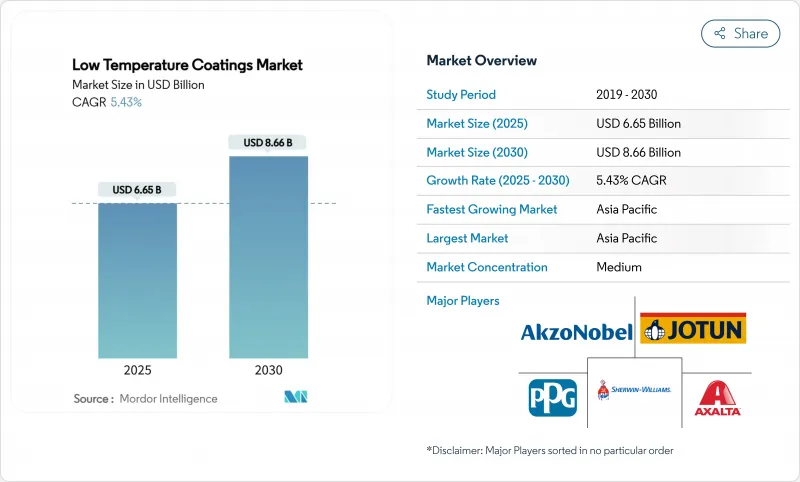
저온 코팅 시장 규모는 2025년에 66억 5,000만 달러로 추정되며, 예측 기간(2025-2030년)의 CAGR은 5.43%로, 2030년에는 86억 6,000만 달러에 달할 것으로 예상됩니다.
이 꾸준한 진보는 공정 열 배출을 줄이는 규제 압력, 저온 경화 프로파일에 적합한 에너지 가격 상승, 120℃에 가까운 온도에서 완벽한 성능을 발휘할 수 있는 기술 진보를 반영합니다. 공장이 375°F의 베이크 사이클에서 285°F로 경화되는 배합으로 이행함으로써, 최대 25%의 에너지 절감이 일반적이 되어, 처리량이 향상되고, 카본 실적가 삭감되고 있습니다. 또한 기존의 오븐 조건에서는 변형하는 플라스틱, 복합재료, 3D 프린팅 부품의 사용이 증가하고 있으며, 전기자동차(EV)의 생산이 급증하고 있으며, 열적으로 안정하지만 완만하게 경화하는 배터리 케이스가 요구되고 있는 것도 수요를 밀어 올리고 있습니다. 경쟁의 심각성은 중간 정도이며, 주요 공급업체는 수지 화학, 레이저 지원 경화, 전략적인수를 활용하여 점유율을 보호하는 반면, 틈새 기업은 해상 풍력 발전의 유지 보수 및 적층 제조와 같은 초저 베이크 분야를 목표로하고 있습니다. 이산화티타늄을 필두로 하는 원재료 비용의 변동과 25µm 이하의 초박막을 성막하는 기술적 어려움이 여전히 주된 역풍이 되고 있습니다.
이 수치는 내식성을 유지하면서 큐어 피크를 400°F에서 325°F로 낮춘 생산 라인에서 확인되었습니다. 또한 오븐의 체류 시간이 짧아지면 라인 속도가 증가하고 자산 이용률이 향상됩니다. 캘리포니아 및 독일과 같은 에너지 요금이 높은 지역에서는 이러한 배합이 먼저 채택됩니다. 광열비가 줄어들고 필터 유지보수가 줄어들기 때문에 1년 이내에 투자 회수가 가능합니다. 범위 1 배출량을 줄임으로써 미래의 탄소 경계 요금제에 대비할 수 있습니다.
전기자동차의 배터리 하우징과 전자 모듈은 기존의 베이크에 흔히 발생하는 열 충격을 견딜 수 없습니다. 130 °C에서 중합하는 코팅은 유전체를 보호하고 접착층을 유지하며 배터리 셀의 화학적 특성을 방해하지 않고 절연 저항의 목표를 달성합니다. 열 인터페이스 재료는 35°C에서 접착되기 때문에 페인트 공장은 현재 셀 조립체의 하류에 통합된 낮은 베이킹 존을 통합하고 있습니다. 반도체 패키징 라인은 미세 피치 기판의 휨을 피하는 150 ° C 이하의 사이클을 요구함으로써이 동향을 반영합니다. 아시아태평양은 EV공급 체인이 밀집되어 있기 때문에 리드하고 있지만, 북미의 기가팩토리에서는 급속하게 동일한 큐어 윈도우를 지정하게 되어 있습니다.
25µm 이하에서는 오븐 온도가 낮아지면 유동성과 레벨링이 제한되므로 많은 분말 약품이 오렌지 껍질과 구멍을 형성하는 데 어려움을 겪습니다. 따라서 자동차용 클리어코트 프로그램은 전체 차종을 전환하는 것을 주저하고 대신 막두께를 두껍게 유지할 수 있는 중도층용으로 저베이크라인을 확보하고 있습니다. 135°C에서 가교 밀도를 촉진하는 촉매 패키지는 유용하지만, 배합 비용은 증가합니다. 하이브리드 폴리에스터와 나노필드 수지의 연구는 계속되고 있지만, 대규모 브레이크스루는 아직 2-4년 앞입니다.
폴리에스터 시스템은 2024년 매출의 40.12%를 차지했으며, 건축 내구성의 수년간의 실적과 경쟁력 있는 가격 설정에 뒷받침되었습니다. 폴리에스터는 또한 건축에서 대량으로 사용되는 아연 도금 강판에 잘 접착하기 때문에 기본적인 지위를 굳히고 있습니다. 그럼에도 불구하고, 저온 코팅 시장에서는 유연성과 내화학성이 모두 요구되는 용도에서 폴리우레탄이 유리합니다. 2액형이나 블록도 이소시아네이트형은 120℃에서 경화하므로 폴리에스터에서는 도달할 수 없는 플라스틱이나 복합재료의 카테고리를 열 수 있습니다.
EV 제조업체는 배터리 커버에 유연한 유전체 층을 지정하기 때문에 폴리 우레탄의 수량은 수지 중 가장 빠른 CAGR 7.18%를 나타낼 것으로 예측됩니다. 멕시코의 폴리우레탄 소비량의 연률 5-7%의 성장은 세계적인 기세를 뒷받침하고 있습니다. 수성 2K-PUR 하이브리드는 VOC 규정을 준수하면서도 가전제품의 베젤에 필요한 접착력을 제공합니다. 이러한 요인들이 결합되어 저온 코팅 시장에서 폴리우레탄의 상승이 강화되고 있습니다.
파우더 테크놀로지는 2024년 매출액의 72.14%를 차지했으며 규모의 경제성과 공정 숙련도에 따라 달라졌습니다. 배합 제조업체는 경화 임계값을 10년 전 180℃에서 현재는 140℃로 끌어올려 1제곱미터당 에너지 섭취량을 약 1/3로 줄였습니다. 최대 손 분말 공급업체는 현재 실온에서 3 분 안에 완전한 물성에 도달하는 레이저 경화 시스템을 제공하고 있으며,이 기술 혁신은 라인의 생산성을 더욱 향상시키는 태세를 갖추고 있습니다.
UV/EB 경화는 스프린터이며, 2030년까지의 CAGR은 7.45%를 나타낼 것으로 예측되고 있습니다. 무용제의 조작과 110℃라는 낮은 경화 온도를 겸비하고, MDF 가구 라인이나 비닐 바닥재 공장에 어필합니다. 저스트 인 타임의 조립 구역에 공급하기 때문에 운영자가 즉시 처리해야하는 경우 언제든지 채용이 가속됩니다. 이러한 기능은 기술적 선택을 넓히고 저온 코팅 시장 규모 부문 내에서 건전한 경쟁을 자극합니다.
아시아태평양은 2024년 매출의 46.15%를 차지했으며 CAGR 7.27%를 나타낼 것으로 예측됩니다. 중국의 광대한 파우더 페인트 클러스터는 가전 및 EV의 대량 생산에서 이익을 얻었으며 인도 자동차 생산과 인도네시아 가전 수출이 더욱 견인력이되고 있습니다. 에너지 요금 상승과 주요 도시의 VOC 규제 강화가 저온 경화형 화학물질의 채용을 더욱 뒷받침하고 있습니다.
북미는 금액 기준으로 두 번째로, 그 성장은 정책과 기술의 리더십 모두에 달려 있습니다. 미국 에너지부의 레이저 경화 분말 연구에 대한 자금 지원은 상업화 일정을 단축하고 캘리포니아의 공정 열 규제는 연구소의 돌파구를 실제 구매에 연결시킵니다. 멕시코는 360만 달러를 들여 코일 코트 라인을 확장하고 국경을 넘어 공급망을 강화하고 있습니다.
유럽은 북미에 필적하는 혁신성을 가지면서 적극적인 탄소 가격을 도입하고 있습니다. EU의 산업 탄소 관리 전략은 명확한 저장 목표를 설정하고 산업용 페인트 제조업체를 에너지 희박한 선택으로 유도합니다. 한편, 중동, 아프리카, 남미에서는 다국적 고객이 통일 사양을 강제하고 있기 때문에 제조업체가 점차 로우 베이크 시스템으로 이행하여 저온 코팅 시장 전체의 풋 프린트가 확대되고 있습니다.
The Low Temperature Coatings Market size is estimated at USD 6.65 billion in 2025, and is expected to reach USD 8.66 billion by 2030, at a CAGR of 5.43% during the forecast period (2025-2030).
The steady advance reflects regulatory pressure to trim process-heat emissions, rising energy prices that reward cooler cure profiles, and technological progress that now allows full performance at temperatures close to 120 °C. Energy savings of up to 25% have become common when plants shift from 375 °F bake cycles to formulations that cure at 285 °F, improving throughput and lowering carbon footprints. Demand is also boosted by the growing use of plastics, composites, and 3-D-printed parts that deform under conventional oven conditions, as well as the surge in electric vehicle (EV) production that requires thermally stable but gently cured battery enclosures. Competitive intensity is moderate: leading suppliers leverage resin chemistry, laser-assisted curing, and strategic acquisitions to defend share while niche players target ultra-low-bake segments such as offshore wind maintenance and additive manufacturing. Raw-material cost swings, notably titanium dioxide, and the technical difficulty of depositing ultra-thin films below 25 µm remain the principal headwinds.
Plants that retrofit to low-temperature powder systems save up to 25% in gas or electricity consumption, a figure confirmed by production lines that dropped cure peaks from 400 °F to 325 °F while maintaining corrosion resistance. Shorter oven residence also pushes line speeds higher, improving asset utilization. Regions with high energy tariffs such as California and Germany adopt these formulations first, yet the payoff is now similar elsewhere because carbon charges are widening. Payback is often achieved within one year thanks to slimmer utility bills and fewer filter-maintenance cycles. The move lowers scope 1 emissions, positioning users for future carbon-border fee regimes.
EV battery housings and electronic modules cannot tolerate the thermal shock typical of legacy bakes. Coatings that polymerize at 130 °C protect dielectrics, preserve adhesive layers, and meet insulation resistance targets without disturbing battery cell chemistries. Thermal interface materials are bonded at 35 °C, so paint shops now integrate integrated low-bake zones downstream of cell assembly. Semiconductor packaging lines mirror the trend by asking for sub-150 °C cycles that avoid warpage in fine-pitch boards. Asia-Pacific leads because of its EV supply-chain density, but North American gigafactories are rapidly specifying identical cure windows.
Below 25 µm, many powder chemistries suffer orange-peel and pore formation because lower oven temperatures restrict flow and leveling. Automotive clearcoat programs therefore hesitate to convert entire fleets, instead reserving low-bake lines for mid-coat layers where film build can remain thicker. Catalyst packages that accelerate crosslink density at 135 °C help but add formulation cost. Research into hybrid polyesters and nanofilled resins continues, yet large-scale breakthroughs remain two to four years away.
Other drivers and restraints analyzed in the detailed report include:
For complete list of drivers and restraints, kindly check the Table Of Contents.
Polyester systems accounted for 40.12% of 2024 revenue, supported by a long record of architectural durability and competitive pricing. Polyesters also bond well to galvanized steel, a high-volume substrate in construction, which cements their baseline position. The low temperature coatings market nevertheless favors polyurethane for applications demanding both flexibility and chemical resistance. Two-component and blocked isocyanate chemistries cure at 120 °C, opening plastic and composite categories that polyesters cannot reach.
Polyurethane volumes are projected to expand at a 7.18% CAGR, the fastest among resins, as EV makers specify flexible dielectric layers for battery covers. Mexico's 5-7% annual growth in polyurethane consumption underscores global momentum. Water-borne 2K-PUR hybrids meet VOC caps yet still deliver the adhesion required for consumer electronics bezels. These factors together reinforce polyurethane's rise within the low temperature coatings market.
Powder technology held 72.14% of 2024 revenue owing to scale economics and process familiarity. Formulators have driven cure thresholds from 180 °C a decade ago to 140 °C today, slashing energy intake per square meter by roughly one-third. The largest powder suppliers now offer laser-cured systems that reach full properties in three minutes at room temperature, an innovation poised to lift line productivity further.
UV/EB curing is the sprinter, forecast at a 7.45% CAGR to 2030. It merges solvent-free operation with cure temperatures as low as 110 °C, which appeals to MDF furniture lines and vinyl flooring plants. Adoption accelerates whenever operators need instant handling to feed just-in-time assembly zones. These capabilities broaden technological choice and stimulate healthy rivalry inside the low temperature coatings market size segment, where UV/EB solutions already command double-digit shares in industrial wood.
The Low Temperature Coatings Market Report is Segmented by Resin (Polyester, Epoxy, and More), Technology (Powder, Liquid - Solvent-Borne, Liquid - Water-Borne, UV/EB-cured), Substrate (Metals, Plastics and Composites, Wood, Other Substrates), End-User Industry (Architectural, Industrial, and More), and Geography (Asia-Pacific, North America, and More). The Market Forecasts are Provided in Terms of Value (USD).
Asia-Pacific dominated the landscape with 46.15% of 2024 revenue and is projected to compound at 7.27% CAGR, the fastest regional clip. China's vast powder coating clusters benefit from high-volume appliance and EV production, while India's automotive buildouts and Indonesia's appliance exports supply additional pull. Rising energy tariffs and intensifying VOC rules in major cities further encourage the adoption of cooler-cure chemistries.
North America ranks second in value; its growth rests on both policy and technology leadership. The U.S. Department of Energy's funding for laser-cured powder research shortens commercialization timelines, and California's process-heat regulations translate lab breakthroughs into real purchasing commitments. Mexico adds momentum by expanding coil-coat lines with USD 3.6 million in new capacity, strengthening cross-border supply chains.
Europe matches North America for innovation yet differs by wielding aggressive carbon pricing. The EU Industrial Carbon Management strategy sets explicit storage targets, nudging industrial coaters toward energy-lean options. Meanwhile, manufacturers across the Middle East, Africa, and South America gradually migrate to low-bake systems as multinational customers enforce uniform specifications, enlarging the overall low temperature coatings market footprint.