



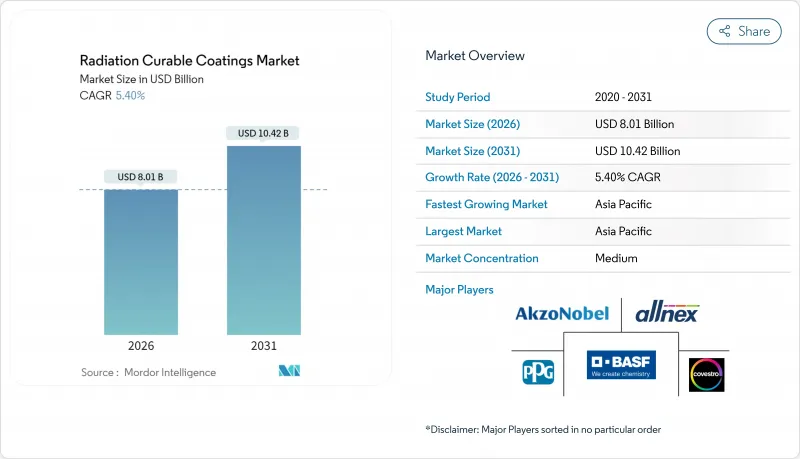
방사선 경화형 코팅 시장 규모는 2026년에는 80억 1,000만 달러로 평가되었고, 2025년 76억 달러에서 계속 성장하고 있습니다.
2031년까지의 예측은 104억 2,000만 달러에 이를 것으로 보이며, 2026-2031년에 걸쳐 연평균 복합 성장률(CAGR) 5.4%로 성장할 전망입니다.
시장 참여자들은 이러한 상승세를 전 세계적으로 강화된 VOC 제한, 에너지 효율적인 생산 방법에 대한 탐구, 그리고 무용제 화학 물질의 꾸준한 채택에 기인한다고 분석합니다. 아시아태평양 지역은 규제 조화와 새로운 산업 생산량 증가로 지역 내 우위를 점했습니다. 미국 환경보호청(EPA)의 에어로졸 코팅용 국가 휘발성 유기 화합물 배출 기준이 2025년 1월 17일 발효되었으며, 준수 기한이 2027년 1월 17일까지 연장되어 제조업체가 제품을 재구성할 수 있는 24개월의 기간이 마련되면서 규제 추진력이 시장 채택을 가속화하고 있습니다.
전 세계 규제 기관들은 허용 가능한 VOC 기준치를 지속적으로 낮추고 있으며, 이는 방사선 경화형 코팅 시장을 용제를 배출하지 않는 100% 고형분 포뮬러로 이끌고 있습니다. 미국 환경보호청(EPA)은 2025년 1월 17일 에어로졸 코팅에 대한 개정된 국가 VOC 배출 기준을 시행하여 제조업체에 2년간의 제형 재평가 기간을 부여했습니다. 캘리포니아 대기자원위원회(CARB)는 물과 면제 화합물을 “VOC 규제” 계산에서 제외하는 병행 제한을 운영합니다. 이러한 조치들은 용제 오븐 없이 즉시 경화가 가능한 UV 또는 전자빔(EB) 라인을 도입한 코팅 업체들에게 혜택을 주어 에너지 발자국을 줄이고 공장 생산량을 높입니다. 연방 기준은 산업용 유지보수 코팅을 450g/L로 제한하지만, 일부 주에서는 100-250g/L까지 낮추며 무용제 기술의 매력을 더욱 높이고 있습니다.
감압식 라벨, 유연 포장재, 접이식 카톤을 생산하는 변환업체들은 기존 인쇄기의 속도를 저하시키는 긴 건조 단계를 제거하기 위해 UV 잉크에 의존합니다. 즉시 경화 인쇄물은 라인에서 완전히 접착된 상태로 출력되어 즉각적인 후가공 및 출하가 가능하며, 이는 적시 주문과 맞춤형 디자인에 필수적입니다. 업계 전문지는 2025년 포장 산업을 정의할 요소로 신속한 자동화, 지속가능성 규정 준수, 하이브리드 디지털-플렉소 워크플로우를 전망합니다. INX 인터내셔널과 같은 장비 공급업체는 식품 접촉 규정을 충족하고 수축 슬리브용 고불투명 백색을 지원하는 LED 호환 에너지 경화형 잉크 세트로 대응하고 있습니다. 이러한 솔루션은 인쇄-포장 응용 분야에서 방사선 경화형 코팅 시장의 입지를 강화합니다.
맞춤형 올리고머 백본과 고순도 광개시제는 일반 수지에 비해 상당한 비용 증가 요인입니다. 2025년 미국 관세로 인한 운송 추가 요금(캐나다 및 멕시코산 특정 원자재 25%, 중국산 다수 제품 10%)은 코팅제 생산사의 조달 예산을 더욱 압박하여 여러 기업이 조달 전략을 재설계하도록 촉발했습니다. 선 케미컬(Sun Chemical) 및 동종 제형사들은 원자재 지출 급증을 상쇄하기 위해 임시 가격 할증료를 도입했으며, 이는 방사선 경화형 코팅 시장 전반의 마진 압박을 부각시켰습니다.
올리고머는 2025년 방사선 경화형 코팅 시장 점유율 45.12%로 가치 사슬을 주도했으며, 이는 필름 경도, 유연성 및 내화학성에 대한 결정적 역할에 기인합니다. 올리고머 기반 방사선 경화형 코팅 시장 규모는 생산자들이 다양한 최종 사용 수요를 충족시키기 위해 폴리에스터, 우레탄, 에폭시-아크릴레이트 백본을 활용함에 따라 꾸준히 확대될 것으로 예상됩니다. Allnex의 UCECOAT 7856은 고광택 바닥재용 무용제 분산체를 제공하여 기존 VOC를 제거하는 진보된 사례입니다.
동시에 광개시제는 6.78%의 연평균 복합 성장률(CAGR)을 기록할 것으로 전망됩니다. LED 전용 등급이 저에너지 파장에서도 우수한 성능을 발휘하여 라인 운영자가 고온 램프 하우징으로부터 안전하게 작업할 수 있기 때문입니다. 단량체는 점도와 가교 밀도를 조절하는 역할을 지속하며, 연구실에서는 화석 연료 의존도를 낮추기 위해 바이오 기반 메타크릴레이트 희석제를 개발 중입니다.
UV 램프는 간단한 개조 경제성과 강력한 글로벌 유통망 덕분에 2025년 설치 용량의 69.10%를 차지했습니다. 노후화된 수은 전구를 철 도핑 변종으로 교체하는 공장들은 기존 라인에서 더 높은 조사량을 끌어내 대규모 개조를 연기하고 있습니다. 그러나 전자빔 장치와 연계된 방사선 경화형 코팅 시장 규모는 가장 빠르게 성장할 전망으로, 2031년까지 연평균 6.97% 성장률을 기록할 수 있습니다. 가공업체들이 광개시제 없는 경화, 깊은 필름 침투, 산소 불감성 중합의 장점을 평가함에 따른 결과다. 현재 전자빔 라인은 차단 포장재에 흔한 고농도 안료 시스템을 처리하며, 식품 캔 제조업체와 보호 코팅 적용업체의 관심을 촉진하고 있습니다.
LED-UV 광원은 한때 좁은 웹 라벨 인쇄기에 국한되었으나, 작동 온도가 40°C를 거의 넘지 않아 현재는 대형 그래픽 및 산업용 파켓 라인을 조명합니다. 하이브리드 이중 경화 설비는 UV와 수분 경화 화학 물질을 결합하여 그림자가 진 오목 부분의 접착력을 보장하는 반면, 새로운 레이저 유도 광중합 장치는 노출 시간을 밀리초 단위로 단축하여 2차 생산성 도약을 약속합니다.
방사선 경화형 코팅 시장 보고서는 원재료(올리고머, 단량체, 광개시제, 첨가제), 경화 기술(UV 램프, 전자빔 등), 수지 화학(에폭시-아크릴레이트, 우레탄-아크릴레이트, 폴리에스터-아크릴레이트 등), 최종 사용자 산업(목재 및 가구, 포장 및 인쇄 잉크, 일렉트로믹스 및 반도체 등), 지역(아시아태평양, 북미)별로 분류됩니다.
아시아태평양 지역은 2025년 시장 점유율 41.05%와 연평균 복합 성장률(CAGR) 5.96% 전망으로 이중 주도적 위치를 차지하고 있습니다. 중국, 일본, 인도는 전자, 포장, 자동차 부문을 주도하며, 국내 환경 규제가 유럽 기준을 점차 반영함에 따라 지속적인 원료 수요를 창출하고 있습니다. 가구, 바닥재, 플라스틱 소비재용 첨가제 생산 능력은 베트남 중부에서 중국 동부 해안 지역으로 확장되며, 자외선 경화형 목재 래커와 플라스틱 탑코트의 수요를 지속적으로 유지하고 있습니다.
북미는 기술력이 풍부하며, EPA의 지령이 용제 프리화를 추진하고, 캘리포니아주가 전미의 VOC 규제의 선행 지표가 되고 있습니다. 미시간과 온타리오의 자동차 제조 업체는 내부 부품 LED-UV 경화 터널을 통합하여 에너지 풋 프린트 감소를 실현합니다. 그러나 2025년에 도입된 미국의 관세제도로 경화수지 제조업체는 변동위험을 완화하기 위해 국내의 후방통합 강화를 촉구하고 있습니다.
유럽의 비전은 그린딜과 REACH 확대에 초점을 맞추고 있으며, 이에 따라 2025년 9월부터 네일 제품 내 TPO 광개시제 사용이 금지되었다. 2026년 시행 예정인 패널 제조사 대상 포름알데히드 규정과 포장재 및 포장 폐기물 규제는 방사선 경화형 화학물질에 유리한 시장 환경을 조성합니다.
남미, 중동, 아프리카 지역에서는 다국적 기업들이 운송비 및 환율 리스크 회피를 위해 위성 코팅 시설을 구축하며 수요가 신생적이면서도 꾸준히 증가 중입니다. 브라질의 유연성 플라스틱 필름 인쇄 프로젝트와 사우디아라비아의 패널 가구 프로젝트는 유럽 및 북미에서 도입된 환경 규정이 기술 이전을 가속화하는 방식을 보여줍니다. 현지 제형 개발사들은 여전히 수입 올리고머에 의존하지만, 점진적인 규제 강화는 인프라와 기술력이 강화되면 이들 지역이 차세대 성장 축이 될 것임을 시사합니다.
The Radiation Curable Coatings Market size in 2026 is estimated at USD 8.01 billion, growing from 2025 value of USD 7.60 billion with 2031 projections showing USD 10.42 billion, growing at 5.4% CAGR over 2026-2031.
Market participants attribute this upswing to stricter global VOC limits, the search for energy-efficient production methods, and steady uptake of solvent-free chemistries. Asia Pacific secured regional primacy on the back of regulatory harmonisation and new industrial output. Regulatory momentum accelerates market adoption as the EPA's National Volatile Organic Compound Emission Standards for aerosol coatings took effect January 17, 2025, with compliance deadlines extended to January 17, 2027, creating a 24-month window for manufacturers to reformulate products.
Global regulators continue to narrow permissible VOC thresholds, a move that propels the radiation-curable coatings market toward 100% solids formulas that emit no solvents. The United States Environmental Protection Agency enforced updated National VOC Emission Standards for aerosol coatings on 17 January 2025, giving manufacturers a two-year window to reassess formulations. California's Air Resources Board operates parallel limits that exclude water and exempt compounds from "VOC regulatory" calculations. Together, these measures reward coaters that deploy UV or electron-beam (EB) lines capable of instant curing without solvent ovens, thereby trimming energy footprints and boosting plant throughput. Federal thresholds cap industrial maintenance coatings at 450 g/L, yet some states press down to 100-250 g/L, intensifying the appeal of solvent-free technologies.
Converters running pressure-sensitive labels, flexible packaging, and folding cartons rely on UV inks to eliminate the long drying stages that slow conventional presses. Instant-cure prints exit the line fully bonded, permitting immediate finishing and shipment, vital for just-in-time orders and personalised designs. Trade journals foresee rapid automation, sustainability compliance, and hybrid digital-flexo workflows defining packaging in 2025. Equipment suppliers such as INX International have responded with LED-compatible energy-curable ink sets that satisfy food-contact protocols and support high-opacity whites for shrink sleeves. These solutions strengthen the position of the radiation-curable coatings market within print-for-pack applications.
Tailored oligomer backbones and high-purity photoinitiators add notable expense compared with commodity resins. Freight surcharges arising from 2025 US tariffs, 25% on selected Canadian and Mexican inputs, and 10% on many Chinese goods have further strained coating producers' procurement budgets, prompting several companies to re-engineer sourcing strategies. Sun Chemical and peer formulators adopted temporary price surcharges to offset the spike in raw-material outlays, highlighting margin pressure across the Radiation curable coatings market.
Other drivers and restraints analyzed in the detailed report include:
For complete list of drivers and restraints, kindly check the Table Of Contents.
Oligomers steered the value chain with 45.12% radiation curable coatings market share in 2025, underpinned by their decisive role in film hardness, flexibility, and chemical resistance. The radiation-curable coatings market size tied to oligomers is expected to widen steadily as producers exploit polyester-, urethane-, and epoxy-acrylated backbones to serve contrasting end-use demands. Allnex's UCECOAT 7856 exemplifies progress, delivering a solvent-free dispersion for high-gloss flooring that eliminates traditional VOCs.
In parallel, photoinitiators are projected to chart a 6.78% CAGR because LED-specific grades thrive under lower-energy wavelengths, safeguarding line operators from high-temperature lamp housings. Monomers continue to regulate viscosity and cross-link density, with laboratories channeling bio-based methacrylate diluents to cut fossil dependence.
UV lamps accounted for 69.10% of the 2025 installed capacity thanks to simple retrofit economics and a robust global distributor network. Plants replacing ageing mercury bulbs with iron-doped variants have squeezed higher irradiance out of existing lines, postponing large-scale overhauls. However, the radiation-curable coatings market size associated with electron-beam units could expand the fastest, potentially topping 6.97% CAGR to 2031 as converters weigh the merits of photoinitiator-free curing, deep-film penetration, and oxygen-insensitive polymerisation. EB lines now handle thick pigmented systems common in barrier packaging, spurring interest among food canners and protective-coatings applicators.
LED-UV sources, once confined to narrow-web label presses, now illuminate wide-format graphics and industrial parquet lines because operating temperatures rarely exceed 40 °C. Hybrid dual-cure set-ups merge UV and moisture-curable chemistries to ensure adhesion in shadowed recesses, whereas novel laser-induced photopolymerisation units promise second-level productivity leaps by cutting exposure times to milliseconds.
The Radiation Curable Coatings Report is Segmented by Raw Material (Oligomers, Monomers, Photoinitiators, and Additives), Curing Technology (UV Lamp, Electron Beam, and More), Resin Chemistry (Epoxy Acrylate, Urethane Acrylate, Polyester Acrylate, and More), End-User Industry (Wood and Furniture, Packaging and Printing Inks, Electronics and Semiconductor, and More), and Geography (Asia-Pacific, North America, Europe, and More).
Asia Pacific holds a commanding role with a 41.05% 2025 share and a 5.96% CAGR outlook that places the region on a dual leadership trajectory. China, Japan, and India dominate electronics, packaging, and automotive sectors, delivering constant feedstock demand as domestic environmental regulations increasingly mirror European norms. Additive capacity for furniture, flooring, and plastic consumer goods is expanding from central Vietnam to eastern coastal China, keeping UV-curable wood lacquers and plastic topcoats in high rotation.
North America remains technology-rich, with EPA edicts steering solvent-free adoption and California acting as a bellwether for national VOC limits. Automotive OEMs in Michigan and Ontario now integrate LED-UV tunnels for interior trims to achieve energy-footprint reductions. The US tariff regime introduced in 2025 has, however, prompted curing-resin producers to strengthen domestic backward integration to buffer volatility.
Europe's vision focuses on the Green Deal and REACH expansions, which have banned TPO photoinitiators in nail products since September 2025. The incoming 2026 formaldehyde rules for panel producers and the Packaging and Packaging Waste Regulation reinforce market conditions favourable to radiation-curable chemistries.
Across South America, the Middle East, and Africa, demand is emergent yet steady as multinationals deploy satellite coating facilities to sidestep freight and currency risk. Projects in Brazil for flexible plastic film printing and in Saudi Arabia for panel furniture underscore how environmental codes imported from Europe and North America accelerate technology transfer. While local formulators still rely on imported oligomers, gradual regulatory tightening suggests these regions will constitute the next growth flank once infrastructure and skills deepen.