



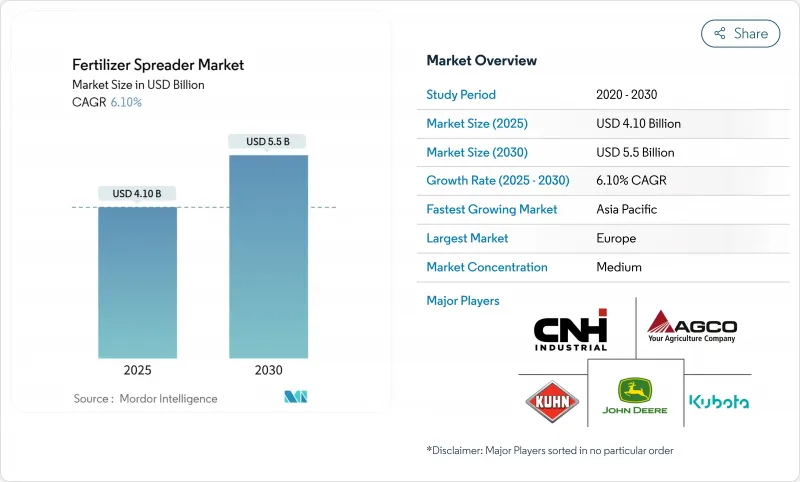
비료 살포기 시장 규모는 2025년에 41억 달러에 이르고, 2030년에는 55억 달러로 상승할 것으로 예측되며 CAGR은 6.1%를 나타낼 전망입니다.
정밀 농업의 진화, 심각한 노동력 부족, 환경 규제 강화로 인해 생산자는 기존 기계를 GPS 호환 가변 속도 기계로 교체하거나 업그레이드해야 합니다. 로터리 스피너는 넓은 스와스 커버리지로 인해 여전히 큰 면적의 곡물 생산을 지배하고 있지만, 균일성과 다영양소의 정확도가 수율을 좌우하는 공압식 공기 흐름 시스템이 지지를 모으고 있습니다. 북미와 유럽의 보조금 제도는 하이 스펙 살포기의 투자 회수 사이클을 단축하고 디지털 유통 채널은 소규모 브랜드 시장 진입에 새로운 길을 열고 있습니다. 한편, 미립자 미량 영양소 블렌드와 시즌 동안 액체 비료에 대한 수요가 증가함에 따라 제조업체가 지원해야하는 제품 믹스의 폭이 넓어지고 있습니다.
꾸준한 인구 증가와 식생활의 변화로 1에이커당 수확량에 대한 기대가 높아지고 있습니다. 토지 확장의 가능성은 제한되어 있기 때문에 고가치 작물에는 고급 공기 흐름 기계에 의한 균일한 양분 배치가 중요해지고 있습니다. 토양 맵핑 플랫폼과 동기화되는 가변 속도 분배기는 생산자가 산포량을 미세 조정하고 기존 헥타르에서 더 많은 생산량을 좁힐 수 있습니다. 이러한 기능은 토양 열화를 악화시키지 않고 생산성을 향상시키려는 아시아태평양 및 아프리카 수출 지향 생산자를 지원합니다. 농장 수준에서 투자 대 효과를 입증 할 수있는 제조업체는이 지속적인 수요의 물결을 탈 수 있습니다.
북미와 서유럽의 농장 경영은 두 자리 임금 인플레이션과 운영자 부족에 직면하고 있습니다. 자주식 살포기는 승무원의 요건을 삭감하고, 날씨 창문이 닫히기 전에 복수의 농장 루트를 완료할 수 있기 때문에 노동력 부족이 채용의 계기로 바뀐다. GPS 오토스티어와 폐색 센서를 사용하면 경험이 풍부한 운전자도 숙련된 운영자에게 필적하는 오버랩 정밀도를 달성할 수 있어 인력의 병목 현상이 완화됩니다. 계절 노동력 이동 동향에 직면하는 남미 생산자는 처리 능력을 유지하기 위해 더 큰 용량의 PTO 유닛을 채택하고 있습니다. 원격 진단 및 운영자 교육을 번들로 제공하는 장비 공급업체는 추가 서비스 수익을 얻는 위치에 있습니다.
첨단 살포기의 가격 태그는 2만 5,000달러에서 20만 달러로, 박리 다매로 경영하는 중소 농장에 있어서는 장애물입니다. 신용에 대한 접근은 신흥 경제국 전체에서 불균일하기 때문에 생산자는 수년간의 효율성 향상보다 눈에 띄는 유동성을 선호합니다. 헥타르당 사용량을 과금하는 기기 아즈아 서비스 모델과 레거시 스피너를 타겟으로 한 후부 VRT 키트가 브리지 솔루션으로 인기를 끌고 있습니다. OEM은 하드웨어, 소프트웨어 업데이트 및 농학적 조언을 번들로 제공하는 구독 패키지를 시험적으로 도입하여 자본 스파이크를 평준화하고 시장 도달범위를 넓히고 있습니다.
로터리/스피너 유닛의 비료 살포기 시장 규모는 2024년 상당한 규모에 달했고, 세계매출의 46%를 차지했습니다. 공압식 공기 흐름 설계는 현재 수량이 적은 CAGR 9.6%를 나타낼 전망입니다.
기류 살포기는 또한 입자를 편석시키지 않고 방출 제어된 펠릿과 코팅된 영양제를 지원하며 프리미엄 가격 투입 프로그램에 선정되는 기술로 자리매김하고 있습니다. 바람이 자주 부는 지역에서는 밀폐된 붐 설계가 드리프트를 최소화하고 버퍼 영역 규제 강화를 지원합니다. 붐 길이 최적화 및 유압 팬 구동 효율성에 투자하는 제조업체는 투입 자재 공급업체가 미립자 미량 영양소공급을 확대함에 따라 지속적인 점유율 확대를 기대하고 있습니다. 활성탄 라이닝의 드롭 호퍼와 내식성 합금은 기계의 수명을 연장하기 위해 도입되었으며 비료 살포기 시장에서 자본 비용의 상승을 고려할 때 이것은 중요한 구매 고려 사항입니다.
기존의 비GPS 살포기는 여전히 비료 살포기 시장 점유율의 72%를 차지하고 있지만, 이는 설치 대수가 많고 비용에 민감한 지역에서는 저가가 매력임을 반영하고 있습니다. 그러나 정밀/GPS 가이드 플랫폼은 정량화 가능한 투입 자재의 절약과 디지털 기록의 보존을 의무화하는 환경 컴플라이언스에 힘입어 CAGR 11.0%를 나타내 성장을 지속하고 있습니다.
이동 전화 네트워크를 통해 전송되는 VRT 처방은 운영자가 이동하는 동안 속도를 변경할 수 있어 영양제 분산이 고해상도 토양층에 확실하게 적응할 수 있도록 합니다. 주요 OEM은 ISOBUS 호환 컨트롤러를 통합하여 혼합 브랜드 함대가 지도 및 기계의 건강 데이터를 공유할 수 있도록 합니다. 스마트폰에서 액세스할 수 있는 증강현실 교정 도구는 설치 오류를 줄이고 비료 살포기 시장에서 이전에 업그레이드를 방해했던 학습 곡선을 낮춥니다.
유럽은 성숙한 정밀 농업 인프라와 기술 도입에 보조금을 내는 공통 농업 정책의 인센티브를 반영하여 2024년 점유율 29%로 비료 살포기 시장을 선도했습니다. 엄격한 질산염 지침과 유역 보호 규정으로 인해 가변 속도 산포는 대규모 경작 경영의 거의 필수 요건이되었습니다. 이 지역의 강력한 딜러 네트워크와 확립된 대출 경로는 고사양 기계로의 길을 원활하게 합니다. 이 시장을 목표로 하는 제조업체는 농장 관리 플랫폼과의 소프트웨어 통합과 서브미터 정확도를 가능하게 하는 유럽 위성 보정 신호와의 호환성을 강조합니다.
아시아태평양은 2030년까지 연평균 복합 성장률(CAGR) 7.8%를 나타내 이 지역의 성장률은 세계에서 가장 빠릅니다. 중국에서는 수율을 유지하면서 비료강도를 저감하는 방향으로 정책이 변화하고 있어, 살포 효율을 최적화하는 살포기 수요가 발생하고 있습니다. 정부의 농업 근대화 프로그램은 특히 여러 소농을 가진 협동 조합에 기계화를 조성합니다. 2024년에 324억 달러로 평가된 인도의 농약 부문은 확대되고 있으며, 살포 장비에 대한 투자 능력이 높아지고 있음을 보여줍니다. 제조업체 각사는 논용의 좁은 작업폭이나 기술적인 트레이닝을 받지 않은 오퍼레이터를 위한 간소화된 제어장치를 제공함으로써 아시아의 상황에 맞는 설계를 진행하고 있습니다.
북미는 상품 가격 변동과 장비 비용 상승의 최근 역풍에도 불구하고 비료 살포기 시장 규모를 크게 유지하고 있습니다. 대규모 곡물 재배는 확립된 디지털 농법에 따른 정밀 기술의 통합과 데이터 관리 기능을 강조합니다. 그러나 AGCO의 2024년 2분기 매출액이 15.1% 감소한 것은 농가가 장비 교체보다 서비스 수명을 우선하기 때문에 설비투자에 신중함을 반영했습니다. 각 제조업체는 기존의 살포기에 가변 속도 기능을 추가하는 복고풍 패키지로 지원됩니다. 브라질의 대두 작부 면적이 확대되고 있기 때문에 좁은 살포 테두리로 광대한 농원을 커버할 수 있는 고능력기에 대한 수요가 높아지고 있지만, 남미의 성장은 환변동에 의해 균일하지 않습니다.
The fertilizer spreader market size is valued at USD 4.1 billion in 2025 and is forecast to climb to USD 5.5 billion by 2030, translating into a 6.1% CAGR.
Evolving precision-farming practices, acute labor shortages, and tightening environmental regulations are compelling growers to replace or upgrade conventional equipment with GPS-enabled variable-rate machines. Rotary spinner designs still dominate large-acreage grain production because of their wide swath coverage, yet pneumatic airflow systems are gaining traction where uniformity and multi-nutrient accuracy drive yield. Subsidy programs in North America and Europe are shortening payback cycles for high-specification spreaders, and digital sales channels are unlocking new routes to market for smaller brands. Meanwhile, rising demand for granular micronutrient blends and in-season liquid fertilization is widening the product mix that manufacturers must support.
Steady population growth and changing diets are escalating yield-per-acre expectations. Because land expansion potential is limited, uniform nutrient placement through advanced airflow machines is becoming critical for high-value crops. Variable-rate spreaders that sync with soil-mapping platforms let growers fine-tune application, squeezing more output from existing hectares. These capabilities support export-oriented producers in Asia-Pacific and Africa, trying to lift productivity without aggravating soil degradation. Manufacturers able to prove field-level return on investment are well-positioned to ride this secular demand wave.
Farm operations in North America and Western Europe face double-digit wage inflation and persistent operator gaps. Self-propelled spreaders reduce crew requirements and can finish multi-field routes before weather windows close, turning labor scarcity into a catalyst for adoption. GPS autosteer and blockage sensors allow less-experienced drivers to achieve overlap accuracy comparable to skilled operators, mitigating the talent bottleneck. South American growers confronting seasonal labor migration trends are also adopting higher-capacity PTO units to maintain throughput. Equipment suppliers that bundle remote diagnostics and operator training stand to capture additional service revenue.
Price tags on advanced spreaders range from USD 25,000 to USD 200,000, a hurdle for small and medium farms operating on thin margins. Credit access is uneven across emerging economies, so growers prioritize near-term liquidity over multi-year efficiency gains. Equipment-as-a-service models that charge per-hectare usage and retrofit VRT kits targeting legacy spinners are gaining popularity as bridge solutions. OEMs are experimenting with subscription packages bundling hardware, software updates, and agronomic advice to flatten capital spikes and widen market reach.
Other drivers and restraints analyzed in the detailed report include:
For complete list of drivers and restraints, kindly check the Table Of Contents.
The fertilizer spreader market size for rotary/spinner units reached a substantial scale in 2024, commanding 46% of global sales as large-acreage grain farms value wide coverage and low operating costs. Pneumatic airflow designs, though currently smaller in volume, are expanding at a 9.6% CAGR because airflow paths deliver even distribution of multi-density blends critical to vegetables, orchards, and seed crops.
Airflow spreaders also support controlled-release pellets and coated nutrients without particle segregation, positioning them as the technology of choice for premium-price input programs. In regions with frequent wind events, their enclosed boom design minimizes drift, aligning with tightening buffer-zone regulations. Manufacturers investing in boom length optimization and hydraulic fan drive efficiency expect continued share gain as input suppliers broaden granular micronutrient offerings. Activated-carbon-lined drop hoppers and corrosion-resistant alloys are being introduced to lengthen machine life, a key buying consideration given rising capital costs within the fertilizer spreader market.
Conventional non-GPS spreaders still occupy 72% of the fertilizer spreader market share, reflecting the sheer installed base and the appeal of lower ticket prices in cost-sensitive geographies. Precision/GPS-guided platforms, however, are registering 11.0% CAGR backed by quantifiable input savings and environmental-compliance mandates that require digital record keeping.
VRT prescriptions transmitted over cellular networks let operators alter rates on the go, ensuring nutrient applications match high-resolution soil layers. Leading OEMs are integrating ISOBUS-compatible controllers so that mixed-brand fleets can share maps and machine health data, a capability prized by custom-applicator service providers managing multi-client routes. Augmented-reality calibration tools accessed via smartphones reduce set-up errors, lowering the learning curve that historically deterred upgrades within the fertilizer spreader market.
The Fertilizer Spreader Market Report is Segmented by Machine Type (Drop Spreaders and More), Technology (Conventional, Precision/GPS-Guided, and More), Drive Mechanism (PTO-Driven Mounted and More), Fertilizer Form (Granular and More), End-Use Application (Row-Crop Farms and More), Sales Channel (OEM and More), and Geography (North America, Europe, Asia-Pacific, and More). The Market Forecasts are Provided in Terms of Value (USD).
Europe leads the fertilizer spreader market with a 29% share in 2024, reflecting mature precision-agriculture infrastructure and Common Agricultural Policy incentives that subsidize technology adoption. Stringent nitrate directives and watershed protection regulations make variable-rate application a near-requirement for large arable operations. The region's strong dealer networks and established financing channels smooth the path to high-specification machines. Manufacturers targeting this market emphasize software integration with farm management platforms and compatibility with European satellite correction signals that enable sub-meter accuracy.
The Asia-Pacific region is advancing at a 7.8% CAGR through 2030, the fastest regional growth rate globally. China's policy shift toward reduced fertilizer intensity while maintaining yields creates demand for spreaders that optimize placement efficiency. The government's agricultural modernization program subsidizes mechanization, particularly for cooperatives serving multiple smallholders. India's expanding agrochemical sector, valued at USD 32.4 billion in 2024, signals growing investment capacity for application equipment. Manufacturers are adapting designs for Asian conditions by offering narrower working widths for paddy fields and simplified controls for operators with limited technical training.
North America maintains a significant fertilizer spreader market size despite recent headwinds from commodity price volatility and rising equipment costs. Large-scale grain operations value precision technology integration and data management capabilities that align with established digital farming practices. However, AGCO's 15.1% sales decline in Q2 2024 reflects cautious capital spending as farmers prioritize equipment longevity over replacement. Manufacturers are responding with retrofit packages that add variable-rate capability to existing spreaders at lower entry points. South American growth is uneven due to currency fluctuations, though Brazil's expanding soybean acreage drives demand for high-capacity machines that can cover vast plantations during narrow application windows.